Cinder (The Lunar Chronicles #1) by Marissa Meyer

Cinder (The Lunar Chronicles #1) by Marissa Meyer

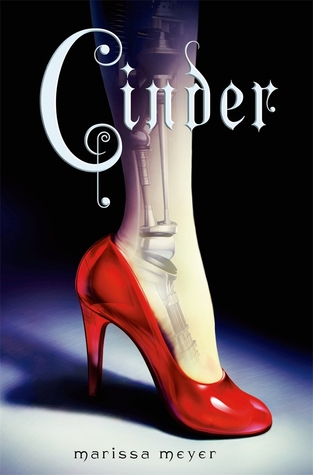
cinderTypical young adult fantasy in that the ‘big twist’ was obvious from the start, but this story still has some charm. Cinder is a cyborg mechanic who wants to go to the ball, but she doesn’t have the time or money to do so. She lives in a world where cyborgs are despised, but tolerated. Humankind is suffering from a plague, one which strikes without warning and leaves the affected dead within days. There’s a draft for cyborgs to be tested upon in order to find a cure for this disease but Cinder is lucky in that her number hasn’t been drawn yet.

Unfortunately for the citizens of New Beijing, the emperor has been struck down with this disease. His son, Kai, is not ready to take the throne, but he doesn’t have time to prepare because an evil Queen from Luna is headed to the planet, presumably to marry Kai and extend her holdings from the moon to earth. Queen Levannah is a member of the race called Lunars who, though once regular settlers from earth, have evolved the ability to control their bio-electric energy and can make others do their bidding. The stage is set for an epic show down between prince, cyborg, and moon queen and it’s all going to happen at, of course, the ball.

Which, like in the original Cinderella tale, was my favorite part. Meyer’s plot very slowly winds itself towards this pivotal moment and I loved her take on the ‘slipper’ left on the stairs. I listened to this audio book on my commute to work but, when I got to the ending, I had to finish it in one night rather than waiting for the next day. That says something, I think, about the power of the story once it gets going despite my lukewarm feelings for the first part of it. Also, I’m on the hold list for the next digital audio book which also says something about this tale. I grew fond of Cinder as the story progressed but not of much else.

Other than the true magic of the ball, readers will find much of Cinder predictable and slow. Only recommended for the serious connoisseur of young adult novels and similar to: Splintered, Ash & Bramble, or The Girl of Fire and Thorns.
The 13½ Lives of Captain Bluebear (Zamonien #1) by Walter Moers

The 13½ Lives of Captain Bluebear (Zamonien #1) by Walter Moers

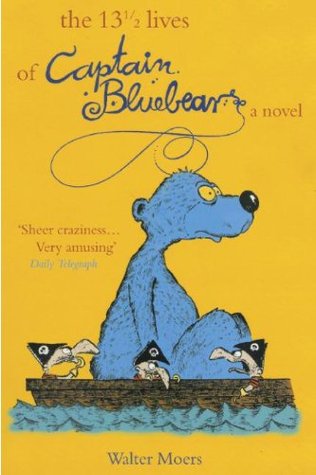
Captain Bluebear tells the story of his first 13-1/2 lives spent on the mysterious continent of Zamonia, where intelligence is an infectious disease, water flows uphill, and dangers lie in wait for him around every corner. -Summary from Goodreads.com

captainbluebearThis book was very strange. It reminded me of Charlie and the Great Glass Elevator by Roald Dahl. Moers writes page after page of strange creatures, worlds, and circumstances that are only connected because Bluebear passes through them. And, like in Dahl’s book, I felt like the author was always hinting about a greater truth behind the story, as if The 13 1/2 Lives of Captain Bluebear was more a gigantic allegory than a children’s book. I enjoyed the fantastic nature of it but I didn’t like the long lists of creatures that read more like crazy encyclopedic entries than an actual story with characters.

Some parts that I enjoyed and there were so many to choose from-
During the life with the Minipirates: “I must, however, admit to having been influenced by their richly embroidered tales and extravagant flights of fancy. They taught me that a good white lie is often considerably more exciting than the truth. Telling one is like dressing up reality in its Sunday best.” pg 19

During Bluebear’s time at the Nocturnal Academy: “One night, Knio and I had an argument about the nature of the universe. He had an appallingly crude conception of the physical world. “The earth is a bun floating in a bucket of water,” he asserted defiantly. “And what is the bucket standing on?” I demanded, trying to floor him. “The bucket stands on the back of the Great Cleaner who polishes the universe to all eternity,” Knio replied self-confidently. “This universe that she polishes so assiduously,” I said, “What in the world does that stand on?” “The universe doesn’t stand on anything, it lies,” Weeny put in. “The universe is as flat as a slice of sausage, you see.” pg 159

“From the Encyclopedia of Marvels, Life Forms and Other Phenomena of Zamonia and its Environs by Professor Abdullah Nightingale. Multidimensional Space: … Simply picture a train travelling through a black hole with a candle on its roof while you yourself, with a candle on your head, are standing on Mars and winding a clock precisely one yard in diameter, and while an owl, which also has a candle on its head and is travelling in the opposite direction to the train at the speed of light, is flying through a tunnel in the process of being swallowed by another black hole which likewise has a candle on its head (if you can imagine a black hole with a candle on its head, though for that you will require at least four brains).” pg 256

From his life in the Eternal Tornado: “One day (the Eternal tornado) swallowed an entire library, and since then a man named Gnothi C. Auton had been busy retrieving books from the sand, arranging them, cataloguing them, and lending them out.” pg 361 Wink, wink, my librarian friends, wink, nudge!

On being questioned by the Zamonium: “Next question, subject Grailsundian demonology: What are Nether Zamonian Diabolic Elves, and how many would fit on a pinhead?” pg 658 So clever.

If you enjoyed The 13 1/2 Lives of Captain Bluebear, you may also enjoy almost anything written by Terry Pratchett or The Hitchhiker’s Guide to the Galaxy by Douglas Adams. Thanks for reading!

Selling the Sunrise by Joshua C. Geiger

Selling the Sunrise by Joshua C. Geiger

sellingthesunriseSometimes life kills you before you die. It’s not a death of the body but a slow wearing away of the spirit that you carried from your birth through your childhood until wherever it is that time finds you now. That flickering flame of beliefs and dreams that you somehow knew was a true vision of reality but you had no real reason to believe so, except that inner feeling in your chest that would incline its head in quiet acknowledgment when you consult it. I thought that life had devoured my romantic streak but then this little book of poetry made me cry and I realized that my flame still burns. Some things can never be lost. That’s what this collection made me feel. I suppose all good poetry should make you feel like that.
One little gripe before I get into my favorite bits, the author has a habit of using parenthesis ( ) to accentuate meanings and voices in his poems. I sort of felt like the regular writing was his talking voice and the writing in parenthesis was his inner mind’s voice or whispers. I got what he was trying to do, but it became annoying because it sort of felt like a crutch or an excuse to not put down exactly what was in his head- a flavor of the truth but not the truth, if that makes sense. Say what you’re going to say, don’t ( ) your way through it. We can take it and so can you. Now, on to the good stuff.

What gets me about Josh’s poetry are the one liners in the middle of an innocuous poem about whatever, the weather or some chick’s eyes, and it’s like that one little bit reaches out and punches you in the gut.

Take this example- Complete pg 19:

“Sometimes it seems
as if my life all happened years ago
and now we’re all just waiting here to die.

and rainbows, they might promise me a break
but the pouring rain isn’t flooding yet,
the floors still reach my feet.

the cloud and bolts still keep me quiet
this silence is complete.”

I think that the first three lines are just genius. “Sometimes it seems as if my life all happened years ago and now we’re all just waiting here to die.” He sets this tone of utter despair, then brings in the rainbow to crack the door open for some light to come in to his inner space, and finally ties it to the ending where you feel a bit of hope in the silence. Gorgeous, just gorgeous.

Or this one, the Sunrise pg 69
(“and sometimes, love”
she says, between gasps for air
“your mouth spends too much time on the sunrise
and not enough time on mine.”)

There we get to see the use of the parenthesis ( ). Blah. But, the sentiment just bowls you over. What passion, what fire. Keep writing, Josh. The world needs to hear more from you.

If you enjoy the poetry of Joshua C. Geiger, I’d recommend picking up a book of Pablo Neruda or David Whyte.

Thanks for reading.

Simple Rules: How to Thrive in a Complex World by Donald Sull and Kathleen M. Eisenhardt

Simple Rules: How to Thrive in a Complex World by Donald Sull and Kathleen M. Eisenhardt
simplerules

I enjoyed the examples that the authors cite for simple rules helping to solve complex problems, but the manner in which to create your own ‘simple rules’ wasn’t really that simple.

I thought that in a book with the title, Simple Rules, that they’d give me a checklist of how to do it: Step 1, 2, 3, you know. The simple rules for how to make simple rules.

But, that wasn’t the case.

Since each problem, situation, business, and life is different, the authors essentially told the readers to use their discernment in the creation of the rules. Pick a ‘bottleneck’ and solve it. I found the suggestion too vague to be very helpful.

Despite these complaints, I did find a gem or two:

“Decisions that require coordination across different departments or teams are another good place to look for bottlenecks.” pg 135

“Better rules are better, and even apparently irrelevant rules can be reasonably effective if they happen to encourage helpful behavior.” pgs 172-173

If you enjoyed Simple Rules, I’d suggest The Checklist Manifesto by Atul Gawande (ways to simplify your work processes) or Yes, And: How Improvisation Reverses “No, But” Thinking and Improves Creativity and Collaboration—Lessons from The Second City by Kelly Leonard (for more simple rules on collaborations).

Thanks for reading.

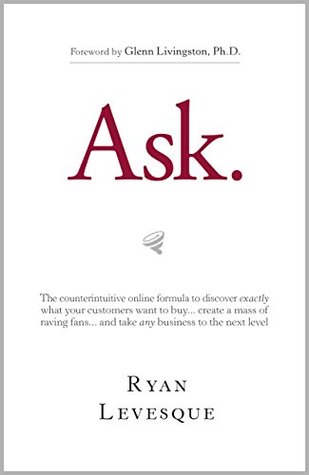
Ask: The Counterintuitive Online Formula to Discover Exactly What Your Customers Want to Buy…Create a Mass of Raving Fans…and Take Any Business to the Next Level by Ryan Levesque

Ask: The Counterintuitive Online Formula to Discover Exactly What Your Customers Want to Buy…Create a Mass of Raving Fans…and Take Any Business to the Next Level by Ryan Levesque
ask

Quite the title, isn’t it?

I picked this up a few months ago because I was looking for some pointers on creating online surveys for the public library. It has some excellent ideas, but they’re buried beneath the coils of a very aggressive marketing formula.

Levesque coaches businesses to send twelve follow up emails to customers, whether they purchase the product or not. Can you imagine?

It’s no wonder that people don’t like giving their emails out, if that is the manner in which they will be used. I have to give it to Levesque- the man certainly doesn’t take no for an answer.

He describes the unique circumstances that gave him this fierce business drive and, unlike other reviewers on this book, I actually liked the autobiographical portion of Ask.

It made me view Levesque as a regular guy before he presented his over-the-top marketing strategies. I mean, perhaps if you were running your own business and needed absolutely every customer who strayed to your webpage, Ask would be invaluable to you. As it is, if the library were to employ this system, I think it would just seriously piss everybody off.

So, anyway, the some gems I pulled out of the mess:
“…people essentially are only good at answering two basic types of questions when they don’t know what they want: what it is they don’t want and what they’ve done in the past.” pg 10

Bring clarity to your business through stat analysis: “We discovered that by paying attention to the right information (provided by the market), you could not only identify what sub-segments exist in your market, but you can also identify which ones are worth focusing on.” pg 53

Put the important questions first: “Generally speaking, you should expect to see a degradation in response the deeper you get into your survey. So, for this reason, it’s essential to prioritize the importance of your questions beyond the initial questions in your survey.” pg 87

When evaluating survey responses: “The reason why response length is vitally important is because it’s an indication of hyper-responsiveness, which is a leading indicator of how likely someone is to purchase a paid solution for the problem or challenge about which we’re asking.” pg 92

Why to use an “open-ended Single Most Important Question”: “To determine what buckets naturally emerge in your market. To identify what people’s hot buttons are. To identify what their objections are. To identify what their biggest challenges are. To use in concert with their demographic information. pg 97

So anyway, to get all of these tidbits in context, pick up Ask and dig through it. But please, if I ever, for whatever reason, give you my email, do not send me 12 follow up emails. Please. And thanks for reading.

Marie Antoinette’s Darkest Days: Prisoner No. 280 in the Conciergerie by Will Bashor

Marie Antoinette’s Darkest Days: Prisoner No. 280 in the Conciergerie by Will Bashor
marieantoinette

I thought that after the King and Queen of France were taken by the Revolutionaries that what happened went like, “You were the monarchs but now we have a Republic. Off with your heads.” and boom, it was done.

How wrong I was.

Did you know, that both Louis XVI and Marie Antoinette were given very brief public “trials”? Did you know that Marie Antoinette languished in a prison for weeks after her husband was executed?

Did you know that the bodies of both former monarchs were dumped in unmarked graves?

Marie Antoinette’s Darkest Days taught me so much about this horrific period of French history.

At times, especially during the actual transcripts of the Queen’s trial, the story dragged, but for the most part, this was a fascinating study of the last days of a much maligned monarch.

“Generations of authors have reveled in reliving the queen’s reign amid the splendors of the court of Versailles and the Petit Trianon, but few have ever found the space (or perhaps the courage) in their voluminous biographies to narrate her final imprisonment in a fetid dungeon cell at the Conciergerie.” loc 198, ebook.

I am a huge fan of historical fiction and I had never heard a whisper about this. Many thanks to Bashor for filling that gap!

Photo by Pixabay on Pexels.com

The King promised his family to say goodbye before he was taken to the guillotine but he never went to them. Can you imagine the heartbreak?

“Say to the queen, my dear children, and my sister,” he continued, “that I had promised to see them this morning, but that I desired to spare them the agony of such a bitter separation twice over. How much it has cost me to depart without receiving their last embraces!” loc 862 ebook.

Cruelly, Marie Antoinette was also separated from her children and her sister-in-law and transported to a different prison. As a mother myself, Marie Antoinette’s heartbreak about having her children taken from her was the hardest part of the book for me to get through.

Even though her sham 48 hour trial didn’t prove definitively that she had done anything wrong, Marie Antoinette was sentenced to death.

Here is a passage that gives the gist of the thing: “Herman: You have never ceased for one moment wanting to destroy liberty. You wanted to reign at any price and retake the throne on the cadavers of patriots. Queen: Whether it was necessary to retake the throne or not, we only desired the happiness of France. If France was happy, we were always content.” loc 1901, ebook.

Photo by Niki Nagy on Pexels.com

Back and forth it went. Accusations of wrong doing, her denial, and then more accusations. I can’t believe that they killed her after that- it’s shocking what a mob mentality can justify.

But the public absolutely hated her. “It was also true that Marie Antoinette was “ill-treated” in the French press and elsewhere. An abundant number of provocative and obscene pamphlets were distributed throughout the capital, the provinces of France, and other European capitals. They argued not only that the queen corrupted the morals of her people but that her luxurious habits were the cause of their hunger. She was even said to powder her hair with the precious flour needed for the people’s bread.” loc 2046. Ugh.

The press has always been a powerful tool to sway public opinion, but what sad results when that power is used generate hate rather than inform and educate.

Marie Antoinette was hard core to the end. She refused to take her last rites from priests who had sworn an oath to the Revolutionaries. This is what she said to the priest who demanded to hear her confession before she was led to her execution:“You are guilty,” said the priest. “Ah, sometimes careless,” said the queen. “Never guilty.” loc 3005 ebook. I may have to use that one.

Recommended for anybody who wants to know more about the last days of Louis XVI and Marie Antoinette but also for those interested in what happens to a society when hatred and fear are allowed free reign. Some further reading: Abundance (excellent historical fiction about Marie Antoinette).

Thank you to NetGalley and Rowman & Littlefield Publishing for a free digital copy of this book!  And, thank you for reading.

Texts from Jane Eyre by Mallory Ortberg

Texts from Jane Eyre by Mallory Ortberg
textfromjaneeyre

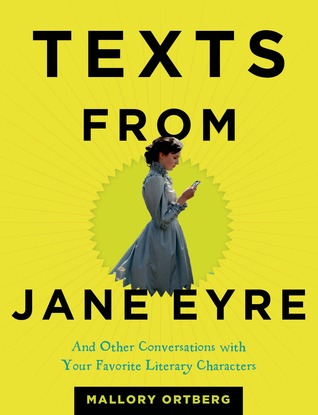
Though the premise was clever, Texts from Jane Eyre reads a lot like text message conversations in real life- shallow and repetitive after the first few lines.

Also, there wasn’t a synopsis included in these pages, so if you hadn’t read a classic or, if you’d read it so long ago that you’d forgotten most of it, you were out of luck.

The best of the lot was the Samuel Taylor Coleridge chapter that starts on pg 43 in which he’s on a ramble about the golden palace of Kubla Khan and then a delivery guy comes to the door and ruins his flow.

The worst was the Harry Potter chapter in which Ron and Hermione have a ‘conversation’ but Ron is written as a complete moron and she is confounded by his idiocy. Very mediocre and unworthy of either of those characters.

If you feel the need to read this one, check it out from the library. A related read if you enjoyed it: When Parents Text: So Much Said…So Little Understood.

Thanks for reading!

Tin Star by Cecil Castellucci

Tin Star by Cecil Castellucci

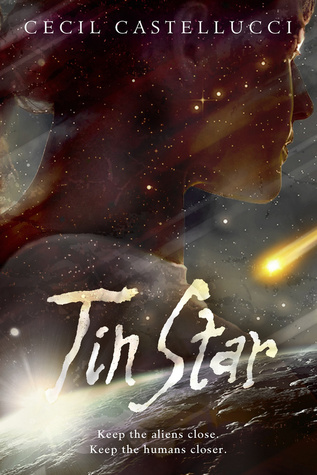
tinstarTin Star is the story of Tula Bane, a teenager who joined a space colonizing cult from Earth. She is abandoned on a way station near the edge of the known universe on the way to her new home.
How will Tula Bane survive among aliens who think human beings are the worst? Will she ever be able to go home to Earth or the colony’s planet? How will she manage to put bread on the table?

I love a good space opera and I thought that I would enjoy Tin Star more than I did.

The promise of books set in space, in my opinion, is the opportunity for unique interstellar exploration and worlds created entirely from the author’s imagination. Because of Tula’s unique plight- being stuck in what is essentially a space gas station- the author left herself very little room to write a creative story.

Mainly, Tin Star deals with character development and social struggles, not adventuring in new places.

The villain of the tale was charismatic and creepy. Take this description: “He had his hand on my shoulder in a way that he had a million times before. Only before it was comforting, encouraging, affectionate. Now it was menacing. He was looking at me and his face was smiling. To anyone looking from afar, he seemed to be pleased with me, but it was just a mask. His attitude shifted from concerned leader to unknowable monster.” pg 4

Tula manages to befriend a shady, insect-like alien named Heckleck. He’s my favorite character.

In this passage, Heckleck explains the problems Tula will face in trying to leave the station: “I know about you,” Heckleck said. “Everyone does. And you will never get off this station. You are nobody. And worse, you’re a Human. Even if you did not get on a ship that would take one of your kind, you’d have nowhere to go but to roam like the others of your kind do.” pg 35.

Keeping it real: with Heckleck.

I thought Cecil Castellucci could have done more with the cultural differences between Tula and the others on the station.

One of the most interesting exchanges in the book was between Tula and Tournour, the head of the outpost. She’s trying to figure out how old he is and, because they’re from different planets/species, it’s a surreal conversation. More of that would have been nice.

But Castellucci wrote cultural and language barriers out of the story by introducing nanites into Tula’s bloodstream to translate alien languages for her.

Something that Castellucci did well was writing profound silences between characters into her story. For much of this story, Tula finds herself standing around with Heckleck and Tournour and having nothing to say. But, somehow, it works.

I liked how Castellucci wrote the thoughts spinning through Tula’s mind at these moments. It reminded me of myself when I can’t think of anything to say: “It was a silent agreement between us that if we spoke too much then we would have to talk about the practical things. … If we ever spoke of the things that truly pressed up against us, our very real worries, our seemingly impossibly plans for escape, our divergent hopes for the future, our bubble would blow apart.” pg 184

This book in three lines: “In the end, good must win over evil. The trouble is trying to figure out which is which. Sometimes they look so much alike.” pg 204

Read this book if you enjoy light, young adult drama in space. If you’re looking for a meaty, space adventure, you’ll need to find another title.

Some read-alikes are: The Knife of Never Letting Go (teen trying to survive on an alien planet) or Gated (teen trying to leave a cult).

Thank you to Roaring Brook Press for sending an advance reader copy of this book. And, thank you for reading!

Magonia by Maria Dahvana Headley

Magonia by Maria Dahvana Headley

magoniaAza Ray Boyle can’t breathe. It seems like she has always been sick- inexplicably short of breath and weak.

This continuous illness has made her always feel different from the people around her. But, perhaps, there are stranger and more exotic reasons why she is different. Ones that Aza can’t even imagine…

Jason is Aza’s dearest friend. They are so close that they almost speak their own language.

He realizes there is more to Aza than meets the eye. How will Jason handle it when he discovers the shocking truth?

This young adult fantasy is weird, but I enjoyed it.

That’s probably because I read a lot of weird, non-fiction. The story of Magonia, a world in the sky above the every day world which we know, has shown up in some of those books.

One of those books, Passport to Magonia: On UFOs, Folklore, and Parallel Worlds, captured my imagination.

That book recounts an incident where a bunch of villagers were holding church service and they heard a crash outside. They went to investigate the noise and discovered what appeared to be a ship anchor attached to the roof of their church. It was connected to, this just blows my mind, a ship in the sky. This supposedly happened in 1211 AD.

The astonishing thing about Passport to Magonia is it has pages and pages of stories like that, eyewitness accounts of bizarre ships, people, and incidents concerning people from the sky. And they all actually happened, reportedly.

I remember thinking that an author needed to get her hands on these stories and turn it into something fantastic. Maria Dahvana Headley used a different source material than the book that I read, but does a good job bringing a mysterious blip in history to life.

She has the ability to interweave actual events with fantasy fiction story lines so that the two begin to blur in the reader’s mind.

I read Headley’s first book Queen of Kings years ago and I remember being struck by its originality.

Headley took Cleopatra’s life and turned it into a vampire story. It sounds sort of silly described that way, (oh, ANOTHER vampire story) but it is actually rather fun.

I had read Margaret George’s The Memoirs of Cleopatra shortly before Queen of Kings so I had a pretty good idea of the actual story of the Egyptian queen.

Back to this book, Magonia isn’t going to appeal to everyone.

I was, at first, rather turned off by the uber-intellectual back and forth conversations of the main characters- Jason and Aza.

I think, since the mega success of John Green’s The Fault in Our Stars, authors make their teenage protagonists so brainy and well-spoken, it is just unbelievable.

I mean, it’s been awhile, but I remember high school. My peers and I were lucky if we could string two cogent sentences together, let alone present verbal dissertations on the meaning of pi.

Anyway, once I was able to look past their flowery repartee, I got really into the story.

Headley paints a magical and dangerous world.

If you enjoyed Magonia, you may also enjoy The Mermaid’s Sister or Under the Empyrean Sky. Both are young adult novels and take place in fantasy worlds that are so close to the world we know, but different in surprising ways.

Check out my review of Aerie, the sequel to this book.

Thanks for reading!