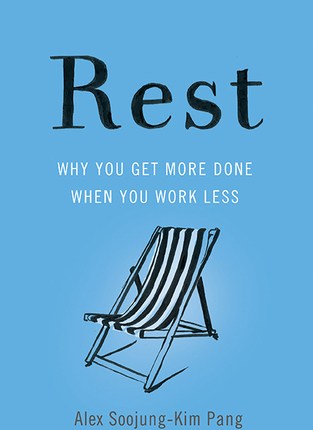
“We shouldn’t regard rest as a mere physical necessity to be satisfied grudgingly; we should see it as an opportunity. When we stop and rest properly, we’re not paying a tax on creativity. We’re investing in it.” pg 11

I think we’re living in a culture that generally glorifies busyness and a frantic pace of achievement. That’s not news.
Alex Soojung-Kim Pang takes a deep dive into the science of rest and shares the insight that taking breaks isn’t something we should squeeze into our schedule. Rest, he argues, is as important as the work itself.
Four of his major points are: “work and rest are partners”, “rest is active”, “rest is a skill”, and “deliberate rest stimulates and sustains creativity”.
I was particularly interested in the creativity-related point of Pang’s hypothesis.
“You need time for rest because that’s when the unconscious mind can get to work. You can’t command inspiration to appear, but you can nudge it, most notably by working steadily and regularly. The romantic image of the artist who does nothing until he’s inspired and then produces in a furious burst of work is misleading.” pg 91

Pang looked into the lives and routines of creative thinkers throughout history and came to the perhaps surprising conclusion that four concentrated hours of work per day is sufficient.
“The pattern of working four hard hours with occasional breaks isn’t just confined to scientists, writers, or other people who are already successful, well-established, and have the freedom to set their own schedules. You can also see it among students who go on to become leaders in their fields.” pg 67
The rest of the day that geniuses such as Charles Darwin or Ernest Hemingway lived were filled with activities like long walks, day dreaming, active rest, sport and other seemingly unrelated moments that fueled the subconscious mind.
“The right kinds of rest would restore their energy while allowing their muse, that mysterious part of their minds that helps drive the creative process, to keep going.”

What these activities may be vary from person to person, but Pang’s research proves time and again that the rest portion of the day is critical.
One of my favorite parts of this book dealt with Malcolm Gladwell’s popular 10,000 hours for mastery idea that he discusses in his book, Outliers. Yes, Pang argues, 10,000 hours are necessary for exceptional performance. But we’re ignoring the rest of the equation.
“It comes after 10,000 hours of deliberate practice, 12,500 hours of deliberate rest, and 30,000 hours of sleep.” pg 74

From morning routines and sabbaticals to naps and carving out time for more sleep, Pang exhorts the reader to make rest a priority. It’s not lazy, it is one of the building blocks of a creative and productive life.
Sign me up. 🙂
- The Ballad of a Small Player: a Metaphysical Movie Review
- Otherwhere: A Field Guide to Nonphysical Reality for the Out-Of-Body Traveler by Kurt Leland
- Psychic Dreamwalking: Explorations at the Edge of Self by Michelle Belanger
- Archetypes on the Tree of Life: The Tarot as Pathwork by Madonna Compton
- The Goddess and the Shaman: The Art & Science of Magical Healing by J.A. Kent


 The Help Desk Book Blog