The 7 Laws of Magical Thinking: How Irrational Beliefs Keep Us Happy, Healthy, and Sane by Matthew Hutson

The 7 Laws of Magical Thinking: How Irrational Beliefs Keep Us Happy, Healthy, and Sane by Matthew Hutson

Matthew Hutson examines some of humankind’s irrational beliefs and shows, through stories and examples, how the beliefs are types of coping mechanisms and can be consciously utilized for a better life.

“These habits of the mind guide us through the world every day. In very basic ways they provide a sense of control, of purpose, of connection, and of meaning, and without them we couldn’t function.” pg 9

Photo by Pixabay on Pexels.com

The beliefs Hutson discusses are “objects carry essences”, “symbols have power”, “actions have distant consequences”, “the mind knows no bounds”, “the soul lives on”, “the world is alive” and “everything happens for a reason”.

I couldn’t possibly touch on every idea that engaged me in this book, but I do want to mention my favorite chapter. I was particularly drawn to “the mind knows no bounds”.

“If anything is magic, consciousness is.” pg 108

Everything Hutson discusses in this book originates in the mind: how we perceive events, people, death, the whole enchilada. I think it is in the interpretation of life and the meanings we assign to things that seem to be the key to magical thinking.

“Believing that our thoughts have the power to drive our own behavior as well as the behavior of the outside world – that they’re not just feeble shadows cast against the inside of our heads – provides a sense of agency and makes us go out there and become active participants in life.” pg 123

Photo by Roy Reyna on Pexels.com

That’s the sort of magical thinking I support – the interconnecting, empowering and mystical kind, that inserts meaning into the most trivial moments and illuminates your life, revealing a pattern of something greater. Then, spring boarding that knowledge into action, having another realization, and so on.

“While mystical states may not unite you with a universal intelligence, they can still tap you into your own potential for transformation. Which makes them mind-expanding after all.” pg 123

Though his writing can become dense at times, Hutson lightens things up with stories from his own life or his research. It feels like a non-fiction psychology book with a heaping dose of philosophy, religion, and memoir.

Photo by Renato Danyi on Pexels.com

“The idea is to face morality as frankly as you can without freaking out. To accept a manageable share of anxiety and to channel it toward building a heaven here on Earth.” pg 162

Here’s author Matthew Hutson dancing with fire!

Good luck with that, fellow readers. I’ll be cheering for you, which, if you read this book and understand the power of magical thinking, may have more impact than you ever imagined.

Be Here Now by Ram Dass

Be Here Now by Ram Dass

A classic exploration of spirituality and consciousness by the former Harvard professor turned drug-fueled, then clean, spiritual seeker, Ram Dass.

What a strange book.

The first part is Ram Dass‘s life story.

Photo by Alesia Kozik on Pexels.com

He has trouble relating exactly how his guru changed his life. He also has trouble expressing his life changing spiritual insights.

This could perhaps be because of all the LSD he experimented with, but no judgement here.

I think Dass could have added another couple hundred pages to the first part and still probably not fully described his experience.

The next section of the book is block text printed on, what seems to be, brown paper bags. Monty Python-esque photos are drawn in, and sometimes behind, the text.

Photo by Giftpundits.com on Pexels.com

It reads like a stream-of-consciousness, path to enlightenment, how-to lecture.

Some of it is worthwhile, but I can’t sugarcoat it: It’s pretty far out there.

My description doesn’t really do it justice. Perhaps Be Here Now is one of those books that needs to be “experienced” rather than read.

The last section was a “cook book” on how to live an enlightened lifestyle.

Photo by Mikhail Nilov on Pexels.com

If you have a question about how an enlightened person lives, it’s probably included in there.

Dass elucidates how he believes you should eat, sleep, breathe, interact with others, think, meditate, raise a family, form a commune and so on.

I didn’t like it because it felt too brain-washy, cult-ish.

Dass attempts to put the reader’s mind at ease to all of the strictures. He mentions that one needn’t be concerned about family or social responsibilities because, once you reach the ultimate level, you’ll realize that none of those things are real anyway.

Looking back on my review, it seems as if I don’t like Ram Dass, but I do.

I rather enjoyed his Polishing the Mirror: How to Live from Your Spiritual Heart and a documentary that I saw about him once called Fierce Grace.

I too have had life experiences that have led me to the belief that human kind is here to “be high” and not just to “get high.”

Photo by Tim Gouw on Pexels.com

I don’t buy into the idea that life has to be lived a certain way to get certain results.

And, perhaps because I haven’t personally had the experience yet, I don’t get the whole guru relationship thing. I know it’s my western background speaking, but there you have it.

Recommended for spiritual seekers, but don’t forget to trust your own inner guidance.

Thanks for reading!

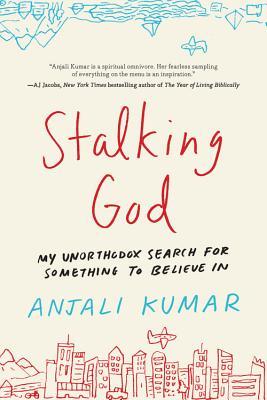
Stalking God: My Unorthodox Search for Something to Believe In by Anjali Kumar

Stalking God: My Unorthodox Search for Something to Believe In by Anjali Kumar

Anjali Kumar is a lawyer who is used to having all the answers. After she had a daughter, Anjali realized she knew very little about the big questions: why are we here? What is it all about? Is there a God?

“In 2010, when my daughter Zia was born, I decided that I needed to find God.” loc 24, ebook.

Anjali went on a quest to find out the answers, not only for the sake of her daughter, but also herself. She touches all the bases – from meditation to faith healing to Burning Man to yoni worship – Anjali leaves no stone unturned in her search to find what is real.

Photo by Artem Beliaikin on Pexels.com

“Along the way, I learned to chant, to meditate, and to marvel. I wrestled with my own identity, from my ethnic and cultural roots in India, to my femininity, to my role as a woman, daughter, mother, and wife. … I fancied myself an explorer, no different really than Magellan or Columbus. I was looking for a new world.” locs 148-163.

It’s a fascinating memoir.

Before each experience, Anjali puts in her research in an effort to find the science behind the beliefs. It’s not always as concrete as she would like it to be, but Anjali tries to engage her brain and her heart in her quest.

This is before she goes to her first “para-tan sounding”: “According to string theory, the entire universe is basically humming – all of it and all of us. Add that to the fact that the chanting of mantras has a long, compelling spiritual history, that cancer researchers are using sound- high-intensity focused ultrasound- to successfully destroy prostate cancer cells … and this whole Paramji thing starts to look like it might be grounded in a bit of hard science…” loc 500

Photo by Nataliya Vaitkevich on Pexels.com

Anjali tries to keep an open mind, even when things sound very strange: “One thing I had to be cognizant of… was how difficult it is as an outsider to come to terms with what are easy to perceive as the odd behaviors and strange beliefs of ‘other people.’ … as outsiders we have no idea what those behaviors and traditions stand for or mean.” loc 904.

She finds layers of meaning, even when particular experiences weren’t all that she hoped they would be. Anjali also experiences a few surprises along the way.

“I was looking for a theory of everything spiritual for Anjali and Zia. And yet, so far, just like those physicists had failed to find a theory of everything in the entire universe, I had failed to find a theory of everything for my own spirituality.” loc 1343.

Photo by Pixabay on Pexels.com

And she never gives up because: “A spiritual home is something that we all have to find for ourselves.” loc 2853.

Recommended for seekers everywhere. Anjali’s discoveries may not be earth-shattering, but they’re real and worth the read.

Thank you to NetGalley and Seal Press for a free advance reader copy of this book. Reminder: the short quotations in this review may change or be omitted in the final printed version.

Thanks for reading!

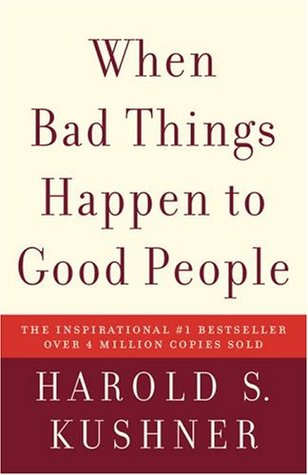
When Bad Things Happen to Good People by Harold S. Kushner

When Bad Things Happen to Good People by Harold S. Kushner
badthingshappen

When Bad Things Happen to Good People is Rabbi Harold Kushner’s examination of life, why things happen and the role of God in all of it.

Kushner wrote the book because his son was born with progeria, a disease where his body aged much faster than it should, and he died young. It shook Kushner to his core. “Tragedies like this were supposed to happen to selfish, dishonest people whom I, as a rabbi, would then try to comfort by assuring them of God’s forgiving love. How could it be happening to me, to my son, if what I believed about the world was true?” pg 3.

Kushner methodically picks apart traditional explanations for why tragedy strikes. When he’s through, none of them hold water.

“I would find it easier to believe that I experience tragedy and suffering in order to ‘repair’ that which is faulty in my personality if there were some clear connection between the fault and the punishment. A parent who disciplines a child for doing something wrong, but never tells him what he is being punished for, is hardly a model of responsible parenthood. Yet, those who explain suffering as God’s way of teaching us to change are at a loss to specify just what it is about us we are supposed to change.” pg 23.

Photo by Pixabay on Pexels.com

It’s no secret that earlier this year, I changed jobs – from a reference librarian to a writer in a newsroom. I picked up this book because I was going through a spiritual crisis of sorts.

It’s not that I’m overly-religious, but I am spiritual. I believe in things we can’t see or explain. I believe in the goodness of people and the universe.

In my job, every day, I read and hear about terrible things that happen for no reason at all. Sometimes, I write about families who lost a child to a rare disease or I read a story about someone dying in a car or motorcycle accident, and I think, “Why do things like this happen?”

I just didn’t see how a universe that was inherently good, as I believed, could have things like this happen, all the time, every day.

Photo by Snapwire on Pexels.com

Kushner says, don’t look for God or goodness in the bad things, look for the good in the response or what comes after. “For me, the earthquake is not an ‘act of God.’ The act of God is the courage of people to rebuild their lives after the earthquake and the rush of others to help them in whatever way they can.”pg 60

In the final analysis, the question why bad things happen to good people translates itself into some very different questions, no longer asking why something happened, but asking how we will respond, what we intend to do now that it has happened.” pg 147

That was a philosophy that I needed.

I now try to look for the good in the response to tragedy and, wouldn’t you know, I find it. Every day, there’s someone who’s kind or generous or brave. The goodness was always there. I just had to change where and how I was looking for it.

Thanks for reading!

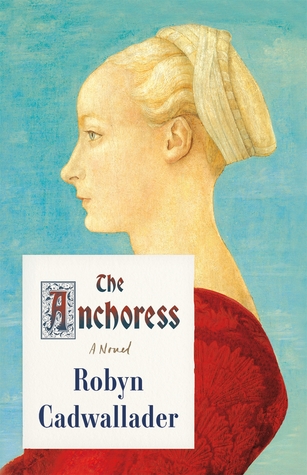
The Anchoress by Robyn Cadwallader

The Anchoress by Robyn Cadwallader

England, 1255. What could drive a girl on the cusp of womanhood to lock herself away from the world forever? -from Goodreads

anchoress

The 1200’s was an exciting time in many ways. But, not if you were a woman.

In The Anchoress, I learned about yet another way in which women were treated poorly by the male dominated church. Apparently, the anchoress was an actual calling where the woman chose to be walled up near or in a church in order to move closer to God.

The people who walled up the woman left a small window for food and waste to pass through. That was the extent of her interaction with the outside world. How messed up was that.

Sarah, the anchoress in this story, chooses the position for a variety of reasons, but they’re not all that mysterious. The description of the book plays it up as a mystery which the reader will figure out in probably five pages or so.

I enjoyed this book more for the historical details of the period.

The interesting part is when Sarah starts to go bonkers (no big surprise there) and her confessor tries to keep her straight. That particular drama was gripping even though most of the action took place in one room.

If you enjoyed The Anchoress, you may want to read A Triple Knot by Emma Campion or Pope Joan by Donna Woolfolk Cross.

Thanks for reading!