Bed Yoga for Couples: Easy, Healing, Yoga Moves You Can Do in Bed by Blythe Ayne

Bed Yoga for Couples: Easy, Healing, Yoga Moves You Can Do in Bed by Blythe Ayne

“If it’s a lazy Saturday morning and you don’t feel like getting up just yet, you can ease into your day with a few shared yoga poses. It’s a great way to feel connected, to hook up your energies and get on the same wavelength.” pg 3, ebook

Bed Yoga for Couples is a simple yoga manual for two practitioners that includes stick figure diagrams, brief explanations of each pose, and a few basic breathing techniques.

I’ve practiced hatha yoga for nearly two decades so I was familiar with the poses in this book. However, even if you have zero experience, most are so simple that beginners shouldn’t have any problems either.
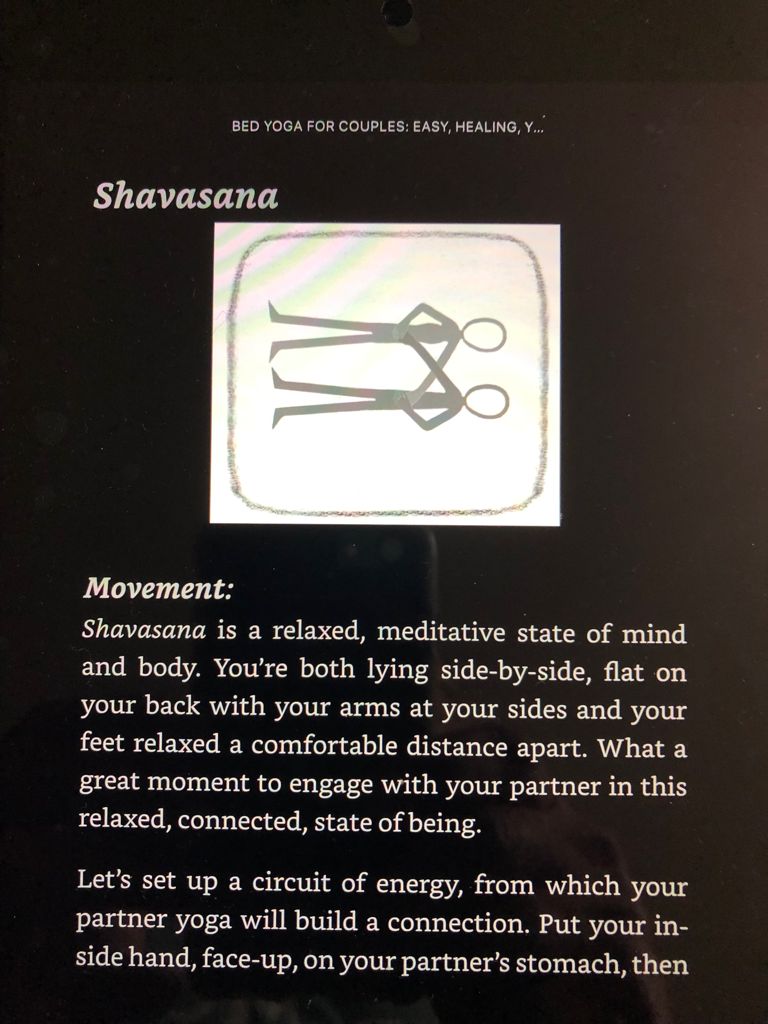
That being said, I’m not convinced of the efficacy of the moves while laying down. Part of yoga, at least for me, is experiencing gravity working on different areas of my body while holding the poses. Clearly, this will be very different while on one’s side rather than standing.

But, as the author Blythe Ayne points out, this method of practice is much easier for anyone who has trouble standing for long periods of time or other health issues that make regular yoga practice difficult.

“The most important point for the two of you to remember is that yoga is about you and for you. … Always communicate clearly with one another about any of the poses- if you’d like to go further into the movement, or if you’ve reached your ‘comfort zone.'” pg 4, ebook

Photo by u0410u043bu0435u043au043au0435 u0411u043bu0430u0436u0438u043d on Pexels.com

I could see this book being most useful for couples who are looking for creative and meditative ways to connect. However, it is not an in-depth examination of the subject. If you’re looking for a detailed history of yoga or the poses, you would be best served looking elsewhere.

Yoga has always had that centering and calming effect on me. The only thing that could possibly improve that experience would be to have it simultaneously with a loved one.

Highly recommended. Thanks for reading!

How to Love (Mindfulness Essentials, #3) by Thich Nhat Hanh

How to Love (Mindfulness Essentials, #3) by Thich Nhat Hanh

Thich Nhat Hanh, monk and spiritual leader, has written a short series of books he calls “Mindfulness Essentials.” This entry is all about love. You might ask yourself, what could a monk possibly know about love? Turns out, plenty.

Hanh applies the mindfulness techniques he’s learned over his lifetime of spiritual practice to the potentially thorny pathways of love, and the result is a gem of a read.

Photo by Asad Photo Maldives on Pexels.com

He counsels lovers to bring happiness to each other through being present in the moment and sharing your appreciation with each other. For example, if someone is distracted or worried, Hanh says you should draw their attention to the physical beauty of the world around them. In this way, you anchor the other in the present moment and ease the suffering of their busy mind.

This type of presence is a gift that you can give to anyone at anytime. And it doesn’t cost anything.

Hahn describes four defining traits of love as loving-kindness, joy, compassion, and equanimity. Then he examines these traits in detail so readers can ponder the mystery of love and see where, potentially, we may be falling short of these ideals.

Photo by Jasmine Carter on Pexels.com

He teaches all love begins with self love and walks hand-in-hand with spiritual practice. Through deep listening and the establishment of intimacy, Hahn believes love heals through empathy and “karuna,” a term that describes suffering with another and then doing what you can to end that suffering.

In addition, don’t take the other person for granted or make assumptions about what they may need. It is only through open communication that, Hahn believes, love lives.

He makes it sound so easy. I wish it was.

Photo by Pixabay on Pexels.com

Recommended for readers looking to learn about the spiritual side of love in a quick and easy read. Hanh doesn’t waste words and I am always in awe of what teachings he has to impart.

Thanks for reading!

Powers of Two: Finding the Essence of Innovation in Creative Pairs by Joshua Wolf Shenk

Powers of Two: Finding the Essence of Innovation in Creative Pairs by Joshua Wolf Shenk

Joshua Wolf Shenk examines creatives pairs throughout history in an effort to see why and how they work, and also why they end.

“The dyad is also the most fluid and flexible of relationships. Two people can basically make their own society on the go. When even one more person is added to the mix, the situation becomes more stable, but this stability may stifle creativity, as roles and power positions harden.” Introduction, pg xxii

Photo by Gratisography on Pexels.com

Shenk believes pairs move through six stages: Meeting, confluence, dialetics, distance, the infinite game and interruption. The stages show the development of the relationship, assumption of roles and eventual fall out of creative pairings.

“This book is written in the faith, underscored by experience, that more is possible — more intimacy, more creativity, more knowledge about this primary truth: that we make our best work, and live our best lives, by charging into the vast space between ourselves and others.” Introduction, pg xxv

I picked up this book because I’m involved in a creative partnership with my spouse (The History Guy, YouTube channel) and I was curious to see how other pairings have worked in the past. It was interesting to see how similarly we function when compared to other creative partners. I mean, everyone is different, but there are patterns that can be observed if you look closely.

“The irony is that, while our eyes naturally follow the star, a pair’s center of gravity is often with the one we see less.” pg 66

Photo by Victoria Borodinova on Pexels.com

Shenk’s chapters were interesting not only in their obscure history about some of the most famous partners in history, but also their implications for people who are looking to share their creative endeavors, and lives, with others.

“High-functioning couples commonly say that one key to a good relationship is giving each other plenty of space. But a big reason there are so many dysfunctional couples, romantic and creative, is that it’s hard for a lot of us to know what that really means or what it would look like in our lives.” pg 128

What works, what doesn’t work, and why?

“Creativity has become a broad, vague term, a kind of stand-in for universal good, even a synonym for happiness (or, as innovation, for profits). But making new, beautiful, useful things is as much about discord as it is about union.” pg 21

Photo by Tim Samuel on Pexels.com

The path isn’t always smooth, but good partners shore each other up. They may be strong where the other is weak. They challenge each other to be better than they ever would have been by themselves.

“Highly creative people have high standards and distinct sensibilities; they see the world in an unusual way (or they wouldn’t be able to make something new out of the materials of that world). Their partners must be a match — and the discovery of a shared sensibility is itself often an impetus to share work.” pg 31

I learned a lot about the Beatles, scientists, dancers, artists, screen writers, authors and more in Powers of Two. This is a book about creativity, yes, but it also looks at relationships themselves. It takes apart power dynamics, personal satisfaction and creative instincts. It is more of a rumination on creative pairs than a scientific thesis.

Recommended for readers who enjoy quirky non-fiction books. You’ll probably learn something new if you pick this one up. I did.

Thanks for reading!

The Truth About Trust: How It Determines Success in Life, Love, Learning, and More by David DeSteno

The Truth About Trust: How It Determines Success in Life, Love, Learning, and More by David DeSteno

“Deciding to trust someone, more than almost any other decision we make, holds the keys to how resilient we, both as individuals and as a society, will be.” pg 241

Trust is one of the things that makes society work. We trust that our taxes will go towards making our society better. We trust we will be paid for the jobs we perform. We trust in contracts, news agencies and family members. Sometimes it seems this trust is misplaced. David DeSteno examines trust, what is it and how or why you decide to give someone all your trust or not.

Photo by Karolina Grabowska on Pexels.com

I held as true many of the fallacies that DeSteno deconstructs in The Truth About Trust. That was disturbing, in a way, but I also enjoyed it because I learned new ways to approach trust issues and even to define what trust is. Although it may seem like a simple concept, I realized that I didn’t know the basic definition of trust. I knew what it felt like, but not the mechanics behind it.

Tell me: what do you think trust is?

“There are two facets to trust: integrity and competence. Some of the best partners or teachers you may ever have had may not be the warmest people in the world, but they knew their stuff.” pg 33

DeSteno reminds readers that beyond examining a new business or potential romantic partner to determine their trustworthiness, you need to remember your own perceptions color your reality.

If you want to be able to trust as you should, take a moment before negotiating with someone new to allow any feelings from a previous event to dissipate. pg 60

Photo by fauxels on Pexels.com

I liked that DeSteno waded into the potentially thorny world of cyberspace and who or what to give your trust to in the technological age. It seems that is going to be the future — programs, applications and machines.

…the basic issue of whether to trust technology has in fact been around for thousands of years. What makes it feel new now, however, is that technology is beginning to encroach on what had until recently been a solely human domain — sociality. pg 183

DeSteno gave me plenty to think about including why I sometimes place great trust where it has not necessarily been earned. Recommended for readers who want to ask themselves the same types of questions.

If you enjoyed The Truth About Trust, I’d suggest also picking up Terms of Service: Social Media and the Price of Constant Connection (DeSteno deals with trust in cyberspace and the two books complement each other nicely) or The Happiness Advantage: The Seven Principles of Positive Psychology That Fuel Success and Performance at Work (which discusses the issue of trusting yourself to do the things that will benefit you most in the future and why we don’t always do those things).

Thanks for reading!