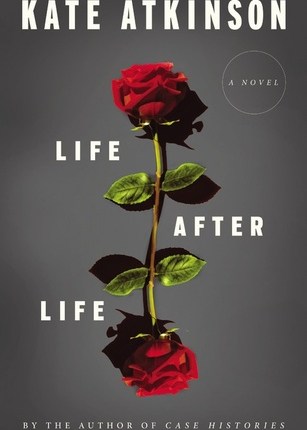
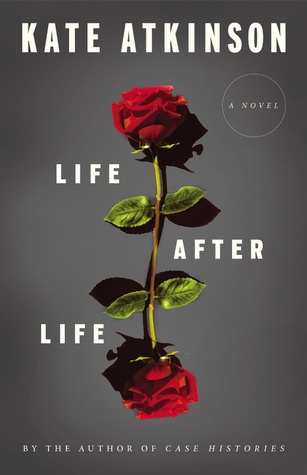
A lovely and unusual book about reincarnation, free will and destiny.
Ursula Todd was born on a snowy day in February with the umbilical cord wrapped around her neck. That was the first time she died…
I loved how Kate Atkinson built this story through seemingly insignificant details. As the reincarnations progress, layers are added upon layers, so that by the end of this tale, it is a rich tapestry of events, emotions and possibilities.
I was surprised by the open-endedness of this story. I feel like Atkinson wrote a tale that reads like real life- it has the meanings that we assign it. Nothing more, nothing less.
I listened to the audiobook of Life After Life and it was very good. A few times, I wished that I had the physical book in front of me so that I could double check a date or detail. Other than that, the narration was excellent.
This story has me wondering about life, reincarnation and all of it. If, as so many world religions say, there are parts of us that are immortal, wouldn’t we all go a bit bonkers after millennia of existence? Would we get bored of it? Would we ever choose to not come back? What’s the bigger picture?
Anyway, this book will make you wonder, question and dream about existence. Which, in my mind, is one of the highest functions of a book.
Recommended for fans of historical fiction, spirituality and life itself. I think Atkinson has written a masterpiece.
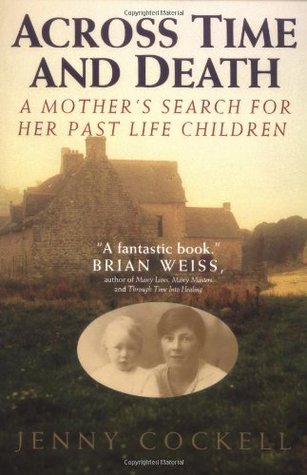
Jenny Cockell retained memories of a former life. In these memories, she died young and left children behind. Across Time and Death documents her acceptance of the memories and her search to find her previous family.
In childhood, my dreams were swamped by memories of Mary’s death. … All this, however, seemed inconsequential beside my fear for the children I was leaving behind.” pg 1.
In the religion of my childhood, reincarnation was neither taught nor accepted. But, as I’ve read different books, I’ve come to believe that it’s true.
I was so curious about it, in fact, that I participated in a past-life regression therapy session. The recording of it is mildly interesting, but mainly traumatic. I saw abuse, a lifetime of servitude and then a death that was penniless and alone in the dark.
The therapist can be heard on the recording, murmuring niceties about being “safe and secure.” There was a lot of, “let it go into the light” and “breathe in and out, slowly.”
Still, I walked out of that session and haven’t gone to another one since. I most likely never will.
If we do indeed live again and again, perhaps there’s a reason that we retain no memory of it. That’s my two cents. Back to Across Time and Death.
As a child, Jenny understood her past life memories more clearly than when she was an adult. “I had no cause to doubt that these memories were real. I assumed that memories of this kind were normal, and I expected everyone else to have them too.”pg 12.
Culture has such power to shape our worldview. Isn’t it true that part of the process for choosing the next Dalai Lama is that the candidate has to recognize the previous Lama’s belongings?
Jenny’s experience with regression through hypnosis seemed to echo mine. “Hypnosis is a strange experience even without the element of regression. All sorts of memories which have been hidden deep within the subconscious and cannot ordinarily be reached can be brought to the surface. This is double edged – both a wonderful and a disturbing experience at the same time.” pg 34. Yes.
When Jenny is finally able to overcome all of her doubts and fears, she then has to consider what the, now grown, children are going to think of her. “I needed to ask for help because I was beginning to panic. I wondered if I had any right to disturb Mary’s children or, conversely, if I had the right to keep my story from them.” pg 107. Which is a legitimate concern.
I’d recommend this book for people who are on the fence or just curious about reincarnation. If your mind is completely made up one way or another, I don’t know that Jenny’s testimony will mean as much to you.
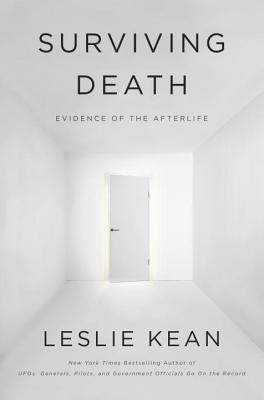
Investigative journalist Leslie Kean takes a close look at a wide variety of unexplained phenomena in order to answer the age old question — does human consciousness survive death intact with the memories, personality, and uniqueness that was exhibited in life?
I found her evidence astonishing.
Much of her research into near-death experiences (NDEs), I had been exposed to in other books. But, the chapters about children remembering past lives, psychic mediums and physical mediums was entirely new to me.
As I read, I kept getting goose bumps up and down my arms. The stories are that powerful.
(Reminder, the following quotes were taken from an advance reader’s copy and may change or be edited in the final printed version.)
Why did Kean write this book? “My intention is to present some of the most interesting evidence from diverse sources and show how it interconnects, making it accessible for the intelligent and curious reader encountering the material for the first time. Strict journalistic protocols can be applied to any topic for which there is data, no matter how unusual or even indeterminate.” loc 51, ebook.
I think she succeeded admirably. Most of Surviving Death is easy to understand, no matter how far-out the material may be.
I’ll admit to losing interest in the passages where she tries to distinguish between intelligence coming from the living human psyche or dead ones, the psi theory vs the survival theory. But, since that was the point of the book, that may be some people’s favorite part so don’t let me put you off.
Take these death bed descriptions of the other side by those about to leave this world: “The great inventor Edison, just hours before his death, emerged from a coma, opened his eyes, looked up, and said: “It’s very beautiful over there.” And more recently, the sister of Steve Jobs reported that just before he died, Jobs looked over the shoulders of his family members, right past them, and said, “Oh wow. Oh Wow. OH WOW!!” loc 2176, ebook.
I was not present when my grandpa passed, but Grandma told me later that at the moment he took his last breath, that a light came into his eyes and his face became so completely peaceful that he looked thirty years younger. I can’t say that I know for sure what waits for us beyond this life, but I can say that I’m not afraid. If you happen to have any fears in that regard, Surviving Death could be of great help to you.
Kean doesn’t answer the question she poses definitively because, of course, she hasn’t died and come back to tell us about it, but the stories and evidence that she presents is compelling. Throughout the chapters, Kean writes about personal, first-hand experiences that she has had. I believe that they are genuine. The hardcore skeptics may disagree.
The most extraordinary part of this book were the physical manifestations that Kean observed in the medium seances. Apparently, these seances have been going on for hundreds of years in certain areas of the world.
Did you know that in the 1920s in Warsaw, Poland, bowls of wax were placed in the seance chapter and apparitions were able to make molds of their hands? “In the Warsaw experiments, gloves were produced with interlocking fingers, with two hands clasping one another, and with the five fingers spread wide apart. Needless to say, the removal of a human hand from such formations would be impossible. Dematerialization was the only method that would leave the molds intact.” loc 4504, ebook. How had I never heard of this!
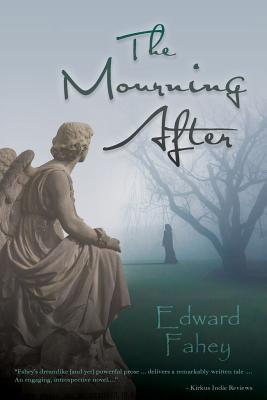
A New Age romance that takes place in the modern era. This is a story about reincarnation, missed chances, and the eternalness of love.
The Mourning After is very dark- so much so that at first I wasn’t sure that I was going to make it through the book. I eventually did, but I was depressed the rest of the day after I finished it. Reader, you have been warned. This book reminded me of Wuthering Heights in that the main characters just can’t seem to get their act together, romantically, but with some metaphysical twists like reincarnation thrown into the plot.
Take this bit, when Denis is about to have a psychotic break/break through to remembering his past lives: “Waters; I…” I looked up. The world was filled with his eyes. So dark, so piercing; and yet so tender. He was only trying to help. “You’re right, Buddy, I’m sorry. It’s just, my brain’s fried and I can’t do this tonight. I should, and I’d like to, but I can’t. I’m so awfully tired.” “Which is exactly when a spirit can break through.” pg 66 The scene builds from there. It’s very intense but true to how, at least how I’ve experienced, those types of things go in real life.
I also liked this part- where the main character is practicing channeled writing: “I began writing bits and pieces of a fictional story around Emma and Squire… Then something else kicked in that seemed joyful and sure of itself. I wrote faster and faster, scribbling down notes, piling them up in boxes, binders, and pocket scraps… Ideas and images kept popping out of nowhere; I had to get them down before they vanished for another hundred years. Or maybe forever.” pg 100
Very accurate and lovely. That is definitely one of Fahey’s strengths- a descriptive narrative. One last part that I thought was beautiful: “I still remember things M told me when we were small… Like the time she said, “Adults don’t know some things kids know. They don’t remember, I guess. They don’t listen inside each other anymore. Maybe they’ve just forgotten how; they’re just too busy doing big people stuff; I don’t know.” pg 115
Childhood is like that, yes?
If you enjoyed The Mourning After, I’d suggest reading Angels on Overtime by Ann Crawford. It is also a romance with metaphysical/New Age overtones, but its overall feel is a lot more playful than this read. I received a free copy of this book through the GoodReads First Reads program. Thanks for reading!
 A lovely and unusual book about reincarnation, free will and destiny.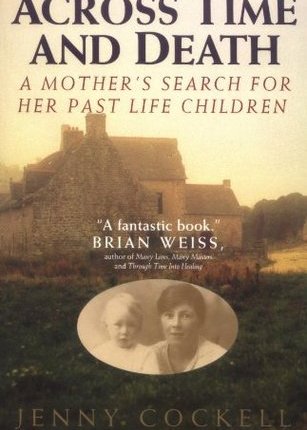



 A New Age romance that takes place in the modern era. This is a story about reincarnation, missed chances, and the eternalness of love.
 The Help Desk Book Blog