The 13½ Lives of Captain Bluebear (Zamonien #1) by Walter Moers

The 13½ Lives of Captain Bluebear (Zamonien #1) by Walter Moers

Captain Bluebear tells the story of his first 13-1/2 lives spent on the mysterious continent of Zamonia, where intelligence is an infectious disease, water flows uphill, and dangers lie in wait for him around every corner. -Summary from Goodreads.com
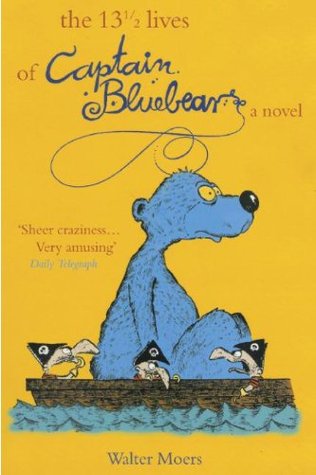
captainbluebearThis book was very strange. It reminded me of Charlie and the Great Glass Elevator by Roald Dahl. Moers writes page after page of strange creatures, worlds, and circumstances that are only connected because Bluebear passes through them. And, like in Dahl’s book, I felt like the author was always hinting about a greater truth behind the story, as if The 13 1/2 Lives of Captain Bluebear was more a gigantic allegory than a children’s book. I enjoyed the fantastic nature of it but I didn’t like the long lists of creatures that read more like crazy encyclopedic entries than an actual story with characters.

Some parts that I enjoyed and there were so many to choose from-
During the life with the Minipirates: “I must, however, admit to having been influenced by their richly embroidered tales and extravagant flights of fancy. They taught me that a good white lie is often considerably more exciting than the truth. Telling one is like dressing up reality in its Sunday best.” pg 19

During Bluebear’s time at the Nocturnal Academy: “One night, Knio and I had an argument about the nature of the universe. He had an appallingly crude conception of the physical world. “The earth is a bun floating in a bucket of water,” he asserted defiantly. “And what is the bucket standing on?” I demanded, trying to floor him. “The bucket stands on the back of the Great Cleaner who polishes the universe to all eternity,” Knio replied self-confidently. “This universe that she polishes so assiduously,” I said, “What in the world does that stand on?” “The universe doesn’t stand on anything, it lies,” Weeny put in. “The universe is as flat as a slice of sausage, you see.” pg 159

“From the Encyclopedia of Marvels, Life Forms and Other Phenomena of Zamonia and its Environs by Professor Abdullah Nightingale. Multidimensional Space: … Simply picture a train travelling through a black hole with a candle on its roof while you yourself, with a candle on your head, are standing on Mars and winding a clock precisely one yard in diameter, and while an owl, which also has a candle on its head and is travelling in the opposite direction to the train at the speed of light, is flying through a tunnel in the process of being swallowed by another black hole which likewise has a candle on its head (if you can imagine a black hole with a candle on its head, though for that you will require at least four brains).” pg 256

From his life in the Eternal Tornado: “One day (the Eternal tornado) swallowed an entire library, and since then a man named Gnothi C. Auton had been busy retrieving books from the sand, arranging them, cataloguing them, and lending them out.” pg 361 Wink, wink, my librarian friends, wink, nudge!

On being questioned by the Zamonium: “Next question, subject Grailsundian demonology: What are Nether Zamonian Diabolic Elves, and how many would fit on a pinhead?” pg 658 So clever.

If you enjoyed The 13 1/2 Lives of Captain Bluebear, you may also enjoy almost anything written by Terry Pratchett or The Hitchhiker’s Guide to the Galaxy by Douglas Adams. Thanks for reading!

Selling the Sunrise by Joshua C. Geiger

Selling the Sunrise by Joshua C. Geiger

sellingthesunriseSometimes life kills you before you die. It’s not a death of the body but a slow wearing away of the spirit that you carried from your birth through your childhood until wherever it is that time finds you now. That flickering flame of beliefs and dreams that you somehow knew was a true vision of reality but you had no real reason to believe so, except that inner feeling in your chest that would incline its head in quiet acknowledgment when you consult it. I thought that life had devoured my romantic streak but then this little book of poetry made me cry and I realized that my flame still burns. Some things can never be lost. That’s what this collection made me feel. I suppose all good poetry should make you feel like that.
One little gripe before I get into my favorite bits, the author has a habit of using parenthesis ( ) to accentuate meanings and voices in his poems. I sort of felt like the regular writing was his talking voice and the writing in parenthesis was his inner mind’s voice or whispers. I got what he was trying to do, but it became annoying because it sort of felt like a crutch or an excuse to not put down exactly what was in his head- a flavor of the truth but not the truth, if that makes sense. Say what you’re going to say, don’t ( ) your way through it. We can take it and so can you. Now, on to the good stuff.

What gets me about Josh’s poetry are the one liners in the middle of an innocuous poem about whatever, the weather or some chick’s eyes, and it’s like that one little bit reaches out and punches you in the gut.

Take this example- Complete pg 19:

“Sometimes it seems
as if my life all happened years ago
and now we’re all just waiting here to die.

and rainbows, they might promise me a break
but the pouring rain isn’t flooding yet,
the floors still reach my feet.

the cloud and bolts still keep me quiet
this silence is complete.”

I think that the first three lines are just genius. “Sometimes it seems as if my life all happened years ago and now we’re all just waiting here to die.” He sets this tone of utter despair, then brings in the rainbow to crack the door open for some light to come in to his inner space, and finally ties it to the ending where you feel a bit of hope in the silence. Gorgeous, just gorgeous.

Or this one, the Sunrise pg 69
(“and sometimes, love”
she says, between gasps for air
“your mouth spends too much time on the sunrise
and not enough time on mine.”)

There we get to see the use of the parenthesis ( ). Blah. But, the sentiment just bowls you over. What passion, what fire. Keep writing, Josh. The world needs to hear more from you.

If you enjoy the poetry of Joshua C. Geiger, I’d recommend picking up a book of Pablo Neruda or David Whyte.

Thanks for reading.

Simple Rules: How to Thrive in a Complex World by Donald Sull and Kathleen M. Eisenhardt

Simple Rules: How to Thrive in a Complex World by Donald Sull and Kathleen M. Eisenhardt
simplerules

I enjoyed the examples that the authors cite for simple rules helping to solve complex problems, but the manner in which to create your own ‘simple rules’ wasn’t really that simple.

I thought that in a book with the title, Simple Rules, that they’d give me a checklist of how to do it: Step 1, 2, 3, you know. The simple rules for how to make simple rules.

But, that wasn’t the case.

Since each problem, situation, business, and life is different, the authors essentially told the readers to use their discernment in the creation of the rules. Pick a ‘bottleneck’ and solve it. I found the suggestion too vague to be very helpful.

Despite these complaints, I did find a gem or two:

“Decisions that require coordination across different departments or teams are another good place to look for bottlenecks.” pg 135

“Better rules are better, and even apparently irrelevant rules can be reasonably effective if they happen to encourage helpful behavior.” pgs 172-173

If you enjoyed Simple Rules, I’d suggest The Checklist Manifesto by Atul Gawande (ways to simplify your work processes) or Yes, And: How Improvisation Reverses “No, But” Thinking and Improves Creativity and Collaboration—Lessons from The Second City by Kelly Leonard (for more simple rules on collaborations).

Thanks for reading.

The Autumnlands V. 1: Tooth & Claw by Kurt Busiek

The Autumnlands V. 1: Tooth & Claw by Kurt Busiek
autumnlands

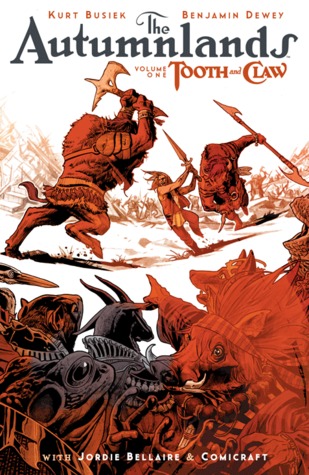
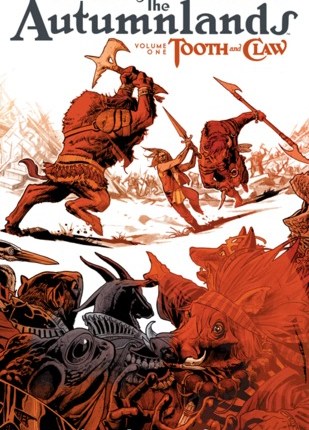
Excellent introduction to a world where anthropomorphized animals live on cities that float in the sky with the help of a magic that is fading from existence.

To combat this magic shortage, a talented magic user gathers a coalition of wizards to bring a great warrior from the past to the present in order to reawaken the powers.

The warrior is surprising, his summoning has unintended consequences, and the reader, after just a few pages, finds herself quickly caught up in a strange new world.

Highly recommended for adult readers who enjoy fantasy graphic novels.

There is a bunch of graphic violence and full frontal male nudity in here so, head’s up librarians. Make sure to shelve The Autumnlands in the appropriate section.

Some similar graphic novels, though I didn’t enjoy them nearly as much as this book: Monstress, Volume 1: Awakening or Wild’s End, Vol. 1: First Light.

Thanks for reading!

Splintered by A.G. Howard

Splintered by A.G. Howard

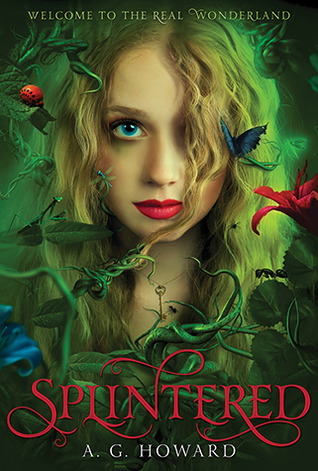
splinteredAlyssa is a descendant of Alice Liddell- the Alice who inspired Carroll to write his tale of white rabbits and fantastical creatures. But, Alyssa has a family secret: the women of her bloodline go insane when they come of age.

She tries to look on the positive side of this: At least one good thing has come out of my inherited insanity. Without the delusions, I might never have found my artistic medium.” pg 10, ebook.

Alyssa is in love with Jeb, a dark and brooding young man with a penchant for grunge clothing and a lip piercing (that she talks about all the time). But, he is dating the most popular girl in Alyssa’s high school class, Taelor (of course).

Things get really exciting when Alyssa starts to hear voices coming from the bugs and plants.

After a brief introduction where the reader learns that Jeb is freakishly controlling and Alyssa’s mother is in an insane asylum, she falls through a mirror and after some trials, finds her way into Wonderland.

I thought this could have been a potentially interesting re-telling of the classic Alice in Wonderland story, but Splintered‘s uniqueness is stifled under a bunch of teen angst and a love triangle.

Granted, I’m not the target audience for this book, but I’d been on a roll lately with awesome fairy tale re-tellings and I thought I’d give it a shot. Oh well.

I actually enjoyed A.G. Howard’s interpretation of Wonderland itself. The characters were familiar but twisted slightly.

Here’s a passage from the tea party- my favorite part: “Now we need to get back to our world. Like yesterday.” “Yesterday, you say?” the hatmaker warbles in his bouncing timbre. “Yesterday is doable.” Guffawing, the hare slaps a knee and adds, “Although two yesterdays would be impossible.” The Door Mouse snickers, slipping back into his uniform. “No, no! You can retrogress as many yesterdays as you please. Simply walk backward the rest of your life.” pg 187, ebook.

See? Howard nailed the classic characterizations, but Carroll’s original creations were far superior to Alyssa, Jeb, and Morpheus, who were her main contributions to the story.

Disregard my opinions on this book if you simply must read any and all fairy tale re-tellings because, at the very least, it is that.

Just be aware what you’re picking up- a young adult romance/coming of age- and if that’s what you’re in the mood for, you may really enjoy it.

I find that my expectations shape my opinion of a book almost as much as the text itself. For example, I think if I had been warned that Alice in Zombieland had really very little to do with the Wonderland story, I may not have disliked it as much as I did.

Splintered actually has a lot of the original Wonderland in it and, if I had to choose between Alice in Zombieland or Splintered, I’d pick this in a heartbeat.

Some highly recommended horror/fairy tale re-tellings (for adults): Alice or All Darling Children.

Thanks for reading!

All Darling Children by Katrina Monroe

All Darling Children by Katrina Monroe

All Darling Children asks the question: what if something corrupted the ‘boy-who-never-grew-up’?

Peter Pan is one of my favorite fairy tales and it has featured in quite a few beautiful re-tellings. (Tiger Lily is one.)

All Darling Children is a masterful, twisted take on a literary classic. I loved this for its horror filled examination of the spiritual cost of eternal youth and the strong female lead.

Photo by luizclas on Pexels.com

From her first moments in Neverland, Madge, the grandaughter of Wendy, can tell that something isn’t right: “Neverland. It seemed a hodgepodge of landscape ripped from a dream. Or maybe a nightmare. On one side, lush forest grew dense with heat and energy. Flowers bloomed in a rainbow of colors. They shuddered as Madge gazed at them, and then, as Pan looked in their direction, shriveled to pale, dry nothings.” loc 525, ebook.

This is not Disney’s version of Neverland.

Peter and his Lost Boys are dangerous in this world. Immature and wild, they try to force the traditional gender role of ‘mother’ on Madge (because they don’t know how to handle girls otherwise) and she resists: “Outsiders aren’t supposed to know how to find the tree house until they’ve been initiated.” “Initiated?” Madge’s stomach fell. “What’s that mean?” “It means you’re in the club, not that you’d ever get in, being a girl and all.” loc 692.

I never questioned the ‘Father’/’Mother’ roles of Peter and Wendy from the original book but, if the authority of the position was abused… it gets so creepy very quickly.

Madge’s story is told in-between entries from Wendy’s old diary. Here’s one of the passages: “I’ve learned much about (Peter), and while he is erratic and inconsistent in most ways, in one he is steadfast. Predictable. Peter must always be forced to try harder. If one gives in, he loses interest. I will never give in.”loc 921.

The back and forth from the story that the reader thinks she knows that is presented in Wendy’s diary, to the new story that Monroe is weaving with Madge, is awesome. There are enough similar elements drawn in from the original that the whole thing feels chillingly familiar- a mirror version of the classic.

Photo by luizclas on Pexels.com

Peter’s bragging about his exploits is presented as charming in Barrie’s version- Monroe takes a far more modern view: “Who wants to hear the story of how I cut off Captain Hook’s hand?” The boys whooped and smacked the table. Madge paled. He’d cut off someone’s hand? What was worse, he was bragging about it? Psycho.” loc 973

If you like twisted fairy tale re-tellings, you may love All Darling Children. I did. Another one that you’ve got to pick up if you liked this is Alice by Christina Henry. It’s an incredible, dark re-imagining of Alice in Wonderland and it’s also amazing.

Thank you to NetGalley and Red Adept Publishing for a free, digital ARC.

Also thank you to my Goodreads friend, Rosemarie Short, for writing a fantastic review that convinced me that I just had to read All Darling Children. You can see her review here: https://www.goodreads.com/review/show…

And, thank you for reading!

The Call of Spiritual Emergency: From Personal Crisis To Personal Transformation by Emma Bragdon

The Call of Spiritual Emergency: From Personal Crisis To Personal Transformation by Emma Bragdon

Though a bit dated (written in 1990), Emma Bragdon presents information about “spiritual emergencies,” what they are and how to help your loved ones or yourself through it.

Photo by Pixabay on Pexels.com

To begin, what is a “spiritual emergency”? : “Spiritual emergence is a natural process of human development in which an individual goes beyond normal personal feelings and desires-ego- into the transpersonal, increasing relatedness to Higher Power, or God. … When spiritual emergence is punctuated by profound emotions, visions, psychosomatic illness, and compelling desires to behave in unusual ways, including suicidal thoughts, the spiritual emergence becomes a crisis, a spiritual emergency.” pg 1.

This process can be absolutely terrifying if the person has no idea what is going on and is surrounded by professionals who are also clueless.

I think that the main problem with integrating such experiences is that modern society neither supports or recognizes them as valid: “People in our culture are afraid of speaking openly about spiritual experiences, because psychic phenomena… have been considered symptomatic of psychosis. Most psychiatrists, psychologists, and even clergy have believed that most spiritual experiences are indicative of either retarded development or emotional disease.” pg 12.

The clergy part of that passage is particularly interesting to me. These are the so-called experts on the spiritual realm, yet, when something breaks through into reality, they’ve got nothing.

Photo by cottonbro on Pexels.com

And humanity is the poorer for it.

Bragdon then relates numerous instances of men and women from all over the world who have gone through this process and reminds us: “In all the major religions of the world can be found examples of people … who have been through intense and sometimes physically and emotionally debilitating periods of spiritual experiences and ultimately attained transpersonal levels of consciousness.” pgs 81.

It makes one wonder, if Jesus, Mohammed, Moses, or pick-your-prophet had been born in the modern era, would his/her vision just been medicated into oblivion?

Bragdon points out that the problem is in the attitudes of the religious and medical establishments- the places that should be the most educated and accepting of these sorts of troubles: “The administrators of (religious) institutions are inconsistent in their view of spiritual experience as part of spiritual growth. The conventional religious establishment is similar to the conventional medical establishment, which is so ambivalent about the reality of spiritual experiences that it doubts their validity altogether.” pg 101.

When did we completely separate the health of the body from that of the soul? After all, one won’t work without the other.

Photo by Retha Ferguson on Pexels.com

Then, she goes on to talk about all of the different ways that these sorts of experiences emerge from drug use, sex, stress, and just life.

It is so pervasive that it seems that it must be a part of the human experience, but it is hard to study and come to grips with in scientific terms because the phenomena can’t be forced or replicated.

Despite these difficulties to categorize and treat it, Bragdon suggests that being present for the person going through it is enough: “What these people do want is acknowledgement, recognition that they aren’t crazy, and the companionship of others who know what they have experienced is real.” pg 113

So, even though this book was written 26 years ago, I don’t think that we’ve really made that much progress in that time- at least not in the arena of holistic medicine or transpersonal psychology.

Some further reading: Polishing the Mirror: How to Live from Your Spiritual Heart, Dreambody: The Body’s Role In Revealing the Self, or The Power of Myth.

Thanks for reading!

Dying to Wake Up: A Doctor’s Voyage into the Afterlife and the Wisdom He Brought Back by Rajiv Parti

Dying to Wake Up: A Doctor’s Voyage into the Afterlife and the Wisdom He Brought Back by Rajiv Parti

Rajiv Parti was living a materialistic dream with the house, car, and beautiful wife to prove it. But, the many things in his life didn’t bring him comfort when he developed prostate cancer and a bunch of unfortunate side effects from the surgery to remove it.

Photo by PixaSquare on Pexels.com

Addicted to pain pills and disconnected from the people around him, Dr. Parti underwent emergency surgery and experienced something so incredible, that when he woke up, he completely changed his life, developed a new form of holistic health treatment, and gave up many of the possessions that were weighing him down.

This is the memoir about that experience and Dr. Parti shares it in the hopes that it will change the reader’s life or at least bring comfort to those who are struggling in their current life experience.

Like many of the other memoirs I’ve read by medical professionals, Dr. Parti talks about the completely scientific view he had of the soul, which is to say, if you couldn’t see it and measure it, then it doesn’t exist.

Also, working on the technological edge of medical breakthroughs in the treatment of various diseases, had given him an invincible feeling.

This experience blew that attitude away: “Feeling like a master of the universe is easy in the world of modern medicine. … Maybe it’s a sense of cheating death for others that gives us cardiac surgical teams the vague feeling that we can overcome our own death. Of course that isn’t true. … Reality popped that myth for me.” pg 10

Photo by Kevin Menajang on Pexels.com

In his near death experience, Dr. Parti not only encountered his father, but also a huge crowd of his ancestors.

They shared messages of forgiveness and love: “Love is the most important thing there is, my grandfather communicated to me. I am glad to let you know that simple truth while you can still make change in your earthly life.” pg 44

But his time on the other side wasn’t all light and love, Dr. Parti also had the (fairly rare) experience of seeing hell and the suffering souls within it.

This is entirely my opinion, but I think that the detached manner in which Dr. Parti was living his life brought forth a major wake-up call from the spirit world. He saw hell first and then heaven and, in a way, that could be a metaphor for his life experience.

Photo by Skitterphoto on Pexels.com

I don’t believe in “hell” myself other than the nightmare that people can create in their own minds and lives, but, I didn’t experience it like Dr. Parti did. This memoir does not focus on the hell portion of the narrative, but, with the rarity of that experience, it could have. That, in itself, says something.

When Dr. Parti “comes back”, he knows that he wants to start a new life and a new focus, but he doesn’t know how.

The information for developing a new type of medicine comes to him slowly during meditation: “What is (the new mode of healing) anyway?” “…It is how nonpharmacological treatments in combination with drugs can heal things like depression and addiction and other diseases. It’s about searching one’s own soul to fight back against the hollowness that pharmaceuticals alone or alcohol and illegal drugs create or don’t really fill.”pg 91.

He eventually develops meditations and lifestyle changes as well as a manifesto for treatment.

To me, the most fascinating part of this memoir was the communication between himself and the spirit world once he was back.

For readers who are unfamiliar with near death experiences, Dr. Parti provides a broad background with some of the major historical figures who went through it.

Like Jung: “(Carl) Jung’s NDE led to a split with Sigmund Freud, who believed that spiritual experiences were fantasies. Jung, however, considered spirituality an important part of our well-being saying that life has purpose beyond material goals and that our main task, the path we should all be on, is the one that leads to our own connection with the universe.” pg 124

Photo by Cliford Mervil on Pexels.com

Ultimately uplifting and empowering, Dying to Wake Up is another excellent entry into the literature about near death experiences.

Recommended for anyone who questions why we are here or what comes after. Some further reading: Into the Magic Shop: A Neurosurgeon’s Quest to Discover the Mysteries of the Brain and the Secrets of the Heart, Dying to Be Me: My Journey from Cancer, to Near Death, to True Healing, or Wisdom of Near-Death Experiences

Thanks for reading!

The Sound of Gravel by Ruth Wariner

The Sound of Gravel by Ruth Wariner

The Sound of Gravel is in the running for my favorite book club read this year! (Bull Mountain is the other pick I really enjoyed.)

It is Ruth Warnier’s memoir about her poverty-stricken childhood in a polygamist cult in Mexico, her dysfunctional mother, abusive step-father, and struggle for survival along with her many siblings.

Photo by Belle Co on Pexels.com

She pulls you in, first line: “I am my mother’s fourth child and my father’s thirty-ninth.” pg 10, ebook. I read that sentence to my husband and his reaction was, “Are you reading a book about royalty?” Unfortunately, no.

Ruthie’s father was a founding member of the “Firstborns”, a polygamist group that broke away from the Mormon church. He believed that, in order to live in the manner that God intended, men are supposed to have multiple wives and as many children as possible, to become like gods in the next life. He lived what he preached.

But, unlike members of royal families, Ruthie’s father, and later her stepfather, did not have the resources available to allow his wives to live in houses with running water or electricity. It is a hard existence but Ruth’s parents live it because of their faith.

Photo by Hank Nielsen on Pexels.com

“After all,” she said, “it is better to have ten percent of one good man than to have one hundred percent of a bad one.” The women of LeBaron (the colony in Mexico) were always saying that…” pg 12, ebook. But what about ten percent of a bad man…

At first, Ruth’s stepfather seems almost normal: “Everyone in the colony was always saying how Lane had a strong work ethic. He spent every day milking cows, planting and baling hay, fixing tractors, trucks, and other equipment- all of which broke down regularly. But in spite of all his hard work, he never made enough money to provide for his eleven kids and stepchildren.” pg 21, ebook.

And his family grew larger than that quite quickly. But, after a short time, he begins to show his true self.

It’s hard to imagine the level of poverty that Ruth and her family endured. Every month, her mother and all of her brothers and sisters made their way by bus from Mexico to the US to collect government assistance. The trip took all day and when they got back, if stepfather Lane did not show up at the bus stop to pick them up, they had to walk a mile home.

Photo by Spencer Davis on Pexels.com

“The rest of us followed silently, watching and listening as Mom took a wide step over the highway shoulder and onto the dirt road, the gravel crunching beneath her footsteps, the sound of home.” pg 29, ebook.

Ruth’s mother tries to do what she can for her children but there’s only so much a perpetually pregnant, struggling mother of five (or more) can do. Some of Ruth’s siblings suffer from disabilities that make it dangerous for them to be left alone with any of the younger ones. After reading what her childhood was like, I am simply amazed that Ruth survived to write this book.

Major trigger warnings for sensitive readers: there are some seriously disturbing scenes of child abuse and domestic violence. But, it is worth the read.

The Sound of Gravel is ultimately uplifting, inspiring, and I highly recommend it. A few similar memoirs: Hillbilly Elegy: A Memoir of a Family and Culture in Crisis , Pigs Can’t Swim, or A Girl Named Zippy.

Thanks for reading!