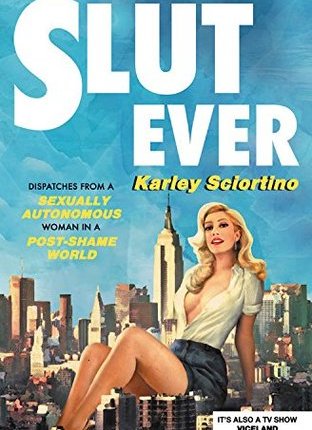
Slutever: Dispatches from a Sexually Autonomous Woman in a Post-Shame World by Karley Sciortino

Slutever: Dispatches from a Sexually Autonomous Woman in a Post-Shame World by Karley Sciortino

“Without question, if I weren’t a slutty as I am, my life thus far would have been far less interesting. … But my sluttiness has also been the cause of many existential bathroom-mirror moments.” pg 8, ebook

Photo by cottonbro on Pexels.com

Karley Sciortino, sex blogger and author, has led a self-described colorful life. It certainly comes through in this tell-all memoir.

Through her experiences, Sciortino has proudly embraced her sexuality and her place in society as a woman who knows what she wants in the bedroom, and takes it. This hasn’t been a simple path.

Part of her struggles are society’s views and programming about “slutty” women.

“It’s a no-brainer that we’re influenced by the people and stories that make up the culture around us. And it’s difficult to cite an example, either real or fictional, of a happy, healthy, promiscuous person – let alone a woman.” pg 8, ebook

The rest of her difficulties seem to stem from a lack of self knowledge or awareness. Sciortino isn’t afraid to tackle any and all issues head on in her own unique way.

“…my goal isn’t to be good or normal or accepted. My goal is to be free. (And maybe also to troll society a bit in the process, for good measure.)” pg 12, ebook

Photo by Nina Uhlu00edkovu00e1 on Pexels.com

It took me a couple chapters to get into this memoir. Sciortino’s writing style is frank to the point it sometimes feels abrasive, but it maintains an honest delivery throughout.

“My biggest revelation of the saga was that group sex is amazing for when you’re drunk, because you can just take a time-out whenever you’re bored or tired and someone else will literally take over for you. Genius.” pg 24, ebook

The early part of the book is fixated on sexual experiences and experimentation. As she delves deeper into her underlying motivations and psychology, Sciortino begins to get to the heart of matters. That’s when I felt this book became worth the read.

She had me asking myself some difficult questions: Why is sexuality such a complex issue? Why should people, in the privacy of their own homes and with proper consent, care what others think?

Photo by cottonbro on Pexels.com

Why are there different standards for men and women?

And why is sexuality, which can play such a large part of the happiness in our lives, so difficult to talk about? (For some, not Sciortino, obviously.)

Recommended for mature readers who don’t mind a nearly stream-of-consciousness style of writing as well as a thick skin to push through Sciortino’s delivery to get to the meaning behind the words – because there is meaning to be found.

Thanks for reading!

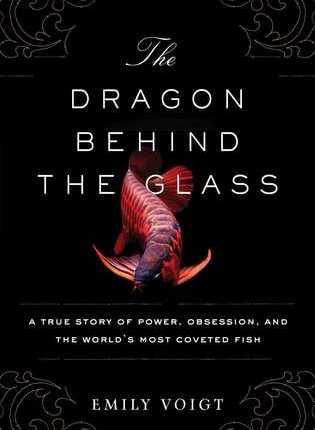
The Dragon Behind the Glass: A True Story of Power, Obsession, and the World’s Most Coveted Fish by Emily Voigt

The Dragon Behind the Glass: A True Story of Power, Obsession, and the World’s Most Coveted Fish by Emily Voigt

The Dragon Behind the Glass documents journalist Emily Voigt‘s descent down the rabbit hole of fish collecting, money, power, and scientific exploration in some of the most remote locations in the world.

“A pair of whiskers juts from its lower lip, and two gauzy pectoral fins extend from its sides, suggesting a dragon in flight. This resemblance has led to the belief that the fish brings prosperity and good fortune, acting as a protective talisman to ward off evil and harm.”

(Fish pictured below is not an arowana.)

Photo by Chevanon Photography on Pexels.com

Though it starts off with a major hook, Voigt takes the reader to a crime scene where a pet store owner appears to have been killed for his shelf of rare fish, the book begins to meander after that and never gets back to the compelling pace of the opening.

That is not to say there aren’t some fascinating history and fish-related trivia tidbits. In fact, the majority of the book consists of that.

“… the keeping of pets reflects our hunger for status symbols, for what the philosopher Jean-Paul Sartre called the ‘carnal, clinging, humble, organic, milky taste of the creature,’ which underlies all luxury goods. The modern pet shop first appeared in American cities in the 1890s; and with it began the mass importation of exotic animals from Asia and South America.” pg 21, ebook.

Photo by La Miko on Pexels.com

Voigt explores the history of aquariums, pet-crazes throughout history, and the ascendance of the arowana as the pet fish of choice in the East. Complicating matters, the arowana has become incredibly rare in the wild, partially due to its desirability among collectors, but also because of the destruction of its native habitat.

“The most highly coveted – or at least the traditional favorite – is the legendary Super Red, native to a single remote lake system in the heart of Borneo. … As late as 2008, researchers with Conservation International reported that rural Cambodians were still eating greens, even as wild populations plummeted due to over-harvesting for the aquarium trade.” pg 30, ebook

Like other rare and precious commodities, the interest and money surrounding the arowana has led to some shady dealings. I wasn’t too surprised by the alleged criminal activity Voigt describes among collectors. But I was flabbergasted by the fierce competition among some scientists in the rush to catalog and name the increasingly rare fish.

Perhaps that’s naive of me. Scholars jockey for prestige as much as anyone else. I suppose I’ve never stopped to think about it.

Photo by Andrea Piacquadio on Pexels.com

I was also surprised by how many species are out there that science has not studied yet.

“When I first set out to report on the Asian arowana, I figured I would start by finding the researcher studying the species in the wild- only to realize no such person exists. The popular illusion that modern science has the entire living world covered, that there is an expert analyzing every crevice, is far from true.” pg 205, ebook

Recommended for readers who are interested in a detailed study of fish, travel and history. It’s a slow-paced adventure, and not for everyone, but there are some treasures to be found if you stick with it.

Thanks for reading!

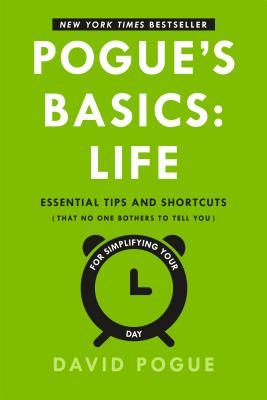
Pogue’s Basics: Life: Essential Tips and Shortcuts (That No One Bothers to Tell You) for Simplifying Your Day by David Pogue

Pogue’s Basics: Life: Essential Tips and Shortcuts (That No One Bothers to Tell You) for Simplifying Your Day by David Pogue

David Pogue and his team tested every suggestion in this book to verify that each works the way it is supposed to.

The result is a gem.

“… the morsels in this book describe features hidden right under our noses, features that lots of people don’t know about. As well as ‘Everyone’s been using it wrong’ insights. Plus tips that are clever, unexpected, and useful.” pgs 5-6

Photo by Kaboompics .com on Pexels.com

I knew some of the tips in these pages, but certainly not all of them.

When I’m done with this book, I’m going to gift it to my pre-teen, who thinks she knows everything but obviously doesn’t. I think she’ll find this incredibly handy in a few years.

A pot of water doesn’t boil over if you lay a wooden spoon across the top of the pot.” pg 81

Who knew? I didn’t. That’s one of the tips I’ve already used to make my life easier.

I’ve also utilized the tip for how to get ketchup out of the bottom of the bottle. And no, it’s not leaving it upside down and leaning against something for two hours though that does work. It is a much more immediate solution.

Photo by Vova Krasilnikov on Pexels.com

Some of the technology tips may be outdated, only because this book was printed in 2015. But I haven’t tested them all yet, so don’t hold me to it. It’s one small section in a stellar lineup of life “basics” that cover topics including the car, travel, food, clothes, your body, animals, house and home, and more.

Highly recommended for anybody who’s looking to make their lives a little bit simpler. Let’s be honest then, that’s everybody.

Thanks for reading!

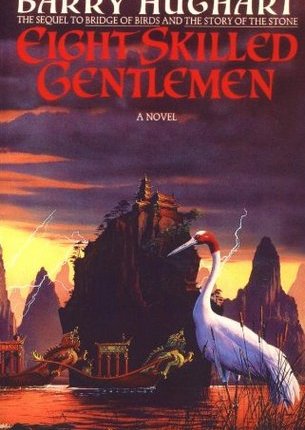
Eight Skilled Gentlemen (The Chronicles of Master Li and Number Ten Ox, #3) by Barry Hughart

Eight Skilled Gentlemen (The Chronicles of Master Li and Number Ten Ox, #3) by Barry Hughart

“My experience with the old man has taught me to keep my mouth shut when the wrinkles around his eyes squeeze up in tight concentric circles, so I waited until his mind relaxed along with the wrinkles, and then he shook himself and turned toward me.” “Ox, have you ever visited the Forbidden City?”

Photo by David Yu on Pexels.com

Eight Skilled Gentlemen is the final book of The Chronicles of Master Li and Number Ten Ox series. I feel it missed the mark somewhat.

Like the previous two books, it has some beautiful imagery and fantastical magic sequences based in an ancient fictional China of Barry Hughart, the author’s, own creation. As usual, I liked the interactions between our two heroes. I also liked riding along while Master Li and Ox attempt to solve the murder mystery.

“All we can do now is go down that list of involved mandarins and find the weak link. You may have you break a few of the bastard’s bones, my boy, but one way or another he’s going to enable us to toss the rest of them in jail,” the sage said grimly.”

Unlike the rest of the series, the overarching story for this entry felt scattered, so much so, that the ending felt almost tacked on. Which seems like a harsh criticism, except those final scenes were my favorite of the book.

Photo by Magda Ehlers on Pexels.com

If only it had felt more connected to the rest of the tale…

Like some of the other readers of this series, I noticed some repetition in Hughart’s storytelling by the third book. Formulaic can still be brilliant, but I’m not certain this book reached that bar.

There was also Hughart’s unfortunate tendency to have his characters launch into song or prose within the story. This should have added to the immersive feeling of the reading experience, but I found myself skimming when I reached those sections. Again, it felt more repetitive this time around than magical.

Adding to my disappointment, Eight Skilled Gentlemen was clearly supposed to be part of a longer series. The final few lines of the book offer no satisfying conclusion for characters whom I have come to love during the 850 pages I spent with them.

The little bit I have researched about the author seems to indicate Hughart had a disagreement with his publisher and then tired of writing it. He passed away in August of last year.

It is incredibly sad because the books are so lovely and Hughart deserved the chance to finish them in a manner he saw fit. I think it’s a loss not just for the author’s family but for the entire fantasy-reading world.

Photo by Magda Ehlers on Pexels.com

In conclusion, if you haven’t read this series and like fantasy, you must give it a try. Just be aware it is a work of art with an abrupt end.

The Story of the Stone (The Chronicles of Master Li and Number Ten Ox, #2) by Barry Hughart

The Story of the Stone (The Chronicles of Master Li and Number Ten Ox, #2) by Barry Hughart

“Ox,” he said, “the writing of your memoirs is doing wonders for your calligraphy, but I must question the content. Why do you choose the rare cases in which matters run melodramatically amok?” I heroically refrained from saying, “They always do.”

The Story of Stone, Barry Hughart

Master Li and Number Ten Ox are at it again.

There’s an unexplained murder, puzzling fragment of a poorly-finished forgery, and nature herself is leaving clues behind with whole swathes of plants dying in a strange pattern.

Photo by carol wd on Pexels.com

“I wasn’t sure that any autopsy could be delightful, but I didn’t care. The old fire had returned to Master Li’s eyes, and I felt like a warhorse who was being called back into battle.”

In the course of solving the mystery, Li and Ox encounter ghosts, hidden torture chambers, and make a journey down to the depths of hell. It is one of the finest homages to Dante’s Inferno that I’ve ever had the pleasure to read.

“Ox, what do you smell in the air?” he asked. “Wet earth, pine needles, pork fat, donkey manure, and perfume from Mother Ho’s House of Joy,” I said. “Wrong. You smell destiny,” Master Li said happily.

And, as usual, readers get to enjoy the sometimes hilarious, and always entertaining, interplay between a brilliant scholar and his surprisingly strong sidekick.

Recommended for readers who enjoy a blend of fantasy, mystery and historical fiction.

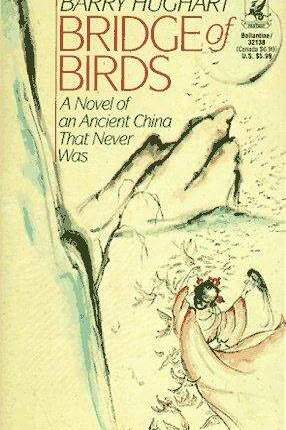
Bridge of Birds (The Chronicles of Master Li and Number Ten Ox, #1) by Barry Hughart

Bridge of Birds (The Chronicles of Master Li and Number Ten Ox, #1) by Barry Hughart

Bridge of Birds is a charming, award-winning fantasy novel that follows the investigative efforts of Master Li as he strives to safe the mysteriously stricken children from the village where Number Ten Ox lives.

“Jade plate, Six, Eight. Fire that burns hot, Night that is not. Fire that burns cold, First Silver, then gold.” pg 22, ebook

Photo by Somya Dinkar on Pexels.com

A beautiful blend of myth and fantasy, the reader is ferried from one exotic locale to the next at the side of the two heroes, one ancient and one young with surprising strength.

We navigate dangerous mazes to hidden treasure hoards, satisfy the grieving souls of haunted ghosts, and marvel at the lightning intellect of Master Li, the scholarly genius with “a slight flaw in his character”.

“My surname is Li and my personal name is Kao, and there is a slight flaw in my character,” he said matter-of-factly. “You got a problem?” pg 32, ebook

There is very little downtime in Bridge of Birds. And just when you think things couldn’t possibly get worse for Master Li and Number Ten Ox, somehow they do.

Despite its breakneck pacing, I found many beautiful moments to marvel over in this story. It is a fairy tale with both substance and heart. Easy to see why it received the 1985 World Fantasy Award for Best Novel and 1986 Mythopoeic Award for Best Fantasy.

Photo by eberhard grossgasteiger on Pexels.com

I think that’s even more impressive when you consider this was Barry Hughart’s debut novel.

“Reverend Sir, in your studies of myth and folklore, have you ever encountered a ghostly handmaiden who pleads that birds must fly?” pg 154, ebook

Highly recommended for readers who like fantasy and historical fiction novels with a dash of mystery and for their heroes to have slight flaws in their character – such a propensity to drink too much wine or the willingness to swindle others but for very good reasons.

The Lies of Locke Lamora (Gentleman Bastard, #1) by Scott Lynch

The Lies of Locke Lamora (Gentleman Bastard, #1) by Scott Lynch

In The Lies of Locke Lamora, readers are introduced to Locke, an orphan in a fantastical city with magical glass relics the size of entire city blocks. The glass is all that was left behind by the people who founded the city. Its inhabitants now do not understand how it was constructed, but that doesn’t keep them from utilizing the spires of magic glass or appreciating its otherworldly beauty.

Within this strange city that is similar to our world’s Venice, yet so different, Locke Lamora is taken in by various characters in the realm’s criminal underworld. The boy shows promise for a life of theft and confidence games… if he can reign in his propensity for accidentally getting people killed.

Photo by Pixabay on Pexels.com

“At the height of a long wet summer of the seventy-seventh year of Sendovani, the Thiefmaker of Camorr paid a sudden and unannounced visit to the Eyeless Priest at the Temple of Perelandro, desperately hoping to sell him the Lamora boy.”

There are layers to this tale. There’s intrigue and backstabbing among the criminal underworld or those who call themselves, “the right people”. There’s a gang of criminal masterminds, the Gentleman Bastards, who prey on the city’s upper class citizens, but who pass themselves off as simple sneak thieves to the rest of the gangs.

And while Locke’s gang, the Gentleman Bastards, are running one of the biggest cons of their life, the chapters of that storyline are interspersed with the personal histories of the gang’s members. Part of that history includes the Gentleman Bastards’ training as priests of the various orders in the city, of which there are many.

So, to recap: there’s complex religion, city hierarchy, criminal hierarchy, levels of con games, and then the real story begins when Locke’s plan, as usual, begins to go sideways.

“I ache in places I didn’t previously realize I owned,” said Locke, gingerly applying adhesive paste to his chin with his fingers. “But it can’t be helped.”

Photo by Francesco Ungaro on Pexels.com

I first read The Lies of Locke Lamora eight years ago in March 2012. I recently re-read it in May 2020. To my surprise, I enjoyed it somewhat less the second time around.

I still like the characters, the story and the setting, all of which were beautifully written. My complaint was the pacing. Just as the author gets rolling on the main story line, he draws us back into the past. I didn’t seem to mind it the first time I read the book, but I definitely noticed it in the second reading.

But don’t let a small thing like pacing dissuade you from reading The Lies of Locke Lamora. It is an awfully entertaining fantasy read. And if I remember correctly, the next two books in the series are fun as well.

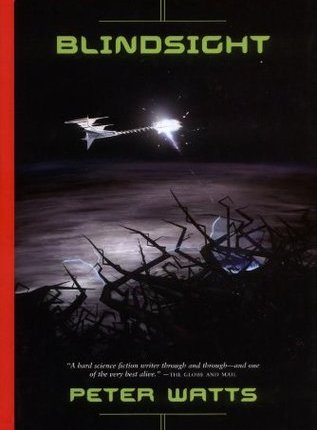
Blindsight (Firefall, #1) by Peter Watts

Blindsight (Firefall, #1) by Peter Watts

Blindsight is an incredibly imaginative science fiction novel that takes on the foibles of human consciousness and examines, in a serious way, what an alien-form of consciousness might look like.

Siri is a unique protagonist. Because of severe seizures when he was young, doctors performed dramatic brain surgery in order to save his life, essentially cutting his brain in half.

Photo by meo on Pexels.com

“The brain’s a very flexible piece of meat; it took some doing, but it adapted. I adapted.” pg 9, ebook.

This early surgery changed the way Siri’s brain worked and how it processed reality, making him the perfect translator for other humans whose brains and bodies have been so changed that baseline humans can no longer communicate with them.

And Siri’s special talents are desperately needed after aliens unleash surveillance technology in the atmosphere. Humanity called the strange lights in the sky, “fireflies.”

“How else would you explain 65,536 probes evenly dispersed along a lat-long grid that barely left any square meter of planetary surface unexposed? Obviously the Flies had taken our picture.” pg 24, ebook.

Photo by Felipe Helfstein on Pexels.com

Siri becomes part of an elite mission sent by Earth to discover where the “fireflies” originated from and who or what created them.

Blindsight isn’t a simple read. It proposes complex ideas that demand some attention to unravel and it makes the reader consider how real is her own perception of this thing we call “reality.”

It asks how technology may change not only how humankind takes in information, but how that information is interpreted and how that would separate people from each other. The characters Peter Watts has created for the alien-seeking mission are some of the most unique I’ve read because he takes those ideas to extreme conclusions.

“When the fate of the world hangs in the balance, you want to keep an eye on anyone whose career-defining moment involves consorting with the enemy.” pg 135, ebook.

But it feels very real. That is Watts’ strength – making the fantastical seem perfectly logical like vampires, real vampires.

Highly recommended for readers who enjoy “hard” science fiction.

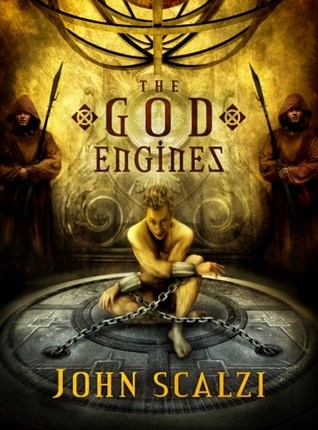
The God Engines by John Scalzi

The God Engines by John Scalzi

In the world of The God Engines, beings called gods power the ships that take humanity between the stars. How the world became this way is not for Captain Tephe to question, instead it is a matter of faith. As part of Tephe’s service and devotion to his own deity, he has to keep the being that powers his engine in check and subservient to his will.

That is not a simple task.

Photo by Pixabay on Pexels.com

“I do not know why this is. Why single made iron can kill a god. I know only that it can. I know the gods fear death more than do men. I can kill you with this, god.” pg 8, ebook

When Tephe is called to perform a secret mission of great importance for his deity, it throws his entire world view in jeopardy. He discovers his god, and all the others, may not be what they appeared to be.

“Words. They have power. To name a god is to give it power. To deny it such is to take it.” pg 16, ebook

I feel like this story was too short to fulfill its full potential. The general idea was very promising – what would a world where embodied gods were used as power sources look like? How would the society be structured? And how would a worshiper’s faith change or be challenged through day-to-day interactions with the gods?

Photo by Ben Yi on Pexels.com

The plot felt rushed as the characters raced from one place to another. I also wanted a bit more background about the universe of The God Engines, but the lack of it added somewhat to the mystery of the story.

“You are charged with silence,” proclaimed the third Bishop. “What is spoken to you here is not to be spoken again, on remit of your soul.” pg 31, ebook

I think the strength of this story is in how it addresses faith. Faith in the goodness of the unseen shapes lives and guides actions. It explains why some gods power ships and others rule empires. Because of faith, humanity has waged wars and conquered planets.

Perhaps someone should have made certain this faith wasn’t misplaced…

Recommended for readers who enjoy short science fiction novels with a liberal dash of horror.