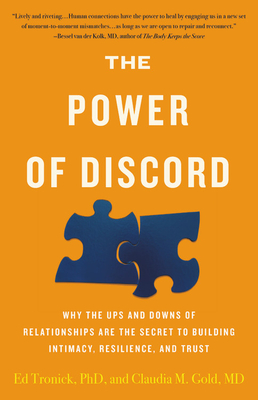
The Power of Discord: Why the Ups and Downs of Relationships Are the Secret to Building Intimacy, Resilience, and Trust by Ed Tronick, Claudia M. Gold

The Power of Discord: Why the Ups and Downs of Relationships Are the Secret to Building Intimacy, Resilience, and Trust by Ed Tronick, Claudia M. Gold

The Power of Discord is a study of human connection and disconnection. The authors, Ed Tronick and Claudia Gold, demonstrate through scientific and therapeutic studies that by working through conflict and the messiness of every day life, our relationships can be stronger than ever before.

Our earliest relationships have a profound affect on the way we interact with others as adults. It is almost scary how fast infants develop the responses that they carry with them into adulthood. In Tronick’s groundbreaking study called the “still-face” experiment, his findings helped researchers discover how infants communicate with their mothers.

Photo by Anna Shvets on Pexels.com

In the experiment, a mother and child are interacting, playing as usual. Then, the mother turns away a moment and when she turns back, her face is still and empty of emotion.

The curious thing about the infants’ reaction to their caregiver presenting them with a face devoid of emotion is that researchers could already see how the relationship between the two was developing. Infants in a healthy relationship kept trying to get a reaction out of the other person until their caregiver “went back to normal.” Infants in a “dysfunctional” relationship, or who were for whatever reason were less connected with their parent, shut down and practiced coping or self soothing mechanisms rather than trying to draw the caregiver out.

Prior to this experiment, it was assumed that infants had little to no communication ability whatsoever.

“When confronted with a stressful situation, (infants) could apply a style of interaction drawn from the everyday exchanges with their caregivers. While they did not yet have the capacity for language or conscious thought, they were able to draw on their countless moment-to-moment interactions to cope with the stress of caregivers’ unfamiliar behavior.”

Photo by Pixabay on Pexels.com

I worried, as I read the study, that the children would somehow be scarred by it. Some of the reactions the researchers described were very intense and painful for everyone involved. But the authors assured readers the level of stress in the experiment wasn’t something beyond what the children would encounter in their daily lives. Still, it seemed rather unfair to them. It wasn’t like researchers could explain what was going on.

Beyond the initial interactions that form the manner in which people craft their relationship styles, Tronick and Gold delve into further issues that may affect how you connect with others like: the pernicious effects of perfectionism and addiction to technology, feeling safe around others, taking responsibility for your connection style, and, the part I liked the most, the surprising way discord makes relationships stronger.

“… it is not simply what happened when we were young that screws us up now. Along the way to growing up and into our adult lives, we continue to create new ways of being screwed up. Only when we have accumulated a whole new set of interactions, when we work through the inevitable moments of disconnection to again find connection, will we grow and change.”

Photo by Josh Willink on Pexels.com

Though we learn how to form connections before we even have language, researchers have found that connection styles can be relearned, relationships can be repaired and are repaired, every day, little by little. In countless “mismatch and repair” moments, we teach ourselves that there is nothing broken that can’t be restored. It builds confidence in the relationship and trust in ourselves and each other – the building blocks of intimacy.

Highly recommended for readers looking to engage in some introspection about their own attachment style or for those who are curious about how relationships are formed and maintained.

Thank you to NetGalley and the publisher for a free advance reader copy of this book.

The Hero With a Thousand Faces by Joseph Campbell

The Hero With a Thousand Faces by Joseph Campbell

“Throughout the inhabited world, in all times and under every circumstance, myths of man have flourished; and they have been the living inspiration of whatever else may have appeared out of the activities of the human body and mind.” pg 1

Joseph Campbell presents his, now classic, thesis of comparative mythology and psychology. By examining different myths from all around the world, he outlines the hero’s journey. The journey has many different steps and elements to it, but beneath it all, Campbell believes, through all the many stories, the journey is one.

Photo by Maria Pop on Pexels.com

“Furthermore, we have not even to risk the adventure alone; for the heroes of all time have gone before us; the labyrinth is thoroughly known; we have only to follow the thread of the hero-path.” pg 18

I think in different circumstances I may have enjoyed this book very much. The topic, comparative mythology, is one I find particularly fascinating. I also like to see how humankind incorporates the mythical not just in our stories, but in the way we set up our societies.

“… every failure to cope with a life situation must be laid, in the end, to a restriction of consciousness. Wars and temper tantrums are the makeshifts of ignorance; regrets are illuminations come too late.” pg 101

Photo by Pixabay on Pexels.com

But honestly, I had trouble focusing because of certain current events. Campbell presents the different myths in pieces organized by his heroic stages rather than in one flowing story. Between the trouble focusing and the bouncing around from myth to myth, this was a difficult read for me. Perhaps I’ll try this book again in the future, when my life doesn’t feel so off-kilter.

I think it has plenty of treasures to be discovered for spiritual seekers of every kind. It also demonstrates that though we look different and live very different lifestyles, at our soul level, there are many similarities to humanity. We find these similarities mirrored through our stories, our life stages, how we live and how we dream.

“Those who know, not only that the Everlasting lives in them but that what they, and all things, really are is the Everlasting, dwell in the groves of the wish-fulfilling trees, drink the brew of immortality, and listen everywhere to the unheard music of eternal concord. These are the immortals.” pg 142

Photo by Gabriel Peter on Pexels.com

I sincerely hope you all live and dream sweetly, immortals, wherever on the hero’s journey you may be: sheltering-in-place or braving the world, and that I will live and dream sweetly, too.

You’re Not Listening: What You’re Missing and Why It Matters by Kate Murphy

You’re Not Listening: What You’re Missing and Why It Matters by Kate Murphy

You’re Not Listening is a fun and enlightening non-fiction read about, you guessed it, listening. Theoretically, we all have the capability of listening, but, as author Kate Murphy points out, we kind of suck at it.

“This is a book in praise of listening and a lament that as a culture we seem to be losing our listening mojo.” pg 3

From politics to business, scientific studies to families, Murphy illustrates pitfalls on the path of active listening and highlights the fact that rhetoric and conversational skills are taught all over the world. The other half of the equation, listening to the information that’s delivered, is not.

Photo by Andrea Piacquadio on Pexels.com

“Done well and with deliberation, listening can transform your understanding of the people and the world around you, which inevitably enriches and elevates your experience and existence. It is how you develop wisdom and form meaningful relationships.” pg 4

In the modern age of social media and the ability to establish instantaneous connections all around the world, you would think people would be feeling more interconnected than ever. Not so, says Murphy.

“People get lonely for lack of listening. Psychology and sociology researchers have begun warning of an epidemic of loneliness in the United States. Experts are calling it a public health crisis, as loneliness increases the risk of death as much as obesity, alcoholism, and heart disease combined.” pg 9

All of our technology bombards us with information while at the same time diverting our attention from the people in our physical lives. It is not just a matter of deciding who to listen to; it’s also a question of shrinking attention spans and one of the many challenges faced by a technologically advanced society. Meanwhile, we’re blasting out our own thoughts and feelings as quickly as they arise… so who has time for any of that?

Photo by fauxels on Pexels.com

“It takes awareness, focus, and experience to unearth and understand what is really being communicated. Good listeners are not born that way, they become that way.” pg 69

I love books that I learn from and that help me become the type of person whom I aspire to be. You’re Not Listening ticks both those boxes in a big way. I can’t recommend it enough for readers who enjoy non-fiction, learning, and the eternal quest of self improvement.

Thank you to the publisher for a free advance reader’s copy of this book.

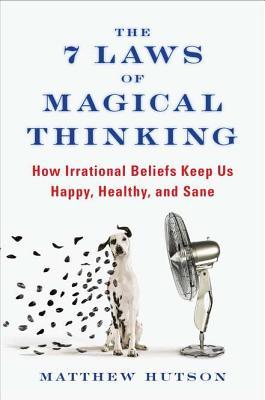
The 7 Laws of Magical Thinking: How Irrational Beliefs Keep Us Happy, Healthy, and Sane by Matthew Hutson

The 7 Laws of Magical Thinking: How Irrational Beliefs Keep Us Happy, Healthy, and Sane by Matthew Hutson

Matthew Hutson examines some of humankind’s irrational beliefs and shows, through stories and examples, how the beliefs are types of coping mechanisms and can be consciously utilized for a better life.

“These habits of the mind guide us through the world every day. In very basic ways they provide a sense of control, of purpose, of connection, and of meaning, and without them we couldn’t function.” pg 9

Photo by Pixabay on Pexels.com

The beliefs Hutson discusses are “objects carry essences”, “symbols have power”, “actions have distant consequences”, “the mind knows no bounds”, “the soul lives on”, “the world is alive” and “everything happens for a reason”.

I couldn’t possibly touch on every idea that engaged me in this book, but I do want to mention my favorite chapter. I was particularly drawn to “the mind knows no bounds”.

“If anything is magic, consciousness is.” pg 108

Everything Hutson discusses in this book originates in the mind: how we perceive events, people, death, the whole enchilada. I think it is in the interpretation of life and the meanings we assign to things that seem to be the key to magical thinking.

“Believing that our thoughts have the power to drive our own behavior as well as the behavior of the outside world – that they’re not just feeble shadows cast against the inside of our heads – provides a sense of agency and makes us go out there and become active participants in life.” pg 123

Photo by Roy Reyna on Pexels.com

That’s the sort of magical thinking I support – the interconnecting, empowering and mystical kind, that inserts meaning into the most trivial moments and illuminates your life, revealing a pattern of something greater. Then, spring boarding that knowledge into action, having another realization, and so on.

“While mystical states may not unite you with a universal intelligence, they can still tap you into your own potential for transformation. Which makes them mind-expanding after all.” pg 123

Though his writing can become dense at times, Hutson lightens things up with stories from his own life or his research. It feels like a non-fiction psychology book with a heaping dose of philosophy, religion, and memoir.

Photo by Renato Danyi on Pexels.com

“The idea is to face morality as frankly as you can without freaking out. To accept a manageable share of anxiety and to channel it toward building a heaven here on Earth.” pg 162

Here’s author Matthew Hutson dancing with fire!

Good luck with that, fellow readers. I’ll be cheering for you, which, if you read this book and understand the power of magical thinking, may have more impact than you ever imagined.

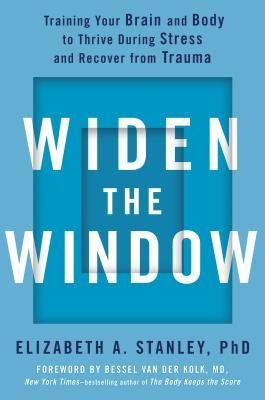
Widen the Window: Training Your Brain and Body to Thrive During Stress and Recover from Trauma by Elizabeth A. Stanley

Widen the Window: Training Your Brain and Body to Thrive During Stress and Recover from Trauma by Elizabeth A. Stanley

Managing stress and recovering from past traumas are some of the many challenges facing humanity in the modern era. Widen the Window addresses both those problems.

Elizabeth Stanley explains how individuals handle stress and trauma varies widely from person to person. It is first affected by your biology, then your unique childhood experiences making everyone’s responses different. What is incredibly stressful to one person may to a cakewalk to the next, and vise versa.

Photo by Pixabay on Pexels.com

She describes the ability to manage responses to stress as a window. Through a variety of mindfulness techniques, healthy eating, maintaining a large social network, and getting plenty of rest, Stanley guides the reader through ways to “widen the window” or increase your ability to manage stress.

I am always on the lookout for ideas on how to appropriately manage stress. If I manage my stress responses when they’re small, it prevents something more serious from building up and coming out in other, perhaps more dysfunctional, ways.

Photo by Pixabay on Pexels.com

I could see this book being useful to every reader who picks it up. Everybody has something they’re dealing with – from current work to family to friends issues or traumatic past experiences that push themselves into the present. We’re all in this together, even if your mind is telling you otherwise.

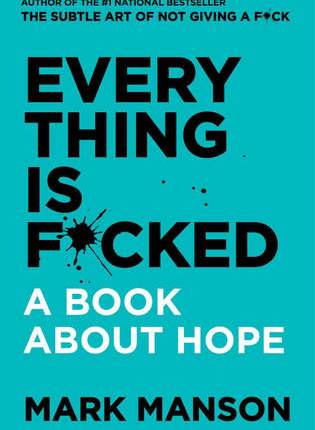
Everything is F*cked: A Book About Hope by Mark Manson

Everything is F*cked: A Book About Hope by Mark Manson

This creatively titled self-help book, Everything is F*cked, presents psychology, philosophy and the author’s view of reality.

In a series of essays, Mark Manson discusses a variety of topics including the differences between the “thinking brain” and “feeling brain.” He uses Isaac Newton’s laws to create a parallel universe’s version of emotional laws and completes a fairly scathing dissection of religion.

Throughout the various topics, he circles back to the idea of hope and how it can potentially create more problems than it solves.

Photo by meo on Pexels.com

Why did Manson write a book about hope?

“This book is my little source of hope. It gives me purpose; it gives me meaning. And the narrative that I’ve constructed around hope is that I believe this book might help some people, that it might make both my life and the world a little bit better.” pg 15

I did not read Manson’s other incredibly popular title, The Subtle Art of Not Giving a F*ck: A Counterintuitive Approach to Living a Good Life, so I went into this one not knowing what to expect. I found Manson to be particularly adept at breaking down complex topics into simple, easy-to-understand analogies.

For example, here’s his take on the psychological cause of a underlying feeling of unworthiness: “This feeling of unworthiness is usually the result of some bad sh*t happening to us at some point. We suffer through some terrible stuff, and our Feeling Brain decides that we deserved those bad experiences. Therefore, it sets out, despite the Thinking Brain’s better knowledge, to repeat and re-experience that suffering.” pg 46

Photo by Pixabay on Pexels.com

And here’s the analogy he crafts around his explanation of unworthiness: “Put another way, the problem isn’t that we don’t know how not to get punched in the face. The problem is that, at some point, likely a long time ago, we got punched in the face, and instead of punching back, we decided we deserved it.” pg 46

His writing is simple and succinct, which could be incredibly useful for readers who are looking for more information about the self help topics presented. I didn’t particularly care for Manson’s overall style, but that’s a personal preference rather than a commentary on the value of what he’s discussing.

“The stories of our future define our hopes. And our ability to step into those narratives and live them, to make them reality, is what gives our lives meaning.” pg 70

Photo by Engin Akyurt on Pexels.com

I think this author may be similar to Sarah Knight and her series of self help books about The Life-Changing Magic of Not Giving a F**k. Readers either love or hate those, I fell somewhere in between.

My favorite part of this was when Manson dived into some Buddhist philosophy in the chapter, “Pain is the Universal Constant.” He discusses the teaching of suffering being similar to a person struck by arrows. The first arrow brings physical pain and the second brings the emotional pain, which can be far worse and last longer than the physical pain because of the narratives we weave around it.

Through meditation, the second arrow, emotional pain, can be diminished or perhaps eliminated.

“That while pain is inevitable, suffering is always a choice. That there is always a separation between what we experience and how we interpret that experience. That there’s always a gap between what our Feeling Brain feels and what our Thinking Brain thinks. And in that gap, you can find the power to bear anything.” pg 186

Photo by Aleksandar Pasaric on Pexels.com

Recommended for readers who aren’t offended by strong language and have the ability to hold the book they’re reading in that gap in their minds — between the thoughts and the emotions, in the space of pure being.

I’ll meet you there. 🙂

Aware: The Science and Practice of Presence by Daniel J. Siegel

Aware: The Science and Practice of Presence by Daniel J. Siegel

Daniel Siegel, MD, psychiatrist and author, shares his research into neuroscience and a meditation practice he has developed called the “Wheel of Awareness“.

“The Wheel practice is a way to open awareness and cultivate a larger, more expansive container of consciousness. People who participate in the practice seem to be strengthening their minds.” pg 9

Photo by Polina Tankilevitch on Pexels.com

The practice uses focused attention on the senses, bodily sensations, mental activities and interconnectedness, in order to encourage the mind to become more integrated. When this integration happens, the mind gives off certain brainwaves that Siegel and other researchers have measured coming from experienced meditation practitioners such as monks.

Basically, Siegel is using western science in an effort to measure and replicate meditation practices.

The science portions of Aware are not very accessible to the non-scientists readers and I could see that being off-putting. However, if you are interested in the intersection of neuroscience and meditation practice, this book could be incredibly useful to you.

“Where attention goes, neural firing flows, and neural connection grows.” pg 19

Photo by cottonbro on Pexels.com

I found the implications of Siegel’s research to be fascinating. He claims, through focused attention, one can change the neural patterns and behavior of the brain. Meditation affects biology in a physically measurable way.

There have been countless studies on the positive benefits of meditation practice, but, I think, fewer on the changes in the function and integration of the mind. The rewards of such can be profound.

“When our minds wander unintentionally, we are not present, we are not receptively aware, we are not mindful, and studies suggest, we inhibit being happy — even if we are daydreaming about exciting things. … Presence cultivates happiness.” pg 49

Besides the Wheel of Awareness portion, the part of Aware I found most helpful was a discussion about the proper cultivation of empathy, the ability to put yourself in another’s place to feel and share what they are feeling.

Photo by Anastasia Shuraeva on Pexels.com

Tania Singer, in a presentation to the Dalai Lama, had this advice: “… we need to place empathy in the larger space of altruistic love and compassion. This space will act like a buffer for empathic distress. Since altruism and compassion are positive mental states, they reinforce our courage and give us the resources to deal with the suffering of others in a constructive way.” pg 86

I liked the visual of that and think it will come in handy in the future.

Recommended for non-fiction readers interested in the science behind meditation and the development of presence. Spiritual seekers looking for different meditation methods may want to look for that in another, less technical, book.

Thanks for reading!

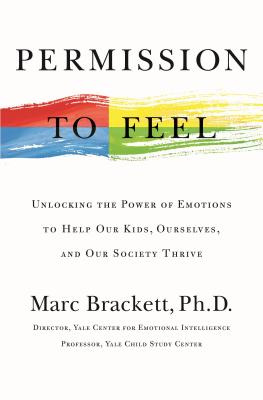
Permission to Feel: Unlocking the Power of Emotions to Help Our Kids, Ourselves, and Our Society Thrive by Marc Brackett

Permission to Feel: Unlocking the Power of Emotions to Help Our Kids, Ourselves, and Our Society Thrive by Marc Brackett

“And when we can’t recognize, understand, or put into words what we feel, it’s impossible for us to do anything about it: to master our feelings — not to deny them but to accept them all, even embrace them — and learn to make our emotions work for us, not against us.” pg 2

Marc Brackett, Ph.D., is the director of the Yale Center for Emotional Intelligence. In this book, Permission to Feel, he has given the world a new set of tools to learn more about ourselves through our emotions, to facilitate communication, and to teach the next generation how to do the same.

Photo by Andrea Piacquadio on Pexels.com

I really appreciated this book as I am someone who has trouble sharing emotions.

I am probably like this because, as Brackett explains, we learn our communication styles from our parents. My mother had a lot of kids and, though I know she cares, never had much time for one-on-one interaction.

My father is so introverted he barely speaks to his family. I have spent entire car rides with my dad while sitting in absolute silence, which sounds like it could be desperately uncomfortable, but with him it’s not. That’s just the way he is.

And what I have become. It can take time to coax anything like an intimate conversation out of me and few have ever bothered to try.

But I want to be better at sharing what’s going on in my inner world. This book has shown me a way I can move towards making that happen.

Photo by August de Richelieu on Pexels.com

“Feelings are a form of information. They’re like news reports from inside our psyches, sending messages about what’s going on inside the unique person that is each of us in response to whatever internal or external events we’re experiencing. We need to access that information and then figure out what it’s telling us.”

Brackett first outlines why emotions are important as they affect everything from “where we direction our attention” to decision making, relationships, creativity and our physical health.

He then explains how to become “emotion scientists,” which he says are more desirable than “emotion judges.” The scientist listens and seeks clues to tease out what is going on in order to help. The judge does the same, but then, rather than helping, he strangles any potential improvement by putting the smack down on what they discover.

“We all want our lives, and the lives of the people we love, to be free of hardship and troubling events. We can never make that happen. We all want our lives to be filled with healthy relationships, compassion, and a sense of purpose. That we can make happen.” pg 21

Photo by Daria Shevtsova on Pexels.com

Then, he gives the tool kit he has spent years honing in workshops and studies, and shares how to apply it in various areas of your life.

I could see this book being useful to parents, educators, leaders or people like me. I knew I had room for improvement in accessing my emotions, but no idea how to go about it. Now, I know.

Thank you to the publisher for a free advance reader copy of this book. The short quotations I cited in my review may change or be omitted in the final print copy. Permission to Feel should be published in early September 2019.

Thanks for reading!

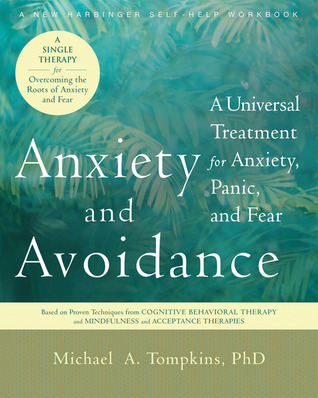
Anxiety and Avoidance: A Universal Treatment for Anxiety, Panic, and Fear by Michael A. Tompkins

Anxiety and Avoidance: A Universal Treatment for Anxiety, Panic, and Fear by Michael A. Tompkins

Everyone experiences anxiety in some form or another in their lives. The trouble comes when you find yourself altering your behavior to avoid triggering yourself, painting your life into smaller and smaller boxes in order to attempt to control the anxiety.

Photo by Eternal Happiness on Pexels.com

This self help workbook hands you the keys to your anxiety response. By unlocking that, you give yourself back the freedom that you may have lost to uncontrollable anxiety.

Emotional flexibility, then, is the key to recovery from your anxiety disorder.”

Michael Tompkins uses cognitive behavioral therapy, mindfulness and acceptance therapies to tackle most major anxiety issues.

I liked his approach because mindfulness is a practice that I enjoy incorporating into my life anyway. By applying it to my anxiety responses, I learned a lot about myself in a very short period of time.

Photo by Karolina Grabowska on Pexels.com

“The purpose of both our primary and secondary anxious responses is to protect us from the threats and challenges of life. For some people, however, the natural and normal secondary anxious response creates problems. These people are stuck in their secondary anxious responses and because they’re unable to move out of it, they have an anxiety disorder.” pg 22

But no matter what coping mechanisms therapists may bring to the table, we have to be willing to put them into action. Tompkins reminds readers to be gentle with themselves and that “true motivation is an invitation, not a push.”

“True motivation is a willingness to try because you recognize and accept that it makes sense for you to change.” pg 43

Once you know your triggers and responses, Tompkins guides the reader through exposure therapy to continue releasing any further anxiety responses.

Photo by Kaboompics .com on Pexels.com

I know no method or book will be a breakthrough for everyone, but I found this particular book to be incredibly helpful and informative. I highly recommend it for anyone suffering from anxiety, panic or fear.

It could be the jump start you need to discover true healing and freedom from the fears that may be holding you back from living the life you’ve visualized for yourself.

Thanks for reading!