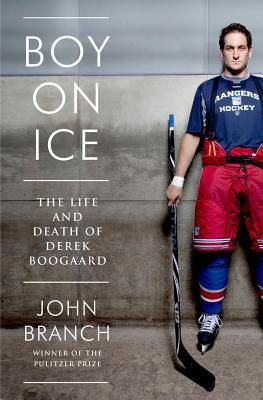
This is a biography of Derek Boogaard, a hockey player who died at age 28 of alcohol and prescription drug poisoning.
I didn’t know very much about hockey before I read this but fortunately John Branch discusses the history of the hockey for readers like me. He also examines the reasons why violence began and then persisted in the sport.
Branch explains the unofficial position called ‘enforcer’ on the hockey team that, essentially, intimidates or pummels the opponents into submission.

I knew that hockey was violent from anecdotal stories but I didn’t realize how the various minor leagues supported the development of the enforcer role. Men are specifically scouted for their abilities in this area.
Derek wasn’t born an enforcer. In Canada, hockey is like football in some small towns in America- everybody plays beginning at quite a young age.
His enormous size drew attention but he wasn’t particularly skilled at the game. Coaches put him into the enforcer role and he was able to fulfill their demands.
Throughout his life, Derek suffered from pain caused by his job and began to take prescription drugs to find some relief. Predictably, he became addicted.

Branch carefully dissects the reasons why Derek abused drugs and it is very sad. His family obviously cared about him, but they either did not realize the extent of the problem or because of the distance that they lived away from Derek, they didn’t have the ability to do anything about it.
An additional layer of complexity is added to the story with Branch’s explanation of concussions in professional sports and how, in the late 1990’s and early 2000’s, medical experts were just becoming aware of the extent of the problem.
After his death, Derek’s family donates his brain to the medical community and what they discover was truly shocking.
I liked Branch’s analysis of the social, economic, and personal reasons why Derek lived the way he did. He painted a picture that was both approachable but also extraordinary.
Approachable in that Derek was a boy from a small town in Canada who liked quiet family evenings and country music. Extraordinary in that Derek was a professional athlete with a million dollar paycheck and needed to experience life to its fullest.

I also liked reading portions of a childhood diary written by Derek that included his grammar mistakes and misspellings. The inclusion of this material lent a very personal feel to the book.
From Derek’s childhood to his last struggling days, Branch gives meticulous dates, times, and names.
I didn’t like the seemingly endless descriptions of Derek’s bloody fights on the ice. During his career, it seemed like he fought constantly and the biography feels monotonous throughout that portion. He went to a game, got in a fight, and repeat.
For that reason, the graphic details, I would recommend Boy on Ice to, primarily, fans of the game. If you have season tickets for your hockey team and relish the atmosphere, you may really enjoy this biography.

Personally, I found the descriptions of violence too disturbing to be enjoyable. However, Branch raises legitimate questions about the place of the enforcer in hockey, how it causes permanent damage to the men who take up that role, and how it changed and then ended the life of Derek Boogaard far too soon.
I received a free copy of this book through Goodreads First Reads. Thanks for reading!
- The Ballad of a Small Player: a Metaphysical Movie Review
- Otherwhere: A Field Guide to Nonphysical Reality for the Out-Of-Body Traveler by Kurt Leland
- Psychic Dreamwalking: Explorations at the Edge of Self by Michelle Belanger
- Archetypes on the Tree of Life: The Tarot as Pathwork by Madonna Compton
- The Goddess and the Shaman: The Art & Science of Magical Healing by J.A. Kent
 The Help Desk Book Blog