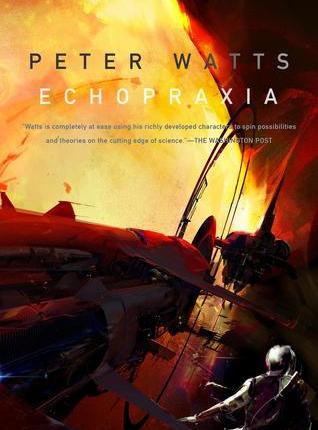
Peter Watts returns readers to the dystopian world of Firefall with Echopraxia, the second novel in the series.
Meet Daniel Bruks, an outcast biologist with a secret. He’s struggling to continue with his scientific studies in a world that has ceased to make sense after the alien contact in Firefall.

“The Theseus mission would be well past Pluto by now. If it had found anything, Bruks hadn’t heard about it. For his part, he was sick of waiting. He was sick of life on hold, waiting for monsters or saviors to make an appearance. … He wished the world would just hurry up and end.” pg 15
His life quickly changes when he finds himself herded into an esoteric and technologically advanced cult’s desert compound while they’re under attack from weaponized zombies. (It makes more sense when you read it, I promise.) What follows is an exploration into the realms of religion, technology and faith.
“One day you’re minding your own business on your camping trip…” “Field research.” “… the next you’re in the crossfire of a Tran war, the day after that you wake up on a spaceship with a bull’s-eye painted on its hull.” “I do wonder what I’m doing here. Every thirty seconds or so.” pg 81
The same microscopic lens Watts used to take apart consciousness in the last book, he applies to a totally different topic, religion, in this one and it doesn’t quite work.
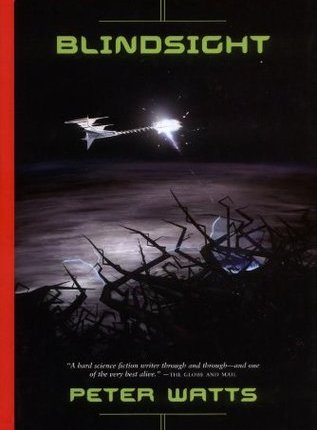
He doesn’t take any time to introduce readers to some of the more far-out concepts from the last book. If I had dived into Echopraxia without reading Firefall, I would have been totally lost. And as it was, I certainly was confused by the end.

Where the last book was a space and science adventure, this one is a journey, both metaphorical and physical. The threats along the way are somewhat as scary, but the characters aren’t as well-fleshed out.
Maybe I was spoiled in the last book because I really enjoyed Siri, the narrator’s, character. Daniel Bruks is more difficult to love.
But it’s not just the characters. The science of the last book was more connected to the story line. In this book, it almost felt like a tacked-on after thought.
And as hard as I tried to put the pieces together, the ending never quite made sense. I put some serious thought into it too. It’s one thing to leave an ending somewhat ambiguous so the readers can hash it out, it’s another to give almost no clues at all.
That’s not to say Watts isn’t brilliant, because he is. However, if you have the choice between reading Firefall or Echopraxia, I would suggest the former rather than the latter.
- The Ballad of a Small Player: a Metaphysical Movie Review
- Otherwhere: A Field Guide to Nonphysical Reality for the Out-Of-Body Traveler by Kurt Leland
- Psychic Dreamwalking: Explorations at the Edge of Self by Michelle Belanger
- Archetypes on the Tree of Life: The Tarot as Pathwork by Madonna Compton
- The Goddess and the Shaman: The Art & Science of Magical Healing by J.A. Kent

 The Help Desk Book Blog