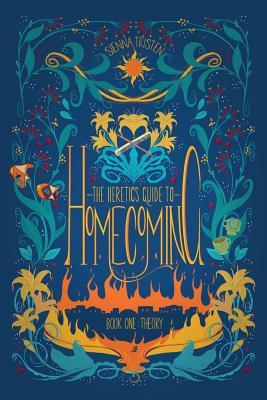
The Heretic’s Guide to Homecoming is a fantasy journey in which Ronoah, an introverted and anxious main character, discovers a strength inside himself that he didn’t know he had and, along the way, learns about the world outside of the regimented and ill-fitting expectations of his hometown.
It is not a simple adventure because Ronoah, with all of his hang ups, is a very unlikely hero.
“… Ronoah was not one tenth the rebel she needed him to be. Inertia had him by the throat, and its consequence was a keen pain squatting ugly at the bottom of his soul, rotting it from the roots up.” pg 9
Like other readers, I found author Sienne Tristen‘s depiction of Ronoah’s crippling anxiety and panic attacks to be one of the most insightful and sensitive pieces of writing I’ve ever had the privilege to read. Unlike most works of fantasy in which the action takes place in an external world, Ronoah’s greatest battles are in his own mind.
The anxiety speaks with its own voice and becomes a main character throughout the story.
“What were you thinking, it sneered, acting like you’re so important, so worldly, making it out like you’re some big intellectual champion when all you really are is a petulant runaway with a few bits of trivia stuck in your useless head? Talking and talking like you’re an authority on anything- who do you think you are?” pg 53

Ronoah’s interactions with the other characters from the book take on a secondary importance to the all-encompassing relationship that he has with his inner world. But they are still beautiful connections.
“… He had this way of grabbing life by the horns and refusing to let go, no matter how it tried to shake him off. You know those people you sometimes find, the ones who…” “Who shine.” pg 154
Sienna Tristen’s writing brings to light foibles of anxious people that might otherwise remain shrouded in the sufferer’s inability to vocalize their feelings. Anybody who has ever spent a sleepless night stuck in the agony of fear and indecision will understand exactly what Tristen is spelling out in this story.
On the other hand, I found the first two-thirds of the book to be extremely triggering because of this gigantic magnifying glass that is held up to anxiety. The pacing didn’t do me any favors either. As Ronoah slowly twisted in the unending spirals of panic in his own head, I hung on the hook right along with him.

It was helpful to see Ronoah’s thinking process which Tristen writes so beautifully. Almost every time, readers can feel the moment he tips from functional person with some worries to frozen anxious mess. In my own life, I’ve started to watch for those tipping points- the moments I go from concerned about the future to paralyzed by anxiety. It has actually been quite illuminating.
But all of that new found self knowledge doesn’t make for a fun read. Fiction is one of my escapes from reality. In this book, I found quite a lot of reality and it wasn’t an escape after all.
“How far do you have to push your boundaries before you can feel them stretch? How high do you have to climb before your horizon expands? Is it possible to notice your own growing, or is improvement like an eyeball- visible to everything but itself?” pg 193
Recommended for readers who don’t mind very slow pacing in exchange for gorgeous writing about anxiety. Mind the triggers.
Thanks for reading!
- The Ballad of a Small Player: a Metaphysical Movie Review
- Otherwhere: A Field Guide to Nonphysical Reality for the Out-Of-Body Traveler by Kurt Leland
- Psychic Dreamwalking: Explorations at the Edge of Self by Michelle Belanger
- Archetypes on the Tree of Life: The Tarot as Pathwork by Madonna Compton
- The Goddess and the Shaman: The Art & Science of Magical Healing by J.A. Kent



 The Help Desk Book Blog