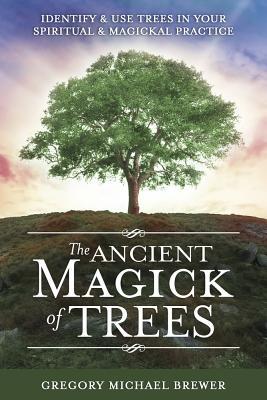
“Since the dawn of humanity, in all cultures and religions across the globe, trees have been revered not only as a life-sustaining source of food and medicine but also as a place where spirits dwelt, awaiting to reveal great mysteries to those who sought their wisdom, knowledge, and magick.” pg 2
Author Gregory Brewer examines the wonder and mystery that are trees from the pagan perspective in this book which is part informational, tree-related ritual/meditation suggestions, and reference.
Understanding the symbolism of trees throughout countless cultures of human history is an enlightening study, but equally important is learning to form a personal connection with them in order to better comprehend the interaction of how the divine reveals itself to us through nature.” pg 243
The majority of the book is dedicated to descriptions and occult associations for different types of trees.
I read The Ancient Magick of Trees in order to learn more ways to invite nature into my life. The book has that but I found Forest Bathing: How Trees Can Help You Find Health and Happiness to be more immediately practical. I also connected more with the information in the forest bathing book.
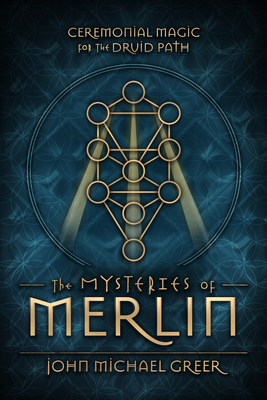
John Michael Greer, one of the most influential authors on Druidism in the modern age, takes a crack at reviving ancient traditions through ceremonies involving the mysterious figure of Merlin. As for his success at this integration, I think that’s up to individual readers to decide for themselves.
I didn’t connect with the rituals myself, but the first part of this book which details the author’s research into mystery cults and mythology in general, was fascinating to me.
“… myths are things that never happened but always are. They express spiritual truths too profound to be communicated in any more direct way.” pg 12
Though this topic has been covered by a variety of different authors, perhaps most notably Joseph Campbell, Greer’s take on the subject is welcome and refreshing. His focus in this book is piecing together what the Pagan Celtic religion of Britain may have looked like through the fragmentary records and mythology that remain behind.
“Was Merlin, then, purely a god, and his appearances as a Dark Age prophet and wizard only garbled mythology? That is a surprisingly difficult question to answer.” pg 27
Greer’s writing is accessible even for those who may not have a background of western occultism or paganism to draw upon. But, this book might be most useful for those who feel drawn to those spiritual paths because, as I mentioned before, the majority of this book is dedicated to detailing rituals that Greer has created for those traditions.
Seekers interested in the forgotten history of paganism in Europe, as I am, might be better served with another book. If I find one, I’ll let you know.
“Vortigern ordered the workmen to dig into the hill and they found the lake; once the water was drained away, the rocks appeared, and the dragons leapt out of them and began to fight each other. As they struggled, Vortigern asked Merlin what the combat meant, and the boy burst into tears and began to prophesy.” pg 22
As for the actual historical personage of ‘Merlin,’ I think Greer’s interpretation of the sparse evidence is as good as any I’ve read which, admittedly, isn’t very much because there’s not much to go on.
And as for the retrieval of ancient traditions and mystery cults, perhaps new mythologies, like this book, need to be written. The old lineages may simply be lost forever.
Here’s my contribution to the mysteries of Merlin which I recovered through my explorations into the Qabalistic Tree of Life. It is from a series of pathworkings I recorded called “The Light Congress”:
In Chapter 13, Merlin is the wizard in the wood who called himself ‘Nobody’:
Though he appears again further on in the book, these two initial encounters were quite revealing. I hope you find some meaning in the symbolism and message therein.
Through The Light Congress, I hope to discover a new path, one of endless spiritual mythologies and stories for the modern age. It remains to be seen how successful the attempt will be.
Small disclaimer, Mr. Greer and my’s only association is through the reading of his books (which are quite worthwhile for spiritual seekers and I highly recommend them). I wish him well in his exploration of the worlds of spirit and the mysteries they contain. Any missteps I make in my personal journey are my own fault and may be laid entirely at my doorstep.
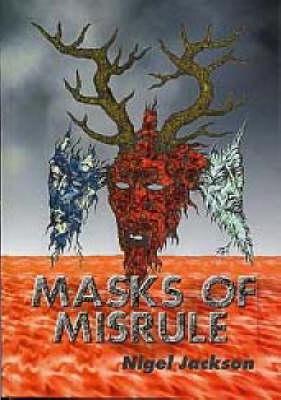
My mind has been going in circles as I’ve pondered, for days, how to review this book. It is a poorly organized and bewildering publication that could be tremendously important for pagans or religious scholars who are looking for information about The Horned God.
“The Knell of Inbetweenness hath been struck, The Bell of MISRULE soundeth; Reverberating the Thirteen Angles, Echoing through the Nine Spheres”
It begins with a foreword by Michael Howard speaking of the scarcity of information about a male god within the existing neo-pagan revival movement. Then, the author, Nigel Jackson, goes into what could almost be called a tirade against established religions and the current neo-pagan movement in a chapter entitled, “In the Sign of the Horns.”
“The old time is passed away and the ‘age between the ages’ is begun: the Aionic Twilight falleth over the world and the day of the cross and the mitre is wholly done with.” pg 11
Honestly, that type of tribalism and fear-mongering is a poor look for any type of spiritual movement. Why immediately alienate readers from other spiritual paths who are coming to your materials with an open mind and a willingness to learn?
Despite his initial hostility, Nigel Jackson quickly turns his attention to what he believes are different aspects of a male pagan god, throughout history, and includes various rituals to invoke this ancient being.
As I mentioned earlier, it is a bewildering hodge-podge of material with only the thinnest of connecting threads between. Newcomers to occult matters or pagan practices may lose their way within the quickly shifting time periods, places, names and associated mythologies.
However, I found information in “Chapter Three: Cycles of the Midnight Hunt” and “Chapter Seven: Wudewasa, the Knowledge of the Green Man” that was completely new to me and interesting.
“It was held that when nocturnal thunder broke over the wildwood and the forked lightning-flash clove the darkness and the night-tempest roared and tossed the boughs, that the wild host of Woodwoses came forth in primal panoply, raging through the hoary oaks and pines, their eldritch voices mingling with the storm’s tumult.” pg 107
The printing of Masks of Misrule is a travesty for any lover of books. The font is irregular and fades, seemingly at random, within the text. The cover is ridiculous and does nothing to convey the seriousness with which the author treats his subject.
But if you set all of these concerns aside, some of the mythology contained within this book is entirely original, at least to me, and could be incredibly useful for seekers who are looking for a new movement within paganism that celebrates the male side of nature.
Margot Adler talks to adherents in different traditions all across the United States, and a few in Europe, in order to banish some of the mystery and misconceptions surrounding neo-pagan groups.
“Since Pagans are a very diverse group, it is wrong to say all Pagans believe this or that, but here are some beliefs that many people in this book share: The world is holy. Nature is holy. The body is holy. Sexuality is holy. The imagination is holy. Divinity is immanent in nature; it is within you as well as without. Most spiritual paths ultimately lead people to the understanding of their own connection to the divine.” pg 11, ebook.
I didn’t know much of anything about pagan religions before I read this book, mainly because I am from a particularly conservative part of the country and there are very few groups of this type around. It’s hard to get to know people if there aren’t any to talk to.
In some circles, just the word “pagan” inspires fear because it’s not clear what this means or people might be threatened by how someone’s beliefs might be different from their own.
“Neo-Pagans look at religion differently; they often point out that the root of the word means “to relink” and “to connect,” and therefore refers to any philosophy that makes deep connections between human beings and the universe.” pg 24
Adler examines an extraordinary number of pagan groups, an almost bewildering amount. I liked that this book introduced me to so many different paths and ideologies, but at the same time, it began to get somewhat repetitive as she broke down all of the different groups.
But as the friend who had recommended this book reminded me, Drawing Down the Moon was created in the years before the existence of the internet. It was intended not just to explain what these groups were, but also operated as a catalog of sorts, for readers who were looking for the right path for themselves.
Recommended for spiritual seekers who are looking for a tradition that fits or for anyone who is curious about the stunning variety of spiritual beliefs there are out there. I learned so much.
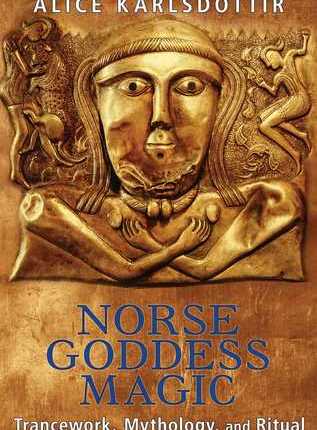
This is a new age, non-fiction book about trance work, which can loosely be described as deep meditation. I practice a type of meditation called “pathwalking” which is basically just another word for the same kind of practice. This book is about someone who focuses on the Norse religion exclusively.
I read Norse Goddess Magic not for the details about the Norse pantheon (which admittedly I know very little about, so it was very interesting and educational) but mainly for the author’s experience in trance work. To my disappointment, she spends pages and pages explaining what going into trance is, how she does it, and then only a few paragraphs in each chapter detailing an actual trance.
I wanted the book to be mainly trance work. That is what made it unique and original- her personal sojourns into “another world” and what she brought back. The rehashing of all of the old mythologies were, as I said, interesting, but if I wanted to read them, I could have picked up any book about Norse mythology.
I also felt like Alice spent a lot of time explaining why trance work is a valid method of information gathering and defending her opinion on why she believes that. I agreed with her completely so I just read through the pages thinking- preaching to choir, get to the trances! So, that was a frustration.
A part of the book that I disagreed with was Alice’s assertion that it is “difficult” to go into trance. In my experience, if you believe something is difficult to do be that hypnosis, meditation, whatever- you’re putting stumbling blocks on your path that don’t need to be there. Going into trance is as simple as watching your breath flow in and out. If you breathe, you can go into trance. I felt like she did a disservice to beginners with that particular teaching.
I felt like Alice’s trances were so closely focused on one goddess or aspect of the goddess, that she didn’t really get all that she could out of her trance work or interactions in the other worlds. She read all of this information to prime her subconscious mind and then… it felt like not much happened.
To be fair, she did see the person she was looking for, describe their physical characteristics, express the emotion that they evoked in her, and then, maybe, have a brief interlude with them. In my personal trance work, there’s more interaction in the world itself but that could be the difference of our focus.
Alice said from the start that she wanted to know more about these different goddesses and form a working relationship with them whereas I’m just curious to see what’s out there. I’ve run into Roman gods and goddesses, Native American figures, Tibetian locations, some Egyptian and Hindu gods… but again, I’m not focused on one or another of the world religions. With an open mind, it’s incredible the types of things that you see.
So, I don’t believe in priming your mind with symbols before you do your work. Pick where you’re going or who you want to see, and just go. Personally, I use the symbols on the Tree of Life or tarot cards. Believe that you can do it. Figure out what works for you. And do it.
Then write it down so that I can read it. 🙂 Because I will.










 The Help Desk Book Blog