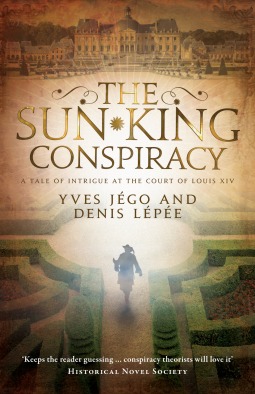
The Sun King Conspiracy by Yves Jégo

The Sun King Conspiracy by Yves Jégo

A historical fiction about a French King, his mistress, his minister, his mother, an aspiring actor with a secret past and a secret society with hidden knowledge that could change the world.

“A chief minister is dying, yet people are interested only in counting the supporters and detractors of an entertainer…” pg 9, ebook.

Unfortunately, I didn’t really care for The Sun King Conspiracy.

I felt like it was trying to be a mystery like The Da Vinci Code with the complexity of an epic historical fiction. It didn’t quite reach either pinnacle.

“According to Colbert’s report, the murderers took nothing else of any worth from my apartments. From this, I deduce that their only concern was to seize those papers.” pg 36, ebook.

It was probably just me, but I kept getting the ministers and their roles confused. Also, their alliances and reasons why they hated each other never really made sense to me.

“The truth is,” said the scholar with a sad smile, “that this question of succession seems to be the only matter that interests anyone in Paris, when the real subject that ought to occupy us, the only one worthy of any interest, is entirely different: it concerns the stability of the Kingdom.” pg 142, ebook.
Photo by Katarzyna Modrzejewska on Pexels.com

It felt like there were nuances to the court relationships that were never explicitly stated.

Maybe the author assumed a familiarity with the court of the Sun King that I don’t possess.

The whole secret society part of this story was just flat. I felt like I’d read the same conspiracy in half a dozen other books.

“I am more aware of this than anyone else. I have paid so dearly for it that my belief in its ultimate success is perhaps the only thing that still keeps me alive…” pg 229, ebook.

Photo by medium photoclub on Pexels.com

I didn’t connect with any of the cast of characters either. They were so cookie cutter.

Here’s hoping I like the next read more. 🙂

Thanks for reading!

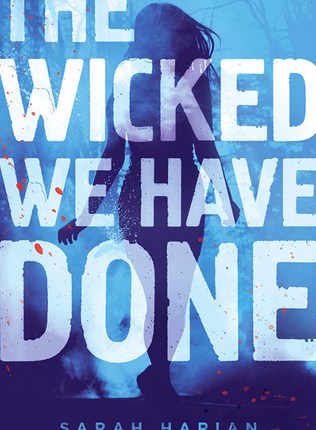
The Wicked We Have Done (Chaos Theory, #1) by Sarah Harian

The Wicked We Have Done (Chaos Theory, #1) by Sarah Harian

In a not-too-distant future, humanity has developed the technology to see inside the mind of criminals. Through simulations and tracking responses, the law claims to have the ability to measure motivation and “goodness.”

Evalyn Ibarra says she is guilty, but not of the crime she is on trial for. Rather than rely on a jury to prove her innocence, she chooses the “compass room,” the new technology, to prove her innocence.

If she is truly evil, the compass room will kill her. If she is innocent, she will walk free.

Photo by Sora Shimazaki on Pexels.com

“My throat tightens, but there is no time to reflect. I had months to imagine this moment, months to mourn. That time is over, because today is the beginning of my inevitable execution in the Compass Room.”pg 7, ebook.

I found the premise of this book to be interesting, but it suffered in its execution and characterizations. Both were rather flat.

“The tension after Stella leaves is awkward and volatile. … We’ve been given provisions, so it’s obvious that, if this is the Compass Room, we are meant to head out. It’s either that or stay in a house full of psychopaths.” pg 25, ebook.

Did I mention that the compass room tries more than one criminal at a time? Very Hunger Games-esque.

“The one thing I do know about the Compass Room is that this test is supposed to see who you truly are, despite your research. Despite good acting or the lies you tell yourself.” pg 27, ebook.

Photo by Alex Andrews on Pexels.com

Wouldn’t it be something if detecting evil was as simple as marking a chemical or hormonal response of the brain?

But then, of course, you wander into the problem: what if the technology gets it wrong? Or glitches?

“A terrorist attack finally convinced the Supreme Court. All charged in the bombing were forced to undergo the Compass Room’s exam. And they were all found to be, as reporters said on the news, ‘morally tarnished.'” pg 12, ebook.

The thing about execution is that there are no second chances or second guesses. Evalyn believes herself to be innocent. Will the room think so too?

I think if the author had fully explored the compass room and the psyches of those involved, I may have enjoyed it more.

Photo by Ignacio Palu00e9s on Pexels.com

As it was, I felt like we only skimmed the surface of what was possible. It lacked complexity because of the number of characters she wrote into the story.

Also, the author includes some half-baked romances, perhaps to prove this is in the “new adult” genre? I don’t believe it added much.

There’s also some non-spooky horror elements, that are meant to evoke the harrowing nature of the compass room. They felt overdone.

If you must read The Wicked We Have Done, I recommend borrowing it from the library.

Thanks for reading!

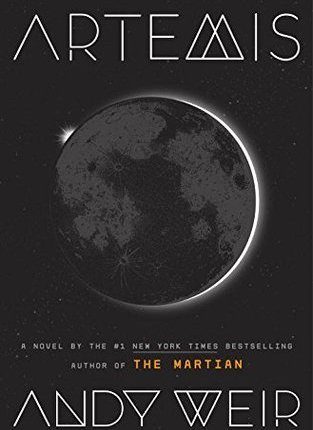
Artemis by Andy Weir

Artemis by Andy Weir

Jazz lives on Artemis, the first city on the moon. She delivers packages to eek out a living as well as other, more shady, methods of income.

“I live in Artemis, the first (and so far, only) city on the moon. It’s made of five huge spheres called “bubbles.” They’re half underground, so Artemis looks exactly like old sci-fi books said a moon city should look: a bunch of domes.” pg 5

Photo by Alex Andrews on Pexels.com

One day, one of the richest men on the moon makes her an offer far too lucrative for her to refuse… all she has to do is something very dangerous and illegal. No problem, right?

“I’m sorry, but this isn’t my thing,” I said. “You’ll have to find someone else.” “I’ll give you a million slugs.” “Deal.” pg 46.

Andy Weir’s follow-up to The Martian was disappointing to me.

Unlike his first book, the science is watered down. It’s not as educational and quirky. In my mind, the exceptional science was what separated The Martian from other science fiction offerings.

The characterizations are one dimensional, like The Martian, but it was less of a problem in the first book. In that one, you were mainly dealing with one person, alone.

In Artemis, Weir tries to build a city of characters and I didn’t buy into it.

Photo by murat esibatir on Pexels.com

The main character, a female narrator, is particularly problematic. She just didn’t sound like a woman to me.

“I landed like a sack of sh*t. But I landed on the other side of the alcove and didn’t break anything. … Whatever. A clumsy, awkward success is still a success.” pg 124.

But beyond those small problems, Artemis is still enjoyable.

Weir put a huge amount of thought into how an economy on the moon would work. It is the most realistic I’ve ever read.

He also nails the human condition, the drive for novelty and tourism.

Weir describes the trouble with travel: Even when it’s a once-in-a-lifetime vacation. You leak money like a sieve. You’re jet-lagged. You’re exhausted all the time. You’re homesick even though you’re on vacation.” pg 152.

Photo by SevenStorm JUHASZIMRUS on Pexels.com

Word.

Members of my book club voiced the opinion that Weir wrote this book as if he was prepping it for the screen. I agree.

If you’re going to read one Weir book, go with The Martian. Borrow this one from the library.

Thanks for reading!

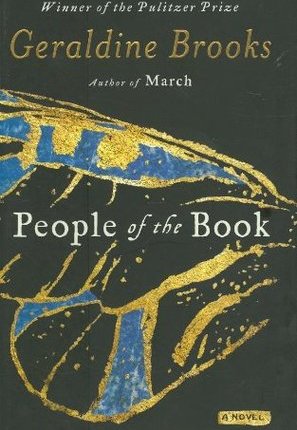
People of the Book by Geraldine Brooks

People of the Book by Geraldine Brooks

The story of an extraordinary book and the people who surround it.

And I did not enjoy it.

My reaction to this one was a huge surprise. I adored Geraldine Brook’s Year of Wonders and I thought this would be an easy hit for me.

Photo by Rachel Claire on Pexels.com

I think the problem is fairly simple- never connected with the main character. I loved Anna from Year of Wonders. I couldn’t stand Hanna.

The small details of her work that she found so absorbing, I didn’t enjoy.

I didn’t like how she treated people sometimes. I thought she seemed rather arrogant.

I also didn’t like how the timelines bounced around from character to character. I was listening to People of the Book as an audiobook. Without being able to look back and check, I found myself getting confused when I stopped in the middle of a passage and picked it up again after a work day.

Photo by Emre Can on Pexels.com

Brook’s writing is just fine. Again, I can’t believe I didn’t like this.

Highly recommend Year of Wonders. I give this a solid pass.

Thanks for reading!

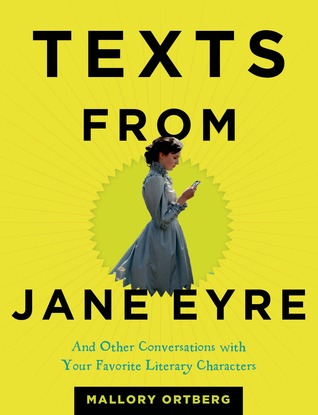
Texts from Jane Eyre by Mallory Ortberg

Texts from Jane Eyre by Mallory Ortberg
textfromjaneeyre

Though the premise was clever, Texts from Jane Eyre reads a lot like text message conversations in real life- shallow and repetitive after the first few lines.

Also, there wasn’t a synopsis included in these pages, so if you hadn’t read a classic or, if you’d read it so long ago that you’d forgotten most of it, you were out of luck.

The best of the lot was the Samuel Taylor Coleridge chapter that starts on pg 43 in which he’s on a ramble about the golden palace of Kubla Khan and then a delivery guy comes to the door and ruins his flow.

The worst was the Harry Potter chapter in which Ron and Hermione have a ‘conversation’ but Ron is written as a complete moron and she is confounded by his idiocy. Very mediocre and unworthy of either of those characters.

If you feel the need to read this one, check it out from the library. A related read if you enjoyed it: When Parents Text: So Much Said…So Little Understood.

Thanks for reading!