The Power of Personality: How Introverts and Extroverts Can Combine to Amazing Effect by Sylvia Loehken

The Power of Personality: How Introverts and Extroverts Can Combine to Amazing Effect by Sylvia Loehken
powerpersonality

The Power of Personality is more than just another book that picks apart the obvious differences between introverts, centroverts, and extroverts. It delves very deeply into the strengths and possible hurdles that each face in business, social situations, and with each other.

Loehken presents management techniques for the different personality types and how one might leverage innate characteristics for the most positive outcome possible in a variety of ways. I found the book to be very helpful in explaining my own reactions to most perceived conflicts.

I hope to utilize what I’ve learned in the future to harness my strengths while minimizing the others. Some of my more damaging introverted tendencies are that I’m conflict/contact adverse and easily overstimulated in every day life.

I thought when Loehken discusses how the different personality types view each other that her descriptions were spot on. I think I do tend to categorize most extroverts as loud, unthinking buffoons. My mistake.

I suppose that extroverts view me as “boring, lame duck, sensitive flower, unsociable, professional worrier, reader, timid”pg 51. I never considered why.

Photo by Armando Are on Pexels.com

Perhaps now with a more educated mindset, I can embrace personality differences and work more smoothly with extroverts. Rather than, in my previous experience, pushing them away so that I can have some peace and quiet.

The other portion of the book that I enjoyed is Chapter 8: Stressful Encounters: Status Games pg 161. It reminded me of a book on body language, I Can Read You Like a Book: How to Spot the Messages and Emotions People Are Really Sending with Their Body Language. But, instead of just focusing on body language, Loehken goes into all manner of status symbols, interactions, and conversational cues.

She dissects how, particularly introverts, do themselves a disservice in their professional and personal lives because of how they perceive and react to conflict. It blew my mind.

It may be because this is a European book (the price on the back is listed in pounds) but I have never read anything like this in an American business book. Loehken talks about the unwritten rules of polite society and how, in sometimes subconscious ways, we shape our relationships and our status to the people around us.

Photo by fauxels on Pexels.com

One of her tips for dominating or owning space that I’m going to integrate into my life (right now!) is to sit fully on an office chair instead of perching on the edge. “If you take the whole seating area of a chair, this has a higher status effect than someone who only takes up half the seat or sits on the edge.”pg 175. Lesson learned.

The weak part of this book was any of the bits that dealt with centrovists. Basically, Loehken kept saying (paraphrasing in my own words) ‘If you’re a centrovist, you enjoy the benefits from both types of personalities and will therefore be more successful in whatever it is that we’re talking about in this section.’

It got kind of annoying after awhile because Loehken tells us that everyone exists on a scale of personality (we’re rarely entirely one type or another from situation to situation) so the centrovist advice could have been most applicable for every reader. Unfortunately, it felt more like a ‘Captain Obvious’ moment every time it came up rather than a revelation.

If you enjoyed The Power of Personality, I’d suggest reading I Can Read You Like a Book: How to Spot the Messages and Emotions People Are Really Sending with Their Body Language. It deals with body language rather than the driving personality behind the body, but it is still illuminating. It helps readers monitor the involuntary signals that we send out in our day to day interactions, how to leverage your movements and to send the message that you want to send, rather than broadcasting your internal mindset unintentionally.

I received a free copy of this book through Goodreads First Reads. FTC guidelines: check! Thanks for reading!

Limitless Mind: A Guide to Remote Viewing and Transformation of Consciousness by Russell Targ

Limitless Mind: A Guide to Remote Viewing and Transformation of Consciousness by Russell Targ
limitless mind

Russell Targ is one of the founding members of the Stanford Research Institute’s studies of psychic phenomena. He worked with Hal Puthoff and Ingo Swann to develop the remote viewing protocols for the CIA.

Remote viewing, though lambasted in popular culture in such films as “Men who Stare at Goats,” is an actual practice. It was utilized by United States and Russian militaries with some success or complete failure- depending on who you ask.

I thought that a handbook on remote viewing from this seminal scientist would delve more into the nitty-gritty of the practice. But, it doesn’t.

Targ does give a broad outline of what remote reviewing is. He also give examples of his research, but it wasn’t all that I had hoped it would be.

Limitless Mind is, however, packed with information about psychic studies from the late 1800’s until the current time. Targ discusses the studies from multiple countries covering such diverse topics as spoon bending, distance healing and psychic diagnosis.

If the reader is looking for remote viewing techniques only, I’d recommend Remote Viewing: The Complete User’s Manual for Coordinate Remote Viewing or The Seventh Sense: The Secrets of Remote Viewing as Told by a “Psychic Spy” for the U.S. Military.

Thanks for reading!

Time in a Bottle: Mastering the Experience of Life by Howard Falco

Time in a Bottle: Mastering the Experience of Life by Howard Falco
timeinabottle

Time in a Bottle is a self help book about changing your perceptions to improve your life. Though not a new message, some readers may find this book worth the time.

Howard Falco presents this knowledge with a spiritual slant. Readers who are turned off by that kind of thing may want to choose another book.

The main premise: “Our misunderstanding of time- how our thoughts relate to time, how time is actually created, and how time seems limited- is one of the biggest reasons we suffer and at times feel hopeless or powerless in our lives.” pg 1, introduction.

One of the ways to “master the experience of life” is to realize that you are infinite potential like the universe itself: “You are a part of infinity. To the degree that you feel that life is finite and limited, you will act out of this fear, and work to create an experience that is a result of this fear.” pg 33.

I agree that mindset is important to determining your life’s path. Love and fear seem to be the two driving forces of our world. Wonder why that is…

Photo by Nacho Juu00e1rez on Pexels.com

Falco also discusses giving up resistance to how life is: “It is critical that you know that the ending of your resistance toward any particular thing (sickness, layoffs, war, family, financial trouble, death, political chaos, natural disasters, etc.) is not in anyway condoning these terrible things or giving up on change. It is simply the full acknowledgment that for the moment this is what is happening.” pg 40

He talks about giving up regrets about the past that could potentially be holding you back: “This is not about accepting that something had to happen to you; it is about acknowledging that it did happen and standing in front of the universe saying, “I trust that there is perfection and a specific, divine purpose for my past and the exact way it unfolded. Because of this, I am realizing more of my unlimited potential for the future.”

So then, unburdened, you step into your future with faith.

Falco incorporates quotes from famous philosophers and scientists along with anecdotal stories to illustrate his points. As I said, no new wisdom here, but plenty of good reminders to trust, forgive and move forward to a life outside of time.

Thanks for reading!

Night by Elie Wiesel

Night by Elie Wiesel

Night is Elie Wiesel’s memoir about his experiences during the Holocaust. It is shocking and sad, but worth reading because of the power of Wiesel’s witnessing one of humanity’s darkest chapters and his confession on how it changed him.

Photo by Pixabay on Pexels.com

In the new introduction to the ebook version I read, Wiesel talked about the difficulty he had putting words to his experience. “Convinced that this period in history would be judged one day, I knew that I must bear witness. I also knew that, while I had many things to say, I did not have the words to say them.” pg. 7, introduction

The original version of Night was written in Yiddish. I wish I knew enough Yiddish to read it. There’s something powerful about reading books in their original form.

Wiesel closes his introduction with his reasons for writing this book:“For the survivor who chooses to testify, it is clear: his duty is to bear witness for the dead and for the living. … To forget would be not only dangerous but offensive; to forget the dead would be akin to killing them a second time.” pg 12, introduction.

Even though a member of his community warned Wiesel’s village about the horrors that awaited them, they didn’t believe him.

Photo by Engin Akyurt on Pexels.com

After they were placed in a ghetto, the Jewish population of Sighet thought that the worst was behind them. “Most people thought that we would remain in the ghetto until the end of the war, until the arrival of the Red Army. Afterward everything would be as before. The ghetto was ruled by neither German nor Jew; it was ruled by delusion.” pg 26, ebook.

If I had been in their place, I don’t think that I would have acted any differently. How could one possibly imagine the horrors that they were going to face?

Wiesel is starved, overworked and beaten in the concentration camps. He loses more than his family and faith: “One day when I was able to get up, I decided to look at myself in the mirror on the opposite wall. I had not seen myself since the ghetto. From the depths of the mirror, a corpse was contemplating me. The look in his eyes as he gazed at me has never left me.”pgs 110-111 ebook.

Another Holocaust survivor’s memoir that I highly recommend is Man’s Search for Meaning by Viktor Frankl. Never forget.

Thank you for reading.

Ghost Box: Voices from Spirits, Ets, Shadow People & Other Astral Beings by Chris Moon, Paulette Moon

Ghost Box: Voices from Spirits, Ets, Shadow People & Other Astral Beings by Chris Moon, Paulette Moon
ghost box

Ghost Box is Chris Moon’s collection of paranormal investigations that he has conducted using electronic voice phenomena (EVP) and his own intuitive skills.

There is little to no science presented in this book so if you’re interested in the tech-side of paranormal investigation, you’ll have to keep looking.

Readers who want concrete information about the afterlife may grow a tad frustrated with this book. The majority of Moon’s investigations are conducted through feelings and feedback from the people he’s interacting with.

That’s not to say that he doesn’t have some solid hits. Occasionally, the information that he receives through his “ghost box” is absolutely spot on. It gave me the chills.

I watched a documentary once about Mario Bacci, an Italian man who has been receiving other worldly voices through an old radio for years. He has a group of devoted followers that gathers around him to hear his sessions with his own “ghost box”. They claim to hear their deceased family members through Bacci’s radio.

That documentary convinced me that this phenomena is real because of how the people reacted when they heard the noises coming through the radio.

Moon had his doubts at first too. When he first receives the box, he doesn’t think it will work. But, through using it and the evidence it provides, he becomes convinced that it is the real deal too.

Photo by Igor Mashkov on Pexels.com

“The machine facilitates real-time two-way communication with the spirit world and, as soon as my dad and I experienced it in action, we knew it would revolutionize the paranormal investigation field.” loc 95, ebook.

He receives this machine from Frank Sumption- an electrical tech who claims to have completed Thomas Edison’s ‘Telephone to the Dead.’

I didn’t even know that was a thing. “Apparently, Edison’s mother was a Spiritualist and he was very close to her. After her death, Edison started to re-examine his views on the afterlife. He realized that since energy could neither be created nor destroyed and that it could only change form, we humans (being energy) had to go somewhere.” loc 224. Fascinating.

The rest of the book, including aliens speaking through the ghost box and sightings of shadow people, I didn’t connect with as much. But, if you’re interested in that type of information, Moon’s book might be something that you’d really enjoy.

Thank you to NetGalley and Llewellyn Publications for a free digital copy of this book. Reminder: the brief quotations that I pulled for this review may change in the final printed version.

Thanks for reading!

Dreams 1-2-3: Remember, Interpret, and Live Your Dreams by J.M. DeBord

dreams

J.M. DeBord starts his book about dreams with the idea that dream interpretation used to be the job of a wise man or woman in the community. Dreams were an integral part of living a fully conscious and realized life.

Now, dream interpretation experts charge for their services and not everyone has access to their skills.

This clever little book opens the doors of dream interpretation so that average people can again know the meaning of their dreams. It doesn’t stop there- J.M. DeBord also provides suggestions for integrating the dreams into your daily life.

Finally, in Dreams 1-2-3, DeBord empowers readers by reminding us that no matter how expert the dream interpreter, the final meaning for any dream really rests in the hands of the dreamer herself. Only she can feel the “ringing of truth” in the interpretation.

This is by far the best book that I have ever read on dream symbolism. DeBord doesn’t provide lists of animals/colors/scenarios and their most common meanings. He ties whatever shows up in the dream to the rest of its contents and the dreamer’s own internal and external world.

Photo by Ylanite Koppens on Pexels.com

In this way, each dream can be understood and applied in as unique a way as the dream itself.

My one critique of Dreams 1-2-3 is that DeBord made the process seem so simple. I’d read the dream example and think, I have absolutely no clue what that one means, and then DeBord would go on to provide a crystal clear interpretation.

See how simple it is?… he seems to say. Perhaps not.

DeBord may have a gift for it, honed by practice, and he doesn’t realize that what he is doing is rather amazing. I suppose he gives me a goal to strive towards.

I have had a few dreams since completing this book and, with DeBord’s method, have been able to wring some meaning from what I otherwise would have assumed to be nonsense. Dreams 1-2-3 has already changed my life. Read it if you want to change yours too.

Thanks for reading!

Linchpin: Are You Indispensable? by Seth Godin

Linchpin: Are You Indispensable? by Seth Godin
linchpin

Seth Godin draws on his experiences in business and life to convince the reader to be a linchpin rather than a cog in the machine of work.

He says it better than I did: “This book is about love and art and change and fear. It’s about overcoming a multigenerational conspiracy designed to sap your creativity and restlessness. It’s about leading and making a difference and it’s about succeeding.” pg 2

You have our attention, Godin. What do we do?

Through a series of blog-like sections, Godin explains that there is no road map or simple answer. “Our world no longer fairly compensates people who are cogs in a giant machine. … Leaders don’t get a map or a set of rules. Living life without a map requires a different attitude. It requires you to be a linchpin.” pg 19

Essentially, you have to embrace the uniqueness and drive that is inside of you. You have to create a platform of work rather than a resume. You have to decide to discard mediocrity.

“The very system that produced standardized tests and the command-and-control model that chokes us also invented the resume. … Great jobs, world-class jobs, jobs people kill for- these jobs don’t get filled by people e-mailing in resumes.” pg 72

That’s so outside the usual paradigm of work, for most of us, that it can sound scary.

Photo by Andrea Piacquadio on Pexels.com

“Often, when people hear about my radical ideas for how you should train for a career, as well as the best way to present yourself, they object. They point out that not fitting in is certainly going to be an ineffective way of getting one of these average jobs. … If you need to conceal your true nature to get in the door, understand that you’ll probably have to conceal your true nature to keep that job. … The linchpin says, “I don’t want a job that a non-linchpin could get.” pgs 78-79

It seems like he’s asking a lot, but the alternative is to give up and conform. Godin says that this mindset isn’t impossible: “My fundamental argument here is simple: In everything you do, it’s possible to be an artist, at least a little bit.” pg 94. We can do that, right?

I didn’t agree with everything in Linchpin. I thought that Godin was far too hard on journalists… it is easy to look at an industry, or any situation really, from the outside and criticize the people in the thick of it.

News agencies know that they have to embrace the future or die. Just how to do that is up for grabs and adding Godin’s toolbox of how to excel at work couldn’t hurt. I don’t think that reinvention or evolution is an impossible task. It’s just tricky because, as Godin noted, “there is no roadmap.”

Recommended for people who may be bored with where they are and can see a glimmer of where they want to be- but aren’t sure how to get there. Also recommended for those who work in the newspaper business because we clearly need more linchpins.

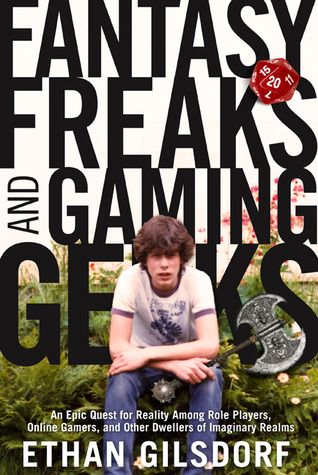
Fantasy Freaks and Gaming Geeks: An Epic Quest for Reality Among Role Players, Online Gamers, and Other Dwellers of Imaginary Realms by Ethan Gilsdorf

Fantasy Freaks and Gaming Geeks: An Epic Quest for Reality Among Role Players, Online Gamers, and Other Dwellers of Imaginary Realms  by Ethan Gilsdorf
fantasyfreaks

Ethan Gilsdorf carried angst about his gaming habits for various reasons for years. This book could have been a healing for him, but he doesn’t seem to take that leap.

It made me sad. Yes, perhaps the start of his DnD experience coincided with his mother’s illness, but I think that was not the only reason why he entered the world of fantasy.

Some people are born wanting to see worlds beyond this one. Why that is, I don’t know. I just know that it is so. Ethan suggests, in Fantasy Freaks and Gaming Geeks, that it takes trauma to send a person in that direction, I disagree. I think some of us were born that way. 🙂

The content of the book is excellent. He travels from the UK to New Zealand and everywhere inbetween to find people who are engaging in LARPS, SCA, Tolkien, gamer conventions, Worlds of Warcraft, EverQuest, and more.

I loved his interviews with the man/woman on the street. He’d ask why they were doing whatever it was they were doing and they’d answer with conviction. There’s something very satisfying in reading personal statements by passionate people.

The enthusiasm nearly drips from the pages. I loved that.

I was hoping that Ethan would learn from all of these people who absolutely loved what they were doing with no regrets. But, he seemed to go to his default mode of judging and self-pity rather than expansion.

Ethan made some steps towards self realization at the end of the book, but I wish he had gone further.

If you enjoy this book or topic, may I suggest Of Dice and Men: The Story of Dungeons & Dragons and the People Who Play It. It’s a non-fiction read about Dungeons and Dragons. It lacks the comprehensive nature of Fantasy Freaks and Gaming Geeks, but David Ewalt carries none of the emotional baggage of Ethan Gilsdorf so it feels more light-hearted.

Thanks for reading!

Across Time And Death: A Mother’s Search For Her Past Life Children by Jenny Cockell

Across Time And Death: A Mother’s Search For Her Past Life Children by Jenny Cockell
acrosstime

Jenny Cockell retained memories of a former life. In these memories, she died young and left children behind. Across Time and Death documents her acceptance of the memories and her search to find her previous family.

In childhood, my dreams were swamped by memories of Mary’s death. … All this, however, seemed inconsequential beside my fear for the children I was leaving behind.” pg 1.

In the religion of my childhood, reincarnation was neither taught nor accepted. But, as I’ve read different books, I’ve come to believe that it’s true.

I was so curious about it, in fact, that I participated in a past-life regression therapy session. The recording of it is mildly interesting, but mainly traumatic. I saw abuse, a lifetime of servitude and then a death that was penniless and alone in the dark.

The therapist can be heard on the recording, murmuring niceties about being “safe and secure.” There was a lot of, “let it go into the light” and “breathe in and out, slowly.”

Still, I walked out of that session and haven’t gone to another one since. I most likely never will.

If we do indeed live again and again, perhaps there’s a reason that we retain no memory of it. That’s my two cents. Back to Across Time and Death.

Photo by Pixabay on Pexels.com

As a child, Jenny understood her past life memories more clearly than when she was an adult. “I had no cause to doubt that these memories were real. I assumed that memories of this kind were normal, and I expected everyone else to have them too.”pg 12.

Culture has such power to shape our worldview. Isn’t it true that part of the process for choosing the next Dalai Lama is that the candidate has to recognize the previous Lama’s belongings?

Jenny’s experience with regression through hypnosis seemed to echo mine. “Hypnosis is a strange experience even without the element of regression. All sorts of memories which have been hidden deep within the subconscious and cannot ordinarily be reached can be brought to the surface. This is double edged – both a wonderful and a disturbing experience at the same time.” pg 34. Yes.

When Jenny is finally able to overcome all of her doubts and fears, she then has to consider what the, now grown, children are going to think of her. “I needed to ask for help because I was beginning to panic. I wondered if I had any right to disturb Mary’s children or, conversely, if I had the right to keep my story from them.” pg 107. Which is a legitimate concern.

I’d recommend this book for people who are on the fence or just curious about reincarnation. If your mind is completely made up one way or another, I don’t know that Jenny’s testimony will mean as much to you.

Thanks for reading!