In Three Years of Quantrell, John McCorkle recounts riding as an irregular with William Quantrell and how they fought against the Federals in Missouri and Kansas during the American Civil War.
It is a sobering look at how war is hell. McCorkle never knew who he could trust and who he couldn’t. During the infamous raid at Lawrence, Kansas, McCorkle says that some good men may have died in the raid, “but that wasn’t our intent.”
It’s hard to imagine what a country at odds with itself must have been like. People would take advantage of each other, steal property, and even the lives of their neighbors.
My one quibble with this memoir is it contains a lot of travel. It feels like McCorkle said we went here, then here, then here… as he goes through his memories of the war. There’s plenty of “hours of boredom punctuated by moments of terror.”
Recommended for history readers who want an original source for research about the American Civil War.
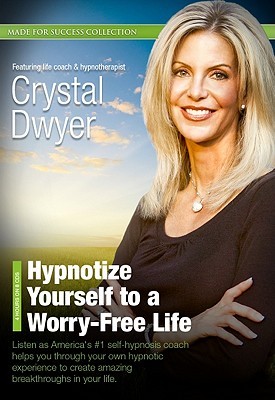
Crystal Dwyer, a new age instructor, has developed a set of guided meditations to enable listeners to improve their lives in a variety of ways. These tracks address issues from insomnia to anxiety. She has a pleasant voice and the meditations are enjoyable.
If you’re not into new age themes, you may want to try another hypnosis program. At the beginning of the audiobook, Dwyer is straight forward with her beliefs about God being within each of us and our individual power as creators. I could see that being problematic with those who don’t connect with those teachings.
I feel that the title of this work is a bit misleading. There are going to be ups and downs in any life. To suggest that you can eliminate anything seems suspect and sort of pie-in-the-sky. It reminds me of books that tout “read this and lose ten pounds in three weeks” and things of that nature. These meditations are valuable enough without the publisher (or author) making promises that perhaps they can’t keep.
That being said, I don’t think many people know what hypnosis is. In my experience, hypnosis, similar to a trance-state, just feels like deep relaxation. Everyone is different, but when I’m under, my body feels heavy but light, which seems impossible. My limbs sort of disappear and I feel as if I’m floating.
Once I’m there, in that relaxed state, then I let the meditation I’m listening to just wash over me. It feels really good actually. Generally, at the end, the hypnotist will say something like, “You’re coming back and you’ll feel entirely refreshed.” And, wouldn’t you know it, I do.
I think popular culture hasn’t done hypnosis any favors with people’s expectations about how it works. (The film “Office Space” comes to mind.) You don’t turn into some suggest-able zombie person when you’re under. Like most things, hypnosis and relaxation are a choice. Worry is a choice. It’s all about controlling that inner narrative and changing your inner thought processes to ones that are pleasing to you.
A child once asked me to teach her about hypnosis so she could “control her brother”, which cracked me up. But then I explained to her that hypnosis isn’t a tool for controlling other people. The name of the game is improving and controlling yourself.
It’s like Marcus Aurelius said: “You have power over your mind – not outside events. Realize this, and you will find strength.”
Recommended for seekers looking for another tool to help them on their path to self knowledge.
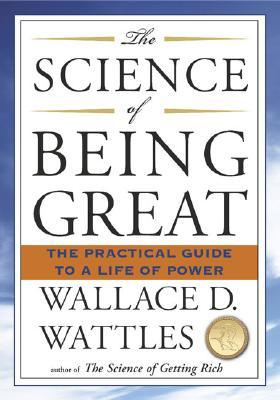
In the latest installment of “Heidi re-listens to all the old audiobooks on her hard drive”, I gave The Science of Being Great another chance to share its wisdom with me.
Couched in religious language, Wallace Wattles shares his new age viewpoint long before modern audiences became enamored of it with the mammoth success of The Secret. In fact, that’s how the publisher marketed this older manuscript, as source material for The Secret.
I suppose it could be considered “source material” in that Wattles teaches enlightenment is to be found within. But he has very little in it about the guiding power of emotions, which was a cornerstone of The Secret. Wattles book is more along the lines of: You are a god walking among gods and should act accordingly. And don’t stick your nose into other people’s business.
Some of his advice is more tricky, such as: see the world in a perfect state of becoming. Nothing has gone wrong or could go wrong. Everyone and everything is perfect for where they are and everything has the chance to get better.
That’s hard stuff to swallow if you take a second to think about it. “The world is in a perfect state of becoming.” Maybe I’ve become too accustomed to looking for problems rather than relying on faith that everything is working out how its supposed to.
Other parts of this book sounded similar to more modern new age authors with these ideas: Books and people will be drawn to you when you need them. Go where your inner feelings tell you to go. As you think, so you will become. Thoughts are things, etc.
By comparing and contrasting this book with other authors, I’m not intending to denigrate those teachings. I wouldn’t want to dismiss the power of the mind and emotions. Using just those things, people can certainly change their lives.
It’s just that the way they are packaged in The Science of Being Great may make it difficult for some readers to absorb it. Take the word “God” for example or “the Father”. Wattles throws those two around in every other sentence or so. That could be problematic for people who have struggled with religion or have involving it. Or those who don’t believe religion and science can mix.
And the whole book takes itself so seriously. Even the title “The Science of Being Great”, reminds me of an encyclopedia entry or something. I’ve had the most success in my own personal life when I’ve lightened up and stopped making such a big deal out of things.
In conclusion, is there helpful information in this book? Yes. Would I recommend taking the time to go through it to find those gems? It depends on how you learn best, I guess. Personally, I’d recommend Esther Hicks if you want the same sort of new age teachings with less religious trappings and a bigger dose of fun.
Humor is an interesting concept. It varies from person to person and even day to day. Something that you find funny today might not even make you crack a smile tomorrow.
But what I’ve discovered through watching a variety of stand-up comics is that the most successful ones tend to bring their own lives into the act in a powerful way. They distill what makes them unique and apply a humorous lens to it, making you feel like laughing or crying. It’s almost like storytelling through jokes. I feel like you have to be a brave person to even attempt it. Because what if you fail?
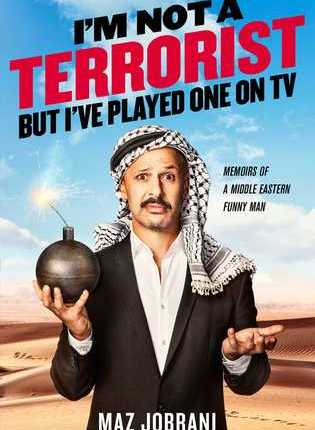
Have you ever watched Maz Jobrani‘s stand up? He does some storytelling and it’s rather funny. But he also has a back-and-forth with his audience, highlighting the differences between everyone but, beneath that, our essential humanness.
It is that unique voice that comes through in his memoir. He describes growing up Iranian in America and it wasn’t an easy ride. But even through his difficulties, Maz makes it amusing.
He helped me to understand what it is like to be an Iranian in America and also a successful, stand up comic.
In addition to his life story, Maz’s detailed descriptions of other countries makes the reader want to travel to all sorts of exotic locales. This book made me want to visit Petra. 🙂 Some day, perhaps.
If you enjoyed I’m Not a Terrorist, But I’ve Played One on TV, you may want to read Sleepwalk With Me and Other Painfully True Stories by Mike Birbiglia, Shrinkage: Manhood, Marriage, and the Tumor That Tried to Kill Me by Bryan Bishop or I’m Just a Person by Tig Notaro.
In similar ways to this book, Birbiglia, Bishop and Notaro take their lives and share them with us, the readers. They make you laugh, and like Maz, you can’t help but appreciate the brilliance and bravery of comedians. Life isn’t always funny, but it can be. It just depends on what you focus on.
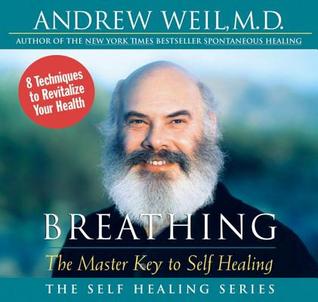
Andrew Weil presents pranayama, Eastern breathing techniques for health and well being, for a Western audience. If you have never tried meditation or deep breathing before, this would be a good place to start.
Weil talks about how breathing is one of the only bodily functions that can be performed both consciously and automatically. That unique control allows for a bridge to be made between the conscious and subconscious minds. Ever notice how people who are upset breathe faster? There’s reasons for that.
The first disc of this audiobook is almost unbelievable in Weil’s claims of healing mental and physical disorders through simple breathing, but I don’t think he’d lie about it. I guess our culture has always put so much belief in Western healing through the use of medicines and concrete therapies, that we haven’t always entertained other types of healing.
Of particular interest to me was Weil’s testimony about a patient of his with anxiety disorders that were so severe that they were causing heart palpitations. His patient was given medications to suppress the anxiety, but after awhile they stopped working and Weil’s patient was forced to find something else. He approached all manner of doctors and psychologists, but didn’t see any movement forward on his problems until he began to practice Weil’s breathing techniques.
I know a few people in my own life who might find that story interesting too. Couldn’t we all use tools to increase our inner peace and decrease those pesky anxieties?
The second disc is half a dozen or so different breathing exercises. They’re all fairly simple and you can do them in minutes.
I listened to this audiobook years ago and, honestly, forgot everything I learned. But I explored it again last week and realized that it was never too late to get back on track. Recommended self help book for anybody who breathes. 🙂
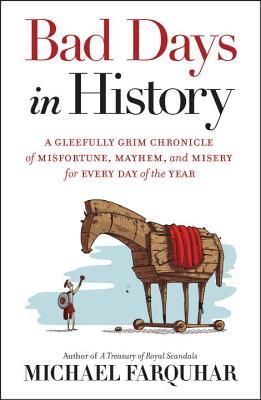
Michael Farquhar has compiled a veritable treasure trove of historical events and organized them by the calendar day upon which they occurred.
“Plucked from all eras of history, and from around the globe, the bad days in this book are intended to amuse, tantalize, and enlighten — without being too predictable.” From the introduction.
From ancient Rome to the more modern era, anyone interested in history should find something to enjoy in here.
For example, those who like to learn about doomed romance, may I suggest March 29: “There was nothing particularly special about Yaoya Oshichi, a grocer’s daughter living in 17th-century Japan. Indeed, her memory undoubtedly would have been lost to history had it not been for the extraordinary circumstances of her death — a tale of romance so tragic that it enshrined the 16-year-old girl forever in Japanese literature and theater.”
Or maybe you want to learn about the publishers of the so-called “Wicked Bible” who faced a committee for their misdeeds on May 8: “Some readers of a 1631 edition of the King James Bible were shocked (or at least pleasantly surprised) when they came across the Seventh Commandment in the Book of Exodus: ‘Thou shalt commit adultery.’ Then there was the apparent blasphemy found in Deuteronomy, chapter 5: ‘The Lord hath shewed us his glory, and his great asse.” (The proper word was ‘greatnasse’.)
From the amusing to the tragic, there’s something for everyone. Each listing is a short version of the event, just a couple of pages. If you want something more in-depth, you’ll have to keep looking. However, if you just want a few pages of something interesting to read before bed, this book could fit the bill.
Recommended for history lovers and trivia hounds.
Thanks for reading!
Here’s the History Guy episode I wrote about Yaoya Oshichi:
In the era before women could vote, an extraordinary detective and lawyer was solving crimes the police couldn’t and defending those who couldn’t afford it. Her name was Grace Humiston and this is her story.
Grace was admitted to the bar in the state of New York in 1905, becoming one of only a thousand female lawyers in the whole United States. pg 29
Readers, this lady was incredible. Though she fell out of public favor later in her career, Grace accomplished so much. She was the first woman to become a consulting detective for the New York Police Department. They formed a missing persons bureau because of her work to reform how they searched for victims of crimes.
Grace was even the first woman to serve as a Special Assistant U.S. District Attorney. She brought down businesses that were abusing immigrants through peonage practices. I’m telling you, this lady was hardcore.
The case that catapulted her into the limelight was the disappearance of Ruth Cruger, a teenager who went to get her ice skates sharpened in New York City and never returned. Her family insisted Ruth wouldn’t have run away, as the authorities suggested when they reported her disappearance.
“My girl has been kidnapped,” Henry said to the reporters. “This talk about her having gone away voluntarily is an unwarranted insult to her and to us. It is nothing more than a screen for police shirking.” pg 47
When a reporter asked about how she had solved the case so quickly after the police had given up, Grace did not couch her words. “To begin with, the police are no good,” Grace told the reporter. “They had all the facts to start on that I had and did nothing.” pg 71
Savage.
The facts of this story merit a five-star rating but how they are organized brought down my rating of this book. Brad Ricca opens with the Ruth Cruger case and puts chapters inbetween detailing Grace’s history. It disturbs the flow of the story. I think if he had gone from an opening, gripping chapter about Ruth into a chronologically organized history, I may have enjoyed it more.
Another gripe some readers had with Mrs. Sherlock Holmes is that it had an unsatisfying conclusion. I’m not of that opinion. Often, life doesn’t end stories with a bowtie or an ending worthy of their beginning. In non-fiction, especially when careers rise and then fall as in this book, there isn’t a satisfying ending to be had.
I enjoyed learning about this extraordinary lady and I appreciate the level of research Ricca put into these pages. One can feel, especially in the conclusion, how this was a labor of love for him. Not just to bring Grace back into the public’s mind and heart, but also to remind readers about how people still go missing today and, sometimes, they’re never found.
I wanted to reprint all the people gone missing in the last year here, at the end, but it would not have been ‘cost effective’, they told me, even in the smallest type. So think of one name for me. Maybe it is someone you know. Or someone you saw on a show or a flier once. Or maybe it is your name, or a name you once had. Whoever it is, write that name here…. pgs 362-363
We are solving more and more cold cases with the advent of DNA databases. Perhaps some day this issue will be a thing of the past. Until then, we’ll rely on the Graces of today to lead us, clue by clue, to wherever the trail ends.
Thanks for reading!
Here’s the History Guy episode I wrote about Grace Humiston:
Converse with Charisma is an audiobook collection of business speakers and experts who each offer different suggestions for how to improve your speaking skills, networking, presentation and improvisational speaking styles.
My big takeaway from this, besides some very helpful hints, is that speaking and networking is a skill that can be learned. It’s not something that some people are just born with and others aren’t. That being said, it would certainly be a step out of my comfort zone to try some of these suggestions.
For example, one of the sections was a meditative visualization where you see yourself going to a networking event and successfully exchanging business cards with 25 contacts. I’m game for most any meditation, but in this middle of this one, my mind was screaming at me combinations of “WHAT ARE YOU DOING?” and “NOOOOOOO”.
But then again, I’m a self-confessed introvert. I’m trying to step up my presentation game for filming an episode of my family’s YouTube channel and also taking a bigger part in marketing it. These are both skills I think I can master, but it’s scary to try new things, you know?
Anyway, back to Converse with Charisma.
My favorite section was Jim Rohn’s fun, motivational speech on the first disc. As I’ve expressed in a few other reviews, Rohn is a master storyteller and life coach. He lifts you up, empowers you, makes you believe in life-long learning and goal setting. I think this collection may be worth borrowing from the library just to hear his contribution.
As for new material, the presentation on disc 8 “Thinking on Your Feet” contained a bunch of information I hadn’t heard before. It gives suggestions for soliciting questions from a crowd and leading programs. It also gave a formula for organizing speeches to make a higher impact. I think I’m going to have to listen to that part a couple times to get everything I can out of it.
Recommended for people looking to step up their speaking and presentation game… fellow introverts I’m looking at you.
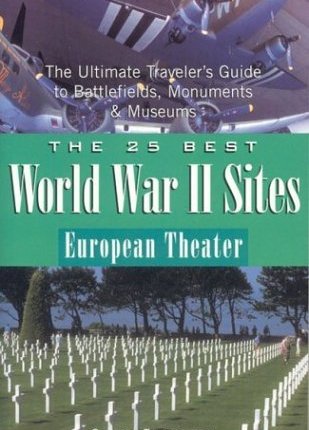
Excruciatingly detailed travel guide for those interested in World War II. My husband, The History Guy on YouTube, thought it was amazing.
I’m married to someone who is obsessed with war, war machines, war documentaries, military uniforms and, well, you get the idea. This one time, I went to England just to wander around a tank museum with him. A tank museum. This is true love, people. Was I bored? Yeah. Did I care about any of the tanks? No. Could I think of a million other things I’d rather be doing? Yeah. And yet, there I was- the hippie in the tank museum.
Me at the Tank Museum. Really, it’s me.
So, my plan is: convince him that he needs to go on a tour of the European Theater- all of the battle fields in order. It will probably take him two, three months, say, six months to do it right. I will suck it up and go with him, somehow finding a way to survive half a year in Europe. HALF A YEAR!
Think of the libraries, the museums… oh my God, the pubs! The art! The culture!
This book is step one. 🙂 Check back with me in twenty years or so and I’ll let you know how the war lover and the hippie’s European tour went. Maybe we’ll end up writing a tour guide of our own. Half of the book will be war stuff, the other half will be a tree-hugging, far-out love fest. Heck, I’d read it.





















 The Help Desk Book Blog