Random House Word Menu is a useful reference tool for anyone looking to be precise in her writing or conversation.
The book is divided into subject areas like ‘the sciences,’ ‘social order,’ ‘cognition,’ and much more. After each word, a brief description is given.
In some ways, Random House Word Menu feels quite similar to the ubiquitous Dewey Decimal system used by librarians.
With this book in hand, I could see researchers being able to find specific volumes more easily because the search terms are at his fingertips. He would then be able to give that information to a librarian, or utilize it himself if he knows the library system, in order to find exactly what he needs.
However, I tried to look up the word, ‘librarian,’ in the Word Menu and it wasn’t there! Oversight or purposeful act- you tell me.
I suppose author Stephen Glazier wouldn’t want to give too many tools to those book dragons. Who knows what they would do next…
Highly recommended for reference purposes. The only thing that would make this better would be if the book was digital and could be updated with minimal time, effort and resources. Until then, the physical tome will have to suffice.
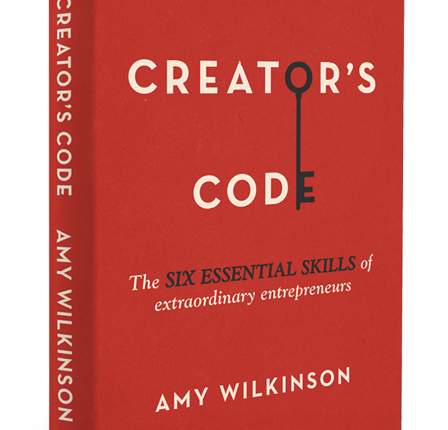
For The Creator’s Code, Amy Wilkinson interviewed over 200 wildly successful entrepreneurs and narrowed down the skills that they used to create their businesses to an “essential” six.
These essentials are the keys to the “creator’s code,” she writes.
My favorite chapter from The Creator’s Code is Chapter 5: Network Minds- Solve Problems Collectively. We’ve recently instituted some collaborative projects where I work and I’m excited to see this creative skill in action.
Also, I enjoyed the portion of the book where Wilkerson explored businesses trying to integrate computer games into the work day in order to encourage co-workers to help each other as well as to instill a sense of play into the creation process.
I wish that my library management system could be tweaked to do something like that. Imagine how fun that would be! Playing computer games in order to boost productivity.
In some ways, this book reminded me of Napoleon Hill‘s Think and Grow Rich. He also interviewed hundreds of wealthy people to understand their mind set. However, unlike the New Age, positive thinking slant of Hill’s work, Wilkinson relies on scientific studies as well as real world results.
Of the two approaches, I personally favor Napoleon Hill’s, but readers of a more scientific mind-set might enjoy this book more.
While we’re on the subject of read-alikes, I also read [book:How to Fly a Horse: The Secret History of Creation, Invention, and Discovery|20342540] by Kevin Ashton and it shared some of the stories from The Creator’s Code.
It felt slightly repetitive because of this. Otherwise, I may have given The Creator’s Code five stars instead of four. It felt like I was covering the same material. Despite this bookish deja vu, The Creator’s Code is very well researched.
So, if you’ve already read the other book, don’t be hesitant to pick this one up too. It was just not ground-breaking reading for me- my reviewer’s bias, I suppose.
There are some differences between the two works: How to Fly a Horse focuses on the history of the creative process and uses that knowledge to encourage the average Joe to be creative today.
The Creator’s Code has distilled the essential nature of creation and lists guidelines that can be used for success in business, art, science, whatever.
Though both encourage creation, Wilkinson gives actionable steps to take at the individual level whereas Ashton focuses more on the big picture.
If you enjoyed The Creator’s Code, I highly recommend How to Fly a Horse by Kevin Ashton and Think and Grow Rich by Napoleon Hill. Both of these works share the themes of success in business through creativity exploration.
I received a free copy of this book through Goodreads First Reads. FTC guidelines: check! And thank you for reading!
“I knew then that something was going to happen in Ireland. I had no idea then just what an enormous and irrevocable change it was going to make to my life.” pg 5, ebook
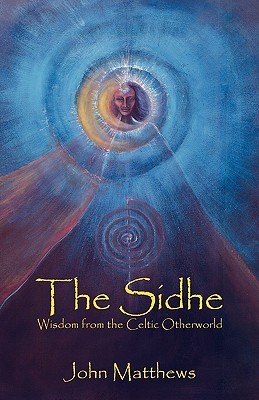
John Matthews received a call from a friend whose occupation is archaeology. The friend showed John into a barrow where he first saw the glyph that is on the cover of this book.
John claims that through meditation upon the glyph, he communicated with other beings whom he believes are ‘the Sidhe.’
“To truly know a thing is to become one with it. Just as to become one with it is to truly know it.” pg 27, ebook
He shares the communications that he had through the glyph throughout the text. At the end, he includes six exercises that the beings gave him and encourages readers to try the practices for themselves.
Readers could potentially experience the connection John felt.
“Drawn by this feeling, I lay down beneath the branches of the old oak, and, as I had done countless times before, stared up through the branches at the patches of blue sky that showed through. As I did so a sense of stillness and peace descended upon me.” pg 36, ebook
It could be that the channelers are tapping into a similar place. In this book, John calls it the “great net” of creation. I’ve heard it called, “Indra’s net,” among other names in other sources.
Whatever it may be, I find it interesting that the communications received are similar enough to draw comparisons.
“Among the greatest gifts we have observed in your race is the desire to know and to explore. This hunger has propelled you far along the path of the day and the path of the night. Hence, your journey is indeed one of exploration, not only in time and space, but in the dimensions of Spirit.”
Of course, I had to try John’s method for myself. I’m always so curious about these kind of things.
Unfortunately, I fell asleep rather than having a memorable experience. I expect the fault was on my side, but perhaps I experienced something in my sleep- I just failed to remember it.
I do plan to give the meditation a try again in the future, when I’m not so sleepy.
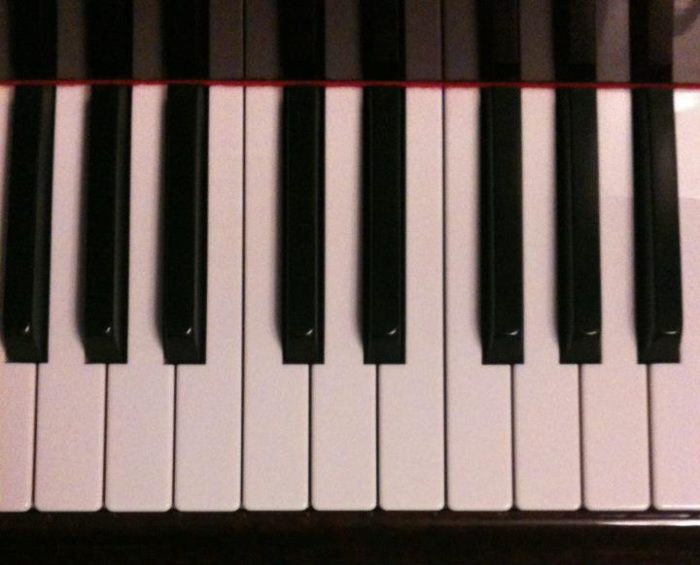
I was fascinated with the way the glyph looks like a treble clef with multiple circles. When John began to describe the Sidhe’s connection to music, I felt that comparison made sense.
“Much of our time is spent in the making of music- though for us it is more serious than a pleasant pastime, since it is part of our creative process in more than an abstract fashion.” pg 69
Playing music is one of the few activities that put me into a flow state. Perhaps I should try meditating that way.
Anyway, I recommend this book for the curious or spiritual seekers. If you try the exercises within, please do share your results. Maybe some day, the world will have more answers than questions about these ineffable things.
Or, maybe, we’ll open yet another door for endless discoveries. Either way, I’ll be interested to see what comes next.
Find Your Goddess by Skye Alexander is a compendium of goddesses and their various aspects as well as attributions from all over the world. She covers the well-known goddesses from the Roman, Greek, Egyptian and Norse pantheons, and also delves into the lesser known (at least to me) Shinto, Hindu, and Native American deities.
Some of the entries have corresponding artwork opposite the deity information- but not all. I wish every listing had some artwork because, as they say, a picture is worth a thousand words.
Though I picked this book up for entertainment’s sake, I could see this being a useful tome for spiritual seekers who are looking for a tradition that fits their inner reality.
On a different note, I could see gamers discovering the information contained in Find Your Goddess quite handy. Anyone looking to roleplay characters in their tabletop games or dungeon masters who want to craft a scene with new (to players) world powers could utilize this book.
This could also be a useful reference book for pagans on the forefront of recreating rituals and knowledge bases from long ago. I find it interesting that once upon a time the goddesses in this book were recognized and worshipped, and now society has forgotten not just about the deity herself but also how she was honored or her role in keeping civilization together.
Many of the goddesses have roles in the home or schools- goddesses of the hearth, learning or heart. But some have spheres of influence that were primarily held by male gods, at least in the western world.
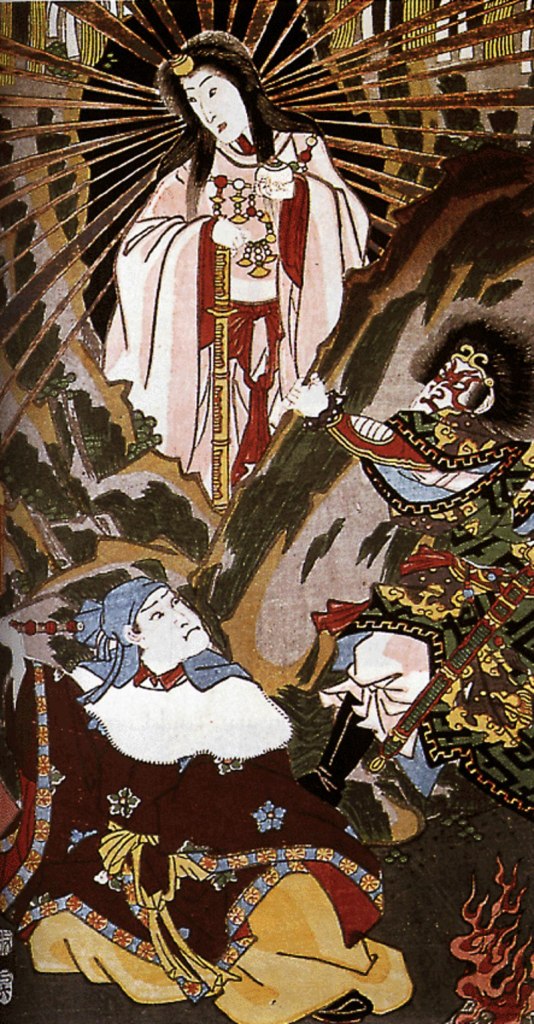
One of these that comes readily to mind is Amaterasu Ōmikami, a goddess of the sun and the Japanese imperial family. The Greek and Roman god Apollo has always occupied that role in my classically-educated mind.
Japanese Sun goddess Amaterasu emerging from a cave.
I enjoy considering other viewpoints because my own biases come to the forefront when I do so. Though I may not be able to rid myself completely of these biases, knowledge and wisdom helps me to see the blind spots. My hope is to know where they reside so I may easily brush them aside when they raise their ugly heads.
Highly recommended for pagans, spiritual seekers or readers with a curious mind, like me.
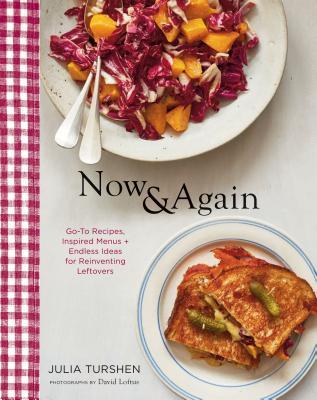
Now & Again is a cookbook that utilizes leftovers from the dishes within its pages to create new and exciting meals using the same ingredients in different ways.
I thought the premise was a good one. People who find themselves cooking meals for one or for a large family may have trouble with wasting perfectly good food. Not because the meal isn’t tasty, but because it is tricky to get the proportions correct during the preparation.
I liked the pork chop recipe from Now & Again. By following the written instructions, the meat was juicy when I ate it, which is a fair indicator of the skill of the chef who authored the book. At least, that’s what I believe.
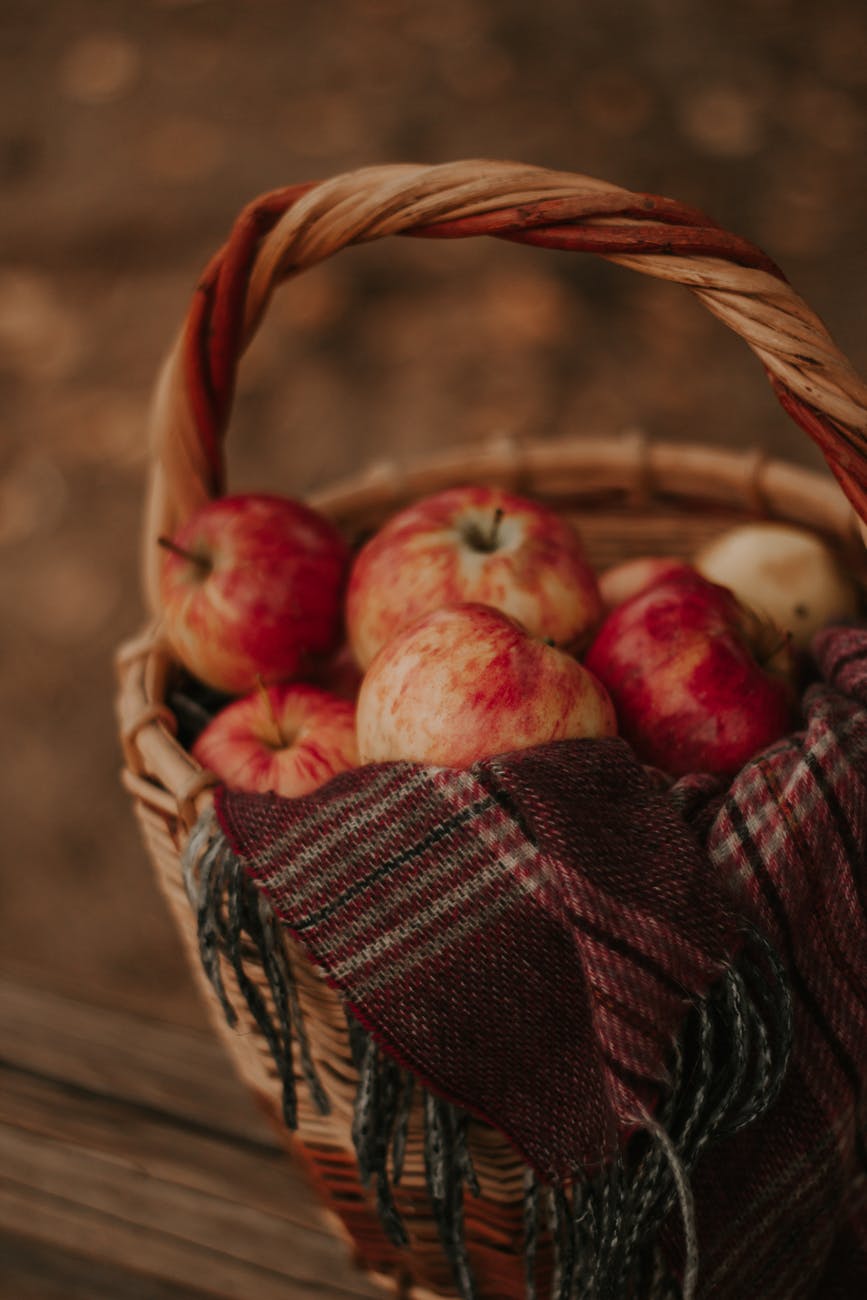
However, the apple cake I attempted from this book was probably one of the worst things I’ve ever baked. The author said the cake should have the texture of banana bread. That was not the case for me.
To borrow a term from The Great British Baking Show, the cake was stodgy. The texture was all wrong. And it seemed to stick going down my throat. I took one bite and threw the rest away.
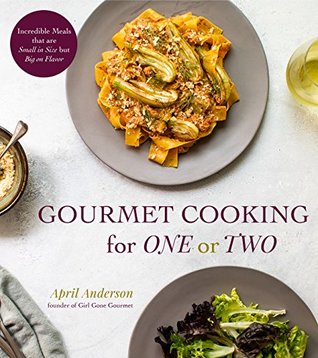
April Anderson, founder of Girl Gone Gourmet, has compiled a beautiful book of smaller portioned “gourmet” recipes. Photos of each dish are found opposite the instructions.
It is a pleasure to turn the pages and an even bigger one to utilize the recipes found within.
It is a truth universally acknowledged, that a person in possession of excellent cooking skills, must be in want of people to eat their food.
All joking aside, I love to cook. I find it profoundly relaxing to turn on some music and start chopping vegetables or heating the oven.
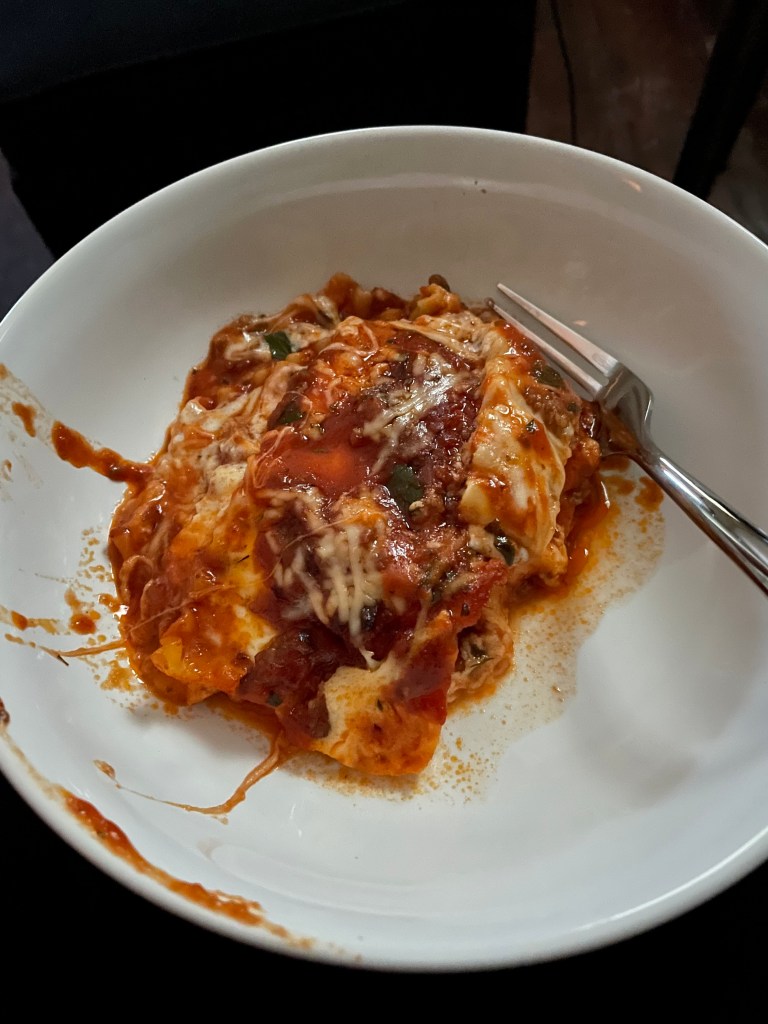
Here’s my two slice sun-dried tomato and sausage lasagna from page 31!
There’s a definite rhythm to cooking- like an ancient domestic hymn. Humanity must eat. Some of us have the good fortune and privilege of eating well.
However, when you’re by yourself, it can be difficult to control the portions. Most recipes assume at least two or more people are going to eat the food. It can be problematic and wasteful.
For example, I’ve made dishes and given three-quarters of it away to family, and still have three or four meals left for myself.
Anderson has scaled back her recipes in order to amply feed one, or so she writes. She reminds readers to have fun!
“Last but not least, I want you to enjoy yourself, because I believe time spent in the kitchen cooking for yourself is time well spent.” pg 10
My pork chops were yummy!
I tried a couple dishes in here (sun-dried tomato and sausage lasagna pg 31 and pork chops with savory apple bacon hash pg 123). They were tasty, but I still had way too much food for just me.
The moderate kitchen skills are required to make these dishes. You’re putting together sauces and browning meat, seasoning and slicing.
I took my time with it and didn’t have any difficulties. Beginner chefs might be a little overwhelmed, but if you take your time, you can do it.
Recommended for foodies who can find their way around the kitchen and aren’t afraid to try recipes that might be challenging. Make sure you have some containers on hand because you will probably still have leftovers.
“When we unlock our sakti we re-connect with our capacity for inner joy and peace with ourselves: all our experiences begin to join up and make sense. Freeing our sakti in this way gives us the key back to our sexual selves, so that we may inhabit our whole being with authenticity and joy.” pg 508 ebook.
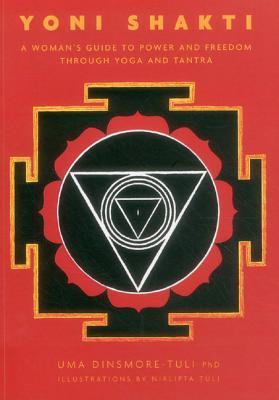
Author, yogini and tantrika, Uma Dinsmore-Tuli, shares yoga sequences, mantras, mudras and meditations to assist readers in becoming more aware of their inner selves.
What does this accomplish, you may be asking yourself. According to Dinsmore-Tuli, it’s the foundation of a mindful existence.
“All of the poses to unblock the life force energy are also very practical means to keep the creative and sexual energies in circulation so that they are available to nurture and enrich our creative, family, social and professional encounters.” pg 518, ebook
That sounds pretty good to me.
So, I tried some of the suggestions from this book which I had to cherry pick because there are dozens to try. And my results were unexpected and stunning.
After the first practice, I experienced an almost immediate increase in my sensitivity to my body’s energy and overall energy level. After the first week, this improved awareness led to some fascinating experiences during my meditations.
Apparently, practitioners of yoni shakti routinely encounter visions or spontaneous energy body knowledge. The goal is not to seek these experiences, but to be aware when they arise and dissipate, and then utilize them for greater self knowledge.
Using these teachings, I feel like I’m learning a whole new dimension to life- one that arises from practices of mindful awareness. Yoni Shakti is a good reference book for that journey.
That being said, a majority of this book is repetitive to the point of unreadable. I realize Dinsmore-Tuli is passionate about the women’s movement in yoga, but she goes on so much about past abuses by gurus and organizations that it detracts from the delivery of the wisdom of the book.
I found myself skimming entire sections because they read the same in the previous chapter and the ones before it.
On the other hand, this book shines in its accounts of the women who were suffering and then rediscovered their power and ability to heal themselves through their yoga practice.
“There is a deep relief in knowing that other women have experienced the same losses, and a comfort in hearing others speak about what is so often unspoken. The sharing is healing.” pg 597
Recommended, with a few reservations, to spiritual seekers interested in yoga and tantra- particularly women.
“This book is concerned with the Chinese folk art of arranging objects to enhance harmony and good luck, called feng shui. This ancient knowledge enables us to seek peace and new growth through our relationship with the objects around us…” pg 11
When was this art form started? No one knows! As the author points out in the section entitled, ‘A brief history of feng shui’:
“… (feng shui’s) close association with the ancient Chinese lodestone compass has led some to think it may have begun around the time the compass was invented, an accomplishment traditionally credited to the Yellow Emperor, the great mythological hero-priest-ruler of ancient China, who is supposed to have lived around 2700 b.c. There is no historical proof for this attribution…” pg 17
Despite not knowing its origins, historians can tell the art has been around for so long because so many buildings were built facing the south which is considered the “most auspicious direction.”
“Traditional Chinese walled cities, temples, and other important structures were usually oriented to face the south. The Forbidden City is Beijing was built on a precise north-south axis, with all its major halls facing the south.” pg 34
Kwan Lau goes on to explain feng shui’s ties to mythology, the elements of traditional Chinese medicine, the four directions, and the stars.
It was surprisingly complex.
“Readers should not be dismayed by the complex interplay of all these symbols and associations. The folk art of feng shui draws information from a wide range of sources and a rich tradition of ancient cosmological thought, and for this reason it can be daunting for the beginning practitioner.” pg 48
There’s way too much to incorporate all of the information I learned in this book all at once. I think the aspect of feng shui I’ll start with in my own life is furniture placement.
I was dismayed to discover the couch I was sitting on while reading this book was in the “death” region of the feng shui layout of my front room. However, on a positive note, it faces south, which is very good and has a wall instead of a window behind it.
Perhaps some furniture moving is in order.
The world is a less threatening place with a happy, well-balanced home at the center of it. And sometimes, moving your furniture can change your life.” pg 108
Recommended to readers interested in the art- both newcomers to the topic as well as practitioners who want a reference book on the ‘Nine Stars, Eight entrances, and Bagua Combination Method’ of feng shui.
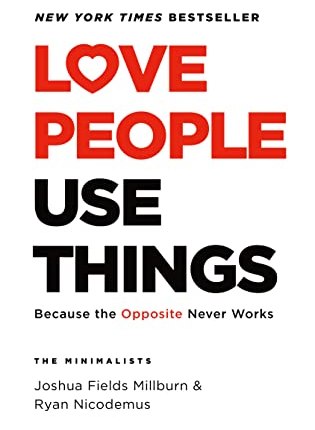
‘The Minimalists,’ Joshua Fields Millburn and Ryan Nicodemus, share their life journeys towards intentional living using seven different areas of focus: stuff, truth, self, values, money, creativity and people. Readers are invited to use the lessons they have learned to enact positive change in their own lives.
I, like many, had preconceived notions about what minimalism is. I thought it was about creating a living space that has like one chair, one table, and a cup with a single sharpened pencil in it. You can see the room, can’t you. In my mind, that was minimalism- bare to the point of ridiculousness.
Millburn addresses this misconception early on in the book.
“Minimalists don’t focus on having less, less, less; they focus on making room for more: more time, more passion, more creativity, more experiences, more contribution, more contentment, more freedom.” pgs 35-36
Sounds pretty good to me, Josh. So how do we get there?
“Minimalism is a practice of intentional living. While it starts with the stuff, it’s ultimately a stewardship program for one’s life.” pg 124-125
I’ve recently experienced some major changes in my life, which include relocating to a new home and moving almost a decade’s worth of stuff. During the process, I took the time to try on every piece of clothing in my wardrobe and, to my not-unexpected dismay, about three-quarters of the clothing no longer fit.
It was simply a matter of donating the old clothes then. But I found myself hesitating to do so. I’ve lived a lot of life in those clothes and just holding them brought back so many memories.
I realize the memories aren’t in the items, they’re in me. Millburn points out that it’s easy to make that mistake.
“While it’s true that our memories are not in our things, it is also true that sometimes our things can trigger memories inside us.” pg 20
He recommends taking pictures of these treasured items so you can continue to access the memories at will while still making room for growth.
Because that’s what all of this minimalism stuff is geared towards: Living an intentional life so you can grow with the values that you’ve chosen for yourself. What you’re aiming for is growing like a cultivated flower about to bloom rather than a tumor that spills out uncontrolled in all directions.
“Growth is a critical component of a meaningful life- as long as it’s responsible growth- because continual improvement makes us feel alive and brings purpose to our actions.” pg 170
To do so, we must first confront the reasons why we’re holding on to all these items in the first place.
“Fear is a common theme with people who are starting to confront their stuff. We’re afraid to pull back the curtain because we’re afraid not of the stuff itself, but of the work that must be done to live a more rewarding life after getting rid of it.” pg 102
And for me that’s the crux of the issue- fear. What am I afraid of? I’m afraid of living a life that doesn’t match up with my values. I fear change, not because it might be negative but because it pulls me out of my little routines into a place of uncomfortable uncertainty.
Your fears are probably quite different from mine, but the point is that you have them. Do you know what yours are?
Highly recommended for readers interested in self improvement, self help or the minimalist movement. Thank you to the publisher for a free advance reader’s copy of this book.





















 The Help Desk Book Blog