How The Secret Changed My Life: Real People. Real Stories. by Rhonda Byrne

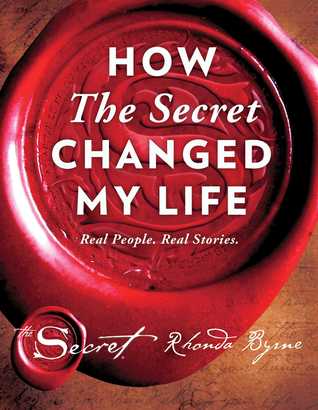
How The Secret Changed My Life: Real People. Real Stories. by Rhonda Byrne
secretchangemylife

How the Secret Changed My Life adds nothing new to the Secret franchise, but it’s still fun to read if you enjoy hearing success stories about people who utilized the Law of Attraction.

The criticisms of it have been voiced elsewhere and more eloquently: that it is predominantly focused on material things and that it stresses being happy at any cost.

That being said, I liked the stories.

I liked hearing about how people hit rock bottom and then changed their lives for the better. I really liked hearing that you can do or have or be anything that you want. Who wouldn’t?

Here’s Rhonda in the introduction: “I want you to know how easily you can change your life, and it’s not by running around trying to force it into the shape you want. You change your life in the only way you can ever change it: change your mind, and then your life will change.” loc 47, ebook.

All true change comes from within, I do believe that. Until I typed this out, I didn’t realize just how many times she used the word “change” in those two sentences. Counting back I see… five times? That’s a lot of change, people.

I feel like this book warns the reader away from negative emotions, but they serve a purpose too. It gives you a starting point- if you know what you don’t want, then you know what you do.

I’m not suggesting that you wallow in negative emotion, but feeling it, acknowledging it, then moving on isn’t as bad as this book makes it out to be.

Photo by Andre Furtado on Pexels.com

In this passage, Rhonda is suggesting the use of “Secret Shifters” to control your mood: “The Secret Shifters… are things you can focus on whenever you find yourself feeling angry, frustrated, or any other negative emotion, in order to change those negative feelings in an instant. They might be beautiful memories, future events, funny moments, nature, a person you love, or your favorite music.” loc 409, ebook.

I say: feel whatever you’re feeling and trust that your emotions will eventually rise again like a cork in water. Helping yourself along with “Secret Shifters” or gratitude lists or whatever is fine, but for goodness sake, don’t force it. “What you resist, persists.”

I really agreed with this next passage: “Most of us have the wrong idea about happiness. We believe that if we get everything we want, and if life continually goes our way, we will be happy. And from that belief, we create all the excuses in the world for why we can’t be happy right now. … It’s those very excuses that are preventing you from being happy now.” loc 457, ebook.

I used to do that- looking forward to circumstances or events and ignoring where I was. The journey really is the point, so why not be happy now?

Recommended for readers who are looking for a quick, uplifting read about the Law of Attraction or for those who are interested in getting started but don’t necessarily believe or know how it works. The latter, in particular, may find a great deal of worth in these pages.

As I said, I liked it, but I’d also recommend reading Abraham Hick’s books too: to learn the value of negative emotion, not be afraid of feeling your full emotions, and to learn not to practice affirmations unless you’re feeling “in the zone” so to speak.

Additional reading: The Vortex: Where the Law of Attraction Assembles All Cooperative Relationships and Co-creating at Its Best: A Conversation Between Master Teachers.

Thank you to NetGalley and Atria Books publishing for a free copy of this book!  And, thank you for reading.

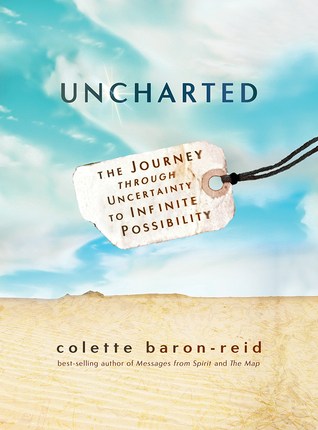
Uncharted: The Journey through Uncertainty to Infinite Possibility by Colette Baron-Reid

Uncharted: The Journey through Uncertainty to Infinite Possibility by Colette Baron-Reid
uncharted

In Uncharted, Colette Baron-Reid guides the reader with journaling, visualization, personal stories, and meditation exercises through unexplored realms of the spirit as a method for greater self knowing and actualization.

I enjoyed this book, but it felt a bit all over the place. Let me explain what I mean by examining some of the many subjects discussed:

In the introduction, Colette begins by giving some background information into what’s been going on with her for the past couple of years.

One of those big changes is that she is now channeling an group of beings, whereas, prior to this, she wasn’t.

In this passage, she’s talking about the entity helping her to write Uncharted: “It’s like “they” had the puzzle pieces, and when I was ready for them, they dropped them down on the page for me to discover. I’m not realizing that this is, in essence, what channeling an “entity” is. It’s something I never quite understood, and I’m afraid I didn’t respect its power as I should have. So I hereby surrender my inner critical cynic who doubted others when they shared their channeling stories. I get it now.” loc 55, ebook.

She calls this/these entities, Fred. Throughout the book, Fred pops up and shares a message or clarifies something. I felt as if the channeled messages could have composed a whole other book in addition to this one.

Plus, it’s clear that she’s still honing her ability to talk and understand to this inner knowing. Anyway, it “muddied the waters,” so to speak, of Uncharted from nearly the first page.

Colette doesn’t think much of the ego or what she calls the “small self”:“When you view the world through the limits of your small self, you see only the separated parts of the material world. You are guided by your personal narratives that tell you who you are based on your past experience, ambitions, and goals that were set within the Realm of Form. You’re oblivious to being part of one big matrix of interconnectedness. You forget where home is, and you feel lost.” loc 634, ebook.

Photo by Sachin C Nair on Pexels.com

I’ve read all sorts of different teachings about the ego, but I’ve started to lean towards Abraham Hick’s thoughts on the matter. They teach that the ego is the lens through which the divine within you perceives reality and that our desires are breadcrumbs along the path to eternal joy if we allow ourselves to realize them.

Hicks also says that (paraphrasing): “If you only remembered how much you wanted to be in these bodies, you wouldn’t be so quick to fault yourself and your desires. You are the leading edge of thought- you take spirit beyond which it has ever been before.”

In my mind, that is the function of ego: to express our unique personality. Isn’t the desire to be free of ego also a desire driven by the ego?

I did like Colette’s definition of co-creation, which is one I’d never heard before: “Here’s how it works between you and Spirit. You, as an individual, are always cocreating. The divine creative force is always there with you, along with spirits and allies who enthusiastically join in as you co-create reality. And you are never alone.” loc 712, ebook. Encouraging, I think.

Photo by Mayu on Pexels.com

I also liked the lesson on fate, our internal “stories” and the subconscious mind: “Listen, it’s not fun to admit that while your story about yourself has been influenced by other people and things that just seemed to happen “to” you, it was also co-written by you personally to a large degree. Fate played a role, to be sure, but you can take much greater control over your “fate.” As Carl Jung is supposed to have said, “Whatever is not brought from the unconscious into the awareness seemingly comes to us as fate.” loc 1568, ebook.

The fact that shadow dwells hand in hand with light is something that I’ve learned through my own meditation practice.

Here’s what Colette has to say about it: “In the Realm of Light, we recognize that light always exists in duality with a shadow- there’s no avoiding it. There is always a dark side to everything, a contrast between what is nourishing and loving and what is draining and entangled in fear, anger, or hatred. Those emotions will always exist, but they don’t have to overwhelm you or scare you away from the process of co-creation and transformation.” loc 1892, ebook. I believe that is true.

As for the movement through Colette’s “realms”, it reminded me of shamanistic work by Robert Moss. I’m not sure about the order in which she explores things (seems like every teacher has a different way to do it), but I think that, if your intention is greater self knowledge and if you practice what Colette teaches, you will find it.

In fact, if you try just a fraction of what she suggests in Uncharted, you will learn something about yourself. She gives plenty of exercises to attempt in here if one particular method doesn’t speak to you.

Recommended mainly for the New Age enthusiasts because of the subject matter, methods, and channeled material, but also for anyone who is curious about finding and embodying one’s authentic power.

Some similar reads: Thank & Grow Rich: A 30-Day Experiment in Shameless Gratitude and Unabashed Joy by Pam Grout, Ask and It Is Given: Learning to Manifest Your Desires by Esther Hicks, and Active Dreaming: Journeying Beyond Self-Limitation to a Life of Wild Freedom by Robert Moss.

A big thank you to Hay House and NetGalley for a free digital copy of this book!  And thank you for reading.