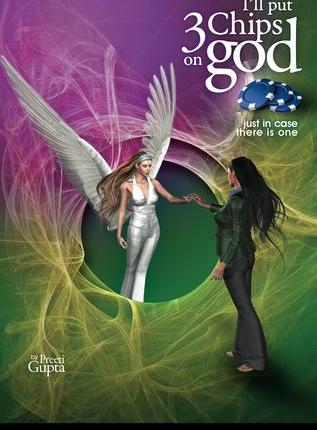
I’ll Put 3 Chips on God, Just in Case There is One reads like what you would get if you crossed Bridget Jones’ Diary with an episode of Seinfeld and added a dash of New Age spiritual musings.
Preeti, in a conversational way, discusses topics ranging from karma to palm reading.
I liked that she didn’t talk down to the reader or apologize for her thoughts. She just puts it out there and lets everybody come to their own conclusions.
My favorite part of this book was when Preeti goes to the astrologist twice to see if he would give her the same natal chart on both visits. She lets some years pass so that she won’t be recognized by her face and compares the results. They don’t match.
Preeti celebrates the fact that the charts were completely different because it backs up her theory that folks who are in the spiritual business only for money are hucksters.
But, at the same time, she doesn’t dismiss astrology as utter nonsense and leaves the door open for more learning on the subject.
It’s refreshing to find an author who is that willing to entertain different traditions even in the face of a fraudulent experience. She freely admits that she doesn’t know the ultimate truth and I think everyone can resonate with that idea… because, who does, really? Not me.
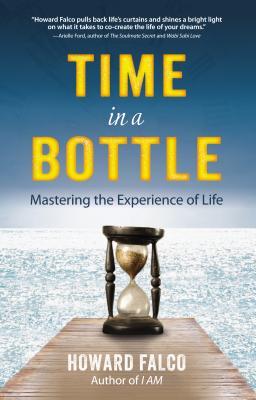
Time in a Bottle is a self help book about changing your perceptions to improve your life. Though not a new message, some readers may find this book worth the time.
Howard Falco presents this knowledge with a spiritual slant. Readers who are turned off by that kind of thing may want to choose another book.
The main premise: “Our misunderstanding of time- how our thoughts relate to time, how time is actually created, and how time seems limited- is one of the biggest reasons we suffer and at times feel hopeless or powerless in our lives.” pg 1, introduction.
One of the ways to “master the experience of life” is to realize that you are infinite potential like the universe itself: “You are a part of infinity. To the degree that you feel that life is finite and limited, you will act out of this fear, and work to create an experience that is a result of this fear.” pg 33.
I agree that mindset is important to determining your life’s path. Love and fear seem to be the two driving forces of our world. Wonder why that is…
Falco also discusses giving up resistance to how life is: “It is critical that you know that the ending of your resistance toward any particular thing (sickness, layoffs, war, family, financial trouble, death, political chaos, natural disasters, etc.) is not in anyway condoning these terrible things or giving up on change. It is simply the full acknowledgment that for the moment this is what is happening.” pg 40
He talks about giving up regrets about the past that could potentially be holding you back: “This is not about accepting that something had to happen to you; it is about acknowledging that it did happen and standing in front of the universe saying, “I trust that there is perfection and a specific, divine purpose for my past and the exact way it unfolded. Because of this, I am realizing more of my unlimited potential for the future.”
So then, unburdened, you step into your future with faith.
Falco incorporates quotes from famous philosophers and scientists along with anecdotal stories to illustrate his points. As I said, no new wisdom here, but plenty of good reminders to trust, forgive and move forward to a life outside of time.
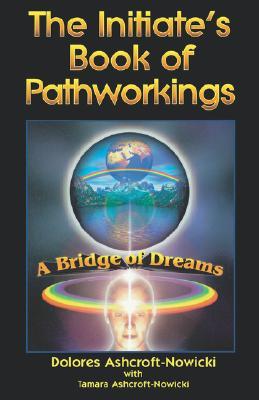
Dolores Ashcroft-Nowicki shares meditations which she calls pathworkings as a method of self actualization.
I understand that directed pathworkings are an actual technique that has been used by mystery schools for centuries to explore consciousness. I just don’t see its usefulness beyond a sort of tourist trip through what “may” be in your mind rather than what “is”.
Let’s compare it to riding a bike. Directed pathworkings are like watching a video of someone riding a bike. Passive pathworkings are like hopping on that bike and riding it all over your neighborhood. You get the visceral experience of being there.
If you’ve never ridden a bike before, watching the video might be safer, but it certainly isn’t more fun.
If we look at the Initiate’s Book of Pathworking as a journal of an adept’s inner work, it feels rather rehearsed and stilted as opposed to the out of body work that was chronicled in Multidimensional Man by Jurgen Ziewe.
If we consider the different approaches between Ashcroft-Nowicki and Ziewe, it also makes more sense that these pathworkings have a clear beginning, middle, and end as opposed to Ziewe’s offerings which are more like real life: random and, at times, nonsensical.
Because (I’m assuming) an adept from The Servants of Light School created these pathworkings through actual experiences on the inner planes, it has the curious side effect of unfolding like a structured lesson plan.
In Nick Ferrell’s book, Magical Pathworking, he discusses the importance of writing pathworkings like a story with a beginning, middle, and end for its consciousness shaping potential, but he never talks about how naturally occurring pathworkings or passive pathworkings, present themselves in that manner, organically. At least, that has been my experience.
I suspect that mystery schools experienced some pathworkings through their consciousness research, recorded the patterns that occur, and then sought to imitate that inner perfection by scripting pathworkings like the ones found in this book.
There is value to be found in this book as it provides a nice introduction to pathworking in general: “What is a pathworking? It is similar to a virtual reality trip. Pathworkings are perfectly natural and can occur spontaneously in the form of daydreams. Used as a structured series of visualizations, they hold many possibilities for the student.” Introduction, pg x
I found some of this book silly like the Healing Spring (Women only) pathworking on page 61. Women only? We’re dealing with consciousness here which is neither male or female, but pure being. If a guy wants to run the Healing Spring pathworking, I’m not going to be the one to say no.
Some of the poetry in the pathworkings is very beautiful and felt authentic, which again made me wonder who wrote these for the SOL. W.E. Butler? Dion Fortune? So curious:
“Forest Lord, with twelve-tined crown, Now we come to bed thee down. Rest content when sleeping deep, Leave the Summer Queen to weep.
Rest thee well till comes the Spring When harebells in the wood do ring; Then rouse thee up the maid to wed And seek the joy of the greenwood bed.
Hunter, blessed be thy sleep; Choose a maid thy bed to keep. Dreams of silver, dreams of gold Will guard against the winter’s cold.” pg 190
To give you a comparison, here is a chant from some pixies in a passive pathworking that I experienced a couple of months ago:
“Awake the trees, awake the night, awake the shining moon. Feed the plants, free the life that dwells within the bloom. To keep the forest growing tall, the pixie people sing, We bring the song and dance the call to wake the Forest King.
Awake the night, awake the moon, awake the powers old, We’re the ones that call upon the Spirit of the fold. Dance the dance, sing the songs, make the forest wake, In our stead, these plants have fed the thirst that never slakes.
Feels very similar, yes? That’s the fascinating thing about consciousness research to me. It feels so familiar but, at the same time, infinitely unknown.
It’s just my opinion but, I think, in addition to space, our own minds are the next frontier of human exploration.
“These “serial” workings will grow with you as you explore them, and can bring about many strange events, both in your astral life and in your physical existence. They are more potent than they seem, so take them slowly.” pg 214. One a week has worked pretty well for me. I feel like I’m learning and growing but not being overwhelmed by the changes.
A dated portion of this book that I found rather amusing, especially since the recent kerfluffle over the year 2012: “As the year 2000 comes ever closer, speculation as to the future of the world gets wilder. Exactly the same kind of hysteria hit the known world in the year 1000… The year 2000 will usher in a time of adventure, opportunity, and yes, a lot of changes. But we will survive. Things may be very different a hundred years from now, but we have survived big changes before and will do so again.” pg 231 Amen.
“One of the things an initiate learns is that every man and woman is essentially a “multi-versal” being. That is, we exist simultaneously in many dimensions and parallel universes. We have a consciousness in each one, a life in each one, a purpose and destiny in each one. But each is minutely different. With every passing moment in time, we change our future in each universe by constantly making decisions that affect the course of that future.” pg 240. I don’t know that I agree with everything in that passage, but isn’t it a beautiful view of reality? Layers within layers of truth, all interacting and changing each other, eternally.
If you liked the guided pathworkings in this book, you may want to read: Magical Pathworking: Techniques of Active Imagination by Nick Farrell, Pathworking and the Tree of Life: A Qabala Guide to Empowerment & Initiation by Ted Andrews, or the second half of A Garden of Pomegranates: Skrying on the Tree of Life by Israel Regardie. If you want examples of (mostly) passive, out of body experiences, read: Multidimensional Man by Jurgen Ziewe or Psychic Warrior: The True Story of America’s Foremost Psychic Spy and the Cover-Up of the CIA’s Top-Secret Stargate Program by David Morehouse.
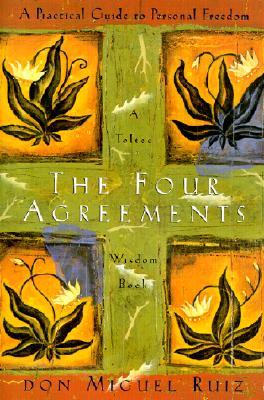
The Four Agreements is a simple and short presentation of some very deep wisdom. In a world filled with spiritual reading material, this one’s a goodie. It just made a lot of sense to me.
These lessons come from the shaman culture of Central America. “Toltec knowledge arises from the same essential unity of truth as all the sacred esoteric traditions found around the world. Though it is not a religion, it honors all the spiritual masters who have taught on the earth. While it does embrace spirit, it is most accurately described as a way of life, distinguished by the ready accessibility of happiness and love. introduction pg x. Happiness and love! Sign up the Hippie Librarian, pronto.
The book goes on to talk about how everyone has unconscious beliefs that we pick up as children. We view and experience our world through these beliefs. Most folks aren’t even aware that they have them and this causes a myriad of misunderstandings and problems: “We keep searching and searching, when everything is already within us. There is no truth to find. Wherever we turn our heads, all we see is the truth, but with the agreements and beliefs we have stored in our mind, we have no eyes for this truth. We don’t see the truth because we are blind. What blinds us are all those false beliefs we have in our mind.” pg 17.
So, how do you cut through the fog of these beliefs to see clearly? Ruiz suggests using The Four Agreements.
The first is: “be impeccable with your word… you begin to see all the changes that can happen in your life. Changes first in the way you deal with yourself, and later in the way you deal with other people, especially those you love the most.” pg 46. This includes your inner voice, the way you talk to yourself and how you narrate your reality.
Ruiz mentions that some people talk to themselves in a manner that they would find unacceptable to use with the people they care about. Change the way you speak and, Ruiz claims, your life will follow.
The second agreement is: “Whatever people do, feel, think, or say, don’t take it personally. If they tell you how wonderful you are, they are not saying that because of you.” pg 59 This helps you because: “When we really see other people as they are without taking it personally, we can never be hurt by what they say or do. Even if others lie to you, it is okay. They are lying to you because they are afraid. They are afraid you will discover that they are not perfect.” pg 63.
The third agreement is ‘don’t make assumptions’: “If others tell us something, we make assumptions, and if they don’t tell us something we make assumptions to fulfill our need to know and to replace the need to communicate.” pg 74. Now that I’ve been looking for this, I’ve caught myself assuming things all the time.
It’s funny how quick hurt feelings evaporate when I just put an “assumption” label over any stories I’ve concocted. It has actually been world-changing for me: to realize how many stories I make up because I’m bored or confused or simply don’t know what someone else is thinking. And to realize that they’re not real is such a relief. Really.
Finally: “Just do your best – in any circumstance in your life. It doesn’t matter if you are sick or tired, if you always do your best there is no way you can judge yourself. And if you don’t judge yourself there is no way you are going to suffer from guilt, blame, and self-punishment. By always doing your best, you will break a big spell that you have been under.” pg 85.
This was another big one for me. I used to get down on myself about how circumstances played out even if I had nothing to do with it. Now, I just pause and give it a quick think over, “Did I try my best?” Generally, yeah, I was trying my guts out.
And that’s all I can ask of myself, really. I can’t control the uncontrollable, I can only do the best I can with what I’ve got in front of me.
The Four Agreements may help readers live in the now and experience life as it is rather than as they’ve imagined it to be. At least, that’s what it has done for me. Also recommended for readers who may be interested in spirituality but want a easy place to start. This one is simple and packs a big punch in a very few pages.
I Hope I Screw This Up is a part-diary, part-spiritual evolution manual and 100 percent the Hippie Librarian’s type of read. Kyle Cease shares his thoughts and personal path towards becoming his best self. I didn’t find it to be as funny as promised in the blurb, but I do think it has worth as, “another finger pointing towards the moon,” as Eckhart Tolle would say.
The beginning of this book is hard to get through- for the writer and the reader. Kyle explores his fears and inability to get started. But, he slowly gets into his groove and, boy, does he begin flowing. Here’s the start of the turn-around: “You would have sensed my inauthenticity immediately if I was feeling fear in every ounce of my body and I just overlooked it in order to write the “right” thing. Instead, by baring my soul and telling you what I’m actually experiencing, I’m freeing myself from the pain I would otherwise be hiding and holding on to. Something I’ve learned is that sharing my deepest truth, no matter how scary it is in the moment, is freedom.” loc 48, ebook. And he’s off to the races.
“Just because I haven’t done this before doesn’t mean that I can’t access the ability to write the most amazing book that has ever been written. We all have the exact same level of ability to access the unlimited creativity available in every moment.” loc 158, ebook. I believe that too-
humanity’s ability to access unlimited creativity every moment. I suppose I believe that Kyle could write the most amazing book that has ever been written. Does he do it in this tome? I guess that depends upon how well you’re able to connect with what he’s done.
I enjoyed this discussion about the limitations of the mind: “Your mind is constantly putting you in survival mode all day so it can protect itself from what it thinks will be death, and unfortunately, your mind thinks almost everything is death.” loc 224, ebook. Isn’t that the truth.
And he touches on some of the problems with the New Age movement: “I know it sounds weird to say that sadness is actually a good thing, but the societal lie is that it’s better to be happy than to be sad. That’s just a belief that our mind created. … one of the strongest things you can do is to actually feel the emotions that you’re experiencing.” loc 510. Every emotion has a time and place. The insistence upon positivity at any cost, doesn’t work. Serenity now, insanity later… yes?
He also goes into the life-changing benefits of meditation, which I also agree with. By slowing down and taking the time to go within, your inner being speaks to you and gives you guidance: “Every single one of us has this calling within us, but most people are so locked into the habits and distractions they’ve created in their life that they can’t hear it. It doesn’t take anything special to discover what that calling is or what it wants you to do; all you have to do is turn down the volume of your distractions and listen.” loc 706. It may sound weird if you haven’t experienced it yet but it’s true.
For the most part, Kyle keeps his book in this dimension of reality and doesn’t dip into the far-out. But, there is a part where he briefly jokes about a picture of himself and how, at the universal energy level, we’re all the same. So, technically, you’re looking at a picture of yourself in the book that you wrote, even though it seems that you’re looking at a picture of him in a book that he wrote. That could be a bridge too far for some readers, but the Hippie Librarian took it all in stride.
Enthusiasts of Eckhart Tolle and Abraham Hicks will probably enjoy Kyle Cease. He’s authentic in the way that spiritual teachers are, understandable and amusing. He also makes a good case for falling in love with your fears. Now, the hard part, to practice it.
Thank you to Netgalley and North Star Way publishing for a free digital copy of this book. Reminder: the brief quotations that I pulled from the advance reader’s text may differ slightly in the final printed version.
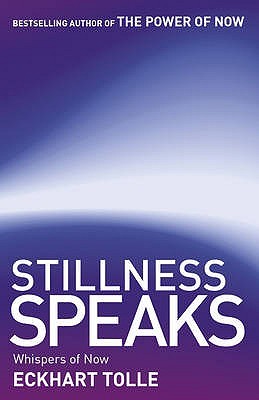
Shorter and simpler than his other books, Stillness Speaks is the essence of Eckhart Tolle. If you’re interested in his teaching, but don’t feel up to some of his more far-out ideas, this would be a good place to start.
Waking up to who you really are: “When you recognize that there is a voice in your head that pretends to be you and never stops speaking, you are awakening out of your unconscious identification with the stream of thinking. When you notice that voice, you realize that who you are is not the voice- the thinker- but the one who is aware of it. Knowing yourself as the awareness behind the voice is freedom.” pg 29.
If you feel like things are out of your control, Eckhart Tolle hands the reins of power back to you: “Your thoughts make you unhappy. Your interpretations, the stories you tell yourself make you unhappy. “The thoughts I am thinking right now are making me unhappy.” This realization breaks your unconscious identification with those thoughts.” pg 120.
This book is filled with mind-blowing moments. Take this one (I underlined it in my copy): “Death is not the opposite of life. Life has no opposite. The opposite of death is birth. Life is eternal.” pg 103. Eckhart Tolle mic drop.
I’ve always loved his thoughts about the relationship between nature and man: “Nature can bring you to stillness. That is its gift to you. When you perceive and join with nature in the field of stillness, that field becomes permeated with your awareness. That is your gift to nature. Through you nature becomes aware of itself. Nature has been waiting for you, as it were, for millions of years.” pgs 85-86. So, go hug a tree today. 🙂
This book is an experience which is hard to describe. Read it and let me know what you think.
I picked up The Alchemy of Freedom because I was looking for an accessible book about alchemy. Unfortunately, it wasn’t actually about alchemy nor was it accessible in my opinion.
But, everybody is ready at different times for different manners of spiritual teachings. Don’t let my incomprehension deter you if you find the description intriguing.
I’m neither a genius nor a guru, just someone who studies religions and spirituality in a comparative, curious, meandering way. This could be the book that opens a door for you.
It simply wasn’t that for me.
There are some gems hidden in these pages but I found it mainly to be a labyrinth of words. I’ve had a similar feeling when listening or reading the works of Eckhart Tolle.
I feel like what Almaas is saying is worthwhile, so I made my way through it. But I just didn’t get the majority of it. Puzzling my way through this book was like grasping a cloud.
I had finished this book last week in preparation for writing a review the day it came out, but when I sat down to write yesterday, the words wouldn’t come. Rarely does reading a book leave me speechless.
I’ll pull some highlights to give you a feel for it. Reminder: this was a digital advance reader’s copy so the final published version could be slightly different.
I was able to comprehend Almaas’ thoughts about our “true nature” and most of the passages I highlighted talk about it: “Whether we recognize it as presence or awareness or emptiness, true nature is crucial to the process of awakening, realization, enlightenment, and liberation. It is the source of all spiritual experiences, insights, and transformations.” loc 116-133.
The bits of alchemy that Almaas did discuss were illuminating: “When we are experiencing ourselves as true nature, we realize that a human being is really the alchemical laboratory. The human being, the human consciousness, the human mind, the human heart are the instruments through which the magician works.” loc 186.
Most books that discuss alchemy are symbols heaped upon symbols. Perhaps it’s just the nature of the topic, but it’s frustrating.
About the philosophers’ stone: “The alchemists spent millennia trying to find it. They considered it the final result of the magnum opus, the great work of spiritual and material transmutation. Some alchemists thought they could make it, others believed it had to be discovered. … I am not teaching anything about alchemy here; I am borrowing the idea because it fits with what I am trying to say about true nature. … We can only experience true nature in the manifold ways it presents itself, and yet it is always one thing.” loc 666
I felt like this next quotation encompassed my experience of this book: “Sometimes we can rapidly absorb a teaching, and other times we can’t get very far with it for a long time. But we don’t need to get into a mental struggle with the ideas and the notions. Although understanding is an important part of awakening, it need not happen immediately.” loc 922.
So, that’s a relief. Perhaps my awakening is still on its way. Until then, I’ll just chill where I am.
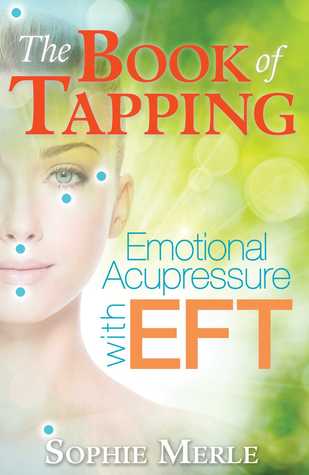
Ok, friends, prepare yourself to go on a journey with your favorite hippie librarian into the world of EFT- emotional freedom technique.
I didn’t know what to expect from The Book of Tapping being unfamiliar with this entire method. What I found fascinated me.
What is EFT? :“The central tenet of its theory is that any discontent or disorder in our lives is the result of an imbalance in the energy that flows through our physical bodies. Its main concern is the restoration of harmony using the meridian points of Chinese acupuncture, for which EFT is an emotion-based variation.” loc 18, ebook.
“It is commonly believed in the Western World that matter and energy are entirely separate things. However, to understand how EFT works, it is important to recognize that we live in a world comprised of a single energy.” loc 81, ebook. I’m game to try anything once.
I’ve read other new age teachers, Abraham Hicks comes to mind, who teach that everything is vibration. So, to bring about great change, one need only take on a different vibration. I figured that EFT was a “tapping” version of that philosophy.
There are some huge claims made early in this book: “Some of the common problems EFT can eliminate are: Phobias. … Tragic memories. … Irresistible urges. … Difficult emotions. … Restrictive beliefs. … Illness and physical suffering.” loc 65, ebook. “Really?” I thought as I read those pages. “I’ve got to learn how to do this, like yesterday.”
So, utilizing the lessons in The Book of Tapping, yours truly practiced her first rounds of EFT. I wasn’t expecting much, if anything to happen, but the results were surprising. First of all, I noticed a lightness around my head and face. It’s hard to describe, but it was as if a real weight or wet towel dropped off of the top of my head. I was very impressed and kept at it. In successive practices, I didn’t experience that enormous lightness of the first go-round, but it still felt like an improvement over where I had been.
“Once EFT has become a habit, you can also perform tapping rounds in your imagination. All it takes is to close your eyes, concentrate on your problem, and mentally perform the sequences.” loc 564. I memorized the method and use it now at work, in the car, when my co-workers are frustrated, an angry person calls on the phone, or if I have a panicky moment. It could be that it is an excellent in-the-moment distraction from what’s going on or maybe I’m actually changing my vibration. Frankly, I don’t care why it works, I’m just telling you- it works.
Keep an open mind, readers. Saying that, I have to admit, I wouldn’t necessarily have believed it if I hadn’t experienced it first-hand. This EFT thing is for real. Sometimes, I stumble upon books that change my world-view and this is one of those books. The Book of Tapping just might be one for you too.
Thank you to NetGalley and Inner Traditions for a free digital copy of this book.
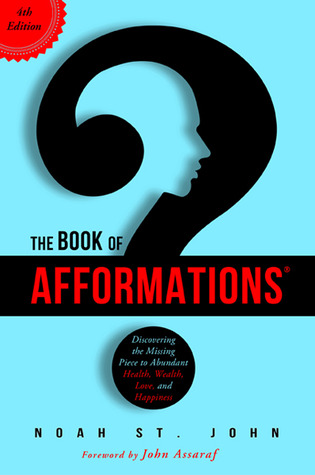
The Book of Afformations isn’t just another self help book putting forth the same old ideas of positive thinking, visualizations, and affirmations. Noah St. John has created a four part system to literally change the way you think, then act, and as a result, your life.
Step One: Ask yourself what you want, in all areas of your life. (A part of this stage is writing down all of the negative questions that you ask yourself like “Why am I never enough?”. That section was difficult to get through but eye opening.)
Step Two: Form empowering questions to help you achieve the priorities that you wrote down in Step One.
Step Three: Accept. Accept these new ways of looking at your life situation. Repeat the afformations. Create new beliefs and internal dialogue. Repetition is key here.
Step Four: Act. Here is where St. John steps away from other New Age authors that I’ve read. He suggests writing down three actions to take for each Afformation that you want to incorporate into your life. Do one a day. Keep going.
It seems really simple and the author peppers the text with success stories of people who have created amazing change in their life with this system. Another part of his book is a short biographical section about the author, how he came up with the system, and the extraordinary changes that he has made in his own life using it. The last couple pages are ads selling St. John’s other books, success workshops, online audio programs, and applications. They all seem to be quite popular, so it seems that at least some folks are having success with this.
I enjoyed the read and the author gave me some really interesting new techniques to try in my own life. I’d suggest this book to anyone who has tried affirmations and failed or is just looking to try something new for their negative thought patterns.
I received a free copy of this book through the Goodreads First Reads program. Thanks for reading!








 The Four Agreements is a simple and short presentation of some very deep wisdom. In a world filled with spiritual reading material, this one’s a goodie. It just made a lot of sense to me.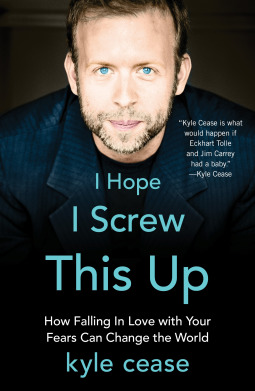
 I Hope I Screw This Up is a part-diary, part-spiritual evolution manual and 100 percent the Hippie Librarian’s type of read. Kyle Cease shares his thoughts and personal path towards becoming his best self. I didn’t find it to be as funny as promised in the blurb, but I do think it has worth as, “another finger pointing towards the moon,” as Eckhart Tolle would say.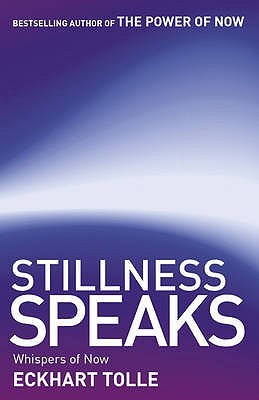








 The Help Desk Book Blog