Medicine, Miracles, and Manifestations: A Doctor’s Journey Through the Worlds of Divine Intervention, Near-death Experiences, and Universal Energy by John L. Turner

Medicine, Miracles, and Manifestations: A Doctor’s Journey Through the Worlds of Divine Intervention, Near-death Experiences, and Universal Energy by John L. Turner
johnturner

I felt like this memoir was all over the place- from remote viewing to Johrei, prophetic dreams to explanations of brain functions.

Dr. John Turner has an incredibly open mind when it comes to integrating traditional Western and holistic medicinal techniques. That was refreshing, but, because he was covering so much material, I felt like he didn’t spend enough time going into detail about the different modalities.

I wanted more depth and less breadth.

There were some interesting bits in here though.

Dr. Turner experienced, first hand, a case of spontaneous healing. His patient had a large brain tumor and, through the intercession of some monks and some radiation therapy, her tumor completely disappeared: “Here was a case of emotional disarray that when corrected, allowed healing to take place. Was it the patient’s realization or belief in karmic cause of her disease that allowed her brain to join with radiation to expel the foreign invader?… Were surgery and radiation necessary at all? I paced back and forth in my office, pondering the matter.” pg 60

Photo by Oles kanebckuu on Pexels.com

Dr. Turner practiced daimoku (intense chanting of a certain set of words, like a prayer) for two hours a day for a year.

Here is what he had to say of the experience: “I believe that chanting sets up resonant circuits in the brain that activate usually quiescent neural pathways. I came to know this feeling of attonement quite well, and after the promised 12 months I discarded the incense sticks, the gong, and the chanting. I could recreate the feeling through meditation… However, I saw no practical way in which to use this complex and time-consuming process for the benefit of my patients.” pg 89-90

Dr. Turner practicing Johrei (a light healing technique) in his surgery: “After placing the last suture, I gave him 20 minutes of intraoperative Johrei, letting Okada’s light flow through a spiritual cord to me, and then to the patient. This was a first for Hawaii and perhaps for any medical center (and surely for any neurosurgical operating room) outside of Japan. (My patient’s) recovery was spectacular…” pg 134

Photo by Pixabay on Pexels.com

The technique seems strange to me, but if it works, I say use it!

One of the first accounts I have read of remote viewing being used for medical diagnosis and treatment: “…it occurred to me that I should run the cause of this patient’s pain as a remote viewing target and see what Ed Dames could do to arrive at the answer. Not only would this be a confirmation of the power of remote viewing as a method of medical diagnosis, I would also have a chance to witness an expert at work. The results, as you will see, were everything I had hoped for; the patient fared well, much better than if I had tried to wait for the condition to become obvious on examination.” pg 194

If you are looking for more books about neurosurgeons who are considering non-traditional therapies in their practice, try Into the Magic Shop: A Neurosurgeon’s Quest to Discover the Mysteries of the Brain and the Secrets of the Heart by James Doty or Proof of Heaven: A Neurosurgeon’s Journey into the Afterlife by Eben Alexander.

Thanks for reading!

When Breath Becomes Air by Paul Kalanithi

When Breath Becomes Air by Paul Kalanithi
whenbreath

This is Paul Kalanithi’s life story. He relates how he got into neuroscience, his exhausting and life consuming training, his illness, and his eventual transition out of this world into the next.

At first, Paul didn’t even want to become a surgeon because his own father was one and he saw how hard it was to balance work and family: “When we did see him, late at night or on weekends, he was an amalgam of sweet affections and austere diktats, hugs and kisses mixed with stony pronouncements … He had reached some compromise in his mind that fatherhood could be distilled; short, concentrated (but sincere) bursts of high intensity could equal.. whatever it was that other fathers did. All I knew was, if that was the price of medicine, it was simply too high.” pgs 24-25, ebook.

But, even though he started out as an English major, Paul’s own interests led him towards the profession. He was passionate about medicine and making the best decisions for patients. He was interested in what makes life worth living and how the brain’s functions effect quality of life.

kalanithi.interior-ata-photo---suszi-lurie-mcfadden
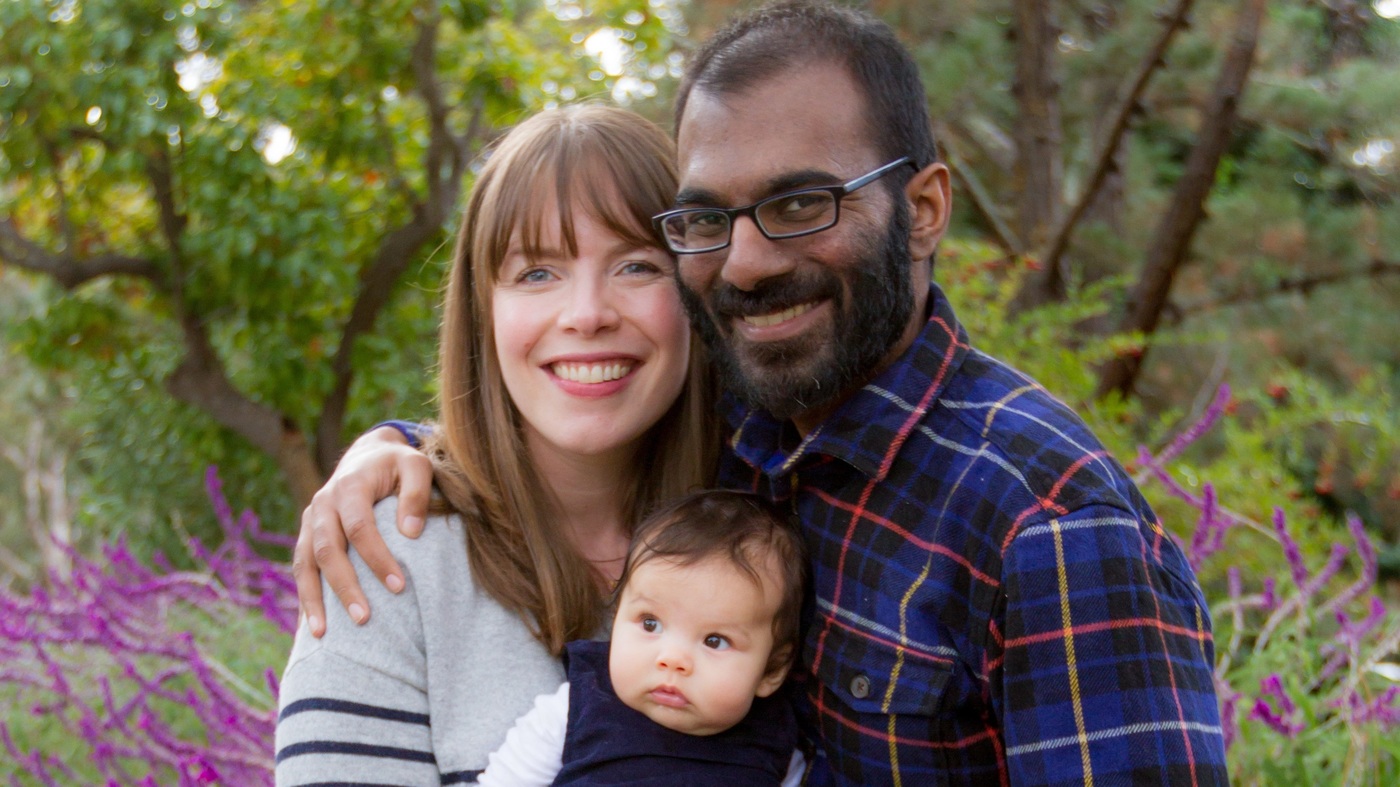
Dr. Lucy Kalanithi and Dr. Paul Kalanithi with their daughter, Elizabeth Acadia.

This is what he had to say after a sobering visit to a home for people who had suffered severe brain injuries as children: “Only later would I realize that our trip had added a new dimension to my understanding of the fact that brains give rise to our ability to form relationships and make life meaningful. Sometimes, they break.” pg 34

It was really difficult for me, personally, to read the parts of this memoir that dealt with Paul learning how to make life and death decisions for ailing patients. He talks in depth about taking people off of life support because they didn’t want their bodies to be kept alive while their brains were gone. I was reminded of how my grandfather, though he never suffered any debilitating brain injury, was kept alive through endless medicines and machines to reduce the water around his heart. He eventually refused to eat and refused a feeding tube, so he slowly withered away.. this from a man who lived for eating and described the joys of consuming a fresh peach in summer as one of his favorite memories. It was heartbreaking.

In this passage, one of Paul’s professors is talking about the same type of situation with his own grandma: “But “what was most evident,” he continued, “was the slow drawing away from life… By the time Bubbeh stopped praying, she had stopped virtually everything else as well.” pg 41 ebook. Eating was my grandpa’s form of prayer. So, you may want to avoid this memoir if you have any fresh grief that you’re dealing with, as this book brings it all bubbling to the surface.

kalanithi3

Photo from timeshighereducation.com

Paul studies so hard to become a doctor to learn the secrets of life and death. But, he begins to realize, that as a doctor, he’ll constantly deal with these moments but never truly understand them: “I began to suspect that being so close to the fiery light of such moments only blinded me to their nature, like trying to learn astronomy by staring directly at the sun. I was not yet with patients in their pivotal moments, I was merely at those pivotal moments.” pg 56

Then, he has his own illness and realizes that, even though he’s seen death and suffering, he really knew nothing about it: “It occurred to me that my relationship with statistics changed as soon as I became one.” pg 82. The rest of the book is so very sad, but one thing is clear, Paul Kalanithi finally found the moment when breath becomes air, what he had been searching for his whole life.

Neurosurgeons write really fine memoirs. At least, that’s been the case for nearly every one I’ve come across.

Some read alikes, if you’re interested: A Thousand Naked Strangers: A Paramedic’s Wild Ride to the Edge and Back by Kevin Hazzard (not a neurosurgeon, but Kevin talks about the burnout that comes in the medical community), Medicine, Miracles, and Manifestations: A Doctor’s Journey Through the Worlds of Divine Intervention, Near-death Experiences, and Universal Energy by John L. Turner (neurosurgeon), Into the Magic Shop: A Neurosurgeon’s Quest to Discover the Mysteries of the Brain and the Secrets of the Heart by James R. Doty (neurosurgeon), or Proof of Heaven: A Neurosurgeon’s Journey into the Afterlife by Eben Alexander.

Thanks for reading!

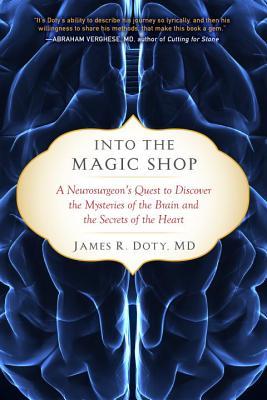
Into the Magic Shop: A Neurosurgeon’s Quest to Discover the Mysteries of the Brain and the Secrets of the Heart by James R. Doty

Into the Magic Shop: A Neurosurgeon’s Quest to Discover the Mysteries of the Brain and the Secrets of the Heart by James R. Doty

This book is James Doty’s memoir. He had a tragic childhood with parents who, for various reasons, were not present for him. Then, after an encounter with a total stranger, James was taught meditation, creative visualization, and positive thought practices that changed his life.

As he comes of age, he dismisses the compassion related portions of his childhood training and focuses instead upon the money and prestige that it brings as he pursues a career as a neurosurgeon. It’s a fascinating and educational account.

Photo by Vidal Balielo Jr. on Pexels.com

I was particularly taken with the near-death experience portion of the book. James approached that experience as an atheist so I felt that made his opinion on it rather different than other accounts I’ve read.

Some of the bits that I want to remember (advance reader’s copy cited so the final published book may contain slightly different wording):
“Some of the wisest patients and people I have ever met have been children. The heart of a child is wide-open. Children will tell you what scares them, what makes them happy, what they like about you and what they don’t. There is no hidden agenda and you never have to guess how they really feel.” pg 3

Photo by Juan Pablo Serrano Arenas on Pexels.com

“Everyone has a story, and I have learned that, at the core of it, most of our stories are more similar than not.” pg 60  But not everyone tells their story.  Thank you, Dr. Doty, for telling yours.

“When our brain changes, we change. That is a truth proven by science. But an even greater truth is that when our heart changes, everything changes. And that change is not only in how we see the world but how the world sees us. And how the world responds to us.” pg 151  I think that this is one of the great mysteries of life.

About his near death experience: “At the time I felt the warmth of a light and a sense of oneness with the universe. I was enveloped in love, and while it didn’t transform my religious beliefs, it informed my absolute belief that who we are today doesn’t have to be who we are tomorrow and that we are connected to everything and everyone.” pg 203

Photo by Pixabay on Pexels.com

“There’s a reason stock traders are using meditation techniques; these techniques help them become not only more focused but, sadly in some cases, more callous. This is what Ruth warned me about before she taught me to visualize. Yes, we can create anything we want, but it is only the intelligence of the heart that can tell us what’s worth creating.” pg 231 A powerful lesson, but one, I think, that can only be learned through personal experience.

If you enjoyed this book, try Proof of Heaven: A Neurosurgeon’s Journey into the Afterlife by Eben Alexander or The Power of the Heart: Finding Your True Purpose in Life by Baptist de Pape.

Thank you to the Goodreads First Reads program for an advance reader copy of this book.  And, thank you for reading!