Bringing the Tarot to Life: Embody the Cards Through Creative Exploration by Scott Martin

Bringing the Tarot to Life: Embody the Cards Through Creative Exploration  by Scott Martin
bringingthetarot

Bringing the Tarot to Life is a unique tarot manual that invites the reader to use her own imagination in assimilating and interpreting the cards. I’ve never read anything quite like it.

Scott Martin was an actor and theater teacher for many years. “It struck me that just as an actor delves into his character, so a student of the tarot can explore the archetypes that are represented in the seventy-eight cards in the tarot. He can develop his intuitive abilities by participating in the written and performance exercises an actor uses to hone his talent and to create his role in a play.” loc 112-128, ebook.

He based the first two sections of the book on that idea and created a series of theater-inspired games and exploratory exercises to be played in groups or alone.

The last portion of the book consists of Martin’s interpretations of the cards. I found that section to be the least interesting, but there could be descriptions in those pages that others may not have heard. So, don’t let me deter you.

There was also some trivia included for tarot enthusiasts. Something that I didn’t know was that before Paul Foster Case helped to form The Golden Dawn, he was in theater.

Paul Foster Case became interested in tarot in 1900 when someone asked him where he thought playing cards came from. … Prior to that, he was actively involved in the theater. He was the musical director on a showboat and later worked in musical theater and vaudeville.” loc 128, ebook. But old man river, he just keeps rolling along…

Photo by Mikhail Nilov on Pexels.com

I agreed with Martin’s thoughts on improving your intuition: “How does one develop his intuition? One obvious answer is to expose the mind to more creative and imaginative ways to thinking and looking at the world. Creativity and intuition are inextricably linked.” loc 164. Indeed.

My favorite of the exercises presented in this book is “I Am What I Do” loc 231, ebook. It encourages readers to assign jobs to the different cards.

“Many people in life, as well as characters in plays, define themselves to a great extent in terms of what they do. … the possibilities are virtually limitless: The Ten of Pentacles- a family counselor. The Five of Swords- a crooked hedge fund manager. The Knight of Cups- a poet.” loc 231.

I thought that was hilarious. And, I was looking at the cards in ways that I never had before. Talk about ‘Bringing the Tarot to Life’!

Recommended for beginners or advanced practitioners of tarot cards. Every reader will most likely find an exercise or two to their liking because of the huge variety Martin offers.

Thank you to NetGalley and Llewellyn publishing for a free digital advance reader’s copy of this book. Reminder: the brief quotations that I cited in this review may change slightly in the final published version.

And, thanks for reading!

Feast of Sorrow: A Novel of Ancient Rome by Crystal King

Feast of Sorrow: A Novel of Ancient Rome  by Crystal King
feastofsorrow

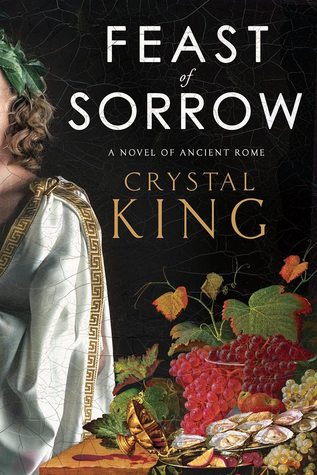
A Feast of Sorrow captures the beauty, opulence and madness of Rome during the reign of the Caesars. The story is told from the point of view of a slave in the household of Apicius. But, not just any slave. Thrasius is a cook, a coquus, the head of Apicius’ kitchen. He makes some of the finest delicacies known and invents new ones.

Apicius is wealthy beyond reason. He has the ability to purchase Thrasius the finest ingredients and the rarest spices. Apicius’ dream is to become Caesar’s gastronomic adviser. But that position isn’t acquired by wealth alone. Political currency and power is the only way forward.

And the stage is set. Feast of Sorrow has heroes, villains and, of course, food. What a strange and weird feast it is. Honeyed dormice, flamingo tongues, and more- only the best for Apicius and his clients.

Thrasius begins writing a book to preserve his master’s recipes for all time. “I added your trick about using eggs to help make cloudy wind clear, instructions on how to preserve oysters, and even Fannia’s recipe for how to make wormwood liquor. I thought about how many cooks don’t have the right information or knowledge.” loc 1592. Interestingly enough, after the tale, Crystal King talks about how Apicius’ recipes are some of the oldest surviving examples of ancient cuisine.

“Stuff the dormice with pork forcemeat and also with all the flesh from all the parts of the dormouse, pounded with pepper, pine nuts, silphium, and liquamen. Sew them up and arrange them on a tile and put them into the oven or cook them, stuffed, in a covered pot.” -On Cookery, Apicius. Loc 4466, ebook. Mmmmmm.

King fills these pages not just with food, but also, to modern eyes, the strange and sometimes cruel practices of the Roman people. Did you know that Roman diners used to wipe their hands clean in the hair of their slaves? Did you know that Romans had special priests who read the flight of birds to determine if an event was going to be successful or not? Did you know that patricians, the nobility of Rome, were judged not only for their appearance and natural abilities but also how well they could throw a dinner party?

I enjoyed this book not only for the way that King told the story of the nameless people who made Apicius’ name known for all time but also for the twists and turns it contains. Feast of Sorrow will shock you, entertain you and, maybe, make you want to try a dormouse.

Thank you to NetGalley and Touchstone Publishing for a free digital advance reader copy of this book. Note: the brief quotations that I pulled from my copy may change in the final published version. Thanks for reading!

The Keys to the Temple: Unlocking Dion Fortune’s Mystical Qabalah Through Her Occult Novels by Penny Billington, Ian Rees

The Keys to the Temple: Unlocking Dion Fortune’s Mystical Qabalah Through Her Occult Novels by Penny Billington, Ian Rees
keystothetemple

I’d recommend The Keys to the Temple for mid-level to advanced students of the Qabalah. As simple as the authors have made it, they still assume that you know the worlds, paths and general theory. If you haven’t studied The Mystical Qabalah, this won’t make any sense at all.

If you have the background and the interest, The Keys to the Temple may be of great interest to you. This book contains one of the clearest explanations of the path of the spiritual journey that I have ever read.

Let’s start from the top. What is the Qabalah? “The Qabalah is a spiritual system that has been practiced secretly in Europe since at least the 12th century though it draws on deep roots within Judeo Christian tradition. loc 3117.

The Mystical Qabalah and Israel Regardie’s classic A Garden of Pomegranates: Skrying on the Tree of Life were my stepping stones into another way of viewing reality.

I have read criticisms of the books, that they’re too cerebral or dry theory. “However when most people encounter the book they are confronted by a dense-seeming text with long lists of apparently unrelated facts: the idea that this is linked with the vivid imagery and dynamism of the novels can be difficult to understand.” loc 172. I agree that it is “dense” but since it was my introduction to the stuff, I didn’t know any better.

Photo by Matheus Bertelli on Pexels.com

Dion Fortune went a step further and wrote fictional novels to put Qabalistic theory into the real world. The Keys to the Temple takes these books apart by plot, character, theory and then gives practical exercises for personal meditation on the works.

That last part, the practical exercises, is the most important in my mind. It’s like learning to ride a bike. You can read books about it and watch other people riding bikes or talk about riding bikes. But, it’s not until you ride yourself that you get the experience and thrill of it.

With this book, the authors have handed you a bike and shown you the door of the garage. It’s just up to you to ride out there. “Anyone can read this book, but only those who do the work will gain anything from it. The secret of magic is that it is experiential.” loc 2374.

Photo by Pixabay on Pexels.com

Fortune was also deep into Jungian psychology. “She came to significant conclusions when contrasting psychological and magical approaches in prompting change. Fortune was a forward thinker, and the first to acknowledge that ideas and theories could develop for the better. Her stories seem almost to anticipate the direction psychology would travel, into area that might now be described as spiritual psychology.” loc 3117. And this was in the early part of the 19th century. She truly was a woman ahead of her time.

I’m excited about this book and its potential. The Western Mystery tradition never gets its own shelf in the book stores. The new textbooks, what few there are, are mixed in with the New Age/New Thought works. But, that’s not quite right. It’s truly a category all of its own.

I think the time has come for these practices to be re-introduced to the world. The Keys to the Temple is a step in the right direction.

Thank you to NetGalley and Llewellyn Publications for a free digital copy of this book.

Thanks for reading!

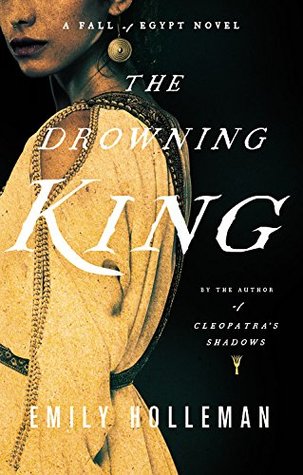
The Drowning King (Fall of Egypt #2) by Emily Holleman

thedrowningkingA well-researched historical fiction written from the point of view of Arsinoe and Ptolemy, Cleopatra’s ill-starred siblings. I didn’t even know that Cleopatra had a sister. And, I only knew Cleopatra had a brother because of his infamous gaffe when he presented Caesar with Pompey’s head.


The Ptolemys were a storied dynasty. Descended from one of Alexander the Great’s generals, they had the charming tradition of marrying their siblings. This politically motivated inbreeding kept all of the power in the family. There’s a lot of weird brother/sister vibes in this book, but it’s historically accurate. If that kind of thing freaks you out, you’d be better off avoiding this read.

The Drowning King takes advantage of these unknown characters to spin the history in a different way. I can’t say that I was a fan of all of the changes.

Holleman depicts Cleopatra as a manipulative hysteric who sat idly by while her libraries burned because she trusted that Caesar’s men would protect them. Blinded by love, perhaps? I couldn’t swallow that interpretation.

But, the Roman attitude towards women is portrayed accurately: “The soldiers distrusted her sister for what she was: an Eastern woman with an eye for rule. Hadn’t they already deposed one of those? In Rome, Cleopatra had told her once, slack-jawed with shock, women are chattel, no more and often less. Or as Arsinoe had heard more than one centurion sneer after Berenice’s death, In Rome, women know their place.” loc 96, ebook. How extraordinary then that Cleopatra managed to rise to the heights that she ultimately obtained. I suppose that also helps explain her extraordinary fall.

I liked how Holleman incorporates the size and diversity of Egypt in her tale: “Alexandria was full of Upper Landers, but they bore no more relation to these creatures than a tomcat did to a lion. The men who busied themselves along the palace courtyards wore tunics and mantles and bantered in flawless Greek. … But here men of the same blood looked different, foreign to her eyes, ghosts of some forgotten land. She doubted whether they could even speak her tongue, and she wondered how so many members of her family had ruled without bothering to learn theirs.” loc 871. That’s because the descendants of Alexander’s general spoke Greek and the common people spoke Egyptian. It reminds me of how the nobility in England spoke French while everybody else spoke English.

I also enjoyed the conversation between Ptolemy’s counselors and the young ruler about whether or not they should kill Pompey: “Pompey was once wed to Caesar’s beloved daughter, Julia. And if you kill him, you’ll be slaying Caesar’s former son-in-law.” loc 2472. Beyond the fact that Pompey was Caesar’s son-in-law, he was still a Roman. Ptolemy was not. Romans divided the world into two groups- those that were Roman and those that were not. The counselors didn’t understand that, advised the boy poorly and sowed the seeds for his destruction from that very first meeting with Caesar.

I felt badly for Ptolemy. He was surrounded by either incompetent or power hungry people. There were none who loved him for just who he was rather than what he could bring them. “Nothing he’d done- nothing he’d ever done- had made a dent. With one nauseating exception: the murder of Pompey. And for all he knew, that would be his sole legacy: the ignoble assassination of his father’s alley. Dark thoughts consumed him too frequently now; he had to stay strong and drive them from his mind.” loc 4532, ebook. “The drowning king,” indeed.

I enjoyed this book, I did, but it was no Margaret George’s The Memoirs of Cleopatra. I found myself comparing the two in my mind and this one came up wanting. Unfair, perhaps, but there it is.

Thank you to NetGalley and Little, Brown and Company publishing for a free digital copy of this book.

And thank you for reading!

The Alchemy of Freedom: The Philosophers’ Stone and the Secrets of Existence by A.H. Almaas

The Alchemy of Freedom: The Philosophers’ Stone and the Secrets of Existence by A.H. Almaas

I picked up The Alchemy of Freedom because I was looking for an accessible book about alchemy. Unfortunately, it wasn’t actually about alchemy nor was it accessible in my opinion.

Photo by Evgeny Tchebotarev on Pexels.com

But, everybody is ready at different times for different manners of spiritual teachings. Don’t let my incomprehension deter you if you find the description intriguing.

I’m neither a genius nor a guru, just someone who studies religions and spirituality in a comparative, curious, meandering way. This could be the book that opens a door for you.

It simply wasn’t that for me.

There are some gems hidden in these pages but I found it mainly to be a labyrinth of words. I’ve had a similar feeling when listening or reading the works of Eckhart Tolle.

I feel like what Almaas is saying is worthwhile, so I made my way through it. But I just didn’t get the majority of it. Puzzling my way through this book was like grasping a cloud.

Photo by Rok Romih on Pexels.com

I had finished this book last week in preparation for writing a review the day it came out, but when I sat down to write yesterday, the words wouldn’t come. Rarely does reading a book leave me speechless.

I’ll pull some highlights to give you a feel for it. Reminder: this was a digital advance reader’s copy so the final published version could be slightly different.

I was able to comprehend Almaas’ thoughts about our “true nature” and most of the passages I highlighted talk about it: “Whether we recognize it as presence or awareness or emptiness, true nature is crucial to the process of awakening, realization, enlightenment, and liberation. It is the source of all spiritual experiences, insights, and transformations.” loc 116-133.

The bits of alchemy that Almaas did discuss were illuminating: “When we are experiencing ourselves as true nature, we realize that a human being is really the alchemical laboratory. The human being, the human consciousness, the human mind, the human heart are the instruments through which the magician works.” loc 186.

Photo by Vinu00edcius Vieira ft on Pexels.com

Most books that discuss alchemy are symbols heaped upon symbols. Perhaps it’s just the nature of the topic, but it’s frustrating.

About the philosophers’ stone: “The alchemists spent millennia trying to find it. They considered it the final result of the magnum opus, the great work of spiritual and material transmutation. Some alchemists thought they could make it, others believed it had to be discovered. … I am not teaching anything about alchemy here; I am borrowing the idea because it fits with what I am trying to say about true nature. … We can only experience true nature in the manifold ways it presents itself, and yet it is always one thing.” loc 666

I felt like this next quotation encompassed my experience of this book: “Sometimes we can rapidly absorb a teaching, and other times we can’t get very far with it for a long time. But we don’t need to get into a mental struggle with the ideas and the notions. Although understanding is an important part of awakening, it need not happen immediately.” loc 922.

So, that’s a relief. Perhaps my awakening is still on its way. Until then, I’ll just chill where I am.

Photo by Jill Wellington on Pexels.com

Thank you to NetGalley and Shambhala Publications for a free advance reader’s copy of this book.

And thank you for reading!

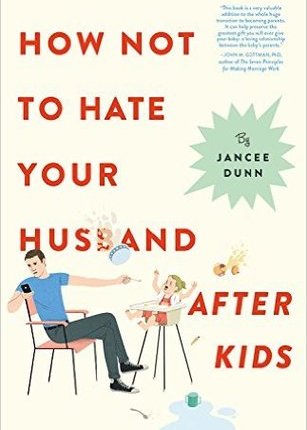
How Not to Hate Your Husband After Kids by Jancee Dunn

How Not to Hate Your Husband After Kids  by Jancee Dunn

This book gave me so many “ah-ha” moments that after a hundred pages I started to feel like an idiot. Why did I assume that so many of these little “life after baby” marital frustrations had only ever happened to me?

How Not to Hate Your Husband After Kids made me feel like I was part of a larger group called ‘mothers who try to do it all and feel secretly guilty that they can’t and wonder how everybody else does it.’ What a relief to know it wasn’t just me.

Photo by Andreas Wohlfahrt on Pexels.com

Dunn weaves her personal stories in with interviews from experts in fields as diverse as couples’ counseling to organizational gurus on a quest to save her sanity and her marriage from the hole that it had fallen into post-baby.

She is largely successful and gives plenty of tips that readers can incorporate immediately into their lives.

But, I was bothered by the, what I interpreted as, straight-up manipulation of her husband. Yes, Dunn is simply following expert advice, but reading about her self-satisfied crowing as she changes some of his more irritating behaviors felt disrespectful.

I mean, husband Tom is going to read this book.

I would feel devastated if my spouse wrote those sorts of things about me for millions of people to read and dissect. Granted, he was clued in that things were being recorded in a tell-all book, but still.

Photo by Public Domain Pictures on Pexels.com

“When I was six months pregnant with my daughter, I had lunch with a group of friends, all of whom were eager to pass along their hard-won scraps of parental wisdom. … ” … get ready to hate your husband,” said my friend Lauren. … Wrong, I told her calmly… But my friend Lauren was right.” locs 115-140 ebook.

We joke about how babies change lives but it’s not really funny, is it. It is a legit problem that marital happiness decreases because of less sleep, less money, less time, less sex… no need to go on.

Dunn begins her efforts to change her situation when she realizes that she’s reached a breaking point.

“Our daughter is now six, and Tom and I still have endless, draining fights. Why do I have the world’s tiniest fuse when it comes to the division of childcare and household labor? I am baffled that things have turned out this way.” loc 158.

In cringe-inducing honesty, Dunn admits to being verbally abusive to her spouse. My stomach actually churned when I read the sorts of things that she’d call him during fights.

Photo by cottonbro on Pexels.com

That part of the memoir made me very glad that she decided she didn’t want to live like that because I know that I wouldn’t have wanted that either.

I learned a lot about “maternal gatekeeping,” a pernicious practice where a mother discourages fathers from interacting with their children because of an internal belief that she knows better how to do EVERYTHING. And also, I learned about the importance of blocking time on weekends for personal rejuvenation and rest.

“And must we be compulsively busy every second of the day, briskly doing something “useful”? Nonstop activity can be addictive, but it’s a mistake, warns the University of Houston’s Brene Brown, a mom of two.” loc 1697.

Word. Everybody needs to chill out, calm down and unwind.

We also need to appreciate each other more.

At the end of the day and on the other side of all of the experts, Dunn comes to a dozen important realizations. One of which, appreciation, seems to be the magic bullet for most of her formerly-insurmountable marriage woes. It isn’t a new message but it is one that is worth repeating.

Photo by Magda Ehlers on Pexels.com

Recommended for parents of all ages, How Not to Hate Your Husband After Kids contains wisdom for just about every troublesome situation that one may find themselves in after children. Let’s hope the book can live up to its title.

Thank you to NetGalley and Little, Brown and Company for a free digital copy of this book. And thank you for reading!

The Zen of You and Me: A Guide to Getting Along with Just about Anyone by Diane Musho Hamilton

The Zen of You and Me: A Guide to Getting Along with Just about Anyone by Diane Musho Hamilton
zen of you and me

The Zen of You and Me takes on conflict mediation through zen philosophy. I learned a lot about managing conflict but more about myself and why, perhaps, I tend to avoid it. Hamilton is never preachy, but gently guides the reader through the dark woods of differences into the clear fields of appreciation and inclusion.

“It is a very freeing experience to suddenly realize that a difference between us is not only OK- it is stimulating and worthwhile. This realization heights our confidence to bring them out directly and openly.” loc 180.

Hamilton talks about leading classes through difficult discussions about race and privilege. The group only manages to make their way through it when one of the members expresses his desire to be heard and the others in the group allow themselves to listen.

But it isn’t easy to listen. You might be angry or otherwise triggered by what you’re listening to. Hamilton addresses that: “Threat provokes such intense sensations in our body and mind that sitting still seems wildly counter intuitive and impossible. But the first step is to learn to sit still and simply pay attention.” loc 310. Mindfulness provides the way out.

Photo by Elina Fairytale on Pexels.com

I also learned that I’m not as good a listener as I could potentially be. Hamilton provides some excellent advice for improving your skills: “Listening has a lot in common with meditation. Both involve a clear intention of bringing attention to this moment, receiving input, and letting go of the preoccupations of the self. … My first impulse was to tell her it was OK; everything would be all right. Then it occurred to me that she didn’t want to hear that. … I distinctly remember the warm sensation of letting go move through me.” loc 377.

I’ve started practicing not listening to answer but listening to listen. I surprised myself with how often my mind was racing away somewhere else as soon as another person opened her mouth. But, now that I know I do that, I can focus on changing that behavior. Thanks Diane Musho Hamilton!

I expect that now I’ll experience my loved ones in wholly new ways. “Anytime we express our real thoughts and feelings, it creates more truth and reveals a bigger perspective. And anytime someone else shares their truth with us, we should be grateful that we are given the opportunity to see and feel more than we did before. It is a privilege to feel.” loc 511. It is a privilege, isn’t it.

Hamilton talks about one of her students who set an intention to not lose her temper but was then hijacked by her emotions: “Her conditioned patterns are her suffering, like mine are mine, and yours are yours. I invited her to include them, to love them, because this practice is love.” loc 1331. So, it’s not about banging yourself into shape or forcing yourself to become something you’re not. It is more like becoming who you naturally are- which is freedom, joy, love and boundlessness.

Recommended for those who struggle with conflict within themselves or between themselves and others. The Zen of You and Me is helpful, succinct, beautiful and very zen.

Thank you to NetGalley and Shambhala Publishing for a free digital copy of this book. And thank you for reading!

Blood Plagues and Endless Raids: A Hundred Million Lives in the World of Warcraft by Anthony R. Palumbi

Blood Plagues and Endless Raids: A Hundred Million Lives in the World of Warcraft by Anthony R. Palumbi
blood plagues

Anthony R. Palumbi’s memoir is about video games, relationships and play/life balance.

Blood Plagues and Endless Raids took a chapter for me to warm up to it. Palumbi begins his homage to World of Warcraft with an icky story about driving to meet his guild mates for the first time. But once I got past that part, I enjoyed this gaming memoir quite a lot.

I’ve mentioned in previous reviews that I am, or used to be, a very dedicated player of Everquest, both one and two. Though it never had the mammoth popularity of WoW, Everquest had quite a few things in common with the mega-hit including some game dynamics and gamer-speak. So, I found myself nodding along most of the time.

You don’t have to be a gamer to appreciate this memoir. Palumbi explains every slang term and technique that pops up. He also delves deeply into game morality, relationships in MMORPGs (massive multiplayer online role playing games), addictions, game burnout, the notable players and even how WoW entered popular culture. It is an informative and, for readers like me, a nostalgic treat.

Photo by Soumil Kumar on Pexels.com

Even though, in-game, Palumbi and I would have moved in entirely different circles. He’s a raider, you see. This means he’s into end-game content which in the old days took 40 or so players coordinating, in sometimes very complex ways, to master. I, on the other hand, prefer to wander around and see what there is to see. I like to fish and chat and have fun. Palumbi likes to PvP, strut his stuff in his rare gear and order the main tank around.

Beneath these differences though, there runs a love for gaming and the social-ness of it. He, and I, don’t have that anymore. People have moved on, had families and gone to different games. When I log onto EQ2, there’s not a single person on that I know anymore. It is very sad in some ways.

“Those who match up through games have come to know each other very well long before meeting in person. … WoW romance served, ironically, as a kind of return to romantic tradition, with separation or impossibility as a core component.” loc 467. Have I mentioned that I met my spouse in-game? Let me tell you the tale.

Photo by Luis Quintero on Pexels.com

So, I was wandering beneath the trees of Kelethin (a newbie zone for wood elves) and I was stuck in a perpetual corpse run loop. This was back when death had a cost- you’d die and lose every piece of equipment on your body unless you could go back to the scene and click your corpse. My friend had made me a nice leather piece of armor and I didn’t want to admit to him that I died and lost it, so I was looking for myself, literally. But, I was near Orc Hill and, well, I had died maybe half a dozen times looking for that tunic.

In the midst of this bloodbath, I get this ‘tell’ out of the blue (in WoW they’re called ‘whispers’) by this guy who goes “Hey, do you need some help?” And I experienced a moment of utter panic because I had always been told that people online were dangerous. But I threw caution, and my pride really, to the wind and said, “Yeah, I do.”

So these random guys helped me find most of my corpses and, as I logged on over the next couple of weeks, I met the rest of their friends. One of whom is the man I ended up marrying.

As many people as the games brought together, they also drove people apart. “Choosing a game over another person’s feelings felt strange enough on its own; to have one of my best real-life friends applauding this decision was disconcerting. At the same time, it was rewarding to hear that kind of praise from someone who’d always been so much better at games.” loc 661. I knew people who dropped out of college because of MMORPGs, lost their jobs or their relationships. Another sad reality, but true.

Palumbi also delves briefly into the gender divide on video games and how females are treated differently than their male counterparts. I honestly think that most people assumed I was a guy playing because it was more common. The last thing my future husband said before he flew out to meet me was “You are really a girl, right?” and I had to laugh. Because, REALLY, I am. So, I dealt with some harassment and discrimination because of my gender, but not a horrific amount. Sometimes it seems like I was in the lucky minority.

Highly recommended for current or former gamers or anyone who wants to understand a spouse who plays. Some further reading: You’re Never Weird on the Internet or Fantasy Freaks and Gaming Geeks: An Epic Quest for Reality Among Role Players, Online Gamers, and Other Dwellers of Imaginary Realms.

Thank you to NetGalley and Chicago Review Press for a free digital copy of this book. And thanks for reading!

The Book of Tapping: Emotional Acupressure with EFT by Sophie Merle

The Book of Tapping: Emotional Acupressure with EFT by Sophie Merle
bookoftapping

Ok, friends, prepare yourself to go on a journey with your favorite hippie librarian into the world of EFT- emotional freedom technique.

I didn’t know what to expect from The Book of Tapping being unfamiliar with this entire method. What I found fascinated me.

What is EFT? :“The central tenet of its theory is that any discontent or disorder in our lives is the result of an imbalance in the energy that flows through our physical bodies. Its main concern is the restoration of harmony using the meridian points of Chinese acupuncture, for which EFT is an emotion-based variation.” loc 18, ebook.

“It is commonly believed in the Western World that matter and energy are entirely separate things. However, to understand how EFT works, it is important to recognize that we live in a world comprised of a single energy.” loc 81, ebook. I’m game to try anything once.

I’ve read other new age teachers, Abraham Hicks comes to mind, who teach that everything is vibration. So, to bring about great change, one need only take on a different vibration. I figured that EFT was a “tapping” version of that philosophy.

There are some huge claims made early in this book: “Some of the common problems EFT can eliminate are: Phobias. … Tragic memories. … Irresistible urges. … Difficult emotions. … Restrictive beliefs. … Illness and physical suffering.” loc 65, ebook. “Really?” I thought as I read those pages. “I’ve got to learn how to do this, like yesterday.”

Photo by Riccardo on Pexels.com

So, utilizing the lessons in The Book of Tapping, yours truly practiced her first rounds of EFT. I wasn’t expecting much, if anything to happen, but the results were surprising. First of all, I noticed a lightness around my head and face. It’s hard to describe, but it was as if a real weight or wet towel dropped off of the top of my head. I was very impressed and kept at it. In successive practices, I didn’t experience that enormous lightness of the first go-round, but it still felt like an improvement over where I had been.

“Once EFT has become a habit, you can also perform tapping rounds in your imagination. All it takes is to close your eyes, concentrate on your problem, and mentally perform the sequences.” loc 564. I memorized the method and use it now at work, in the car, when my co-workers are frustrated, an angry person calls on the phone, or if I have a panicky moment. It could be that it is an excellent in-the-moment distraction from what’s going on or maybe I’m actually changing my vibration. Frankly, I don’t care why it works, I’m just telling you- it works.

Keep an open mind, readers. Saying that, I have to admit, I wouldn’t necessarily have believed it if I hadn’t experienced it first-hand. This EFT thing is for real. Sometimes, I stumble upon books that change my world-view and this is one of those books. The Book of Tapping just might be one for you too.

Thank you to NetGalley and Inner Traditions for a free digital copy of this book.