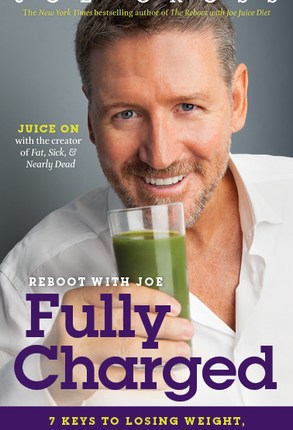
Reboot with Joe: Fully Charged: 7 Keys to Losing Weight, Staying Healthy and Thriving by Joe Cross

Reboot with Joe: Fully Charged: 7 Keys to Losing Weight, Staying Healthy and Thriving by Joe Cross

Fat, Sick, and Nearly Dead is one of the main reasons why I bought a juicer and have attempted to incorporate more plants into my diet. I’m not hardcore about it, but I try.

I didn’t know that Joe from that documentary is named Joe Cross and that he’s written multiple companion books for that film. This one, Reboot with Joe: Fully Charged, is excellent.

What I love about Joe is that he’s realistic. He doesn’t expect that he will eat perfectly for the rest of his life- he just wants to do the best that he can today then repeat the process tomorrow.

Photo by Wendy Wei on Pexels.com

He pushes the big lifestyle changers: diet, exercise, and rest but not in an extreme, unobtainable manner. In addition to common sense ideas about health and diet, Joe has spent years building an online community to support those who are working on major life changes. http://www.rebootwithjoe.com/weight-loss/

When you read this book, you also read examples of people who have turned their lives around with juicing and exercise. It’s inspiring and could be life changing for many people.

I also like that Joe included some of his go-to juicing recipes towards the back of the book. I’ve tried quite a few different juices, but I haven’t found any that I particularly liked. It’s always nice to have some new options that have appealed to other people in the past.

If you enjoyed Reboot with Joe: Fully Charged, I highly recommend his two documentaries: Fat, Sick, and Nearly Dead & Fat, Sick, and Nearly Dead 2. Also, I’d recommend the documentary Forks Over Knives which has a couple companion cookbooks out now.

A big thank you to the Goodreads First Reads program and NetGalley for free copies of this book.  And, thank you for reading!

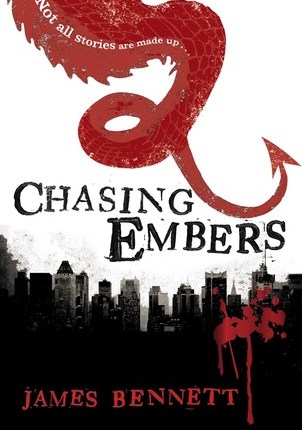
Chasing Embers by James Bennett

Chasing Embers by James Bennett

I seem to be on a dragon themed reading kick lately. And, as far as I’m concerned, that’s awesome!

Red Ben is a dragon, masquerading in human form so that he can walk down the street without everybody freaking out. Hundreds of years before this, he signed a pact called the Lore with a bunch of other magical creatures and knights, in which, he essentially agreed to hide his existence from humanity at large and the knights, in turn, would protect him. Tonight, he was attacked twice. What’s up with that? Ben doesn’t know, but he’s going to find out. He’s also had a falling out with his lady fair. Hiding your true nature from someone doesn’t make for a healthy relationship, but Ben’s enemies seem to know Rose’s (the girlfriend) name. So, now, he has to save his hide, her life, and still preserve the Lore.

Meanwhile, in a desert in Africa, an ancient power is awakening…

I enjoyed Chasing Embers. I really dig the basic premise that there’s a magical world existing alongside ours but we just can’t perceive it. Also, the idea that the Magna Carta wasn’t a political document but a secret, magical pact is fun too.“John, by the grace of God, King of England, Lord of Ireland, Duke of Normandy and Aquitaine and Count of Anjou, doth decree and grant this day, by common counsel of our kingdom, this Pact devised by the Curia Occultus and witnessed by those guardians of our realm. Those Remnants of the Old Lands, which yet linger amongst us, shall forthwith succumb to the Long Sleep…” loc 362, ebook.

The other magical creatures are straight up creepy- like magical creatures should be in my opinion. Also, Bennett seems to ascribe to the Terry Pratchett view that too much magic use thins the veil between worlds and draws attention of the things outside of this world to the magic user, which is also pretty creepy: “The nether wasn’t space, nor the ambient cosmos, but a place that lay beyond, or between, as inner as it was outer. Perhaps it was the raw, empyreal stuff of creation, for all Ben knew. Things lurked in that astral sea, creatures hungry for life, and all magic had its price. When a person drew on the nether- drew on it like a thread in a carpet- they risked unravelling the world entire.” loc 393, ebook.

The romance between Ben and Rose is just the perfect amounts of dysfunction and sparks (nothing graphic in here though for folks who look for such things): “I miss you,” she said, quiet and fierce. “I hate you.” Defeated, Ben rested his head on her shoulder, smoothing down the flowers on her dress. He let her anger hit him like a wave, tasting her muted fury at her love for him. Since he’d first crawled out of his egg, it had always been this way. Some women went for the knight. Others wanted the beast. Neither stood a chance of a happy ending.” loc 711, ebook.

Ben’s angst at his long-lived existence reminded me of Atticus in The Iron Druid Chronicles. He loves deeply but, at the same time, he realizes that those he loves aren’t going to be around that long: “Your love of humans. Do you never grow tired of it? You might as well love a sunbeam that flickers through a cloud. This world was not meant to hold them. Time will take them all so quickly. A blink in the life of a god.” loc 3112, ebook.

What kept Chasing Embers from being a five star read to me is that I thought Bennett explained himself too much. Leave some of the plot mysterious and murky, like magic itself. I don’t need to be spoon-fed why this happened or that happened. Otherwise, this was an excellent read. There’s some language in here and a few disturbing, physical descriptions, but nothing that a mature teen couldn’t handle. Highly recommended for urban fantasy and dragon readers!

Some read alikes: Hounded by Kevin Hearne or Lords and Ladies by Terry Pratchett.

A big thank you to NetGalley and Orbit books for a free, digital advanced reader’s copy of this book for review purposes.  And, thank you for reading!

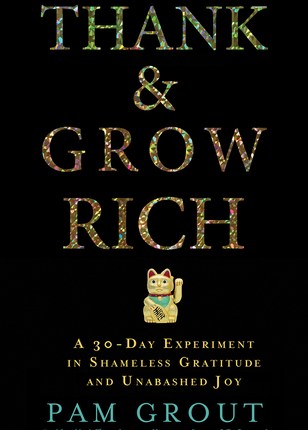
Thank & Grow Rich: A 30-Day Experiment in Shameless Gratitude and Unabashed Joy by Pam Grout

Thank & Grow Rich: A 30-Day Experiment in Shameless Gratitude and Unabashed Joy by Pam Grout

There is a disclaimer written in the description of this book on Goodreads that states it is not for everyone, but it was awesome in my opinion. I am going to admit that I am incredibly biased.

Photo by cottonbro on Pexels.com

I absolutely adored Pam’s other books on New Age thought and had some unbelievable experiences with the experiments recommended in them: E-Squared: Nine Do-It-Yourself Energy Experiments That Prove Your Thoughts Create Your Reality and E-Cubed: Nine More Energy Experiments That Prove Manifesting Magic and Miracles Is Your Full-Time Gig.

However, I couldn’t convince my public library to buy them because, I was told, they are “too fringe”.

Perhaps this book, which focuses on adopting an attitude of gratitude to improve your life, will be mainstream enough to make the cut.

Pam addresses the metaphorical elephant contained in her title early in the book: “No offense to Napoleon Hill, the author of the self help classic on which my title riffs, but the real power is in not thinking. If you want to override your brain’s unfortunate habit of leafing through your past and creating a present hologram to match, forget thinking. And start thanking.” Loc 108, ebook.

I read Think and Grow Rich last year and I could see how other people have beef with the classic. Napoleon Hill focuses on money, making connections, and doing the internal work to shoot yourself into the stratosphere of life success.

There’s very little in there about feeling your way to the same place.

Photo by fauxels on Pexels.com

Pam takes a different approach: “I should get this out on the table right now. This book won’t do a thing for your 401(k) or help you secure the McMansion you pasted onto your vision board. It’s not about getting rich in the traditional sense. … There’s nothing wrong with financial capital, but let me be very clear. It’s incapable of bringing any measure of real happiness.” Locs 324-337 ebook.

She gets to the heart of why seekers chase anything- because we believe that it will bring happiness. Pam suggests getting happy and then the success will come.

And, how does she say that we should “get happy”? By being thankful for what we already have.

“Be astonished by useless things. It’s easy to be thankful for the obvious- healthy kids, public libraries, strong marriages. But in this game we’re going to take it a step further. We’re going to build our gratitude muscle by also appreciating the insignificant and impractical…” Loc 856 ebook.

I had to include that passage for the library mention. Yay libraries!

Photo by Janko Ferlic on Pexels.com

Pam backs up her claims with scientific studies such as: “According to Richard Wiseman, psychology professor at the University of Hertfordshire in England and creator of Luck School, people who think they’re lucky actually are. After eight years of studying hundreds of self-identified exceptionally lucky and exceptionally unlucky people, he concluded that getting good breaks has nothing to do with karma or kismet and everything to do with how we see ourselves.” Loc 991 ebook.

I would like to state for the record that I am one of the luckiest people that I know. 🙂

She also includes a bunch of information from happiness researchers: “When it comes to success, research shows that while IQ, education, and training play cameo roles, the starring role, the headliner on the success stage, is “Do you have a vision? Do you believe it’s possible?” Shawn Achor, author of The Happiness Advantage: The Seven Principles of Positive Psychology That Fuel Success and Performance at Work… claims that predicting success using any other factor (say, your IQ or number of degrees) is about as effective as flipping a coin. What is effective, Achor and Frederickson and other happiness researchers have proven, is creating a happy brain that anticipates accomplishment, that knows success is just a matter of time.” Loc 1876 ebook.

I know that I have a pretty open mind when it comes to these types of books, but my thought is, what’s the harm in it? If it works for you, great! You’ve just discovered a new tool to use for living the best life for you.

If it doesn’t work, no harm done. At the very least, you would know for yourself.

Photo by Belle Co on Pexels.com

I recommend this book for readers of the Abraham Hicks materials because there are quite a few similarities in the philosophies contained within.

Some additional read-alikes for seekers like me who can’t get enough information about the law of attraction: The Power of the Heart: Finding Your True Purpose in Life, Happiness: A Guide to Developing Life’s Most Important Skill, or Dr. Quantum Presents: Meet the Real Creator–You!.

The opinions contained within this review are entirely my own. Thank you to NetGalley and Hay House for a free advance reader’s copy of this book for review purposes!  And, thank you for reading.

The History Major by Michael Phillip Cash

The History Major by Michael Phillip Cash

Something strange happened last night, but Amanda can’t remember what it was. She’s terribly hung over and she knows that she fought with her boyfriend, but that doesn’t explain why her roommate isn’t the person she remembers or why she can’t see out the window. Why does she feel like something is watching her and why does the university campus not look like it did yesterday? And, so starts The History Major.

Discovering what is going on is part of the fun of this short story, so I’d suggest stopping here if you have any intention of reading this yourself. Thank you to NetGalley for a free copy of this short story for review purposes.  ***Please do not read beyond this point to avoid spoilers!!  Warning… Warning!!***

For those that either have read it or are not going to read it… let’s discuss!

So, I feel as if this story, like life some would say, is all about consciousness. How aware are you of your internal worlds? Does our history define us or do we decide what has meaning? Is there such thing as the collective unconscious? And, the biggest question of all, what happens to consciousness after death?

The author begins with Amanda feeling paranoid and it sets the stage for the whole thing: “Her skin prickled again; she felt the sensation of being watched. Amanda turned around and walked backward, looking across the vast estate for the intrusive eyes. The wind ruffled the leaves. Amanda paused, searching for the discordant thing that pulled at her, but there was nothing out of place. She searched but couldn’t find the cause of her uneasiness.” loc 206, ebook. There’s a general feeling of creepiness that never goes away. I didn’t really like that part of The History Major but readers of horror might really love it. Self discovery and self knowledge shouldn’t be scary. The various dream books that I’ve read say that the way to end nightmares is to stop running and face the monster. I feel like Amanda spends far too much time running, but then, I suppose, it wouldn’t make a very good story if she didn’t, would it? Amanda discovers monster, faces monster, and is ok after all.

Amanda is a sympathetic character. I think we’ve all been there: the day after having one too many and waking up to an “uh oh” feeling. She, fairly bravely, faces the first day of college even though she knows something is not right. She even takes her messed up schedule to the secretaries and tries to get them to change her classes. But, I didn’t like how reliant she is on her boyfriend. Given her childhood history (warning, if you are triggered by childhood molestation do not read this book), I can see how she turned out that way, but I wanted her to take the reigns of her life and go for it- not fret about if walking down the sidewalk with another man will make her boyfriend jealous.

I also did not like Death being personified as a monster or the fate of Nick. I don’t believe that Death is evil or comes at us with choking hands. I prefer to view it as a doorway to another reality. As for the “hell” vision for Nick, I think that hell is a state of mind and something that we create on earth, but, this is just my opinion.

“People are trapped in history, and history is trapped in them.” Loc 611, ebook. I thought that The History Major did a good job of using historical figures to help Amanda remember her present circumstances, but I thought that the “history” itself was given too much credit. For example, Amanda could have been watching the tv and been triggered into remembering her past by what came on the screen. Or, she could have taken an art class and been triggered by the works of art in the classroom… there are many topics that could have led to her epiphany.

So, that was my beef with this book: the frightening aspect of searching the subconscious mind, the co-dependent heroine, the nasty personification of Death and the hellish afterlife, and the reliance on historical figures who, when you consider it more closely, have very little to do with what actually happened to Amanda. But, even saying all those things, I read this short story in one sitting and was really interested to see where the author was taking it. Pick up The History Major if you’re interested in a short, metaphysical read. If you’re looking for more in-depth books about any of the history that appears in this story try: Blood & Beauty: the Borgias by Sarah Dunant or Joan of Arc: a History by Helen Castor.

Thanks for reading!

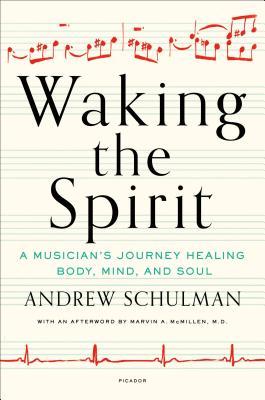
Waking the Spirit: A Musician’s Journey Healing Body, Mind, and Soul by Andrew Schulman

Waking the Spirit: A Musician’s Journey Healing Body, Mind, and Soul by Andrew Schulman
wakingspirit

Waking the Spirit is an educational and uplifting look at music therapy from a world class musician who, not only plays for a critical care unit at a hospital, but was also saved by music himself.

I’ve always known about the healing power of music for the spirit, but I didn’t realize that it had such marked effects on the body itself. When I’m having a bad day or just need to relax, I plop down in front of the piano and play the stress out.

What I did not know, and that Andrew discusses at length in this book, is that music has been used throughout history to treat sick people and the astonishingly positive effects that it has on the critically ill.

The idea behind music therapy in the ancient world is that everything is vibration.

If you play harmonious and balanced music, the human body will, in turn, put itself into harmony and alignment. Sickness was viewed as a simple imbalance: “Early records have been discovered from ancient Egyptian medicine, Babylonian medicine, Arurvedic (Indian subcontinent) medicine, and classical Chinese medicine that incorporated musical healing. The ancient Greeks valued the relationship between music and medicine in the god Apollo, whose gifts included both the musical and healing arts, and the first use of the term “musical medicine” began with Pythagoras, the fifth-century philosopher-mathematician. The Romans are said to have used musicians in their battlefield hospitals as a form of anesthesia.”

Before I read this book, I didn’t realize that music therapy was even a “thing” in hospitals.

It seems like, at least here in the U.S., and this is entirely my opinion, that medicine has moved ever so much farther away from holistic treatments. The preference is for high cost drugs and highly educated doctors to perform surgery… something concrete that people can hold in their hands and say, “Look! This is what I paid for. This thing right here.”

If something, like music therapy, works, but we can’t explain why it works, then people don’t value it as much. That’s where Waking the Spirit comes in.

Andrew provides tons of examples of beneficial music therapy treatments as well as studies to back up his real life experiences. I think this book could be helpful to doctors, nurses, or anyone who is looking to try something inexpensive to make the environment within their institution more appealing.

Take this experience: the patient was in pain and talking to herself (a side effect of the brain surgery she had just undergone). Then, Andrew shows up with his guitar: “At the sound of the first note she turned her head toward me, looking at my face and then at my right hand as it plucked the strings of the guitar. Gone was the scattered expression from her face as her eyes gained focus. She stopped talking, her mouth half-open in surprise, silent. Her face and shoulders relaxed, and she smiled. Not the plastered grin of before but a real smile of pleasure. She was here now, in this room, and not wherever she’d been for the past few hours. Something was connecting. We were just ten seconds into the music.” Powerful.

“Over the years, I’ve witnessed the most remarkable ways in which music can help the healing process, the ways it can calm a patient or lift their spirits, or reach them when they seem locked in a place that no one else can access. It can soothe a staff member’s exhaustion or anxiety and let them refocus on helping a patient, and it can provide a connection for a patient’s family, perhaps bring back old memories and open pleasant topics of conversation.”

Bringing beauty and dignity back to medicine with music.

In this passage, Schulman is talking to Dr. Richard Kogan, a professor of psychiatry, about how just the act of composing music has soothed individuals who are suffering from mental illness and then, their masterworks have gone on to help others: “While it’s important not to overromanticize mental illness- most depressed individuals are too paralyzed to write a symphony and most psychotic individuals are too disorganized to produce a work of art that is coherent- the suffering associated with mental illness can led to bursts of creative inspiration that are less likely to come from an individual that is emotionally content. For many of the greatest composers, music has been profoundly therapeutic.” In other words, artists who used their music to alleviate their own suffering composed some of the greatest music ever written, which in turn as the effect of ameliorating the suffering of others.” It’s a circle of healing.

You don’t have to be a musician to fully enjoy Waking the Spirit. I recommend it for anyone who’s interested in non-traditional treatments for pain and suffering. Thank you to NetGalley and Picador for a free digital ARC of this book.

Thanks for reading!

The Red Queen by Christina Henry

The Red Queen by Christina Henry

redqueenThe second book in The Chronicles of Alice is scheduled to be published on July 12th.

Though it lacked the grittiness and extreme horror of Alice, Red Queen is a fantastic second effort by Henry. We’re reintroduced to Alice and Hatcher as they escape the City and make their way into the wilderness, on a hunt for Hatcher’s long lost daughter, Jenny. Magic, danger, and monsters wait on the path ahead, but those things are nothing compared to what Alice and Hatcher bring with them in their own damaged and twisted minds.

Cheshire, one of my favorite characters, gives a quick summary of the first book in the beginning of this one, in case you didn’t get a chance to read it:“Hatcher and Alice escaped from the hospital, and traveled through the Old City in search of their pasts and in search of a monster called the Jabberwocky who made the streets run with blood and corpses.” The girl shuddered. “I know about him… What about Alice? Did she have a happy ending?” “I don’t know,” Cheshire said.”

Henry weaves enough of the classic tale into her story so that you know that it is a retelling, but still manages to introduce enough original elements in to make it feel entirely new. Like the toll that magic takes on the people who wield it, something that Carroll never addresses: “Maybe power corrupts them,” Alice said. It was a frightening thought, one that made her suddenly reluctant to try any magic at all. She’d spent years under the influence of drugs that made her think she was insane. She was only just learning who Alice was, what it was like to be her own self. She would rather use no magic at all than become some one unrecognizable.”

The world that Hatcher and Alice inhabit feels like the real world in that, there are no guarantees of happily ever after for the main characters. It’s reminiscent of George R.R. Martin in that, Henry makes you feel truly concerned that either Alice or Hatcher are going to be struck down at any moment. But, Henry actually manages to tell a story in 300 or so pages, something that Martin can’t do. Not that I’m bitter or anything… : “The world gobbles us and chews us and swallows us,” Hatcher said, in that uncanny way she had of reading her thoughts. “I think happy endings must be accidents.” “But we hope for them all the same,” Alice said.” I do too.

Alice really comes into her own in this story. She’s brave, but fragile- a damaged hero but resilient. If you’re looking for a strong female protagonist, you’ll find one in this book: “Alice thought, my magic doesn’t seem to be good for much at all. And there is no one who can help me learn, for all the Magicians I have met have been mad or cruel or both. I was mad once too, but it doesn’t seem to have taken properly. I didn’t come out of the hospital with any powerful powers.” Or did she?

This passage summed up the book for me: “This is really all very strange,” Alice murmured. “One of the strangest things I’ve seen, and I have seen lots that is strange. More than my fair share, as a matter of fact.”

Highly recommended for adult readers who enjoy dark fairy tales, magic, and transformation through suffering. I’ve really become a fan of Henry and I can’t wait to see where she takes this story next. If you enjoyed this tale, you may want to try The Library at Mount Char by Scott Hawkins or The Circle by Mats Strandberg.

Thank you to NetGalley and Ace Publishing for a free digital ARC of this book. And, thank you for reading!

The Light: A Modern-Day Journey for Peace by Judith Lambert

The Light: A Modern-Day Journey for Peace by Judith Lambert

In The Light, Judy, the author, chronicles her dreams and her search through various countries and cultures for their ultimate meaning. She calls this book, a memoir, with some pieces changed to protect the privacy of the people involved.

I found it to be an engaging look into the life of a spiritual seeker and a fascinating comparative study of all religions, their symbols, and common meanings.

Judy talks to a librarian named Bill about symbols: “I’ve been having some dreams with symbols that seem to be very powerful and consistent, and I’m wondering whether these symbols have a history or a larger meaning…” “Oh, yes, absolutely,” he broke in. “All symbols have a history and a commonality. There’s no question about that… Images are the means people must employ to understand ideas and feelings. Without them, we cannot reason… but, you see, we often don’t know where these symbols and images come from, do we? We forget their origin and the long history of their use, until we end by thinking that the symbol is the thing itself!”

I’ve heard it said that all symbols are mere pointers. It is like a man trying to draw our attention to the moon by pointing at it, but we mistake the moon for the finger doing the pointing.

Photo by Aron Visuals on Pexels.com

A beautiful description of the chaos at the river, Ganges: “Over the course of the day, blessed pilgrims gathered at Mother Ganga to wash away their sins. Motionless holy men sat absorbed in rumination, their faces turned toward the sun in celebration of the endless cycle of mornings like this. The striking of wet clothing against the steps was accompanied by the distant ringing of temple bells, whose pitch and resonance varied with the preciousness of the material from which they were made- bronze, brass, or iron. And over it all hung a fetid haze smelling of smoke and of- well, I didn’t want to think what else.”

I enjoyedThe Light because Lambert made me feel as if I was there beside her in her spiritual wanderings. I enjoyed the travel parts of this book very much.

The City of Light: “…The Gita,” now he looked out at the Ganges, “speaks of a radiant river of light. Westerners.. well, they often see a surface, and then they have no idea how to look beyond that surface.” He gestured as if to indicate the whole city. “This is the City of Light. Is this not what you were looking for? I do not mean any disrespect, madam,” he hurried on before I could react, “but if one cannot see the Light here, then one has not looked long enough.”

A description of inner illumination: “Nothing changed. Or everything did, for though monk, mandala, walls, cushions, and robes all seemed to remain the same, I felt at last- and only for an instant- the sense of peace that had eluded me since my dreams began.”

Photo by Pixabay on Pexels.com

The author changes immensely over the course of her journey: “I feel a reassuring contentment from all I’ve discovered and all that I’ve been privileged to learn. I am a Jew, a Christian, a Hindu, a Muslim, a Buddhist, everything else, and nothing, all at once. I am…whole… And I believe that all religions possess and have knowledge of the Light. By claiming the Light myself, I can also retain my own personal stories, my own place, and time, and history…” An empowering message and a timely one.

If you enjoyed The Light, you may want to pick up The Realization of Being by Eckhart Tolle (a lecture, any of his talks are along this subject line) or The Invisible Hand: Business, Success & Spirituality by David Green (a memoir about another spiritual seeker and how he found the “Light”).

Thank you to NetGalley and Ann Duran Productions for the opportunity to read and review a digital ARC of this book!  And, thank you for reading.

The New Science of the Paranormal: From the Research Lab to Real Life by Carl Llewellyn Weschcke & Joe H Slate, PhD.

The New Science of the Paranormal: From the Research Lab to Real Life by Carl Llewellyn Weschcke & Joe H Slate, PhD.

Carl Llewellyn Weschcke died last year- may he rest in peace. I eagerly looked forward to reading The New Science of the Paranormal, one of his last (I’m guessing) books that we will ever see from him.

The primary message in here is one of self empowerment and the potential for anyone to develop powers that could be considered “paranormal”. What an appropriate departing lesson from a man who ran a publishing firm dedicated to bringing the occult and mysterious to light.

Photo by Rafael Guajardo on Pexels.com

The New Science of the Paranormal isn’t an “easy” read in that it includes a lot of tables and metaphysical philosophizing about the new age and levels of spiritual evolution.

To me, the most engaging bits were the accounts of students and researchers trying to swing a pendulum with their minds or use dowsing rods to predict the gender of unborn babies.  The scientific experiments that were included are fascinating in their implications.

Also, many of the techniques like water gazing and hand prints in the sand are not ones that I had been exposed to. I’ll definitely be trying some of this out on my own.

“The objective study of paranormal power can dispel many of the myths and “stories” surrounding the topic, including the belief that very few individuals possess paranormal powers. Although certain individuals, often called “advanced beings” or “gifted psychics”, may appear to be extraordinarily empowered, everyone to some degree possesses paranormal potential. Not unlike intelligence, the distribution of paranormal potential within the general population seems to occur in a so-called “normal curve”…

Photo by Lucas Pezeta on Pexels.com

Empowerment: “We are more than we think we are, but we don’t know we are until we develop that level of awareness and related sense of perception. We must grow to become more than we are and all we can be.”

Water gazing, who knew? : “Validated in the lab setting and successfully applied beyond the lab, water gazing is among the most effective self-empowerment techniques known. Whether to increase creativity in writing and art, activate telepathic sending and receiving, facilitating clairvoyance, improve memory, promote successful goal attainment, or generate a state of mental, physical, and spiritual attunement, the powers of water gazing appear to be without limits.”

Photo by Anastasia Shuraeva on Pexels.com

The Crumpled Paper technique was also surprising in its incredible amount of potential uses. Actually, this whole book kind of blew my mind. Perhaps I was dreaming too small.

A bit reminiscent of Abraham Hicks: “…one simple self-administered procedure is: Pay Attention to Your ‘Feelings.’ By that, we don’t mean to get all emotional when ‘feeling’ an idea, concept, event, situation, person, etc., but rather to analyze: what your feelings are telling you, what is it you are sensing, what is the basis for your emotional reaction, etc. And then let yourself explore the ‘answers’ to those questions.”

Know thyself. A message as old as the Delphic oracles.

I’ll close with a quotation included in Chapter Twelve: “Not in the clamor of the crowded street, Not in the shouts and plaudits of the throng, But in ourselves are triumph and defeat.” Henry Wadsworth Longfellow, “The Poets” (1876)

Thank you to NetGalley and Llewellyn Publishing for a free digital ARC of this book!  And, thank you for reading!

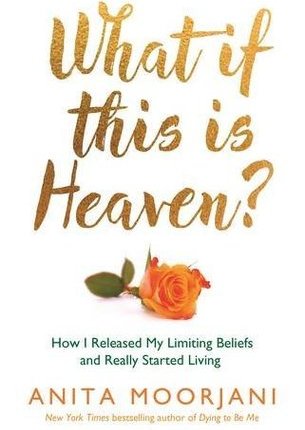
What if This is Heaven?: How I Released My Limiting Beliefs and Really Started Living by Anita Moorjani

What if This is Heaven?: How I Released My Limiting Beliefs and Really Started Living by Anita Moorjani

I was so excited to read What If This Is Heaven?: How I Released My Limiting Beliefs and Really Started Living. Moorjani’s first book, Dying to Be Me, was one of the first accounts of near death experience that I read. In it, she details how she was on her death bed, experienced the world beyond, and then came back to fulfill her life’s purpose.

When she came back, the tumors in her body disappeared and she’s been fine ever since.

It’s an astonishing and uplifting reminder of who we are as eternal beings and why we’re all here. What If This is Heaven is a continuation of this message in that, now, Moorjani is a teacher and lecturer on the topics of spirituality, healing, and self actualization. It’s wonderful.

And, it’s different enough from the first book that readers don’t feel like they’re re-reading the same messages. Moorjani has evolved and I’m very interested to see where life takes her from here.

Here are some passages that I loved:
“A major reason why I chose to return to this life during my NDE (near death experience) was because I understood that heaven is a state and not a place, and I wanted to experience, firsthand, the heaven that this life could actually be.”

“Remember, your only work is to love yourself, value yourself, and embody this truth of self-worth and self-love so that you can be love in action. That is true service, to yourself and those who surround you.”

“On the physical plane, we see love as an emotion, something we have for some people and not others. But the truth is that unconditional love is a state of being, and it’s our birthright. Once we begin to tap into that, we realize is has the power to transform all of our relationships simultaneously- including our relationship with ourselves- for the better.”

“… illness is our body’s way of communicating with us and showing us a better path. Yes, we may die from cancer- or from countless other things- and each of us will die from something at some point. But death is not the enemy. What often is the enemy is the way we view illness…”

Some fascinating teachings about the positive aspects of the ego are included in here: “The ego gives us our sense of identity, our individuality. It’s what allows us to know who we are as individuals and to express our uniqueness. If our ego weren’t necessary, we wouldn’t have been born with it.”

There’s so much more to enjoy in What if This is Heaven beyond these small bits. I highly recommend this read for spiritual seekers and those who are interested in self actualization.  If you enjoyed this book, you may want to read Moorjani’s other book, Dying to Be Me or Co-creating at Its Best: A Conversation Between Master Teachers by Wayne Dyer and Abraham Hicks.

A big thank you to NetGalley and Hay House for the opportunity to review this book!  They sent me a free digital ARC for review purposes. And thank you for reading!