Shadowy art elevates this superhero graphic novel written by the incomparable Neil Gaiman.
Susan Linden is a crime fighter named the Black Orchid. In the first pages of the story, she is killed by gangsters. She spends the rest of the book trying to remember who she is and why she has extraordinary abilities- including reincarnation.
The graphic novel brings in numerous heroes from the DC universe including Batman, Poison Ivy, and Lex Luthor. It was fun to read those interactions.
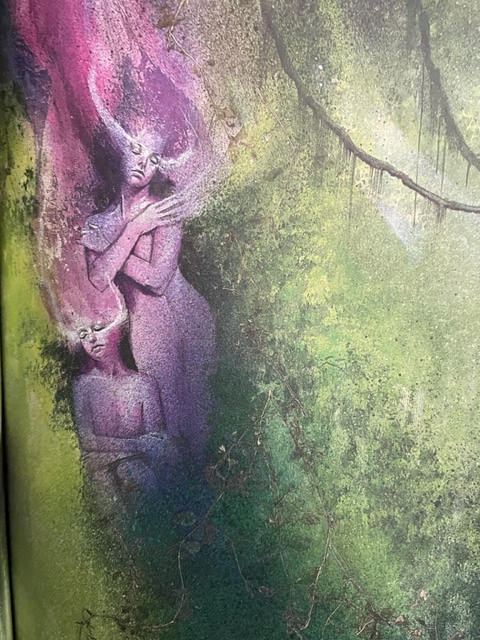
The overall feel of the story is very dark which makes the bright, almost electric purple of the Black Orchid panels stick out so much. Black Orchid and the other flower women are nude and it is handled tastefully throughout.
Here’s the Black Orchid and a friend from the graphic novel:
Before this graphic novel, I had never even heard of Black Orchid. This story makes a great introduction, but it doesn’t go fully into her abilities- some are still a mystery.
At first, I thought it didn’t fit the character that Black Orchid could fly because I associate plants with earth and being tied into the ground. However, in the supplemental materials at the back of the book, it explained that plants can change their density. Then, that particular superhero ability made more sense to me.
This isn’t a story for kids. I’d recommend it for readers 18+ because of the violence and some disturbing dialogue.
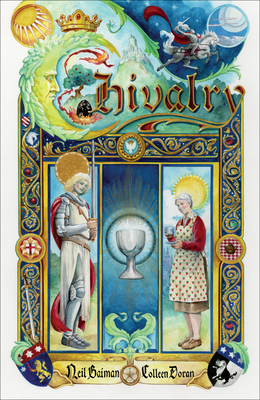
Chivalry is a delightful fantasy short story by Neil Gaiman and illustrated by the talented Colleen Doran.
The story itself is simple: an elderly woman discovers the Holy Grail at a second-hand shop and takes it home. A knight comes questing for the grail and she is unwilling to give it up.
Does everything end up happily ever after for everyone in our tale? Read and see…
I loved the artwork of this story. Doran uses beautiful colors to highlight the art. Some of the pages are done like medieval folios, they were my favorite.
In the notes at the end of the book, Doran shares she wanted to make the whole book like an illuminated manuscript but she discovered that was unworkable. The pages she did do in that style are breath taking.
Highly recommended for fantasy and comic book fans.
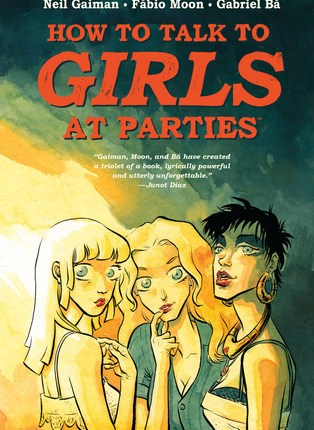
When two young men go to a party, the young women there are so much more than what they expected.
This short story by Neil Gaiman, adopted in a graphic novel format, perfectly captures (in a science fiction-tinged bubble) the bewilderment that goes along with communication and young adulthood.
Sometimes, when you’re trying to chat up members of the opposite sex, it’s as if you’re talking to someone alien from yourself or even just the idea of a person. Gaiman takes this concept and, in typical Gaiman-fashion, runs with it.
He is even able to touch upon the darker side of young, romantic flings. The popular young man in the story gets all the female attention he could want, but at what cost to both him and the young women he leaves behind?
The other young man, referenced in the title because he is hesitant to “talk to girls at parties”, is the one who the narrative follows. His adventure into the worlds of the mind is certainly as wild as his friend’s experience.
This is a quick read, only 10 or 15 minutes, but I found it stuck with me. I was wondering at the layers of meaning in it.
The artwork is beautiful but strange. The women’s eyes are drawn slightly too large for normalcy. It set me on edge and made most of the story unsettling, which I suppose is also the point of the thing.
The story made me think about how much of our relationships take place because we’re brave enough to face that unsettling feeling. And by experiencing “the other”, we come back home a new person than who we were when we left. Maybe not a better person, but different.
Recommended for teens or adults who enjoy science fiction. I think anybody who has faced down their own fears to talk to someone they find enchanting will find something to ponder in this graphic novel.
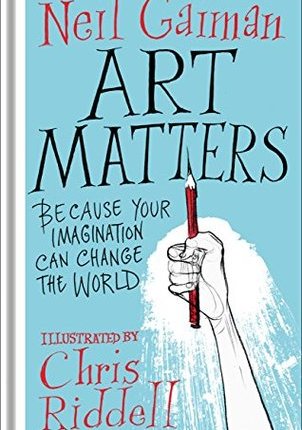
Neil Gaiman and Chris Riddell have created a manifesto for readers, librarians and content creators. This little book celebrates everything having to do with reading, freedom of information and ideas, and how to start creating the life of your dreams, even if you don’t know where to start.
It was compiled from Gaiman’s prolific back catalog of speeches, poems and various other writings about creativity.
“The world always seems brighter when you’ve just made something that wasn’t there before.”
I feel like this should be required reading — especially the parts about how to respond to intellectual disagreements. I think Gaiman penned these words after the bombing at Charlie Hebdo, and they still ring true.
“I believe I have the right to think and say the wrong things. I believe your remedy for that should be to argue with me or to ignore me. And that I should have the same remedy for the wrong things that I believe you think.”
And, of course, I was partial to all of the praise directed towards librarians and libraries, having been a librarian once myself. Sometimes people ask me if I ever think libraries will be closed because “they’re just a building with books” or “they’re a waste of taxpayer money”.
This is how I wished I had replied: “Libraries are about freedom. Freedom to read, freedom of ideas, freedom of communication. They are about education, about entertainment, about making safe spaces and about access to information.” How could that ever possibly go out of style?
Gaiman also gives attention to the bookworms of the world. We make it a better place through our reading and daydreaming and daydreaming about reading. Also, our epic library patronage is a good thing.
“We have an obligation to read for pleasure. If others see us reading, we show that reading is a good thing. We have an obligation to support libraries, to protest the closure of libraries. If you do not value libraries you are silencing the voices of the past and you are damaging the future.”
Gaiman shares a bit about how he became the universally beloved author he is today. Step one, you’ve just got to get started.
“If you have an idea of what you want to make, what you were put here to do, then just go and do that and that’s much harder than it sounds and, sometimes in the end, so much easier than you might imagine.”
He confesses that he lied on early resumes to get his foot in the door. But, after his later success, he went back and worked at all of the places he had claimed before. That way, he didn’t see himself as lying but as “chronologically challenged.” I loved that he took the time to make things right.
Gaiman also has some interesting views about no-start dreamers. He says the saddest thing to him are friends that say they’re too committed to follow their dreams. There’s bills to pay, mortgages and families to support and they can’t take the dive to do whatever it is they’ve always dreamed of doing.
He said he dodged that particular roadblock by skipping a well-paying job or two early in his career, so that he didn’t get too comfortable doing something other than writing. I thought that was an interesting strategy. Creating is about having the courage to just do it, no matter what and not stopping until you’re doing it.
“Somebody on the internet thinks what you do is stupid or evil or it’s all been done before? Make good art.”
The good news is there are more platforms than ever before to get your creations in front of the people who will care about them.
“The gatekeepers are leaving their gates. You can be as creative as you need to be to get your work seen. YouTube and the web (and whatever comes after YouTube and the web) can give you more people watching than television ever did. The old rules are crumbling and nobody knows what the new rules are. So make up your own rules.”
My own life right now points to the truth of that. I left a guaranteed paycheck and employer provided health care to write for my husband’s YouTube channel. We’re not only succeeding but we’re having a lot of fun doing it.
Thank you, Gaiman and Riddell for this beautiful book. I hope it encourages creators everywhere to take the leap.
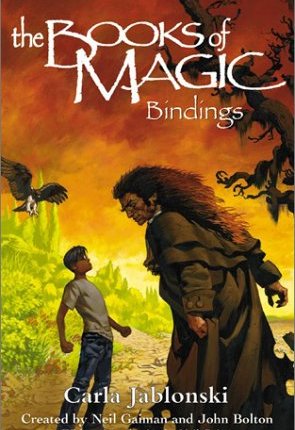
You don’t have to read the previous entry in the series about Timothy to understand this stand-alone story. Carla Jablonski does a good job recapping what has gone on before.
“Throughout all the journeys, it seemed like there were always people trying to kill him or take his magic.” pg 12
My beef with this book is, even though she uses Neil Gaiman’s characters, she doesn’t write with the magic of Gaiman.
The plot is incredibly straight-forward, the bad guys are sadly predictable and it just doesn’t sparkle.
Even Tamlin, the man who went to Faerie long ago and fell in love with its Queen, isn’t as complex as I wish he would be.
Tamlin knew that to the Fair Folk, as something was, it always would be. Nothing ever changed. The ability to see reality and to change was man’s magic. My magic, Tamlin thought.” pg 42
It’s not her fault. Jablonski has written a thoughtful young adult novel about reality not always being what it appears to be and explaining some of Tim’s origins.
She’s just not Neil Gaiman. There’s nothing wrong with that, but if you’re going to write someone’s characters, you need to embody who they are.
Now that he was in a real-life fairy tale, complete with its own monster, he realized how unlikely those stories really were.” pg 111
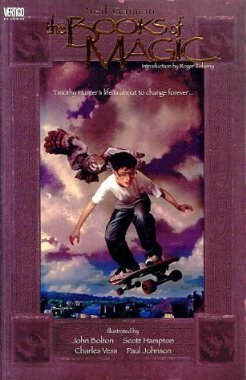
Tim Hunter is destined to become a great magician… isn’t he? Four magical beings take him on realms other than his own, to educate and warn Tim about the path he is about to embark upon.
It is up to Tim to choose his destiny. Great power comes at great cost and it may be more than he is willing to pay.
“Child, magic exists. There are powers, and forces, and realms beyond the fields you know.”
The worlds Neil Gaiman has created in The Books of Magic are haunting and layered and will stick with you after you’ve finished the story and closed the book.
So… typical Gaiman then.
“The true Atlantis is inside you, just as it’s inside all of us. The sunken land is lost beneath the dark sea, lost beneath the waves of wet, black stories and myths that break upon the shores of our minds.”
A fantastic tale about two dead detectives, who are trying to solve a missing person case. It sounds macabre but it’s actually a fairy tale.
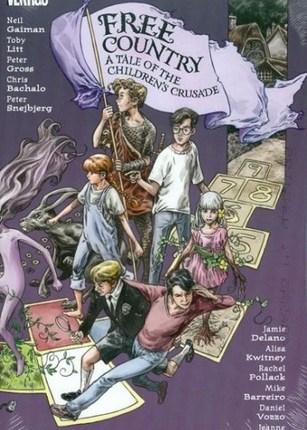
Neil Gaiman includes this in his introduction: “I asked Alisa Kwitney, who cowrote much of the second half of The Children’s Crusade, if there was anything she wanted me to point out and she said yes. I should tell people that in the double-page spread with the mermaids and the magic, she had instructed artist Peter Snejbjerg to draw a very young Nail Gaiman reading a book, oblivious to the wonders around him.”
I made sure to check on that page- and there he was. If you read this too, make sure to look for Neil in the full-page spread depicting Free Country.
The premise of this tale is like Peter Pan, but with a twist. There’s a land where children can live in peace and harmony and never grow old… but at what cost.
“Look at them, who call themselves adult- they eat, they work, they sleep. Their pleasures are gross and ugly, their lives are squalid and dark. They no longer feel, or hurt, or dream. And they hurt us. They say every adult has successfully killed at least one child, heh? Free Country is the refuge. In the past, it was the refuge only for the most fortunate of the few. But those days are ending. It will soon be the home of every living child.”
If I had known the catalog of Vertigo comics, I may have enjoyed this more. But, you don’t need to be an aficionado of comics to enjoy Free Country. It can be a stand-alone graphic novel with plenty of chills and thrills along the way.
It was for me.
Recommended for adults to like twisted tales with a fairy-tale flavor or for 16+ because of the potentially disturbing content.
In Sandman, a powerful group of mortals is trying to trap Death itself. Instead, they catch another important figure, the Lord of Dream. This volume details the Lord of Dream’s struggle to reassert his power after being locked away for so many years.
He’s lost his symbols of authority, which are literally pieces of his power. So, he needs to get those back.
Also, the denizens of the realm of Dream have gone off the rails since their lord has been missing. Some of these are nightmare creatures- fatal to humankind. This isn’t going to be simple.
Sandman, Vol. 1 was very dark. Neil Gaiman is known for his dark fantasy, but there are usually moments of light. In Neverwhere or The Ocean at the End of the Lane, there is darkness, but nothing like this.
Within these pages, there’s serial killers, child abusers, psychotic mental ward escapees, kidnapping rapists- one after another in a seemingly endless parade. It’s a lot to take.
I found I wasn’t a fan of the Lord of Dream himself. His immortal nature has made him unable to understand emotions or even desire to. I suspect that subsequent volumes deal with this exact issue. But, he’s rather unlikeable in Vol. 1.
I really disliked the way he treated women- in multiple relationships. The worst being Nada. Again, I’m guessing that this is a story of redemption. But in that one moment, no spoilers but readers know what I’m talking about… his behavior was unforgivable.
Honestly, I liked Watchmen more. So far. The characters in that tale weren’t necessarily likeable either. I suppose we’ll have to see how the story develops in the next volume.
Recommended for graphic novel readers who like their stories gothic, mythical and with a sprawling storyline.
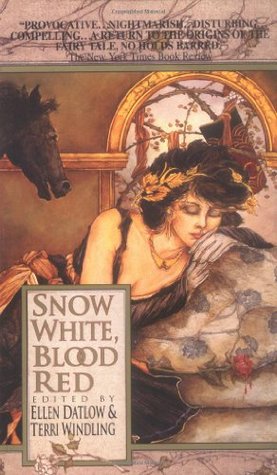
Full credits for Snow White, Blood Red by Ellen Datlow (Editor), Terri Windling (Editor), Elizabeth A. Lynn (Contributor), Harvey Jacobs (Contributor), Steve Rasnic Tem (Contributor), Melanie Tem (Contributor), Caroline Stevermer (Contributor), Ryan Edmonds (Contributor) , Neil Gaiman (Contributor), Leonard Rysdyk (Contributor), Esther M. Friesner (Contributor)
This is a very adult collection of fairy tale re-tellings. From Little Red Riding Hood to Snow White, these are not stories that I’d share with my child or any impressionable young mind.
Fairy tales haven’t always been exclusively for children as Terri Windling explains in the introduction: “..most fairy tales were never initially intended for nursery duty. They have been put there, as J.R.R. Tolkien so evocatively expressed it, like old furniture fallen out of fashion that grown-ups no longer want. And like furniture vanished to the children’s playroom, the tales that have been banished from the mainstream of modern adult literature have suffered misuse as well as neglect.” pg 2
But fairy tales are important because they touch on dreams, archetypes, and the psyche. However, these re-workings were far more bleak than I expected. “The fairy tale journey may look like an outward trek across plains and mountains, through castles and forests, but the actual movement is inward, into the lands of the soul.” pg 10. And personally, I think that the soul is a rather light place.
The most disturbing of the bunch, in my mind was, Little Redby Wendy Wheeler, which told a tale of sexual relations between a mother/wolfish boyfriend/daughter. (A warning for any sensitive readers, triggers abound in these stories from rape to physical/sexual/emotional abuse towards adults as well as children.) “Before she climbed in, Helen looked in my face as though something in my smile disturbed her. “I’ve never noticed before what white teeth you have, Josef,” she murmured. “So large and white.” pg 140 The only saving grace for the darkness of these tales are that they’re short and you’re soon on to the next one.
My favorite was Puss by Esther M. Friesner: an excellent but nightmarish re-imaging of Puss-n-Boots. “Help! Help, ho!” My paws flailed the air; I brandished my plumed hat to make the coachmen see so small a creature as a cat before the horses trampled me. “Robbers, thieves, rascals and hounds! They have despoiled my good master, the Marquis of Carrabas!” pg 319
A close second was Troll Bridge by Neil Gaiman, based on The Three Billy Goats Gruff. His depiction of a troll was creepy but magical, that curious blend of two unrelated traits that Gaiman crafts so well. “Trolls can small the rainbows, trolls can smell the stars,” it whispered, sadly. “Trolls can smell the dreams you dreamed before you were ever born. Come close to me and I’ll eat your life.” pg 286












 In Sandman, a powerful group of mortals is trying to trap Death itself. Instead, they catch another important figure, the Lord of Dream. This volume details the Lord of Dream’s struggle to reassert his power after being locked away for so many years.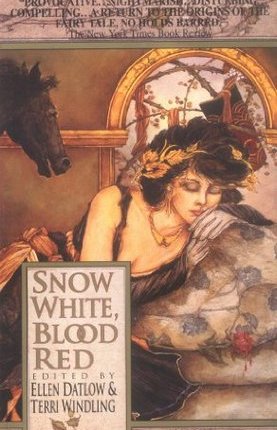
 Full credits for Snow White, Blood Red by Ellen Datlow (Editor), Terri Windling (Editor), Elizabeth A. Lynn (Contributor), Harvey Jacobs (Contributor), Steve Rasnic Tem (Contributor), Melanie Tem (Contributor), Caroline Stevermer (Contributor), Ryan Edmonds (Contributor) , Neil Gaiman (Contributor), Leonard Rysdyk (Contributor), Esther M. Friesner (Contributor)
 The Help Desk Book Blog