“Not only can we defeat entropy, but the universe, in a way, wants us to use our powers as conscious beings to make things better. And part of that is defeating death.” pg 50
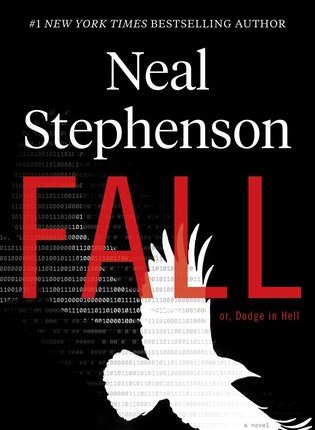
I finally finished Neal Stephenson’s latest book, an opus about the nature of reality that uses mythology, archetypes and technology as the instruments of that examination. Coming in at a hefty 896 pages, it will most likely be the longest book I read this year.
“Far from being a source of frustration, this comforted him, and made him happy — perhaps even a little smug — that he lived in a universe whose complexity defied algorithmic simulation.” pg 19

Richard “Dodge” Forthrast, one of the many protagonists from Reamde, suffers an unexpected injury and dies — to the horror of his loving family. Immediate complexities reveal themselves in his will, which contains very specific instructions on what is to be done with his corpse and living brain.
These instructions will lead to a technological coalition of companies and big money in an effort to create another reality for the “recently diseased”. And, what happens in that new world is beyond anyone’s (among the living) control… isn’t it?
Stephenson, as usual, has created a complex science fiction novel that not only makes you think again about where technology is headed, but also compels you to ask yourself what that exponential development means.
“It’s really only since wireless networks got fast enough to stream pictures to portable devices that everything changed,” Enoch said, “and enabled each individual person to live twenty-four/seven in their own personalized hallucination stream.” pg 236

And lest one think such changes are so far off, you only need to take a look at someone else’s Facebook newsfeed. The difference between what I see on that platform and what my husband sees is shocking. Our “own personalized hallucination stream” is already a reality.
Stephenson is at his best when he’s mixing science fiction and fantasy in Bitworld. He’s at his worst when he’s clocking the changes going on in the real world or “meatworld”, as his characters call it. One likes to think that he had reasons for including the myriad of details that he includes, but readers could also suspect that he needed a good editor.
The first portion of this book moves agonizingly slowly, which prevented it from being a five-star read for me. But that was its only downside in my view.
“So he went into the room where the disciples of Greyhame and Pestle scratched out words on paper, and told them to go through all of their documents and make him aware of any mention they might find of angels, or the One Who Comes, or Daisy, or death.”pg 482

I can’t say I completely understand the ending of the story, but it is epic. I find myself still thinking about it and taking pieces apart in my mind. And, for me, that’s one of the hallmarks of a good read.
Recommended for science fiction readers who can tolerate a very slow build-up for a potentially puzzling end.
Thanks for reading!
- The Ballad of a Small Player: a Metaphysical Movie Review
- Otherwhere: A Field Guide to Nonphysical Reality for the Out-Of-Body Traveler by Kurt Leland
- Psychic Dreamwalking: Explorations at the Edge of Self by Michelle Belanger
- Archetypes on the Tree of Life: The Tarot as Pathwork by Madonna Compton
- The Goddess and the Shaman: The Art & Science of Magical Healing by J.A. Kent



 The Help Desk Book Blog