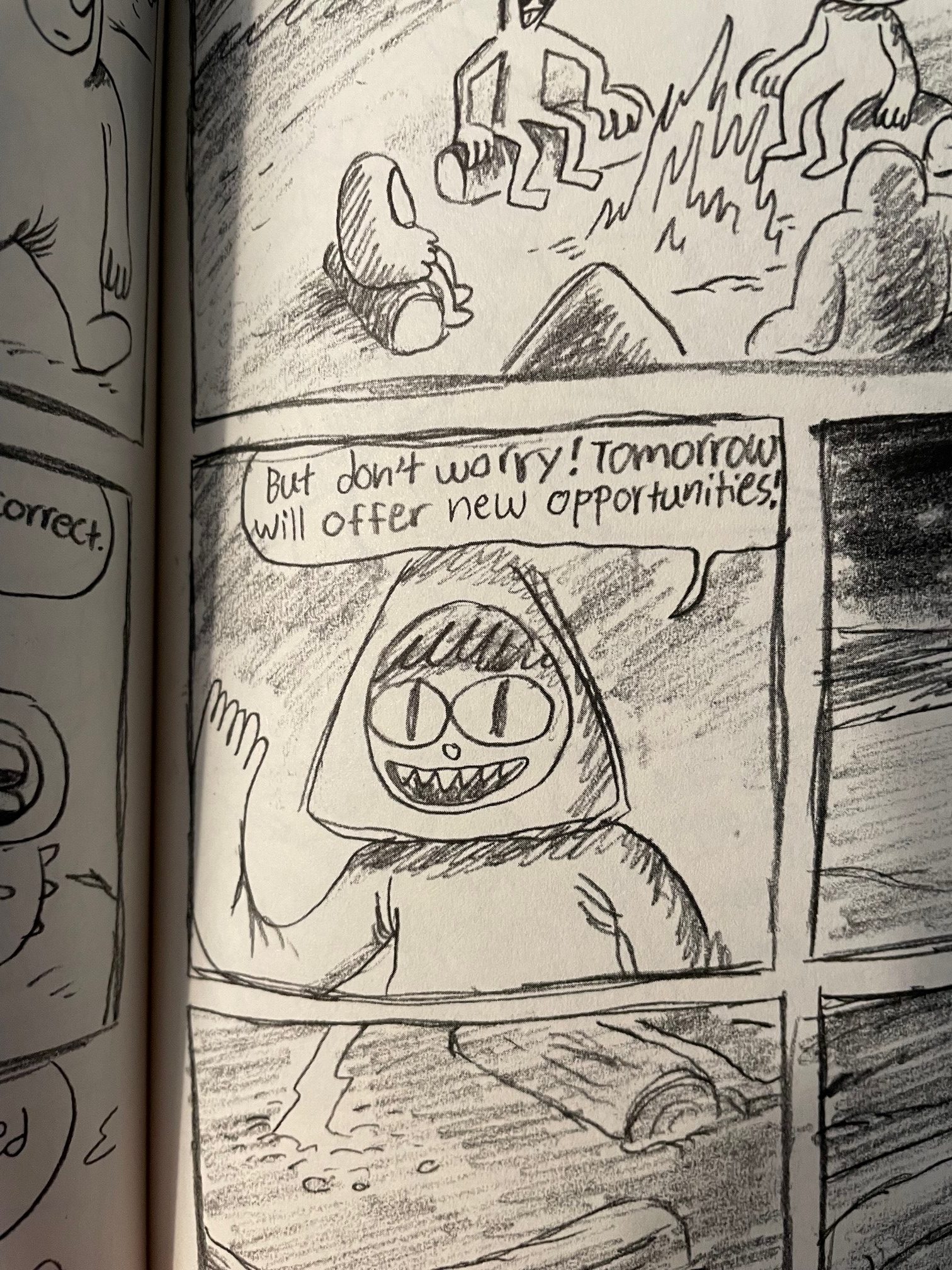
The Paradox of Getting Better is about a young person who is struggling with mental health issues. These struggles are symbolized in the comic by strangely shaped bodies and surreal art.
The artwork itself is done in pencil with words crossed out and rough edges with lines coming off of it. There’s a definite style to this comic. It didn’t resonate with me.
I understand this is an indie comic, but I wanted to see a little more polish to the presentation. As it is, the book felt like an art project in its early stages- more like a book proposal than a finished project.
The writing in this comic is fantastic by the end. However, at the beginning, the main character can’t even speak in words. They just keep saying, “XXXX”, over and over.
I get this is supposed to represent an inability to communicate in the midst of a mental health crisis, but it didn’t quite work. The family members of the individual were able to understand what the sufferer was saying, but the readers weren’t. It didn’t feel fair. I wanted to understand that person too.
This work is very imaginative. I liked the shapes the author incorporated and I also liked the message in the final panels.
If you’re going to read this one, I recommend borrowing it from your local library. Thanks for reading!
“Qualities like gentleness, patience, warmth, and empathy can be so undervalued in this day and age that when we need to sit down with someone devastated by a loss or turbulent change in their lives, we often feel unsure about what to say or do.” pg 7, ebook.
Author Val Walker discovered first-hand that there is a lack of knowledge about offering comfort in the modern age. She was going through a divorce and relocation, and had no one to confide in. She said her friends and family members were either too busy to give her some of their time or they gave her a type of attention she didn’t desire- like mouthing platitudes or giving unwelcome advice.
Walker realized that society has lost its ability to do something as simple as listen and be present. She wrote this book to help others offer this gift to those around them.
“Presence. Unshakable, steady, tender, and empathic presence. Soft strength. That was comfort.” pg 10, ebook
She dispels many myths about what comforting may look like, including my concern that I never know what to say when someone shares their inner turmoil with me.
“Myth: Comforters always know what to say. We don’t have to know the right thing to say. Sometimes there is really nothing that can be said.” pg 21, ebook
After that, Walker interviews mental health professionals from many different modalities, offering different ways that these comforters approach and soothe those around them. From creating art to writing to simply watching television together, there are so many opportunities to spend time and connect with someone in need.
“The language of comforting is a language like any other- it can be learned but, once mastered, can become as effortless as breathing. And if our words and gestures are warm, empathic, and respectful, they will help to create a safe space for the comforter and the one being comforted to inhabit.” pg 81
The past year has been devastating for so many. I picked up this book because I never know what to say when someone comes to me with pain or disappointment or heartbreak.
Walker has reassured me that sometimes the best help anyone can give another is to say nothing at all but to offer the gift of your presence and attention. Because at the end of the day, another word for ‘comfort’ is ‘love’. And we all know how to do that already, right?
“Approximately 15 to 20 percent of the population have trouble screening out stimuli and can be easily overwhelmed by noise, crowds, and time pressure.” pg 10, ebook
Ted Zeff, a self professed highly sensitive person or HSP, shares coping mechanisms he’s cultivated throughout his life-long struggle with the unique way he responds to every day life. Topics range from improving work environments, personal relationships with non-highly sensitive people, getting a good night’s sleep and more.
While you can’t live your life totally removed from the world’s jolts, you can create an environment that minimizes stimuli. If you can anchor yourself to a ship of tranquility, you won’t be tossed about by the waves of stimulation.” pg 22
I am a highly sensitive person too. Most of the tips and habits Zeff suggests in this book are common sense and were not all that helpful to me. The material also becomes somewhat repetitive as the book goes on. But, if you’ve just discovered this about yourself, I could see this book being eye-opening.
“Since our aggressive society values non-HSP behavior, HSPs must learn to create boundaries and speak up. Unfortunately, many HSPs are shy and feel embarrassed to state what they want.” pg 63
Something I did learn about in this book is the highly sensitive person issue of “time pressure”. I know deadlines and meet up times stress me out, but I didn’t realize that was fairly typical of highly sensitive people.
“Combined with your high sense of responsibility, functioning under time constraints can be one of the most difficult aspects of being a highly sensitive person. In this section you will learn specific techniques to successfully deal with the daily pressures of our fast-paced modern society.” pg 32
In The Spiritual Gift of Madness, Seth Farber interviews half a dozen people who have had negative experiences with western psychology as well as experts in mental health. His thesis is the mental health system as it is values medication over other types of therapy and, because of this misguided focus, harms the very people it is attempting to help.
He is a champion of the Mad Pride movement, a group that seeks to celebrate and assist those suffering from mental health issues to embrace who they are rather than medicating it away.
“… helping the mad does not mean drugging or coaxing them into a state of “adjustment,” but rather appreciating the state of madness for what it is: an existential clearing in the jungle of our insane modern society that potentially leads into the realm of true sanity, which, in the world today, means a state of creative maladjustment.” pg 124
I should mention that Farber doesn’t use “mad” in a negative way, rather he uses it to highlight how individuals with different viewpoints from the rest of society are marginalized and sedated into silence. He puts forward the idea that insanity is believing everyone must view the world in the same manner or be ostracized for it. He holds up society’s repeated failures to handle issues like global warming to racial and gender equality as evidence of the insanity of the world.
“Now one of the things that’s so detrimental about the hospitalization is the power impact of being treated like a patient – people end up believing they’re chronically mentally ill.” pg 44
Farber believes mental illness is a transition to a new, potentially powerful state of being that, as a modern society, we quash before it’s completed. He points out that many of the great prophets and visionaries from history had, what we would now call, complete breakdowns before their epic breakthroughs.
“… a few weeks of mania could give one access to a sense of understanding that it could take ‘years of meditation’ to achieve, access to visions of ‘the wholeness’ of the universe and ‘the interconnected nature of love, access to a sense of time and space that allows one to discern what is and what is not important.'” pg 21
Instead of medication and psychiatric facilities, Farber would like to see the creation of safe havens for people going through this process so they could assimilate whatever is going on in their minds before going back to the rest of society. That would be for the experiencer’s protection as well as the public.
I think Farber brings up important issues in this book. As someone who has struggled with mental illness, I’ve viewed the system from the inside and recognize some of the problems he points out. There’s the stigma of the diagnosis and the embarrassment of feeling separated from “normal”. There’s the expectation you will take your meds from the day you’re labeled until you die, no matter the side effects.
But, worst of all, is feeling like you can’t trust what’s going on in your head because it went so spectacularly wrong before and what’s to prevent it from going sideways again.
I agree some changes need to be made to the system and, as a society, perhaps we can do a better job minimizing stigma, maximizing communication, and helping people live in a happy and healthy manner that they choose.
However, I feel like Farber goes too far in his insistence that the “mad” are the future. That somehow they hold the keys to a paradise on earth if only we’d let them share their messages unfettered.
In the midst of my psychosis in 2009, I wouldn’t have wanted any of the nightmares in my head to permanently affect my future or my family. If there are lessons to be learned from it, maybe it’s an individual message for the people undergoing the change rather than expecting it to be universal lessons, applicable for everyone.
But, that’s my two cents. I certainly don’t have all the answers, but The Spiritual Gift of Madness asks some interesting questions.
Recommended for seekers who are interested in a different way to both approach and treat those with mental illnesses or for those who have gone “through the looking glass” and are now viewing the world from the other side, like me and the people in this book and many, many others.
Everyone experiences anxiety in some form or another in their lives. The trouble comes when you find yourself altering your behavior to avoid triggering yourself, painting your life into smaller and smaller boxes in order to attempt to control the anxiety.
This self help workbook hands you the keys to your anxiety response. By unlocking that, you give yourself back the freedom that you may have lost to uncontrollable anxiety.
Michael Tompkins uses cognitive behavioral therapy, mindfulness and acceptance therapies to tackle most major anxiety issues.
I liked his approach because mindfulness is a practice that I enjoy incorporating into my life anyway. By applying it to my anxiety responses, I learned a lot about myself in a very short period of time.
“The purpose of both our primary and secondary anxious responses is to protect us from the threats and challenges of life. For some people, however, the natural and normal secondary anxious response creates problems. These people are stuck in their secondary anxious responses and because they’re unable to move out of it, they have an anxiety disorder.” pg 22
But no matter what coping mechanisms therapists may bring to the table, we have to be willing to put them into action. Tompkins reminds readers to be gentle with themselves and that “true motivation is an invitation, not a push.”
“True motivation is a willingness to try because you recognize and accept that it makes sense for you to change.” pg 43
Once you know your triggers and responses, Tompkins guides the reader through exposure therapy to continue releasing any further anxiety responses.
I know no method or book will be a breakthrough for everyone, but I found this particular book to be incredibly helpful and informative. I highly recommend it for anyone suffering from anxiety, panic or fear.
It could be the jump start you need to discover true healing and freedom from the fears that may be holding you back from living the life you’ve visualized for yourself.













 The Help Desk Book Blog