The Lady Who Plucked Red Flowers Beneath the Queen’s Window by Rachel Swirsky

The Lady Who Plucked Red Flowers Beneath the Queen’s Window by Rachel Swirsky

The Lady Who Plucked Red Flowers Beneath the Queen’s Windowis a fantasy short story about how much one’s world view is shaped by culture, the time period in which one lives, and love.

The main character, Naeva, is a powerful magician. She serves the queen of a matriarchal society to the best of her capability.

Naeva’s love for the queen is used to trap her soul, so she can be summoned from beyond the grave to serve forever.

Photo by Maria Orlova on Pexels.com

“The Queen needs you, Naeva. Don’t you love her?” Love: the word caught me like a thread on a bramble. Oh, yes. I loved the queen. My will weakened, and I tumbled out of my body. Cold crystal drew me in like a great mouth, inhaling.

This binding is problematic, because the queen doesn’t live forever.

I was captivated by this story. It surprised me because short stories aren’t usually my thing.

During a bout of insomnia one night, I read The Lady Who Plucked Red Flowers in one sitting.

You can read it too, if you’d like. It is available in its entirety online: https://subterraneanpress.com/magazin…

There are subtleties in the story about feminine and masculine power, but also mankind’s penchant for judging current culture as superior to all others that have ever or will ever exist.
Photo by Teddy Yang on Pexels.com

“It was becoming increasingly clear that this woman viewed me as a relic. Indignation simmered; I was not an urn, half-buried in the desert. Yet, in a way, I was.”

Naeva suffers not only because she’s trapped and cannot die, but also because her matriarchal culture is left behind in the depths of time.

“I had never before been aware of the time that I spent under the earth, but as the years between summons stretched, I began to feel vague sensations: swatches of grey and white along with muted, indefinable pain.”

Photo by Aistu0117 Sveikataitu0117 on Pexels.com

She changes, but reluctantly and slowly. And love has as large a role in shaping her development as it did in her entrapment.

It is a wonderful fairy tale. I highly recommend it for sleepless nights or a boring lunch hour.

Thanks for reading!

The Book of Speculation by Erika Swyler

The Book of Speculation by Erika Swyler

Simon works in the reference section at a struggling library in Maine, whose biggest draw is a whaling archive. He’s hard up for money and his historic home on the coast is in such disrepair that it’s about to fall into the ocean.

One day, Simon receives a very old book in the mail. Strangely, it has some of his family member’s names in it.

Photo by Suzy Hazelwood on Pexels.com

The text describes a circus, a boy who can’t speak, and a girl who can hold her breath so long that they call her a mermaid.

But, what does this have to do with his family? And why do so many of the people in the book die on the same day?

In addition to the mystery, The Book of Speculation includes one or two love stories: “Redheaded and pretty, Alice has her father’s smile and a way with kids. She’s better with people than I am, which is why she handles programming and I’m in reference.”pg 9, ebook.

Photo by Maycon Marmo on Pexels.com

I did not like how the reference section was stereotypically depicted as the “bad with people” part of the library. I have a soft spot in my heart for those reference types, having been one myself in my previous job. 🙂

Also, for being a librarian, Simon doesn’t act very librarian-y.

Take this part when he receives the mysterious book: “The box contains a good-sized book, carefully wrapped. .. A small shock runs through me. It’s very old, not a book to be handled with naked fingers, but seeing as it’s already ruined, I give in to the quiet thrill of touching something with history.” pg 15.

Photo by cottonbro on Pexels.com

No self-respecting archivist would do that. “Already ruined” so who cares? I don’t think so.

The fantasy/magic portions of this book are subtle and written so that one could almost believe that it was real.

Take Amos’ (one of the characters from the old book) ability to disappear: “People may live for a century without discovering the secret of vanishing. The boy found it because he was free to listen to the ground humming, the subtle moving of soil, and the breathing of water- a whisper barely discernible over the sound of a heartbeat. Water was the key.” pg 18 ebook.

Photo by Jess Vide on Pexels.com

The history recorded in the old book is revealed to the reader through a series of flashbacks. That bothered some of my friends on Goodreads but the circus folk stories are my favorite parts of this book.

The characterizations are ok, nothing extraordinary.

My favorite minor character, Benno, could have used more fleshing out: “After a time Benno climbed down from the wagon. “You are my friend and you are kind,” he said quietly. “More than is good. I was taught to watch for gentle souls, as they’ve not the wit to look after themselves.” pg 124, ebook.

Some similar reads (perhaps a bit more magical than this): The Golem and the JinniMagonia or The Mermaid’s Sister.

Thanks for reading!

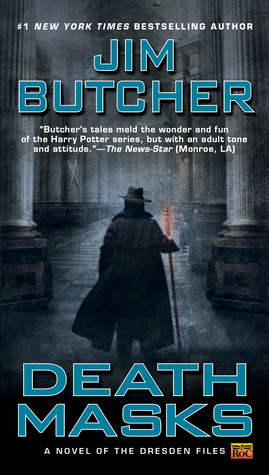
Death Masks (The Dresden Files, #5) by Jim Butcher

Death Masks (The Dresden Files, #5) by Jim Butcher

deathmasksHarry Dresden can’t catch a break… or a full night’s sleep. He’s up against the Red vampire court, he’s being attacked by supernatural creatures with powers he’s never seen before and his ex-girlfriend is back in town.
But, you can’t keep a good wizard down, right?

Even when you introduce a holy relic into the tale: “Someone stole the freaking Shroud of Turn?’ I demanded. ‘Yes.’ I settled back into the chair, looking down at the photos again. This changed things. This changed things a lot.” pg 28

In case you haven’t read the first four entries in this series: Harry Dresden is a wizard for hire. He solves supernatural crimes, he finds lost items and he never seems to make enough money to be comfortable.

“I’d learned something in several years of professional wizarding. Never walk into a fight when the bad guys are the ones who set it up. Wizards can call down lightning from the heavens, rip apart the earth beneath their enemy’s feet, blow them into a neighboring time zone with gale winds, and a million other things even less pleasant- but not if we don’t plan things out in advance.”pg 58

Some criticisms of this series are that the humor is juvenile and corny. I’ll confess: it is. But I still love it.

“I get more threats before nine a.m. than most people get all day,” I responded, and shut the door on him. Purely for effect, I locked it too. Me, petty? Surely not.” pg 110

If I was a male wizard, I think I’d be something like Harry. I’d go in with the best of intentions and end up with the most mediocre of results.

Harry stands up for the little guy and has a soft spot for the ladies. He protects children and holds the door for women.

He likes to drink, wears a leather duster and can’t seem to sleep even when he’s exhausted.

Aren’t we all, in some ways, Harry Dresden? Fighting the good fight, even though we know that death waits around the corner?

“Apocalypse, as you refer to it, isn’t an event. … Apocalypse is a frame of mine,” he said then. “A belief. A surrender to inevitability. It is despair for the future. It is the death of hope.” pg 353

Recommended for fans of urban fantasy and especially the Iron Druid Chronicles by Kevin Hearne. I am a fan of The Dresden Files despite the fact that it can seem formulaic. I think Harry Dresden is worth the read.

Thanks for reading!

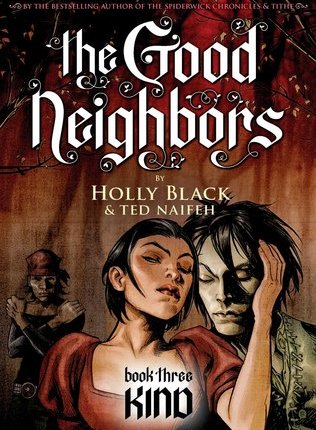
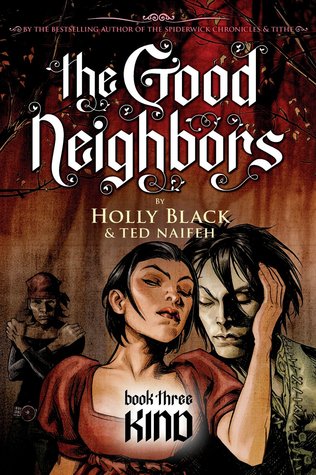
Kind (The Good Neighbors, #3) by Holly Black

Kind (The Good Neighbors, #3) by Holly Black

kindRue’s grandfather put his nefarious plan to merge the faerie world with the normal one in motion at the end of the last book. Now, everyone in Rue’s town is going bonkers. Faeries are roaming the streets, eating and manipulating humans. The more organized groups of people are fighting back. It’s a mess.
“What do you do after the end of the world?”

Meanwhile, Rue has a love triangle going. Her boyfriend Dale has taken up with some bloodthirsty bog faeries and she needs to save him. But, she can’t seem to forget Tam, a young man who has a special talent for speaking the truth and was stolen away from the real world by faeries.

What’s a girl to do?

“When people tell you to forget things, they really just mean that you should pretend to forget. No one actually forgets.” “You are as heartless as any faerie girl, Rue, yet I want you to look at me and to see me. To see me like I see you.” pg 25

And who is going to save the town?

“There is a reason why mystics are mad, Rue. We- people, humans- cannot sustain exposure to the supernatural. That’s why we’re not meant to live like this. Already, people’s minds can’t handle it.” pg 55

The artwork in this series reminded me of The Walking Deadgraphic novel franchise. Sometimes, it’s good, but then in other panels, you can’t tell one character from another.

There are some truly beautiful and grotesque faeries. I think the artist, Ted Naifeh, was at his best with the supernatural creatures.

The ending to this series was a little too predictable for my taste. But, it is good enough for what it sets out to do- entertain young adults with a slightly darker fairy tale.

Thanks for reading!

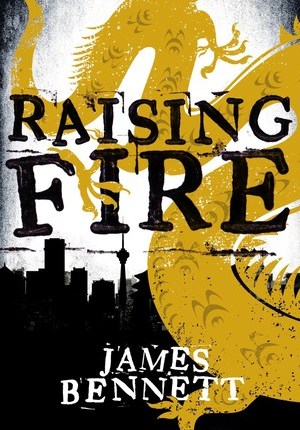
Raising Fire (Ben Garston, #2) by James Bennett

Raising Fire (Ben Garston, #2) by James Bennett
raisingfire

Red Ben, a dragon, is the last of his kind. He is a Remnant, one of the few magical creatures left to walk the earth after the sealing of magic by King John in 1215.

However, laws have been broken, the ancient guild of knights that was tasked with guarding the lore has been slaughtered and the religious branch of the pact is after Ben.

Meanwhile, the last fairy who guards the enchanted sleep of all of the magical creatures, as well as other ancient magics, has gone missing. Could things get much worse? Probably. Ben isn’t holding his breath.

I like the world James Bennett has created.

I also like Ben. He reminds me of a draconic Harry Dresden. He’s magic, cynical and sometimes makes mistakes when he’s tired.

And, like the wizard Harry Dresden, Ben protects the unsuspecting public from great evil and all manner of magical mischief makers.

“Ahead, an open space spread out before him. Tiananmen Square, the largest square in the world, at least offered a safer battleground. With a snap of his wings, he pushed himself after the dragon, flying beyond firing range. A moment of grace that he knew wouldn’t last. He was already too late.” pg 112

Raising Fire is the sequel to Chasing Embers. It delves more deeply into the legend of the fey and how they left the world, and their creatures, behind.

Photo by Eva Elijas on Pexels.com

In the great brier of fabulous beings, the Fay were like roses made of steel. The petals might look pretty enough, but if you didn’t watch your fingers, you’d quickly find out that they were sharper than razor blades.” pg 165

Readers also get to meet Jia, the Guardian of the East. A young being when her parents are put into the enchanted sleep, Jia grows and matures without her family and only the fairy that put them to sleep for a teacher. She plays an important role in this story.

Jia traipsed behind Ben through the valleys of treasure, her eyes wide, her feet crunching over jewels, kicking the occasional urn from her path. An enchanted light illuminated the cavern, shimmering from the treasure itself, gathered over centuries into a bed.” pg 202.

Photo by cottonbro on Pexels.com

Warning: Raising Fire ends on a cliffhanger. If such things bug you, you may want to wait to read it until the next book is out.

Recommended for readers who enjoy cynical heroes, urban fantasy and dragons.

Thanks for reading!

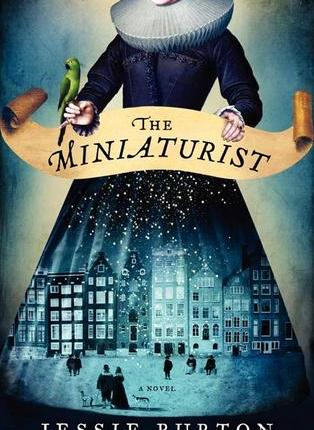
The Miniaturist by Jessie Burton

The Miniaturist by Jessie Burton
miniaturist

A young woman gets married to a man she’s never met. The household she enters is cold and uninviting. As a strange wedding present, her husband buys the woman a mock up of her household.

Against her wishes but wanting to please her husband, Nella hires a miniaturist to build furniture for the gift. The miniatures she receives are accurate enough to be scary. It seems that the miniaturist knows things about her life that Nella doesn’t.

This is a story about secrets, trust and unexpected magic.

What killed this story for me was the pacing. It dragged agonizingly along.

The bits about the miniaturist were fascinating. I loved the premise of it- a complete stranger seems to know more about your life than you do. How is that possible?

But, I found the rest of the story to be too slow to make up for the fun parts.

Also, I have so many unanswered questions. I felt like Jessie Burton didn’t answer most of the questions she raised in the story.

And, I found the ending to be completely unsatisfying.

I enjoyed learning about 17th century Amsterdam. I liked learning about the societal roles of men, women and the power that religion held over people’s lives.

I also liked Cornelia and Otto- the two servants in Nella’s new home. Any scene with either or both of them was charming.

Recommended for readers who have much more patience than me. The Miniaturist reveals its secrets slowly, if at all.

It sounds like The Miniaturist is going to appear on BBC the day after Christmas. I wonder if it will be better than the book: www.radiotimes.com/news/tv/2017-12-13…

Thanks for reading!

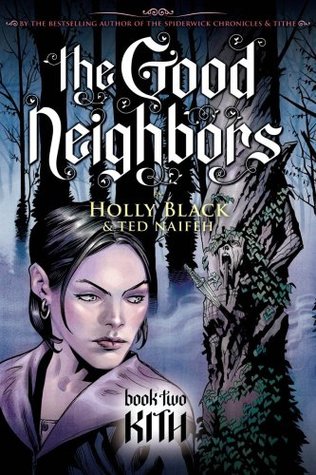
Kith (The Good Neighbors, #2) by Holly Black

Kith (The Good Neighbors, #2) by Holly Black
kith

Rue’s world is getting darker. In the last volume of The Good Neighbors, she discovered that faeries are real and not harmless, glitter-sparkled fantasies like fairy tales have described them.

In this installment, Rue learns about the perils of faerie enchantments and intricate faerie plans. Mixing magic with the every day world, human and faerie, is downright dangerous.

Rue also discovers more about her mother’s (Nia’s) family and not everything she learns is comforting.

“You can’t keep mom here against her will.” “Oh, can’t I?” “Give me a test then. A test like you gave my dad. I’ll win her from you.” “Don’t be silly. Nia, do you want to leave my hill? Does the moral world hold anymore allure for you?” pg 49. Yeah, does it?

Rue’s parents didn’t have a traditional first date. It’s awfully sad just how their two worlds came together.

Rue spends much of this volume trying to walk the line between the faerie and human worlds and feeling guilty about loving and belonging to both.

“Let me propose a toast. To love. In what we love best, our worst selves are revealed.” pg 52.

Love and jealousy play a large part in this story as does control and betrayal.

Sometimes, we ruin the relationships that mean the most to us because we’re careless or confused or bored. Other times, we may not be completely honest with ourselves about whether two people, or in this case human and faerie, even belonged together in the first place.

Rue stumbles her way through these questions in a teenage, angsty sort of way. She’s a flawed heroine, but I rather like her.

I’m looking forward to the last entry in the series.

See my review of the first book in the series: HERE.

Thanks for reading!

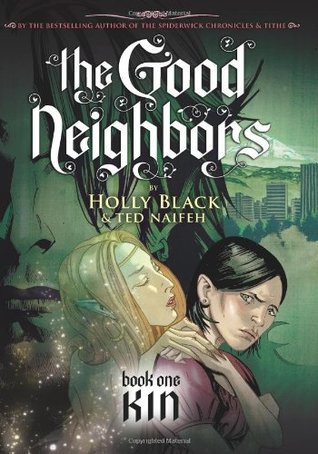
Kin (The Good Neighbors, #1) by Holly Black

Kin (The Good Neighbors, #1) by Holly Black
goodneighbors

Rue’s mother has always been a little different. She talks to plants, hangs out naked in the yard and seems ageless. Rue knows her mother is not like other parents. But then, one day when her mom disappears, Rue begins to see strange things- creatures with horns in the coffee shop, a winged girl hanging out in the high school hallway- and she realizes that she’s different too.

Where has her mother gone and is Rue going crazy?

“You know how sometimes, when you glance at something out of the corner of your eye, it looks different for a moment? Well, sometimes when I look straight at a thing, it looks weird too. And those moments are stretching wider and wider.” pg 5.

I enjoyed the faerie lore in this graphic novel: “If an older mortal is beautiful or good at riddles, we might take them, but we always leave something behind in exchange. Sometimes we glamour wood to take on their appearance or we abandon a faerie in their place.” pg 36.

This book deals with surprisingly dark themes so I wouldn’t let my tween read it. The story contains (non-explicit) drug use, rape and kidnapping. It should be ok for most mature teens.

The artwork is pretty. The people aren’t depicted like normal every day people (especially the faeries) but, for the most part, I don’t think the artist over-sexualized the women. That’s one of my pet peeves with graphic novels: when they depict females as ridiculously proportioned pin ups. But, like I said, this one isn’t over-the-top.

Photo by Anthony on Pexels.com

The faeries are quite creepy too: “Let me tell you a story. … Long ago, mortals called us the fair folk, the people of peace, the good neighbors. They called us these things not because we were fair or peaceful or good, but because they feared us. As they should. As they will again.” pg 77

Recommended for readers who like dark fairy tales and fans of Holly Black.

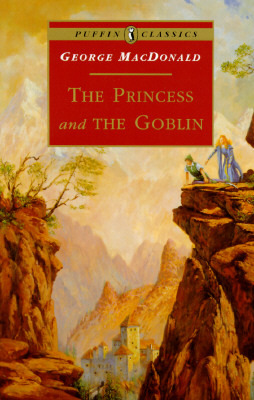
The Princess and the Goblin (Princess Irene and Curdie #1) by George MacDonald

The Princess and the Goblin (Princess Irene and Curdie #1) by George MacDonald
princessandgoblin

A charming fairy tale for children about a princess, a miner and hundreds of goblins- not just one.

The goblins hate the king because they used to be normal humans. They chose to live underground, to be away from the king and his taxes, and that choice has turned them inhumanely ugly and grotesque.

“They had enough of affection left for each other to preserve them from being absolutely cruel for cruelty’s sake to those that came in their way; but still they so heartily cherished the ancestral grudge against those who occupied their former possessions and especially against the descendants of the king who had caused their expulsion, that they sought every opportunity of tormenting them in ways that were as odd as their inventors; and although dwarfed and misshapen, they had strength equal to their cunning.” loc 54, ebook.

So, the king hides away his daughter to protect her from the goblins, while he travels across the kingdom, exerting the rule of law.

One rainy day, she is wandering bored through the house, when she discovers a secret stair with an extraordinary person in a hidden room.

The Princess tries to tell her nurse about her experience, but the nurse doesn’t believe her.

“You don’t believe me, then!” exclaimed the princess, astonished and angry, as she well might be. “Did you expect me to believe you, princess?” asked the nurse coldly. “I know princesses are in the habit of telling make-believes, but you are the first I ever heard of who expected to have them believed.” loc 181, ebook.

Meanwhile, in the mines under the mountains, the miners are accustomed to hearing strange sounds from the goblins who dwell within the walls.

Photo by Sagui Andrea on Pexels.com

“They worked only at night, for the miners’ night was the goblins’ day. Indeed, the greater number of the miners were afraid of the goblins; for there were strange stories well known amongst them of the treatment some had received whom the goblins had surprised at their work during the night.” loc 411, ebook.

One day, a miner named Curdie, hears actual goblin voices and discovers that they are closer to the goblin’s world that anyone ever realized.

He also overhears something frightening and determines to investigate the goblins’ world more to learn the truth.

To discover how the princess’ and Curdie’s worlds come together, you’re going to have to read the story.

Photo by Lisa Fotios on Pexels.com

I enjoyed The Princess and the Goblin. Recommended for tweens or the young at heart.

Readers who crave the simplicity and magic of books like The Hobbit, may also enjoy the story.

Thanks for reading!