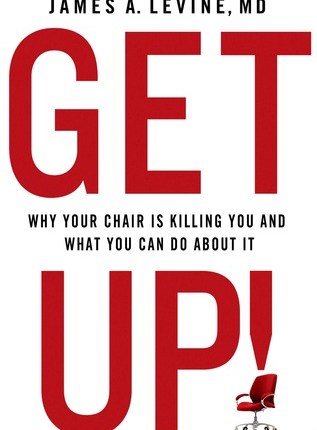
James Levine shares the disastrous consequences of a sedentary lifestyle and has created a clarion call for the modern world.
“When you first contemplate a book about the harm of sitting, you may view it as absurd. How can chairs possibly kill anyone? … However, this book summarizes 40 years of science — the work of scores of scientists and physicians from around the world. The scientific conclusion is clear: Humans are not designed to sit all day long, from a physiological, medical, creative or psychological perspective.” pg 4

This book scared me. Levine provides study after study proving his hypothesis and the results are shocking.
“From birth through death there is a predictable, programmed timetable of movement. We transition from the frenetic nature of childhood, to the organized movement of adulthood, through the stillness of aging.” pg 13
But don’t worry. The body and mind are more flexible than people realize.
“Because the brain is constantly adapting, it takes about three weeks for brain change to occur. A chairaholic can become a walker in three weeks. But watch out! A walker who begins to sit can just as easily become a chairaholic.” pg 46

There are concrete steps you can take to incorporate more movement into your life. The first step is to realize there’s a problem.
Next, look for ways to increase your “NEAT” energy. NEAT stands for “non exercise activity thermogenesis”. Basically, it means, make an effort to move more during your every day routine — cleaning the house, running after the kids, walking the dog, etc.
That seems to be a key for kicking the sitting problem to the curb. In Levine’s studies of urban life compared to agriculture living, that was the difference he noted between the two populations. People living the agriculture lifestyle move all the time. The urban lifestyle… not so much.
“The differences were so large that it staggered us — when you live in an urban setting, even if you are lean, you move half as much as people living in agricultural regions. The decline in calorie burn with urbanization could entirely explain the obesity epidemic worldwide.” pg 60

Fear not, urban dwellers. There are solutions to upping your NEAT energy, even if you are required to be at a desk for the majority of the day. One of these, that I invested in the moment I finished reading this book, is the desk treadmill. Another option is the standing desk.
Both of these tools help you move while still getting your job done.
This book contains more helpful suggestions than simply buying new lifestyle equipment. For example, Levine also suggests a leisurely walk after every meal.
“If people sit after a meal, their blood sugar peaks like a mountain for about two hours. If, however, people take a 15-minute walk at 1 mph after a meal, the mountains become safe, gentle, rolling hills. With a 1-mph walk after a meal, blood sugar peaks are halved.” pg 68
I think I can manage that.
The line that firmly established Levine’s hypothesis in my mind is: “If you see a saber-toothed tiger charging toward you, you don’t fire off an email, you get up and run!” pg 81
It’s that simple. Humans did not evolve to live the way that we’re living. I’m taking steps to change that now. Who’s with me?
Thanks for reading!
- The Ballad of a Small Player: a Metaphysical Movie Review
- Otherwhere: A Field Guide to Nonphysical Reality for the Out-Of-Body Traveler by Kurt Leland
- Psychic Dreamwalking: Explorations at the Edge of Self by Michelle Belanger
- Archetypes on the Tree of Life: The Tarot as Pathwork by Madonna Compton
- The Goddess and the Shaman: The Art & Science of Magical Healing by J.A. Kent




 The Help Desk Book Blog