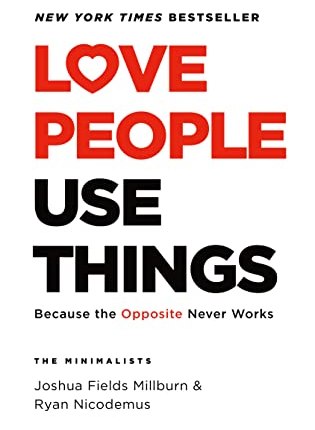
Love People, Use Things: Because the Opposite Never Works by Joshua Fields Millburn

Love People, Use Things: Because the Opposite Never Works by Joshua Fields Millburn

‘The Minimalists,’ Joshua Fields Millburn and Ryan Nicodemus, share their life journeys towards intentional living using seven different areas of focus: stuff, truth, self, values, money, creativity and people. Readers are invited to use the lessons they have learned to enact positive change in their own lives.

I, like many, had preconceived notions about what minimalism is. I thought it was about creating a living space that has like one chair, one table, and a cup with a single sharpened pencil in it. You can see the room, can’t you. In my mind, that was minimalism- bare to the point of ridiculousness.

Photo by Waldemar Nowak on Pexels.com

Millburn addresses this misconception early on in the book.

“Minimalists don’t focus on having less, less, less; they focus on making room for more: more time, more passion, more creativity, more experiences, more contribution, more contentment, more freedom.” pgs 35-36

Sounds pretty good to me, Josh. So how do we get there?

“Minimalism is a practice of intentional living. While it starts with the stuff, it’s ultimately a stewardship program for one’s life.” pg 124-125

I’ve recently experienced some major changes in my life, which include relocating to a new home and moving almost a decade’s worth of stuff. During the process, I took the time to try on every piece of clothing in my wardrobe and, to my not-unexpected dismay, about three-quarters of the clothing no longer fit.

Photo by Tembela Bohle on Pexels.com

It was simply a matter of donating the old clothes then. But I found myself hesitating to do so. I’ve lived a lot of life in those clothes and just holding them brought back so many memories.

I realize the memories aren’t in the items, they’re in me. Millburn points out that it’s easy to make that mistake.

“While it’s true that our memories are not in our things, it is also true that sometimes our things can trigger memories inside us.” pg 20

He recommends taking pictures of these treasured items so you can continue to access the memories at will while still making room for growth.

Because that’s what all of this minimalism stuff is geared towards: Living an intentional life so you can grow with the values that you’ve chosen for yourself. What you’re aiming for is growing like a cultivated flower about to bloom rather than a tumor that spills out uncontrolled in all directions.
Photo by Jess Bailey Designs on Pexels.com

“Growth is a critical component of a meaningful life- as long as it’s responsible growth- because continual improvement makes us feel alive and brings purpose to our actions.” pg 170

To do so, we must first confront the reasons why we’re holding on to all these items in the first place.

Fear is a common theme with people who are starting to confront their stuff. We’re afraid to pull back the curtain because we’re afraid not of the stuff itself, but of the work that must be done to live a more rewarding life after getting rid of it.” pg 102

And for me that’s the crux of the issue- fear. What am I afraid of? I’m afraid of living a life that doesn’t match up with my values. I fear change, not because it might be negative but because it pulls me out of my little routines into a place of uncomfortable uncertainty.

Your fears are probably quite different from mine, but the point is that you have them. Do you know what yours are?

Highly recommended for readers interested in self improvement, self help or the minimalist movement. Thank you to the publisher for a free advance reader’s copy of this book.

And thanks for reading!

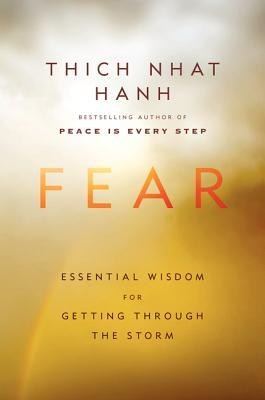
Fear: Essential Wisdom for Getting Through the Storm by Thich Nhat Hanh

Fear: Essential Wisdom for Getting Through the Storm by Thich Nhat Hanh

In Fear: Essential Wisdom for Getting Through the Storm, Thich Nhat Hanh simply and succinctly illuminates the Buddhist path beyond fear into an existence of freedom and joy.

“Nobody can give you fearlessness. Even if the Buddha were sitting right here next to you, he couldn’t give it to you. You have to practice and realize it yourself.” pg 6

Photo by Aleksandar Pasaric on Pexels.com

This book is more than theory, parables and anecdotal stories. Hanh also includes various meditations to assist in the effort.

“When the Buddha was very old, just before he died, he said, ‘My dear friends, my dear disciples, don’t take refuge in anything outside of you. In every one of us there is a very safe island we can go to. … That is a place where you can take refuge whenever you feel fearful, uncertain or confused.'” pg 71

He dissects the various forms fear can take in our lives- from fear of death, grief, anxiety about the future to reconciling with painful emotions from the past.

Photo by David Bartus on Pexels.com

My main takeaway from the book was, to deal with any kind of fear, we need only to approach it with mindfulness and compassion for ourselves and the suffering of others.

“We don’t try to grab on to the pleasant sensation, and we don’t try to push it away. We just acknowledge its existence. When a painful feeling comes, we do the same thing. … A feeling is just a feeling. And you are much more than that feeling.” pg 135

Hanh reminds readers that we are more than the temporary thoughts and feelings that cause so much havoc on their way through our minds and hearts. Our true nature is something else.

My favorite metaphor that Hanh employs to remind readers of this true nature is his comparison of a life to a wave.

“The wave is always water; it doesn’t ‘come from’ water, and it doesn’t go anywhere. It is always water; coming and going are just mental constructions. … Birth and death, coming and going, are just concepts. When we are in touch with our no-birth, no-death nature, we have no fear.” pg 50

Photo by Emiliano Arano on Pexels.com

I appreciated the reminders and found a lot of comfort in these pages. I hope other readers find the same.

Recommended for readers who are interested in learning and utilizing Buddhist philosophy and techniques to overcome any fear or other unpleasant emotion that may be in their lives.

Embrace Your Weird: Face Your Fears and Unleash Creativity by Felicia Day

Embrace Your Weird: Face Your Fears and Unleash Creativity by Felicia Day

Embrace Your Weird is a non-fiction and self help manifesto encouraging creativity and told in Felicia Day’s unmistakably humorous way.

I say “unmistakable” for any of her myriad fans who have watched her ground-breaking web series, “The Guild,” or read another of her books like You’re Never Weird on the Internet. Her tone and sense of humor remains the same.

Photo by Prateek Katyal on Pexels.com

And if you haven’t had the chance to enjoy any of Day’s other creations, I encourage you to give them a try. They’re light-hearted and fun.

“Aside from (over)sharing a lot of my opinions, I have filled this book with exercises designed to uncover the joy of creativity. To help people beat back the fear that keeps them from trying new things.” pg xi

On almost every other page, Day encourages readers to stop a moment and draw a picture, fill out a list, or write empowering messages over and over so that they’ll sink in. The act of reading this book is nearly a creative act in and of itself. (Sadly, I couldn’t do this because I was reading a library book. Suggestion for future readers: buy yourself a copy.)

“No, I don’t think creativity is a cure-all. But I do believe it could be a cure-most.” pg 29

Photo by Pixabay on Pexels.com

Besides reminding readers that we have unique voices and viewpoints that the world needs to hear, Day loosely structures the rest of the book off of life viewed as a game. She asks us to remember our “hero-self,” identify “enemies” and “allies” of our creativity, and to view the steps we take towards creation as “quests.”

Day also shares moments in her life when she’s completed or failed attempting various pieces of this philosophy in her own life.

“I constantly hand my heart over to strangers to batter however they wish, and I wonder why I’m constantly wounded all the time, and this makes me reluctant to create. Good way to operate? NOT REALLY!” pg 143

As I said, the whole book has a definite Felicia Day vibe. And it’s fun!

“Playfulness is the root of all creation. All invention. All discovery. There is no reason NOT to feel joyous when we make things.” pg 206

Photo by Sharon McCutcheon on Pexels.com

She wasn’t afraid to tackle all sorts of hang-ups people might have in their creative process. Day nailed my biggest issue: finishing projects once they’re started.

“But we will never get anywhere if we don’t focus on one thing at a time. And then see that thing through before moving on!” pg 239

Message received. Now to put it into action…

Recommended for anyone looking to start or jump start their creativity. This book is an excellent place to begin. Thanks for reading!

How Not to Die: Discover the Foods Scientifically Proven to Prevent and Reverse Disease by Michael Greger

How Not to Die: Discover the Foods Scientifically Proven to Prevent and Reverse Disease by Michael Greger

I think everybody is aware that your diet has an enormous impact on your health. This book is another reminder that this is true.

Photo by Trang Doan on Pexels.com

Though everyone will one day die, Michael Greger gives some tips to help you live as long and as healthily as possible.

I’m not going to debate the merits of different diets which seem to change as quickly as fads. I think everybody should try to incorporate healthy habits that are right for them as they are able.

How Not to Die is packed with ideas on that front.

Photo by Pixabay on Pexels.com

I think the most interesting part of this book are the effects that various foods have on the body. But you don’t have to take Greger’s word for it, experiment and see what works for you.

Happy eating 🙂

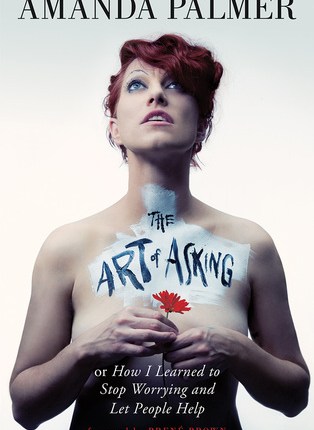
The Art of Asking; or, How I Learned to Stop Worrying and Let People Help by Amanda Palmer

The Art of Asking; or, How I Learned to Stop Worrying and Let People Help by Amanda Palmer

Amanda Palmer is an extremely talented artist who has done it all- from performing in a punk rock band to posing as a statue on the streets.

I can see why readers are passionate about this book and the author. She just didn’t strike a spark for me.

Photo by Jeffrey Czum on Pexels.com

Memoirs can drag on and become self-indulgent and ridiculous. I feel like that was a problem with The Art of Asking.

The tipping point for me was when she formed The Dresden Dolls with her friend and said (I’m quoting from memory here since I was listening to the audiobook): “I finally had the strongly emoting band I’d always dreamed of” or something like that.

I realized, I was strongly emoting on this book, but not in a good way.

I understand her internal struggles in forming a relationship with Neil Gaiman must have been difficult for her, but her “should I date him, he’s older and richer and more famous than me” just came off as silly and very first-world problems.

I get that she loves her fans, her art, her lifestyle- but it just come together to make a read that I enjoyed.

My apologies to her fans. If it helps, my favorite parts of the audiobook were the songs she put between some of the tracks. Those were actually pretty awesome.

Photo by Inga Seliverstova on Pexels.com

And the over-arching theme of The Art of Asking was good too.

Society isn’t comfortable with asking. We don’t know how to do it, don’t feel comfortable with it and it prevents people from making the art that they were born to make.

You can get that part of this book by watching Palmer’s TED talk. Maybe you should do that instead of reading this.

Here ’tis: 

https://www.ted.com/talks/amanda_palmer_the_art_of_asking

Thanks for reading.