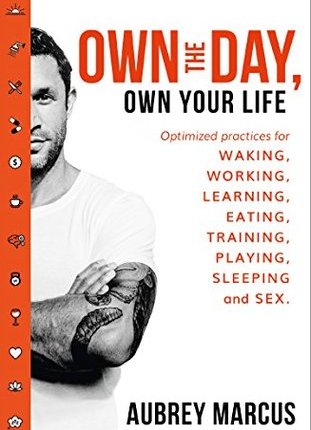
Own the Day, Own Your Life: Optimised practices for waking, working, learning, eating, training, playing, sleeping and sex by Aubrey Marcus

Own the Day, Own Your Life: Optimised practices for waking, working, learning, eating, training, playing, sleeping and sex by Aubrey Marcus

Aubrey Marcus shares different life hacks in an effort to improve your day. Because, as he reminds us: “To live one day well is the same as to live ten thousand days well. To master twenty-four hours is to master your life.” pg 7, ebook

There’s not a lot of new information here, especially not for aficionados of the self help genre. But there are some interesting strategies to try that I enjoyed.

One is to use your commute time to listen to a book or a podcast. As Aubrey points out, if you’re going to be spending the time anyway, you may as well use it to invest in yourself.

“These minutes are precious things. They are the only currency we spend every day whose value fluctuates wildly. Spend your minutes investing in your future self, filling your emotional coffers, and building value and enjoyment, or spend minutes depleting your emotional bank account.” pg 82, ebook

Photo by Stas Knop on Pexels.com

Nothing new, as I said, and also it doesn’t take too much encouragement to get me to read. 🙂 But for anybody who hasn’t tried it yet, I highly recommend incorporating this into your morning commute.

Another strategy suggested in Own the Day, Own Your Life that I attempted to hilarious, yet effective, results was a method for waking yourself up. Basically, you practice deep breathing and then stand under cold water in your shower.

The basic principle behind it, if I understand it correctly, is that our bodies have evolved to handle stress in ways that are completely outdated in the modern world. We react to an emotional email or digital comment as if a tiger was running at us. But it’s not.

All of those chemicals go into us and have no where to go, leading to chronic stress and all of the symptoms that go along with that. The deep breathing and cold water cause a stress reaction too, but it’s one that you control and can switch off at will. The exposure teaches your body how to handle it when you can’t switch it off.

Photo by Gratisography on Pexels.com

In addition to these other supposed benefits, it wakes you the heck up. I can vouch for that. Come on, Heidi, I can hear you say. You really needed a book to tell you to take a cold shower? Well, apparently I did. And that part really works as promised.

If you’ve already got your diet and exercise routines locked down, you’re already well on your way to living your best life and probably don’t need this book. But, for anybody looking for a few pointers or are willing to try new things, this could be the book you’re looking for.

The 4-Hour Workweek by Timothy Ferriss

The 4-Hour Workweek by Timothy Ferriss

“I’ve spent the last three years traveling among those who live in worlds currently beyond your imagination. Rather than hating reality, I’ll show you how to bend it to your will. It’s easier than it sounds.”

Photo by Ronu00ea Ferreira on Pexels.com

Timothy Ferriss promises the stars in the sky in his new-classic business/self help book, The 4-Hour Workweek. Though he gives some good productivity tips, he fails to provide a true road map to freeing yourself from the 9-to-5 grind. Partially, this is because there is no real road map to doing this.

But he does detail how he found his way into a life of his dreams. Readers can take whatever lessons and information from that as they will.

After Ferriss relates a timeline of his life story, he begins by detailing his “DEAL” plan to a four hour work week which consists of “definition, elimination, automation and liberation”. Each step of this process, he says, helps guide the reader to a new world of free time. Though, he admits, traditional bosses may have serious problems with your new program and, perhaps, you should go more “DELA”. Yes, understatement.

“Resolve now to test the concepts as an exercise in lateral thinking. If you try it, you’ll see just how deep the rabbit hole goes, and you won’t ever go back.”

Photo by Anna Shvets on Pexels.com

He examines the concepts of “busy work” and suggests boiling your workload down to the most important tasks you complete. Then, just do those as fast as possible. Don’t allow yourself to be derailed by the internet or chatty coworkers. (Not a friendly method, but Ferriss seems to have his eyes on the prize rather than concerning himself with making friends.)

Out of everything he suggests in the first part of this book, I was most taken with the idea of only checking your email once a day or week. There is a definite time-suck there that maybe I have been blinding myself to.

After that, Ferriss enters more conceptual territory with an idea about creating a business for yourself that essentially runs itself or can be run by someone else, cheaply. For example, a website that sells something awesome. But, what exactly that something or muse is, that’s for you, the reader, to discover on your own.

It reminded me of Godin’s Purple Cow: Transform Your Business by Being Remarkable. You know an awesome product or “purple cow” when you see it, but how exactly to make one isn’t a clear thing. Interesting idea, but necessarily helpful for those looking for actionable items to improve their work life.

The most useful part of the book, in my opinion, is his encouragement to create a dream plan by “dreamlining”. Write down what you want to do. Create a timeline. Crunch the numbers. It may cost less than you thought and, with it on paper, it takes on a bit of reality already. If you don’t get started, how do you know what you might accomplish.

Photo by Negative Space on Pexels.com

“It’s lonely at the top. Ninety-nine percent of people in the world are convinced they are incapable of achieving great things, so they aim for the mediocre. The level of competition is thus fiercest for ‘realistic’ goals, paradoxically making them the most time-and energy-consuming. It is easier to raise $1,000,000 than it is $100,000.”

Ferriss’ tone in this book has been criticized by readers and I see what they mean. Some of his ideas are alienating. Sometimes he seems to say: I’ve done this-this-this and this, and it’s so easy that if you can’t figure it out too, especially with the book I’ve put in your hands, then you must be either complacent or dumb.

But I took this book to be written by someone who dared, a nod to Brené Brown, greatly. Ferriss believed his life could be something other than a slog and yours could too. He’s written down some tips to help you along the way that he discovered through real life trial and error. Read it or not. He’ll be over there, living the life of his dreams.

Photo by Alex Fu on Pexels.com

Recommended, with reservations, to folks interested in life-hacking their work/life balance. I think we can achieve whatever dreams we set our minds to while still being friendly.

Thanks for reading!