Or What You Will by Jo Walton

Or What You Will by Jo Walton

Or What You Will is a unique fantasy novel about a writer, one of her fictional characters, her real life, a final story she is writing, and her love affair with the city of Florence.

“I have been a character, and I have been a narrator, but now I don’t know what I am.” pg 8, ebook.

Photo by Tamara Velazquez on Pexels.com

Told from the point of view of a character inside another character’s mind and between flashbacks to real life and an on-going fictional story-within-the-story, Or What You Will sounds quite complex. But once I got into the flow of it, I enjoyed this quirky tale quite a lot.

“Readers remember you. So you’ll live on in the books. It’s the only form of immortality the real world has.” pg 53, ebook.

I loved learning about Sylvia (the fictional writer’s) life, loves, and writing process. Part of its charm is that this is a meta-filled book for readers who love the process of writing and the development of characters. It is also filled with surprising and entertaining tidbits of real history about Florence which appealed to the amateur historian in me.

Photo by Josh Hild on Pexels.com

There was plenty to enjoy in Or What You Will. My quibble with the book has to do with its ending.

After meticulously building an immersive world, or two, the author unceremoniously ends the story in a few paragraphs.

It was incredibly disappointing, especially when you consider the book is only 226 pages long (ebook). She had room to do more. In fact, I could have stayed in the world she created for twice as many pages.

That being said, the last few pages of the book made me cry. So, perhaps it was a satisfying ending in its way. I just wish it had been developed more fully.

Photo by Daria Shevtsova on Pexels.com

Other than the ending, this is a brilliant and totally unique story, unlike anything I’ve ever read. If you like Jo Walton’s other fantasies, you may want to give it a try.

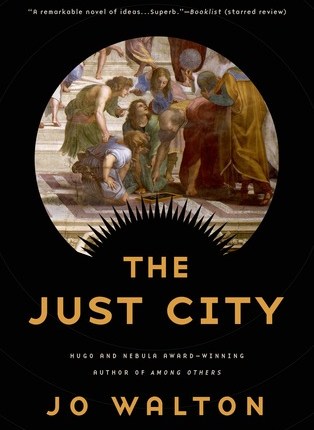
The Just City (Thessaly, #1) by Jo Walton

The Just City (Thessaly, #1) by Jo Walton

When the god Apollo seeks to understand the workings of the mortal mind and heart, he asks his sister, Athene to help him. She reveals a project in which she has gathered together philosophers from across time and space and put them in a settlement called, “The Just City”. In this city, set near a volcano that will one day explode and destroy all evidence of the project, a group of men, women and children will try to recreate the hypothetical state described in Plato’s “Republic”.

Apollo asks to join this group. And our story begins.

Photo by Hert Niks on Pexels.com

The city itself shone in the afternoon light. The pillars, the domes, the arches, all of it lay in the balance of light and shadow. Our souls know harmony and proportion before we are born, so although I had never seen anything like it, my soul resonated at once to the beauty of the city.” pgs 35-36

But what is perfect in theory turns out to be not-so-perfect in practice. Among the thornier problems, the city has shared marriages and children raised by the group, not families. This causes predictable jealousies and secret romances. There’s also something strange going on with the robotic workers Athene brought from a future time to help with the mundane tasks of civilization, like raking the roads and planting the vineyards.

“We are in a time before the fall of Troy. And we are on the doomed island of Kallisti, called by some Atlante.” Even I had heard of Atlantis.” pg 45

Photo by Travel Sourced on Pexels.com

Another major issue, caused because they were pulled from different points in history, are the different philosophers’ views on gender equality. Consent in the Renaissance doesn’t mean the same thing as consent in the Victorian Age.

“You love this city,” Pytheas said. That was what we had been debating that day. “I do,” I said, spreading out my arms as if I could hug the entire city. “I love it. But Sokrates has made me see that it’s only the visible manifestation and earthly approximation of what I really love, the city of the mind.” pg 131

Though I enjoyed this book, the pace was what spoiled it for me somewhat. It marches forward towards an inevitable conclusion far too slowly. The debate scenes are interesting, but simply too plodding.

Photo by Dominika Roseclay on Pexels.com

There’s also a rape, so please be aware if you have potential triggers.

Recommended tentatively for readers who love the classics or historical fiction and can stand a slower-paced read.

Thanks for reading!