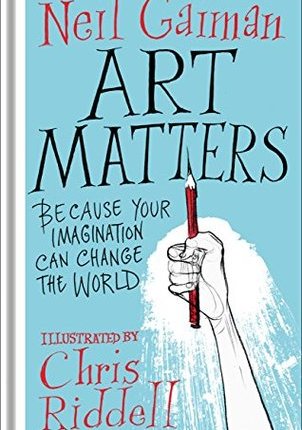
Neil Gaiman and Chris Riddell have created a manifesto for readers, librarians and content creators. This little book celebrates everything having to do with reading, freedom of information and ideas, and how to start creating the life of your dreams, even if you don’t know where to start.
It was compiled from Gaiman’s prolific back catalog of speeches, poems and various other writings about creativity.
“The world always seems brighter when you’ve just made something that wasn’t there before.”

I feel like this should be required reading — especially the parts about how to respond to intellectual disagreements. I think Gaiman penned these words after the bombing at Charlie Hebdo, and they still ring true.
“I believe I have the right to think and say the wrong things. I believe your remedy for that should be to argue with me or to ignore me. And that I should have the same remedy for the wrong things that I believe you think.”
And, of course, I was partial to all of the praise directed towards librarians and libraries, having been a librarian once myself. Sometimes people ask me if I ever think libraries will be closed because “they’re just a building with books” or “they’re a waste of taxpayer money”.
This is how I wished I had replied: “Libraries are about freedom. Freedom to read, freedom of ideas, freedom of communication. They are about education, about entertainment, about making safe spaces and about access to information.” How could that ever possibly go out of style?

Gaiman also gives attention to the bookworms of the world. We make it a better place through our reading and daydreaming and daydreaming about reading. Also, our epic library patronage is a good thing.
“We have an obligation to read for pleasure. If others see us reading, we show that reading is a good thing. We have an obligation to support libraries, to protest the closure of libraries. If you do not value libraries you are silencing the voices of the past and you are damaging the future.”
Gaiman shares a bit about how he became the universally beloved author he is today. Step one, you’ve just got to get started.
“If you have an idea of what you want to make, what you were put here to do, then just go and do that and that’s much harder than it sounds and, sometimes in the end, so much easier than you might imagine.”
He confesses that he lied on early resumes to get his foot in the door. But, after his later success, he went back and worked at all of the places he had claimed before. That way, he didn’t see himself as lying but as “chronologically challenged.” I loved that he took the time to make things right.
Gaiman also has some interesting views about no-start dreamers. He says the saddest thing to him are friends that say they’re too committed to follow their dreams. There’s bills to pay, mortgages and families to support and they can’t take the dive to do whatever it is they’ve always dreamed of doing.

He said he dodged that particular roadblock by skipping a well-paying job or two early in his career, so that he didn’t get too comfortable doing something other than writing. I thought that was an interesting strategy. Creating is about having the courage to just do it, no matter what and not stopping until you’re doing it.
“Somebody on the internet thinks what you do is stupid or evil or it’s all been done before? Make good art.”
The good news is there are more platforms than ever before to get your creations in front of the people who will care about them.
“The gatekeepers are leaving their gates. You can be as creative as you need to be to get your work seen. YouTube and the web (and whatever comes after YouTube and the web) can give you more people watching than television ever did. The old rules are crumbling and nobody knows what the new rules are. So make up your own rules.”
My own life right now points to the truth of that. I left a guaranteed paycheck and employer provided health care to write for my husband’s YouTube channel. We’re not only succeeding but we’re having a lot of fun doing it.
Thank you, Gaiman and Riddell for this beautiful book. I hope it encourages creators everywhere to take the leap.
Thanks for reading!
- The Ballad of a Small Player: a Metaphysical Movie Review
- Otherwhere: A Field Guide to Nonphysical Reality for the Out-Of-Body Traveler by Kurt Leland
- Psychic Dreamwalking: Explorations at the Edge of Self by Michelle Belanger
- Archetypes on the Tree of Life: The Tarot as Pathwork by Madonna Compton
- The Goddess and the Shaman: The Art & Science of Magical Healing by J.A. Kent
 The Help Desk Book Blog