In Three Years of Quantrell, John McCorkle recounts riding as an irregular with William Quantrell and how they fought against the Federals in Missouri and Kansas during the American Civil War.
It is a sobering look at how war is hell. McCorkle never knew who he could trust and who he couldn’t. During the infamous raid at Lawrence, Kansas, McCorkle says that some good men may have died in the raid, “but that wasn’t our intent.”
It’s hard to imagine what a country at odds with itself must have been like. People would take advantage of each other, steal property, and even the lives of their neighbors.
My one quibble with this memoir is it contains a lot of travel. It feels like McCorkle said we went here, then here, then here… as he goes through his memories of the war. There’s plenty of “hours of boredom punctuated by moments of terror.”
Recommended for history readers who want an original source for research about the American Civil War.
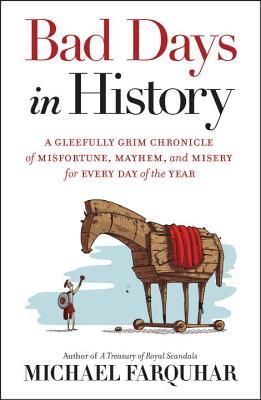
Michael Farquhar has compiled a veritable treasure trove of historical events and organized them by the calendar day upon which they occurred.
“Plucked from all eras of history, and from around the globe, the bad days in this book are intended to amuse, tantalize, and enlighten — without being too predictable.” From the introduction.
From ancient Rome to the more modern era, anyone interested in history should find something to enjoy in here.
For example, those who like to learn about doomed romance, may I suggest March 29: “There was nothing particularly special about Yaoya Oshichi, a grocer’s daughter living in 17th-century Japan. Indeed, her memory undoubtedly would have been lost to history had it not been for the extraordinary circumstances of her death — a tale of romance so tragic that it enshrined the 16-year-old girl forever in Japanese literature and theater.”
Or maybe you want to learn about the publishers of the so-called “Wicked Bible” who faced a committee for their misdeeds on May 8: “Some readers of a 1631 edition of the King James Bible were shocked (or at least pleasantly surprised) when they came across the Seventh Commandment in the Book of Exodus: ‘Thou shalt commit adultery.’ Then there was the apparent blasphemy found in Deuteronomy, chapter 5: ‘The Lord hath shewed us his glory, and his great asse.” (The proper word was ‘greatnasse’.)
From the amusing to the tragic, there’s something for everyone. Each listing is a short version of the event, just a couple of pages. If you want something more in-depth, you’ll have to keep looking. However, if you just want a few pages of something interesting to read before bed, this book could fit the bill.
Recommended for history lovers and trivia hounds.
Thanks for reading!
Here’s the History Guy episode I wrote about Yaoya Oshichi:
In the era before women could vote, an extraordinary detective and lawyer was solving crimes the police couldn’t and defending those who couldn’t afford it. Her name was Grace Humiston and this is her story.
Grace was admitted to the bar in the state of New York in 1905, becoming one of only a thousand female lawyers in the whole United States. pg 29
Readers, this lady was incredible. Though she fell out of public favor later in her career, Grace accomplished so much. She was the first woman to become a consulting detective for the New York Police Department. They formed a missing persons bureau because of her work to reform how they searched for victims of crimes.
Grace was even the first woman to serve as a Special Assistant U.S. District Attorney. She brought down businesses that were abusing immigrants through peonage practices. I’m telling you, this lady was hardcore.
The case that catapulted her into the limelight was the disappearance of Ruth Cruger, a teenager who went to get her ice skates sharpened in New York City and never returned. Her family insisted Ruth wouldn’t have run away, as the authorities suggested when they reported her disappearance.
“My girl has been kidnapped,” Henry said to the reporters. “This talk about her having gone away voluntarily is an unwarranted insult to her and to us. It is nothing more than a screen for police shirking.” pg 47
When a reporter asked about how she had solved the case so quickly after the police had given up, Grace did not couch her words. “To begin with, the police are no good,” Grace told the reporter. “They had all the facts to start on that I had and did nothing.” pg 71
Savage.
The facts of this story merit a five-star rating but how they are organized brought down my rating of this book. Brad Ricca opens with the Ruth Cruger case and puts chapters inbetween detailing Grace’s history. It disturbs the flow of the story. I think if he had gone from an opening, gripping chapter about Ruth into a chronologically organized history, I may have enjoyed it more.
Another gripe some readers had with Mrs. Sherlock Holmes is that it had an unsatisfying conclusion. I’m not of that opinion. Often, life doesn’t end stories with a bowtie or an ending worthy of their beginning. In non-fiction, especially when careers rise and then fall as in this book, there isn’t a satisfying ending to be had.
I enjoyed learning about this extraordinary lady and I appreciate the level of research Ricca put into these pages. One can feel, especially in the conclusion, how this was a labor of love for him. Not just to bring Grace back into the public’s mind and heart, but also to remind readers about how people still go missing today and, sometimes, they’re never found.
I wanted to reprint all the people gone missing in the last year here, at the end, but it would not have been ‘cost effective’, they told me, even in the smallest type. So think of one name for me. Maybe it is someone you know. Or someone you saw on a show or a flier once. Or maybe it is your name, or a name you once had. Whoever it is, write that name here…. pgs 362-363
We are solving more and more cold cases with the advent of DNA databases. Perhaps some day this issue will be a thing of the past. Until then, we’ll rely on the Graces of today to lead us, clue by clue, to wherever the trail ends.
Thanks for reading!
Here’s the History Guy episode I wrote about Grace Humiston:
Excruciatingly detailed travel guide for those interested in World War II. My husband, The History Guy on YouTube, thought it was amazing.
I’m married to someone who is obsessed with war, war machines, war documentaries, military uniforms and, well, you get the idea. This one time, I went to England just to wander around a tank museum with him. A tank museum. This is true love, people. Was I bored? Yeah. Did I care about any of the tanks? No. Could I think of a million other things I’d rather be doing? Yeah. And yet, there I was- the hippie in the tank museum.
Me at the Tank Museum. Really, it’s me.
So, my plan is: convince him that he needs to go on a tour of the European Theater- all of the battle fields in order. It will probably take him two, three months, say, six months to do it right. I will suck it up and go with him, somehow finding a way to survive half a year in Europe. HALF A YEAR!
Think of the libraries, the museums… oh my God, the pubs! The art! The culture!
This book is step one. 🙂 Check back with me in twenty years or so and I’ll let you know how the war lover and the hippie’s European tour went. Maybe we’ll end up writing a tour guide of our own. Half of the book will be war stuff, the other half will be a tree-hugging, far-out love fest. Heck, I’d read it.
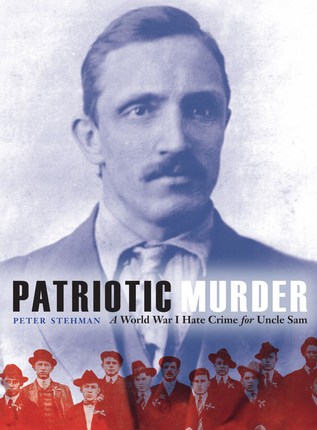
A well-researched and shocking account of the only (according to the author) German immigrant lynched on U.S. soil during World War I.
This non-fiction work is important for a number of reasons. First, it reminds readers of the time period of the Great War. Very few, unless they were just born, are even alive from that period.
We’ve forgotten the Committee of Public Information, a federal committee created by President Woodrow Wilson, and its purpose to educate but also manipulate the public in support of an unpopular war. We’ve forgotten the Liberty Bond drives, a nation-wide push that raised billions of dollars to support the war effort. And we’ve also forgotten how a nation built largely of immigrants, of which Germans were the largest group at that time, were able to demonize an entire country and population to convince ourselves that the war was not only acceptable but just.
After Congress approved war legislation, the task remained of how to convince a splintered nation that entering the conflict was necessary. More than a third of the population was either immigrant or had at least one parent who was. Germans had been the predominant immigrant group for decades, and they had mixed feelings at best about waging war against the Fatherland.pg 17
The propaganda posters, some of which Peter Stehman has included for readers, are chilling. In some, “the hun” is shown as a bloody-thirsty creature, covered in the blood of Americans. Prior to this period, the German immigrant was seen as hard working and industrious. It took image manipulation to make the public believe otherwise.
Their patriotic themes promoted such things as buying war bonds, conserving food, or fuel or vilified Germany’s leaders or its army.pg 43
Robert Paul Prager was a patriotic German immigrant who wanted to work in the mines of Southern Illinois. The miners union not only rejected him for his lack of experience, but also because of who he was, German. He spoke up against their rejection and posted notices on the mines and saloons all around town. A drunken mob formed, took umbrage to his objection, and killed him.
They untied the line and let the body fall three times before jerking the rope to try to break his neck. “One for the red, one for the white, and one for the blue,” someone said, proclaiming their patriotic work done for now. pg 9
Scholars talk a big line about remembering the past so we don’t repeat it in the future, but sometimes I feel like humanity has learned very little. We are still formed of nations and large tribes, seeking the benefit of our members and creating rules to keep others out. We still create an “us vs. them” mentality, think violence is an acceptable solution to disagreements and occasionally bow to the terrible mindless vengeance of the mob.
This book is a timely reminder, and also warning. It is a reminder of the dangers of nationalism and the mob. And, ultimately, the biggest danger of all, of convincing ourselves that others are not people like us, but something else and less valuable and sacred because of that.
I interviewed the author, Peter Stehman, for my former job at the Belleville News-Democrat. Here’s a link to the article I wrote from that hour and a half long interview, if you’re interested: https://www.bnd.com/news/local/articl…
The publisher kindly sent me a free copy of Stehman’s book. I am not being paid for this review.
He was, at least he was then, the president of the Collinsville Historical Museum and this book was a labor of love for him. Stehman was both fascinated and horrified by the fact that this event took place in his home town. For decades, no one wanted to talk about what happened on that April night. It was a matter of embarrassment and shame.
But now, that so much time has passed, people are more willing to talk about it and examine its causes as well as its cost. The tree where they hanged Prager is gone, but the memory remains. Do we learn from it or run from it? The choice is ours.
I’ll end with a quotation by Stehman from his acknowledgments section which comes at the beginning of the book: “Like so much forgotten history, the story of Robert Prager’s demise merits telling for the lessons it offers to today’s world. Patriotism is a wonderful thing, but propaganda, nationalism, and xenophobia have no place in great societies. Sadly, a reminder of that message is as relevant today as it was in 1918.”
Sadly, indeed.
Thank you for reading!
Here’s the History Guy episode I wrote about Robert Prager:
A non-fiction read about an extraordinary man who became the first Italian-American detective in the New York Police Department and his battle against The Black Hand.
Petrosino was “the greatest Italian detective in the world,” declared the New York Times, the “Italian Sherlock Holmes,” according to popular legend back in the old country. introduction, xiv.
Joseph Petrosino was a scrappy boy who grew into a determined man. He dropped out of school after sixth grade and began to work as a shoe shiner on the streets. Then he worked his way up to street cleaner, where he was noticed by a member of the NYPD and recruited to be a member of the police.
He was an excellent recruit, being one of only a handful who could speak multiple dialects of Italian. This was particularly useful in the heavily Irish police force. Petrosino also had a photographic memory and he would arrest suspects off the streets based on a remembered mug shot.
It’s telling that the most famous Italian American in the country in the late 1800s was the one deputized by the powerful to track down and imprison his fellow countrymen. … It was Petrosino, the “hunter of men,” who fascinated the old American stock of Knickerbockers and WASPs, and they embraced him like no other Italian American of his time. pg 19
There was an influx of Italian immigrants into the United States in the late 1800s and they were treated poorly. As a result, they didn’t trust American authorities and didn’t report crimes being committed against them. The Black Hand, a group of unorganized criminals, extorted unknown numbers of Italian immigrants through threats of violence, kidnapping and bombings. That was where Petrosino came into the picture.
He was determined to stop them. Petrosino obtained permission to create the Italian Squad, a special task force designed to stop the Black Hand.
“When murder and blackmail are in the air,” declared the Times, “and the menfolk are white-faced and the womenfolk are saying litanies to the Blessed Mother… all Little Italy looks to the Italian detective to protect it and guard it.” pgs 40-41
I read The Black Hand to discuss with my book club and found it gripping. I was enthralled by Petrosino and the dangers he faced. However, other members of the club thought the book became repetitive. “Another bombing?” one of them said. It was as if they were inured to the horrors of the situation because so many bad things were happening again and again. I thought that just added to the tension of the narrative.
Highly recommended for non-fiction readers or anybody interested in New York City or U.S. history.
This book is slated to become a film starring Leonardo Dicaprio, but the project doesn’t seem to have gone anywhere since 2017. I wonder if it will ever be made.
Thanks for reading!
Here’s The History Guy episode I wrote about Petrosino and the Black Hand:
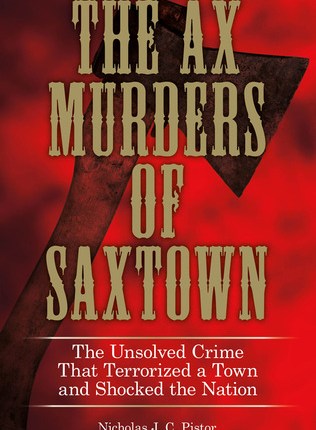
Full title: The Ax Murders of Saxtown: The Unsolved Crime That Terrorized a Town and Shocked the Nation
Imagine you’re a farmer in 1874. You live out in the middle of nowhere. There are no cars, electric lights… each night brings a blanket of silence to the world. Then, one fateful night, there’s a knock on the door. You answer it… and it’s an axe-swinging maniac!
Sound like a cheesy horror film? For one farming family in Southern Illinois, that nightmarish scenario actually happened. A family of five, including two children, one a baby in her mother’s arms, were slaughtered in their home. It was called the most shocking crime since the murder of Abraham Lincoln and garnered national attention.
Nicholas Pistor examines original sources to share the story of the ax murders of Saxtown.
The grounds of the Stelzriede farm glowed with the orange light of oil lamps and handheld torches. A few hours had passed since the Stelzriede bodies had been discovered. The tough Saxtown farmers arrived one by one, and then in groups. … Many showed up on the property with their families. They were too afraid to leave them home alone. pg 44, ebook.
I would have been the same way. There had been extensive rains around the time of the murders and the roads in and out of town were nearly impassable. The residents of Saxtown believed the killer could still be among them. Eek.
Saxtown was a farming community where people primarily spoke German. Everybody knew everybody else and their business. The closest city, sheriff and bank were located in Belleville, almost nine miles north of Saxtown. At the time, they believed the motive for the killings was money. The Stelzriedes were known to loan out cash and it was thought that they kept a stash in their home.
Pistor goes into how authorities conducted investigations during the late 1800’s. It made me wonder that they ever managed to solve anything. There were no forensics or sophisticated evidence gathering protocols.
Public awareness was important in solving crimes. An eyewitness could crack the case open before it began. Detective work relied heavily on what other people saw, a distinct challenge in the remote and lonely woods of Saxtown, where farms were spaced by miles and miles. pg 44, ebook
The saddest part of this non-fiction tale is, in my mind, how terribly this crime affected Saxtown. For decades, residents accused each other of the murders. There were lawsuits and whispers of restless ghosts on the Stelzriede property…
If you’re looking for a true crime read, this is an interesting pick, plus you get to learn about a few other shocking crimes that took place in Southern Illinois and history.
And if someone knocks on my door tonight, I don’t think I’m going to answer it.
Thanks for reading!
Here’s an episode I wrote for The History Guy about the murders:
Hanging the Sheriff takes another look at the life of Henry Plummer. Conventional history labels Plummer as the leader of a notorious outlaw gang in the territory that would eventually become Montana. This book suggests that Plummer’s life story was written by the vigilantes who killed him and they had every reason to make him seem worse than perhaps he actually was.
It was kind of funny — the authors assumed everyone reading their book would know exactly who Plummer was. I had no clue: The image of Plummer as the one man responsible for all crime committed in the mining districts east of the Rockies is so firmly ingrained it is nearly impossible for even the most impartial of readers to drop old suspicions and view him with an open mind.” pg 7
Like I said, blank slate here. And the story they revealed was fascinating.
Plummer was born in Maine and migrated West not just for the Gold Rush but also because of his lung disease. He was a successful business owner and prospector. He was a notorious gunslinger, able to fire five bullets in three seconds. He got in trouble with the law, but was elected marshall and sheriff in two different towns. He killed at least half a dozen people.
“Plummer jumped up. ‘I’m tired of this,’ he said, drawing his pistol and firing at the ceiling. A second shot struck Cleveland, who fell to his knees, pleading, ‘You won’t shoot me when I’m down?’ ‘No,’ Plummer said, ‘Get up.’ pg 25
In his defense, the American frontier was wild and untamed with very few courts or lawmen. Everyone had to police themselves: “As Granville Stuart explained, ‘There was no safety for life or property only as far as each individual could, with his trusty rifle, protect his own.'” pg 26
I would have enjoyed this book more if it had been arranged in a linear fashion (it wasn’t) and if they had included some of the other viewpoints about Plummer. They go on and on about Plummer’s bad reputation but give little explanation, for those who haven’t heard of it, exactly what that reputation was.
“She said that she loved Mr. Plummer,” Thompson wrote, “that she knew that he loved her, that she had the upmost faith in him, that the terrible stories of him were told by men not worthy of belief; that she could never be happy unless she married him.” pg 41 What stories!
This book made me wonder about all of the “history” of the Wild West. Who were the heroes and who were the villains? Things weren’t black and white… and, as the authors pointed out, history was written by the men who survived. Was that the truth of what really happened? I guess we’ll never know.
Thanks for reading!
Here’s the History Guy episode I wrote about Henry Plummer:
Full title: Scandals of Classic Hollywood: Sex, Deviance, and Drama from the Golden Age of American Cinema
Scandals of Classic Hollywood is about movie star scandals, obviously, but also shows the development of Hollywood and how public and private forces place tremendous pressure on the stars of film. I think it’s extraordinary than anyone in the business can be normal at all considering what they go through.
The scandals discussed in this book are more than just smut. They’re history lessons…” introduction
The most fascinating piece of this book is the role of fixers and reputation creators. It makes you wonder what’s real and what’s simply fairy tale in celebrity magazines now. In what other profession do we act like we know a person simply because they were doing their job?
“During this period, stars weren’t born; they were made. Scouts would bring in ‘raw’ star material, culled from the vaudeville circuit, the theater, or the soda fountain counter. The potential star would be given a name, a sanitized (and sometimes dramatized) backstory, a makeover, and a contract.” introduction
The other side of Hollywood that this book gives you an inside look at is the creation of film ratings and the history of censorship.
“To save their monopolies, then, they had to figure out a way to appease the calls for censorship, but to do so without actually appointing a government censor. Thus the studios came together and created an organization — the Motion Picture Producers and Distributors of America — and elected to censor themselves.” pgs 22-23
Each chapter focused on a different person or couple and it seemed like most of the chapters ended in tragedy. Judy Garland, Lombard and Gable, and Fatty Arbuckle are a few who come to mind, but there are a dozen others.
“Whenever a Hollywood star dies young, it’s a tragedy. Whenever a Hollywood star dies young while serving her country, leaving behind her much-beloved husband, with whom she had been very publicly and blissfully happy, the tragedy amplifies into something else entirely.” pg 132
Before TMZ, fans got their gossip through magazines or newspaper columnists, perhaps not with the immediacy that exists now, but there was still tremendous pressure to behave or appear to behave a certain way. The pressure totally messed up some stars.
Like Judy Garland: “Today she remains one of Hollywood’s most enduring stars and the most compelling reminder of what our affection for the idols on the screen, and the machinery that feeds it, does to both body and mind. Her life suggested hope and despair in equal measures, begging you to love her and damning you for doing so.” pg 178
I also loved learning about the eccentricities and bizarre behaviors a few of the stars were known to display. I mean, I always knew Marlon Brando was kind of weird, but this book took it to a whole new level for me…
“He loved to play congas and marimbas, and specialized in playing the recorder with his nose; he owned a pet raccoon; and he was known to make an entire meal out of peanut butter. (When asked why he didn’t fall for Desire costar Jessica Tandy, his answer: ‘She doesn’t like peanut butter.’)” pg 223
Recommended for fans of classic film or those who want to learn more about Hollywood and its stars. Scandals of Classic Hollywood entertains while it educates.
























 The Help Desk Book Blog