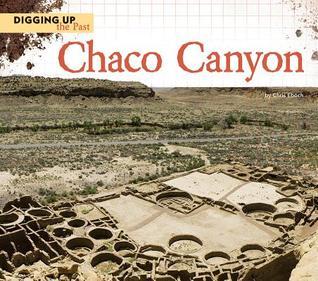
Chaco Canyon is among the most important archaeological sites in North America. pg 7
This non-fiction book for middle graders, part of the “Digging Up the Past” series, gives information about Chaco Canyon, a site that still holds mysteries to be discovered.
It was home to many people but at some point, it’s not clear exactly when, the population wandered away, leaving ruins behind.
According to one descendant, “They didn’t abandon this place. It is still occupied. We can still pray to the spirits living in these places from as far away as our pueblo.” pg 84
The book gives information about the history of digs at the site, which were not conducted with the care and documentation that such things require today. I found that part of the book quite sad. Imagine all of the history that has been lost.
It touches on the challenges researchers face today in their efforts to study Chaco Canyon. These include damage from the weather, large numbers of visitors, and looters.
Recommended for children interested in non-fiction.
“The components of the future earth and of Monks Mound were once bits of matter, created in the cauldrons of exploding stars, moving with great, swirling gravitational forces, like the stars still forming near the Cone Nebula today.” pg xiv
Cahokia: Mirror of the Cosmos is a reference book about the historic site, Cahokia Mounds. Author Sally Chappell takes the reader from the Big Bang all way through to the present – an estimated 13 billion years.
To say it is an ambitious book is an understatement.
“A major change in midwestern climate about 1250 may have caused considerable stress in Cahokia. The overall temperature of the region cooled during this infamous Pacific Climate Episode.” pg 72
That being said, once Chappell gets into the history of the site itself, it is an excellent look at a little-remembered place of forgotten significance.
Monks Mound is the largest earthen mound in North America, but so few people know about it.
The visitor’s center is currently closed for a much-needed update. I’ve been in there half a dozen times and it doesn’t do the site justice.
What Cahokia Mounds could really use is a team of historians, archaeologists, and a couple years worth of grants to properly study it.
And more books like Cahokia: Mirror of the Cosmos.
“By 1900 the Cahokia landscape was so changed by farming, canals, ditches, clear-cutting, railroad construction, housing, erosion, highways, streets, telephone lines, and rogue vegetation that only shadows of its past remained.” pg 151
Recommended for scholars who are interested in Cahokia Mounds. Chappell gives you a broad but ultimately helpful place to start your research.
In Invisible Man, an unnamed narrator moves through a series of events that highlight racism and inequality both in the society and in the people within the system.
This is a book that is difficult to describe and may need to be experienced.
The writing is powerful and builds like a punch in sections. I listened to the audiobook while on a walk through the woods so maybe that’s why I was so sensitive to the rhythms.
I’m not a black man and I’ve never walked a mile in his shoes, but this book gives a short sojourn into another person’s life.
The material is sobering and shocking, at times, lyrical and beautiful in others. Rather like life.
At the end of the book, I found myself hopeful for the narrator. Hopeful that he would move forward from all of the challenges that he faced into a new dawn of understanding and racial equality.
I’m always hopeful for improvement. Always.
I think society sometimes uses aspects of our lives (like gender, race, social status, level of education, sexual orientation) to place people into tidy boxes or make them invisible like the narrator in Ellison’s novel.
One way to combat this evil is to know that we’re not alone as we travel through life. We’re all in this together. We see each other and acknowledge each other’s strengths and weaknesses.
We are seen and appreciated for our uniqueness by the communities we create. It’s a big responsibility.
I read this classic because it is painted on the staircase of the library where I work. I’m trying to read all of the classics recorded there in an effort to become “classically” well-read.
What do I mean by classics? The most-tagged classics on Goodreads.com include such notable books as “1984” by George Orwell, “The Catcher in the Rye” by J.D. Salinger, and “Of Mice and Men” by John Steinbeck.
So, the next problem with this aspiration of mine is — Where do I start? Who is the definitive voice when it comes to choosing classics?
Who better than a library, I thought, literally.
I had the privilege of working at O’Fallon Public Library during the Great Renovation of 2015 to 2016. One of my favorite pieces of improved library space (other than the bubble wall!) are the book spines that were painted on our stairs.
I’d like to invite everyone to read along with me as I “climb the stairs” by reading the classics listed there. The goal is to share the books our community deemed important enough to preserve in our library space for all time.
The next title on the steps is Watership Down, another classic that I have not had the pleasure of reading. (Portions of this review first appeared on the O’Fallon Public Library’s blog.)
“Fate did not hand Genghis Khan his destiny; he made it for himself.” pg 9, ebook
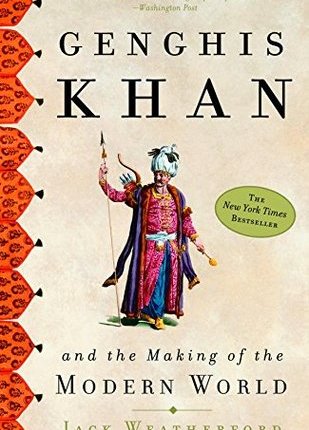
Author Jack Weatherford follows the Mongol empire from Genghis Khan to his grandson, Khubilai, and on to the distant descendants and faded glory of a once-great kingdom.
The early years of Genghis Khan’s life were the most interesting part of this book. However, this history relies on a single text, The Secret History of the Mongols, which was written in code, filled with exaggerations and inflated numbers (perhaps as propaganda) and still has not been thoroughly interpreted.
So, Genghis Khan, the historical personage, remains a shadowy figure. On the other hand, Weatherford opines that Genghis Khan’s empire had long lasting effects even to the present day.
“Seemingly every aspect of European life- technology, warfare, clothing, commerce, food, art, literature, and music- changed during the Renaissance as a result of the Mongol influence.” pg 14
Because the Mongols subjugated so many people, they controlled huge areas of the world and facilitated trade among different kingdoms. Weatherford writes that the Mongols didn’t press their culture upon the peoples they conquered (like the Romans) but adopted and adapted pragmatic customs and manners of civilization from everybody they ran into.
This diversity made the empire strong. For a little while.
But as the years passed, Genghis Khan’s descendants began to suffocate under the weight of this sprawling empire. They squabbled among themselves and spent lavishly on entertainment and comfort.
Their social policies weren’t as open as their patriarch’s. Notably, some of the rulers began to torture and abase their enemies, something that was not practiced during Genghis Khan’s time according to Weatherford.
Plague further divided the empire as the world’s populations decreased and trade faltered. The empire’s ending wasn’t a clear cut cessation, but more of a slow descent into darkness.
As a student of history, I was fascinated by the relatively recent disappearance of Genghis Khan’s Spirit Banner, a ceremonial spear with strands of horse hair braided atop it. It was a potent symbol of the Mongol’s strength and leadership.
“Somewhere in the 1960s, eight centuries after the birth of Genghis Khan, his sulde, the Spirit Banner that he had carried across Eurasia, disappeared from where the Communist authorities had kept it. … others hope that just perhaps the sulde lies forgotten in some dusty basement or bricked-up room from which it will, one day, be brought out to lead and inspire the Mongols once again.” pg 199, ebook
“All too late it is beginning to be realized, slowly indeed but no less surely, that the historic evolution of dress and personal ornament offers a wide field for methodical study; that it is in fact a science and can be made to subserve worthier ends than those of mere amusement.” pg 11, ebook
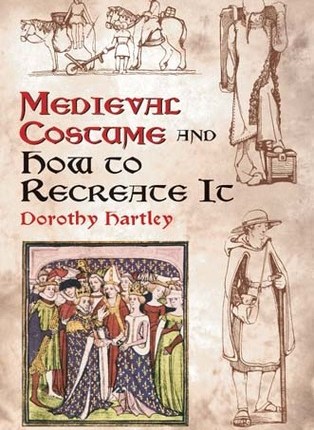
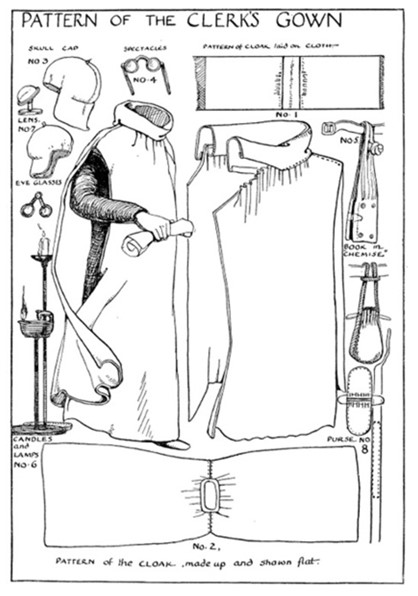
Medieval Costume and How to Recreate It by Dorothy Hartley is more of a history book than practical manual for dressing as a historical figure, unless the reader happens to have a very highly developed tailoring ability.
From the book.
At least, more than I currently have.
That being said, the divisions of different types of historical costumes into profession is inspired. As author Dorothy Hartley explains, at the beginning of the book, professions had a huge affect on how medieval persons looked. Think doctor compared to butcher compared to musician or priest.
“After the careful restrictions of religion and royalty, musicians are refreshingly loose, and may wear anything. Since there is no definite costume for musicians we have concentrated on robes and sleeves that give free play to the arms.” pg 74, ebook
In addition to the visible clothing, this book delves into the garments worn under historical clothing, which was a topic I hadn’t considered before. But, as Hartley writes, dressing as a historical figure gives the roleplayer the opportunity to both entertain and educate through the details of the costume.
For example, the thickness and type of the fabrics that go into hose have an obvious function as well as a proper place on timeline of historical costumes.
“To the casual enquirer it will no doubt seem a curious anomaly: it is none the less a fact that in the majority of costume-books no portions of man’s apparel are slurred over in so haphazard a fashion as those under the above heading.” (hose and breeches) pg 80
This book is a learning experience but, as I mentioned, also a practical one if you already know how to construct a shirt or are curious about how to make a cloak hang correctly.
“China, so far, tends to creep into our narrative only from the time it appears on the imperial horizons of the West, or when it enters the international politics of the twentieth century, or when its economy seems unresistingly relevant (or threatening) to us.” Preface, x
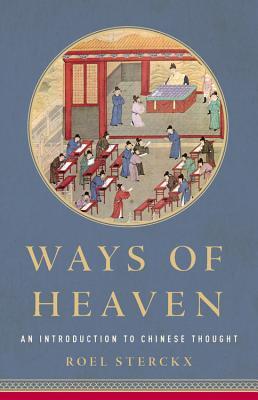
Ways of Heaven, by professor Roel Sterckx from the University of Cambridge, seeks to build a bridge for the western mind to a thorough understanding of Chinese thought through its philosophy, history, historical figures, rituals, food and more.
The result is a delightful window into a different world, complete with context and signposts to guide your way.
I was looking for a book with a general overview of Chinese philosophy and this one definitely fits the bill.
Duke Ling of Wei asked Confucius about military formation. Confucius replied: ‘I have, indeed, heard something about the use of sacrificial vessels, but I have never studied military matters.’ The following day, he left the state. (An. 15.1) pg 221
Sterckx explains how Chinese history changed with each dynasty as well as the interpretations of key philosophical texts. Each succeeding ruling figure had to prove that their rule was legitimate and connected to all of the ones that went before it. Also, if Confucius’s teachings didn’t fit with how the current emperor wanted to rule, all that had to be done was to craft a different interpretation for the new ruler.
In that way, Chinese history and philosophy are both living systems, shaped by those who came before us and also, perhaps, changed in ways we will never know. It is fascinating to consider.
(And also ripe fodder for any authors who are looking for material to create historical fiction or alternative universes.)
I appreciated how Sterckx teases out the importance of symbols and materials that permeate Chinese culture. Lately, I’ve been on a Chinese and Korean television binge through Netflix and I could tell I was missing all sorts of meanings because I didn’t grasp the cultural cues.
Ways of Heaven helps with that too.
“In the Olympics of Chinese metaphor, champions are those who float along the river of life with ease, accompanied by a teacher or loved one and with the looks of a dragon and a character like jade.” pg 367
My favorite part of the book is when Sterckx talks about the use of music in Chinese ritual. How many times in films and television have you seen an ancient sage playing a flute while seated serenely on the side of a mountain? I can think of dozens of examples of just that. Now I know why:
“Music creates an unspoken bond that no other medium can achieve. … It is ritual lived through sound: ‘Music is what sages delight in, and it can be used to make the hearts of the people good. Its effect on people is deep; it can change habits and alter customs.'” pg 241
Highly recommended for readers who are interested in Chinese history or philosophy.
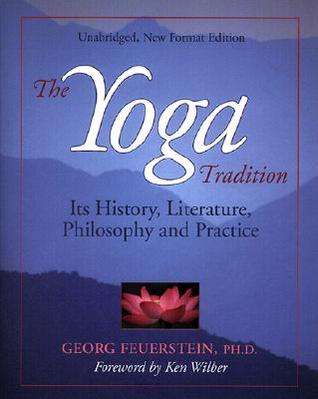
The Yoga Tradition is a reference book for the history and practical methods of yoga in its myriad forms throughout time and different religious traditions.
“In its oldest known form, Yoga appears to have been the practice of disciplined introspection, or meditative focusing, in conjunction with sacrificial rituals.” pg 27
From these ancient beginnings, author Georg Feuerstein takes readers on a fantastical and spiritual journey through the various branches of yoga including Raja, Hatha, Bhakti, Jnana and more. He’s printed original texts, along with analysis of them, throughout the book to provide context and origin materials for each tradition.
What emerges in The Yoga Tradition is stunning in its complexity as well as sheer variety of methods, beliefs and practices.
“Long before the word yoga acquired its customary meaning of ‘spirituality’ or ‘spiritual discipline,’ the sages of India had developed a body of knowledge and techniques that aimed at the transformation and transcendence of ordinary consciousness. This stock of ideas and practices formed the matrix out of which grew the complex historical phenomenon that later came to be called Yoga.” pg 65
Beyond sharing the history, philosophy, and practice of yoga, Feuerstein encourages modern scientists to look closely at the traditions in these pages to see what benefits could be gained from the ancient knowledge.
“Gradually, modern medicine and psychology, aided by advanced scientific concepts, methods, and instrumentation, are rediscovering some of the amazing facts that yogins have talked about and demonstrated for centuries.” pg 400
In my mind, that is one of the most exciting aspects of this book- what humanity could possibly learn about the enduring mystery of consciousness itself through the application of modern methods of study to ancient techniques.
Highly recommended for anyone interested in yoga and looking for a scholar’s thorough dissection of its history and forms. Your search can begin and end with this title.
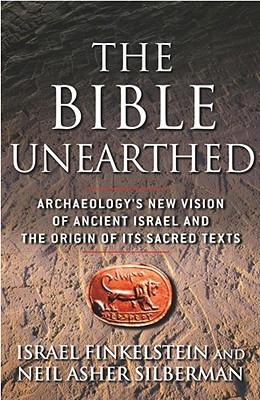
Authors Israel Finkelstein and Neil Asher Silberman examine archaeological evidence in an effort to shine further light on the writing and creation of the first five books of the old testament of the Bible or the Pentateuch.
From a historical perspective, this book was fascinating to me.
“Recent developments in archaeology have finally allowed us to bridge the gap between the study of biblical texts and the archaeological finds. We can now see that the Bible is – along with distinctive pottery forms, architectural styles, and Hebrew inscriptions – a characteristic artifact that tells a great deal about the society in which it was produced. pg 22, ebook
This was the first time I had read a non-fiction book about the actual history of events and leaders from the Bible rather than a theological interpretation. This may have been one of the reasons why I enjoyed it so much, but, despite my inexperience with books on such topics, I still believe it is very well done.
The Bible Unearthed could be a challenging read for some. For example, it doesn’t hesitate to look at potential political reasons for why the Bible was written and constructed in the manner that it was.
The authors also don’t shy away from discussing when there is a lack of historical evidence for long-held assumptions or ideas.
“As far as we can see on the basis of the archaeological surveys, Judah remained relatively empty of permanent population, quite isolated, and very marginal right up to and past the presumed time of David and Solomon, with no major urban centers and with no pronounced hierarchy of hamlets, villages, and towns.” pg 132
Religion doesn’t seem to be a topic that invites inspection or examination. This book does, in my opinion, a brilliant job of looking at only the evidence.
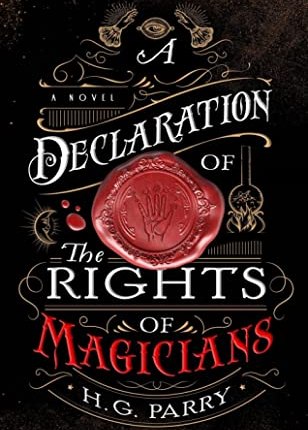
In a world where magic is real and controlled by government authorities, H.G. Parry re-imagines true historical events and people, inviting readers to add an additional layer of conspiracy to movements that changed the course of history like the French Revolution or the slave rebellion in the Caribbean.
The premise didn’t work for me for a couple reasons.
I felt like this book minimized the atrocities that were committed during the era. The slave trade and the French Revolution’s cost in both human lives and suffering is immeasurable, and it felt somewhat flippant to take those events and say, “Well, magic,” as the main driving force behind the conflicts.
I felt the same could be said for the subtle twisting of the lives of historic figures.
“His quiet voice spoke of a country built on Enlightenment principles, whose people were virtuous, where magic was a free resource to be used for the betterment of all, where food was well distributed and plentiful, where courts were in the hands of the people and not the talons of the Aristocracy, where the poorest Commoner was free to vote and grow and be educated.” pg 155
That is not to say that history or historic personages couldn’t or shouldn’t be in fantasy novels. It is a hallmark of the genre to take a reality, change the rules of that reality, and then tell the story with the new rules. Though if that was what the author was going for, perhaps she should have staged her story in another world or made the focus of the story characters she invented with the real people living their lives in the backgrounds.
Taking real events, real people and real world locations to drive the story didn’t coalesce into the fantasy novel I believe she was reaching for.
I think fantasy, alternative-historical fiction is something that can be done successfully, but I have yet to see its promise fulfilled. This may be an unpopular opinion, but I had the same issues with this story that I had with Abraham Lincoln: Vampire Hunter.
Students of history may find themselves frustrated by A Declaration of the Rights of Magicians because of the way the true events are spun. I didn’t have any specialized knowledge of the era, but a friend who is somewhat of an expert told me the complexity of the time period is so dumbed down that he was distracted by it.
“It had seemed so simple after the fall of the Bastille. The National Assembly of Magicians had risen up, exactly as Robespierre had hoped. They had issued a proclamation declaring it the right of all citizens to be free to practice their own magic: a Declaration of the Rights of Magicians.” pg 179
Setting my concerns with fantasy clumsily applied to horrific real life events aside, my biggest issue with this book was the glacial pacing. Readers sit through meeting after meeting, and it’s incredibly dull. But with the time period we were in, it should have been gripping. I told myself that a big payoff for all of this story building was coming, as the book clocks in at over 500 pages, but I felt like it never materialized.
I don’t mind a long book. But please, tell the story.
















 The Help Desk Book Blog