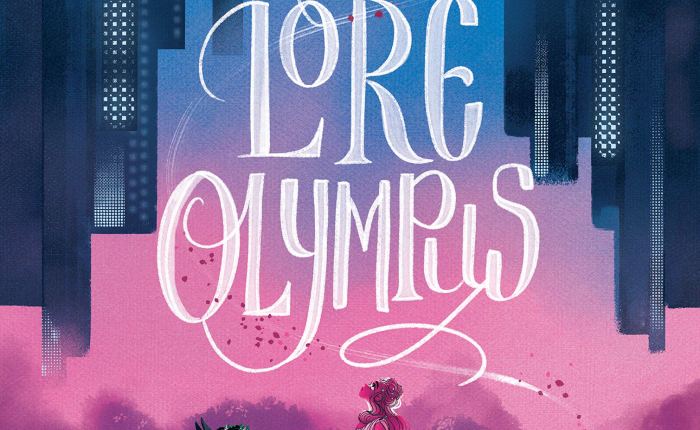
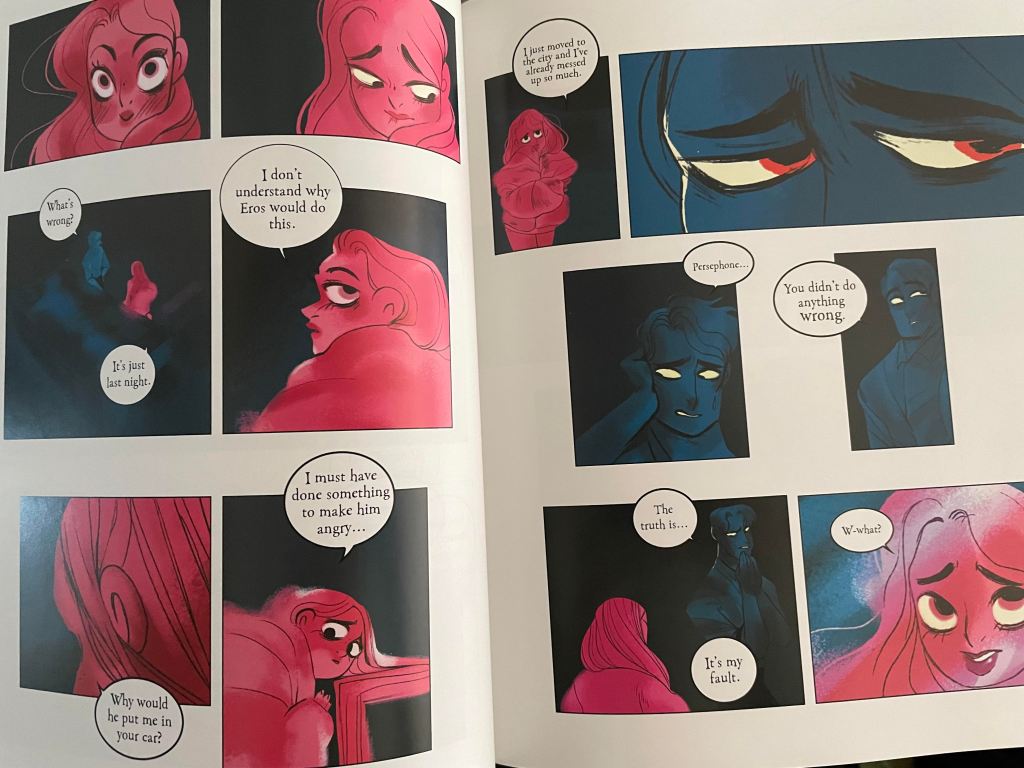
Rachel Smythe has created a cotton-candy colored, contemporary re-telling of Hades and Persephone. It is a very pretty creation but, like the start of most graphic novel series, lacks a little in the storytelling.
I also had trouble telling some of the characters apart. In some panels their features were so blurred that it was impossible to tell who was who.
That being said, I’m not sure that I am the intended audience for this work. The bright colors and quick pacing make me think this may be more appropriate for young adults.
It is shelved with the adult selections at my library, but nothing in the story is inappropriate for teens 14+.
I enjoyed the artwork more than the story itself. It is very pretty and stylized with flourishes and smooth edges.
Recommended for readers who enjoy their mythology being told with a fresh new voice and perspective.
The book begins with the warriors returning home from an epic war in space. Instead of Helen of Troy, the war was fought over one of the only males in the galaxy, a latex-covered man named “He.”
Like in the old tale, the goddesses, children of Titans, overthrew their father, Kronos. In a twist in this world, they decided that all children grow up to throw down their parents and kill several generations of their own children. In order to ultimately control humanity, Zeus, a curvaceous, powerful woman, in an extraordinary display of power, destroys every male in existence. Eventually leading to the events I just described…
“Sing in us, Muse of Odyssia, witchjack and wanderer. Homeward bound. Warless at last.
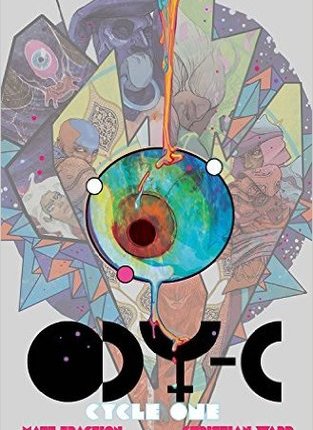
Honestly, this book is hard to explain. I think “acid trip” might do it justice. The colors are vivid and the characters can be nightmarish, vulgar or gorgeous. The universe within this book is a science fiction-themed romp with monsters, goddesses, and all sorts of unbelievable settings — a world of bones wherein the child of a goddess forever seeks its prey, a type of space station fueled by a star in which a rare male child of a goddess endlessly mates with women and then kills them when they inevitably give birth to another female… and more.
“Down in the ruinous piles of viscera once her command and her crew, Odyssia recalibrates. Watching the Cyclops of Kylos make feast of the ODY-C’s girls, they know for the first time since Troiia did fall just what fear really feels like inside.”
It helps to be familiar with classic mythology because the authors don’t take the time to explain how the two are related. Or, I suppose, you could just jump into it blind. I felt like I enjoyed it more knowing both sets of stories.
I was fortunate that the library’s copy of this book included creator interviews in the back to give more context to this incredible work they’ve created.
“Between bearded-lady gods, gender-flipped heroines, gender-uncertain sebex and the odd character who keeps the same gender as their source, the ODY-C is less a gender-bent Odyssey than it is an Odyssey-flavored gender pretzel. Rather, ODY-C is an early next step into what comes after the gender flip: the unfurling of the gender spectrum both to comment on and to dismiss outright what we understand as gender roles and norms in classic literature.”
There is certainly a lot to unpack in here. And it is such a good story.
“The act of telling a story — especially of telling one well — turns your audience’s brain into a photocopy of your own, overriding any other stimuli that the listener is experiencing independently. When a story is so good you feel like you were actually there in the middle of it, it’s because, at least as far as your brain is concerned, you actually were.”
In addition to the Greek and Roman mythology, there’s shades of Scheherazade in the unfolding of the fate of He. Readers are also treated to a new twist on the foundation of Rome myth. At least, I think that’s what it is. With the level of creativity in here, it’s honestly hard to tell.
Recommended for readers who are looking for a graphic novel that is completely different from anything you’ve ever seen before. This is that book.



 The Help Desk Book Blog