
I’ve been reading the rule books of different roleplaying games this year like Nobilis and now The Burning Wheel in order to alleviate boredom and socialize with friends while playing the various games online. While doing so, I have come to appreciate the artistry and finesse that goes into creating the games.
This effort is most easily seen in the rulebooks.
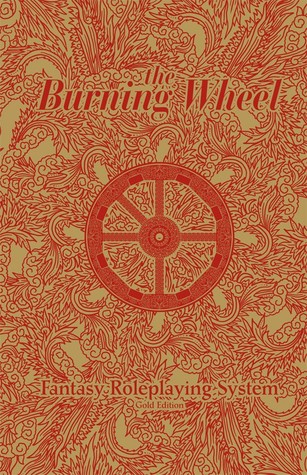
The Burning Wheel rulebook is gorgeous. The artwork and binding are lovely. This is a book that feels like it belongs in your hands when you open it.
I realize that the world is moving more digital all the time, books included, and that makes sense. It saves resources, space, and what could be more convenient than having your entire library with you when you travel?
But I think I would miss the experience of holding a physical book and the sensations that go along with that. I watched a YouTube video review of this game that suggested part of the familiarity of the feel of this book might be related to the fact that it was created in the shape and size of a family Bible.
Whatever the draw is, if you’re going to play this game, I highly recommend buying a physical copy of the book.
That being said, the game itself is incredibly complex. No matter what you want to do in Burning Wheel, it requires some sort of roll. The most annoying aspect of this complexity is in the “resource” portion of the game. I failed a roll a few weeks ago and now my financially-challenged elf bard has to find a job.

Do I really want to play a game to roleplay something like that? I could just live life as it is right now to worry about resources.
The organization of the rulebook also leaves something to be desired. For example, bard songs and their details are located in a couple different places.
So, say you’re playing along, then you want to know what sort of dice you have to roll to sing a song to the trees. In order to find that information, you’ve got to look all over the place. It doesn’t work well at all.

Even the character creation is an unwieldy process. It took two very experienced gamers and I, who admittedly has less experience but plenty of enthusiasm, nearly four hours to put together two characters. Four hours!
Despite its complex and difficult nature, I think experienced gamers who are willing to greatly simplify the rules might still enjoy playing this game. Newbies to RPGs may want to try something else.
- The Ballad of a Small Player: a Metaphysical Movie Review
- Otherwhere: A Field Guide to Nonphysical Reality for the Out-Of-Body Traveler by Kurt Leland
- Psychic Dreamwalking: Explorations at the Edge of Self by Michelle Belanger
- Archetypes on the Tree of Life: The Tarot as Pathwork by Madonna Compton
- The Goddess and the Shaman: The Art & Science of Magical Healing by J.A. Kent




 The Help Desk Book Blog