A Declaration of the Rights of Magicians by H.G. Parry

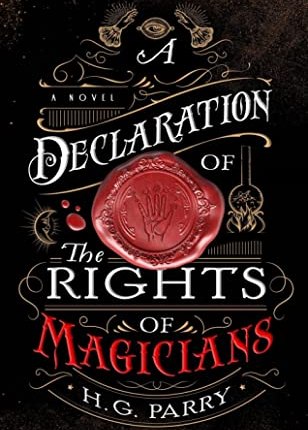
A Declaration of the Rights of Magicians by H.G. Parry

In a world where magic is real and controlled by government authorities, H.G. Parry re-imagines true historical events and people, inviting readers to add an additional layer of conspiracy to movements that changed the course of history like the French Revolution or the slave rebellion in the Caribbean.

Photo by Andreea Ch on Pexels.com

The premise didn’t work for me for a couple reasons.

I felt like this book minimized the atrocities that were committed during the era. The slave trade and the French Revolution’s cost in both human lives and suffering is immeasurable, and it felt somewhat flippant to take those events and say, “Well, magic,” as the main driving force behind the conflicts.

I felt the same could be said for the subtle twisting of the lives of historic figures.

“His quiet voice spoke of a country built on Enlightenment principles, whose people were virtuous, where magic was a free resource to be used for the betterment of all, where food was well distributed and plentiful, where courts were in the hands of the people and not the talons of the Aristocracy, where the poorest Commoner was free to vote and grow and be educated.” pg 155

Photo by Dominika Greguu0161ovu00e1 on Pexels.com

That is not to say that history or historic personages couldn’t or shouldn’t be in fantasy novels. It is a hallmark of the genre to take a reality, change the rules of that reality, and then tell the story with the new rules. Though if that was what the author was going for, perhaps she should have staged her story in another world or made the focus of the story characters she invented with the real people living their lives in the backgrounds.

Taking real events, real people and real world locations to drive the story didn’t coalesce into the fantasy novel I believe she was reaching for.

I think fantasy, alternative-historical fiction is something that can be done successfully, but I have yet to see its promise fulfilled. This may be an unpopular opinion, but I had the same issues with this story that I had with Abraham Lincoln: Vampire Hunter.

Photo by eberhard grossgasteiger on Pexels.com

Students of history may find themselves frustrated by A Declaration of the Rights of Magicians because of the way the true events are spun. I didn’t have any specialized knowledge of the era, but a friend who is somewhat of an expert told me the complexity of the time period is so dumbed down that he was distracted by it.

“It had seemed so simple after the fall of the Bastille. The National Assembly of Magicians had risen up, exactly as Robespierre had hoped. They had issued a proclamation declaring it the right of all citizens to be free to practice their own magic: a Declaration of the Rights of Magicians.” pg 179

Setting my concerns with fantasy clumsily applied to horrific real life events aside, my biggest issue with this book was the glacial pacing. Readers sit through meeting after meeting, and it’s incredibly dull. But with the time period we were in, it should have been gripping. I told myself that a big payoff for all of this story building was coming, as the book clocks in at over 500 pages, but I felt like it never materialized.

I don’t mind a long book. But please, tell the story.

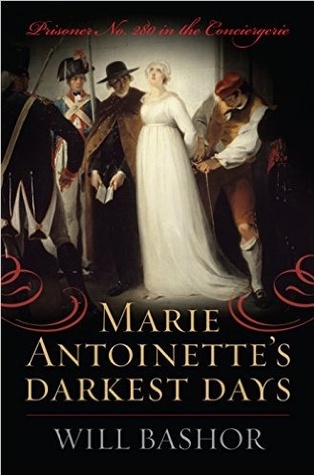
Marie Antoinette’s Darkest Days: Prisoner No. 280 in the Conciergerie by Will Bashor

Marie Antoinette’s Darkest Days: Prisoner No. 280 in the Conciergerie by Will Bashor
marieantoinette

I thought that after the King and Queen of France were taken by the Revolutionaries that what happened went like, “You were the monarchs but now we have a Republic. Off with your heads.” and boom, it was done.

How wrong I was.

Did you know, that both Louis XVI and Marie Antoinette were given very brief public “trials”? Did you know that Marie Antoinette languished in a prison for weeks after her husband was executed?

Did you know that the bodies of both former monarchs were dumped in unmarked graves?

Marie Antoinette’s Darkest Days taught me so much about this horrific period of French history.

At times, especially during the actual transcripts of the Queen’s trial, the story dragged, but for the most part, this was a fascinating study of the last days of a much maligned monarch.

“Generations of authors have reveled in reliving the queen’s reign amid the splendors of the court of Versailles and the Petit Trianon, but few have ever found the space (or perhaps the courage) in their voluminous biographies to narrate her final imprisonment in a fetid dungeon cell at the Conciergerie.” loc 198, ebook.

I am a huge fan of historical fiction and I had never heard a whisper about this. Many thanks to Bashor for filling that gap!

Photo by Pixabay on Pexels.com

The King promised his family to say goodbye before he was taken to the guillotine but he never went to them. Can you imagine the heartbreak?

“Say to the queen, my dear children, and my sister,” he continued, “that I had promised to see them this morning, but that I desired to spare them the agony of such a bitter separation twice over. How much it has cost me to depart without receiving their last embraces!” loc 862 ebook.

Cruelly, Marie Antoinette was also separated from her children and her sister-in-law and transported to a different prison. As a mother myself, Marie Antoinette’s heartbreak about having her children taken from her was the hardest part of the book for me to get through.

Even though her sham 48 hour trial didn’t prove definitively that she had done anything wrong, Marie Antoinette was sentenced to death.

Here is a passage that gives the gist of the thing: “Herman: You have never ceased for one moment wanting to destroy liberty. You wanted to reign at any price and retake the throne on the cadavers of patriots. Queen: Whether it was necessary to retake the throne or not, we only desired the happiness of France. If France was happy, we were always content.” loc 1901, ebook.

Photo by Niki Nagy on Pexels.com

Back and forth it went. Accusations of wrong doing, her denial, and then more accusations. I can’t believe that they killed her after that- it’s shocking what a mob mentality can justify.

But the public absolutely hated her. “It was also true that Marie Antoinette was “ill-treated” in the French press and elsewhere. An abundant number of provocative and obscene pamphlets were distributed throughout the capital, the provinces of France, and other European capitals. They argued not only that the queen corrupted the morals of her people but that her luxurious habits were the cause of their hunger. She was even said to powder her hair with the precious flour needed for the people’s bread.” loc 2046. Ugh.

The press has always been a powerful tool to sway public opinion, but what sad results when that power is used generate hate rather than inform and educate.

Marie Antoinette was hard core to the end. She refused to take her last rites from priests who had sworn an oath to the Revolutionaries. This is what she said to the priest who demanded to hear her confession before she was led to her execution:“You are guilty,” said the priest. “Ah, sometimes careless,” said the queen. “Never guilty.” loc 3005 ebook. I may have to use that one.

Recommended for anybody who wants to know more about the last days of Louis XVI and Marie Antoinette but also for those interested in what happens to a society when hatred and fear are allowed free reign. Some further reading: Abundance (excellent historical fiction about Marie Antoinette).

Thank you to NetGalley and Rowman & Littlefield Publishing for a free digital copy of this book!  And, thank you for reading.