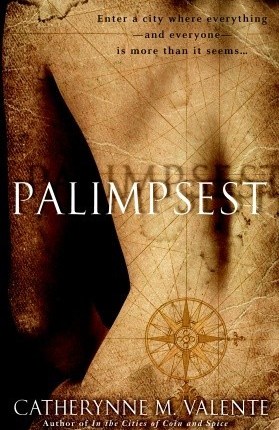
Palimpsest by Catherynne M. Valente

Palimpsest by Catherynne M. Valente

Sex and sleep with a marked individual is the way to the city of Palimpsest, a mystical and deadly place that exists beyond the borders of our world.

The first time you cross over, your spirit is bound with four other travelers. For what purpose, no one knows.

“Where you go in Palimpsest, you are bound to these strangers who happened onto Orlande’s salon just when you did, and you will go nowhere, eat no capon or dormouse, drink no oversweet port that they do not also taste, and they will visit no whore that you do not also feel beneath you, and until that ink washes from your feet… you cannot breathe but that they breathe also.” pgs 4-5, ebook.

Photo by Ekrulila on Pexels.com

A visit to the city leaves a visible mark on your skin, a map of the location you visited. You cannot travel beyond the borders of where you have already been, unless you sleep with someone who has a different map.

“It’s like a ticket. And once you’ve bought your ticket, and been to the circus, ridden the little red train, then you can sort of see other people who’ve done it, too. They walk a certain way. Smell a certain way. Their whole body becomes like an accent.” pg 42, ebook.

Palimpsest is so beyond belief, some people who have been there can’t believe it is more than a dream, at first.

“But it’s a dream,” Oleg insists. “It was fun. We won’t even remember it in the morning.” “You don’t know anything, Oleg,” sighs Gabriel. pg 73, ebook.

Photo by Dapo Abideen on Pexels.com

But, no one has ever woken up from a dream covered in blood.

Palimpsest showcases Catherynne Valente’s mammoth imagination and descriptive powers. The pieces of the city she allows readers to glimpse draw you in and make you want to see more.

Each location is unique, has its own backstory and feel. It’s an extraordinary work of urban fantasy.

The gates of sleep are two, a gate of ivory and a gate of horn. He had been horrified as a child, picturing a great door of tangled antlers and tusks. Surely that was the gate of Palimpsest.” pg 144, ebook.

Photo by Sinitta Leunen on Pexels.com

It’s disturbing to read the main characters become more and more desperate to re-enter Palimpsest.

The way they seek out sex with strangers reminded me of a drug addict’s desperate search. The cost of entering the city is too high.

It ruins peoples’ lives.

I read Palimpsest years ago and couldn’t finish it then because the narration made me feel sick.

I think the trouble was that I used to put myself into the stories I read, imagining myself as the hero, villain, every part.

I’ve ceased doing that, at the cost of some grand adventures. But, in hindsight, it also allows me to navigate my way through stories I would not have been able to touch back then.

Because of its content, I’d recommend Palimpsest only for mature readers and fans of urban fiction. It’s a strange trip, but full of wonders if you can endure the cost to get there.

Thanks for reading!

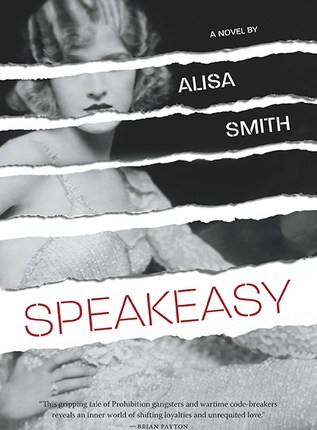
Speakeasy by Alisa Smith

Speakeasy by Alisa Smith

Lena Stillman is a codebreaker during World War II. But she hasn’t always been a hero.

During the depression, she robbed banks with Bill Bagley and the Clockwork Gang.

What is she going to do now that the past seems to have caught up with her?

Photo by Karolina Grabowska on Pexels.com

Speakeasy had some interesting elements, but the story suffered from a back and forth narrative and flat characters.

“I spread my papers out in front of me, and at first they all looked the same: a random mix of roman letters divided always into five characters with a space between each set, so no word lengths were revealed. I was searching for any repetitions.” loc 15, ebook.

The story is told from Lena’s perspective and diary entries of one of the members of her old gang.

“Bill Bagley was being punished because he had failed at something for which he possessed genius.” loc 80, ebook.

Photo by Deepak Verma on Pexels.com

The back-and-forth storytelling was jarring. I liked the stories separately, but together, it didn’t really work.

They interrupted the flow of each other. I think it might have fit together more smoothly in a Part I/Part II presentation rather than interspersed.

I think Bill Bagley, one of the central characters, didn’t have the depth required to pull off this story.

He’s supposed to be this charismatic, brilliant criminal who inspires the men to risk their lives again and again, and also captures Lena’s heart.

Bagley has some failings, but, initially, there must have been something to him to draw the gang together.

Instead, from the start, he comes off as a volatile jerk.

We meet Bagley as he’s denying the parentage of a child who looks just like him: “This un ain’t mine and don’t tell me again that it is,” he said, thrusting the baby back to a lady with burning red cheeks.” loc 80, ebook.

He doesn’t improve from there.

Photo by John-Mark Smith on Pexels.com

“I returned from a visit with Bill, received a threatening note from him, and now this. He must have a copy of it and wanted to hold it over my head.” loc 741, ebook.

I guess I just never understood what Lena saw in him.

Also, for a genius code breaker, she doesn’t seem to be able to puzzle out the people around her very well.

“My morals were just not like other people’s, because unlike the somnolent majority I saw society’s problems. In my youth I had been misguided, and picked the wrong way of lashing out against an unfair system. But I had left the gang behind, and found a greater ease in my soul.” loc 1781, ebook.

Photo by RODNAE Productions on Pexels.com

There’s a twist that occurs during Lena’s code breaking era that I saw coming from miles away. And I’m not particularly good at calling plot twists.

My favorite part of this book were the gang-era years. My heart was in my throat during most of those chapters.

Unfortunately, it couldn’t carry the rest of this novel.

Thank you to NetGalley and the publisher for a free digital copy of this book.

Thanks for reading!

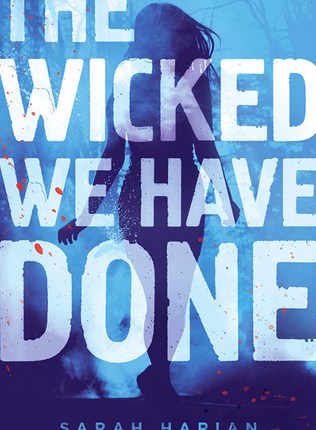
The Wicked We Have Done (Chaos Theory, #1) by Sarah Harian

The Wicked We Have Done (Chaos Theory, #1) by Sarah Harian

In a not-too-distant future, humanity has developed the technology to see inside the mind of criminals. Through simulations and tracking responses, the law claims to have the ability to measure motivation and “goodness.”

Evalyn Ibarra says she is guilty, but not of the crime she is on trial for. Rather than rely on a jury to prove her innocence, she chooses the “compass room,” the new technology, to prove her innocence.

If she is truly evil, the compass room will kill her. If she is innocent, she will walk free.

Photo by Sora Shimazaki on Pexels.com

“My throat tightens, but there is no time to reflect. I had months to imagine this moment, months to mourn. That time is over, because today is the beginning of my inevitable execution in the Compass Room.”pg 7, ebook.

I found the premise of this book to be interesting, but it suffered in its execution and characterizations. Both were rather flat.

“The tension after Stella leaves is awkward and volatile. … We’ve been given provisions, so it’s obvious that, if this is the Compass Room, we are meant to head out. It’s either that or stay in a house full of psychopaths.” pg 25, ebook.

Did I mention that the compass room tries more than one criminal at a time? Very Hunger Games-esque.

“The one thing I do know about the Compass Room is that this test is supposed to see who you truly are, despite your research. Despite good acting or the lies you tell yourself.” pg 27, ebook.

Photo by Alex Andrews on Pexels.com

Wouldn’t it be something if detecting evil was as simple as marking a chemical or hormonal response of the brain?

But then, of course, you wander into the problem: what if the technology gets it wrong? Or glitches?

“A terrorist attack finally convinced the Supreme Court. All charged in the bombing were forced to undergo the Compass Room’s exam. And they were all found to be, as reporters said on the news, ‘morally tarnished.'” pg 12, ebook.

The thing about execution is that there are no second chances or second guesses. Evalyn believes herself to be innocent. Will the room think so too?

I think if the author had fully explored the compass room and the psyches of those involved, I may have enjoyed it more.

Photo by Ignacio Palu00e9s on Pexels.com

As it was, I felt like we only skimmed the surface of what was possible. It lacked complexity because of the number of characters she wrote into the story.

Also, the author includes some half-baked romances, perhaps to prove this is in the “new adult” genre? I don’t believe it added much.

There’s also some non-spooky horror elements, that are meant to evoke the harrowing nature of the compass room. They felt overdone.

If you must read The Wicked We Have Done, I recommend borrowing it from the library.

Thanks for reading!

The Snow Child by Eowyn Ivey

The Snow Child by Eowyn Ivey

A beautiful, magic-tinged tale of an aging couple, the bleak Alaskan wilderness and a child who appears one day in the wood.

Mabel and Jack always wanted a child, but after suffering a miscarriage, they begin to lose hope of ever conceiving. Mabel suffers in female society without a child of her own.

She begs Jack to take her to Alaska for a fresh start. He agrees. But it doesn’t work.

The weather is dark and freezing. The ground is hard and takes more effort than Jack can give. They aren’t thriving.

“All her life she had believed in something more, in the mystery that shape-shifted at the edge of her senses. It was the flutter of moth wings on glass and the promise of river nymphs in the dappled creek beds. … Mabel could not remember the last time she caught such a flicker.” pg 6, ebook.

Photo by Sara Loeffler on Pexels.com

Then, out of the blue, a child magically appears during a snow storm.

She is so light on her feet and silent, Jack and Mabel don’t at first believe their eyes. The child travels with a fox and barely leaves prints to follow on the snow.

“What did he expect to find? A fairy-tale beast that holds young girls captive in a mountain cave? … Or nothing at all, no child, no tracks, no door, only insanity bared in the untouched snow? That is perhaps what he feared the most, that he would discover he had followed nothing more than an illusion.” pg 72, ebook.

Mabel remembers a Russian fairy tale from her childhood, of a couple who builds a girl out of snow. In the story within the story, the girl becomes real.

Photo by Ramirez Cooper on Pexels.com

Could Jack and Mabel have created the child they have always dreamed of?

“I am sorry to say no matter which version, the story ends badly. The little snow girl comes and goes with winter, but in the end she always melts.” pg 96, ebook.

How will Jack and Mabel’s story end?

Recommended for fans of historical fiction and tales that contain magical realism.

Photo by Gantas Vaiu010diulu0117nas on Pexels.com

“In my old age, I see that life itself is often more fantastic and terrible than the stories we believed as children, and that perhaps there is no harm in finding magic among the trees.” pg 189, ebook.

I thought The Snow Child was beautiful and well-told. Highly recommended.

I don’t think The Snow Child has been made into a film, yet, but it has been staged as a musical play.

Thanks for reading!

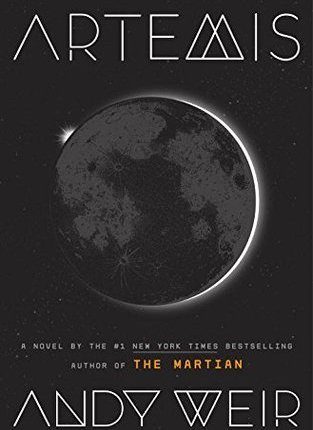
Artemis by Andy Weir

Artemis by Andy Weir

Jazz lives on Artemis, the first city on the moon. She delivers packages to eek out a living as well as other, more shady, methods of income.

“I live in Artemis, the first (and so far, only) city on the moon. It’s made of five huge spheres called “bubbles.” They’re half underground, so Artemis looks exactly like old sci-fi books said a moon city should look: a bunch of domes.” pg 5

Photo by Alex Andrews on Pexels.com

One day, one of the richest men on the moon makes her an offer far too lucrative for her to refuse… all she has to do is something very dangerous and illegal. No problem, right?

“I’m sorry, but this isn’t my thing,” I said. “You’ll have to find someone else.” “I’ll give you a million slugs.” “Deal.” pg 46.

Andy Weir’s follow-up to The Martian was disappointing to me.

Unlike his first book, the science is watered down. It’s not as educational and quirky. In my mind, the exceptional science was what separated The Martian from other science fiction offerings.

The characterizations are one dimensional, like The Martian, but it was less of a problem in the first book. In that one, you were mainly dealing with one person, alone.

In Artemis, Weir tries to build a city of characters and I didn’t buy into it.

Photo by murat esibatir on Pexels.com

The main character, a female narrator, is particularly problematic. She just didn’t sound like a woman to me.

“I landed like a sack of sh*t. But I landed on the other side of the alcove and didn’t break anything. … Whatever. A clumsy, awkward success is still a success.” pg 124.

But beyond those small problems, Artemis is still enjoyable.

Weir put a huge amount of thought into how an economy on the moon would work. It is the most realistic I’ve ever read.

He also nails the human condition, the drive for novelty and tourism.

Weir describes the trouble with travel: Even when it’s a once-in-a-lifetime vacation. You leak money like a sieve. You’re jet-lagged. You’re exhausted all the time. You’re homesick even though you’re on vacation.” pg 152.

Photo by SevenStorm JUHASZIMRUS on Pexels.com

Word.

Members of my book club voiced the opinion that Weir wrote this book as if he was prepping it for the screen. I agree.

If you’re going to read one Weir book, go with The Martian. Borrow this one from the library.

Thanks for reading!

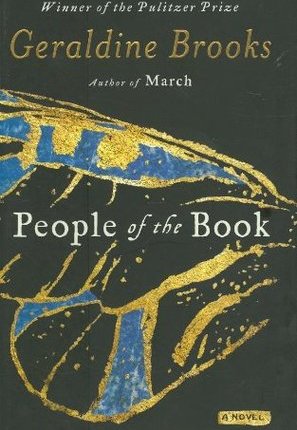
People of the Book by Geraldine Brooks

People of the Book by Geraldine Brooks

The story of an extraordinary book and the people who surround it.

And I did not enjoy it.

My reaction to this one was a huge surprise. I adored Geraldine Brook’s Year of Wonders and I thought this would be an easy hit for me.

Photo by Rachel Claire on Pexels.com

I think the problem is fairly simple- never connected with the main character. I loved Anna from Year of Wonders. I couldn’t stand Hanna.

The small details of her work that she found so absorbing, I didn’t enjoy.

I didn’t like how she treated people sometimes. I thought she seemed rather arrogant.

I also didn’t like how the timelines bounced around from character to character. I was listening to People of the Book as an audiobook. Without being able to look back and check, I found myself getting confused when I stopped in the middle of a passage and picked it up again after a work day.

Photo by Emre Can on Pexels.com

Brook’s writing is just fine. Again, I can’t believe I didn’t like this.

Highly recommend Year of Wonders. I give this a solid pass.

Thanks for reading!

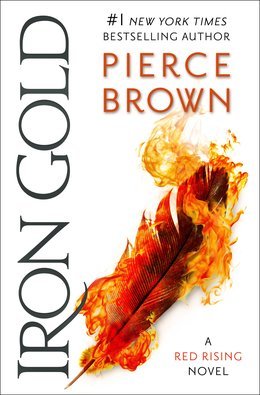
Iron Gold (Red Rising Saga #4) by Pierce Brown

Iron Gold (Red Rising Saga #4) by Pierce Brown

Darrow led an uprising and smashed the hierarchy that had held the worlds in its thrall. Now, ten years later, he is discovering the difficulties of maintaining rule and stamping out the last of the old regime.

More than anything else, Darrow is sick of war. Yet, unrest dogs his every step.

“I remember when you told me I was a good man who’d have to do bad things,” I say. “Your stomach go soft? Or have you spent so much time with politicians that you’ve forgotten what the enemy looks like?” pg 21.

Photo by Plato Terentev on Pexels.com

The government Darrow and his allies have crafted out of the former rebellion is divided in how to proceed. The enemy is entrenched on the planets nearest the sun… and also the planets furthest from it.

“Like you, I wish for nothing more than peace. I wish for a world where the machine of war does not swallow our young. … Our enemies have held dominion over us for too long. First as slaves, then adversaries. And what stability, what harmony can we bring to the worlds we have freed while they continue to define us?” pg 89.

Pierce Brown has crafted a satisfying return to his dystopian world with characters readers loved from his first three books.

We also get to meet a few new ones like a wily thief who gets in over his head and a kind, young Red who discovers The Reaper’s new world isn’t anything like it was portrayed on the holos.

Photo by Marek Piwnicki on Pexels.com

There’s sweeping speeches and heart-pounding battle scenes. Brown’s newest book is incredibly entertaining.

I have two regrets though.

The first is I read the other books so long ago, I forgot many of the small details. If I had it to do over again, I’d re-read the first trilogy before hopping into this one.

“It is our duty to embrace the scars our choices give us, to embrace and remember our mistakes, else we live believing our own myth.”pg 316.

Photo by Rachel Claire on Pexels.com

The second is Brown hasn’t written his next book yet and he ends on, what seems to be for him, a signature cliffhanger.

I refused to read the first three books until the trilogy was complete because I really don’t like waiting for the next entry in a series.

“The key to learning, to power, to having the final say in everything, is observation. By all means, be a storm inside, but save your movement and wind till you know your purpose.” pg 355.

It’s a nod to Brown’s genius that I purchased this new title from the book store. I’m a library patron through and through, but this is one that is worth owning.

Here’s hoping Brown writes really fast.

Highly recommended for science fiction and dystopian fans. Start with Red Rising.

Thanks for reading!

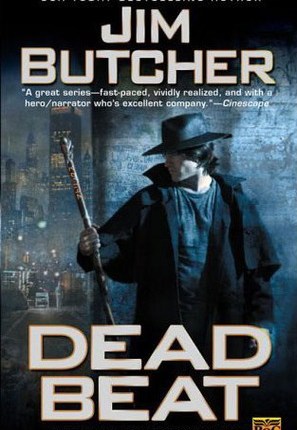
Dead Beat (The Dresden Files #7) by Jim Butcher

Dead Beat (The Dresden Files #7) by Jim Butcher

This entry in The Dresden Files has wizard Harry Dresden fighting necromancers to protect his friends and contemplating his own mortality. We also get to hang out with a few side characters and see a fascinating new side of Bob, who just happens to be one of my favorite characters in the whole series.

“Because that Kemmler was a certifiable nightmare,” Bob said. … That got my attention. Bob the skull was an air spirit, a being that existed in a world of knowledge without morality. He was fairly fuzzy on the whole good-evil conflict…” pg 39, ebook.

Photo by cottonbro on Pexels.com

There’s some ridiculousness and danger to the story, but mainly Harry-angst and the perpetual struggle against darkness.

“And despite every religious faith, the testimony of near-death eyewitnesses, and the imaginations of storytellers throughout history, death remains the ultimate mystery. No one truly, definitely knows what happens after.” pg 30, ebook.

And a few old enemies, of course: “She laughed harder, and the sound of it spooked the hell out of me. … There was no warmth in it, no humanity, no kindness, no joy. It was like Mavra herself…”pg 33, ebook.

Photo by Lachlan Ross on Pexels.com

Harry is still dealing with his disabled hand, which he burnt the heck out of in the last book. “I had a responsibility to keep that destructive strength in check; to use it to help people, to protect them. It didn’t matter that I still felt terrified. It didn’t matter that my hand was screaming with pain.” pg 65, ebook.

Also, some of Harry’s previous decisions about vampires and the Wizard Counsel have some serious consequences. But, anybody who’s been reading this series for awhile, knew that that was only a matter of time.

And there’s the small matter of a certain silver coin that Harry picked up a few books ago and buried under the concrete in his lab. But whatever is in the coin can’t get out of the circle he put it in… right?

“I just keep getting more wounded and tired. … I’m not some kind of superhero. I’m just me. And I didn’t want any of this.” pg 131, ebook.

Photo by Daria Shevtsova on Pexels.com

If you haven’t read this series, I highly recommend you start with the first book. The stories build on each other and become quite satisfying, in my opinion.

The ending of this one contains some ridiculousness that I was not prepared for, but after some thought about the series, I’ve decided that it doesn’t matter.

There is very little Jim Butcher could write in here that I wouldn’t like. Somewhere along the line, I’ve become quite a fan of The Dresden Files.

I didn’t expect it. But that’s the truth.

Check out my other reviews of the series:

Storm Front (The Dresden Files, #1) by Jim Butcher

Fool Moon (The Dresden Files #2) by Jim Butcher

Grave Peril (The Dresden Files, #3) by Jim Butcher

Summer Knight (The Dresden Files #4) by Jim Butcher

Death Masks (The Dresden Files, #5) by Jim Butcher

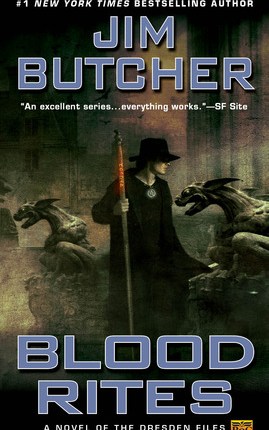
Blood Rites (The Dresden Files, #6) by Jim Butcher

Thanks for reading!

Blood Rites (The Dresden Files, #6) by Jim Butcher

Blood Rites (The Dresden Files, #6) by Jim Butcher

In this entry in The Dresden Files, the vampire Thomas asks Harry to help his friend, an adult film maker. People keep dying on set and Thomas thinks its magic-related.

Part-mystery, part-comedy and 100 percent wizard, I think Blood Rites is one of the best in the series so far.

“I was agreeing to help him and taking a job, just as though Thomas were any other client. It probably wasn’t the smartest thing I’d ever done. It had the potential to lead to lethally unhealthy decisions.” pg 17

Photo by Sharon McCutcheon on Pexels.com

As usual, Harry can’t seem to get his life together long enough to get anything done. He runs from crisis to crisis. But, he’s become self-aware enough to realize what he’s doing.

“My worry and tension slowly grew, and as they did I took a perverse comfort in the familiar emotions. It actually felt good to feel my survival instincts put me on guard against premature mortality. Hell’s bells. Is that insane or what?” pg 93

We learn a lot more about Harry’s personal life in this story.

“The hardest lesson a wizard has to learn is that even with so much power, there are some things you can’t control. No matter how much you want to.” pg 353.

Photo by Ruvim on Pexels.com

And we also get to meet a shady character or two from his past.

Highly recommended for urban fiction fans.

Check out my other reviews of the series:

Storm Front (The Dresden Files, #1) by Jim Butcher

Fool Moon (The Dresden Files #2) by Jim Butcher

Grave Peril (The Dresden Files, #3) by Jim Butcher

Summer Knight (The Dresden Files #4) by Jim Butcher

Death Masks (The Dresden Files, #5) by Jim Butcher

Thanks for reading!