Before We Were Yours by Lisa Wingate

Before We Were Yours by Lisa Wingate

Before We Were Yours is a historical fiction based on the real and heart-breaking scandal of child kidnappings and paid adoptions from the Tennessee Children’s Home Society.

Children were treated like a type of rare commodity. Sadly, abuse and even death awaited some of the unfortunates who passed through the society. Some of the children taken in had families, but the society acted as if they did not.

Photo by Pixabay on Pexels.com

As a student of forgotten history, I didn’t want to believe that such things could have happened in the United States and, relatively, recently. But, it’s true.

“The Foss children and the Arcadia were formed from the dust of imagination and the muddy waters of the Mississippi River. Though Rill and her siblings exist only in these pages, their experiences mirror those reported by children who were taken from their families from the 1920s through 1950.” pg 295, ebook

Lisa Wingate tells the story in two different timelines – one in 1939 and the other in the modern day. The earlier story line is by far the most compelling.

Readers meet Rill Foss, one of five children belonging to an itinerant family who live on the Mississippi River in their house boat. Her story begins the night her mother, Queenie, is having trouble delivering a new baby.

When Rill’s father, Briny, takes Queenie to the local hospital for help, something terrible happens to the children they leave behind.

Photo by Maximilian Mu00fcnzl on Pexels.com

Meanwhile in the modern day, Avery Stafford has moved home to help her father, a senator, during his re-election campaign. There are also concerns about her father’s health as well as her upcoming nuptials to organize.

But then she stumbles upon an elderly woman who has a picture that closely resembles Avery’s own grandmother. Could there be a connection between the two?

“Grief and a change of location can often be more than the mind and body can handle.” pg 43, ebook

Of the two stories, the earlier one is far more interesting. Rill is such a strong and indefatigable heroine in her struggle to keep her siblings together. I was enthralled by each chapter narrating her life.

Photo by Kristina Paukshtite on Pexels.com

The Avery portion of the story, on the other hand, was just so predictable. If Before We Were Yours had just been the modern story, this book would hardly have earned a mention from me, let alone netting the Goodreads Choice Award for historical fiction from 2017.

“Life is not unlike cinema. Each scene has its own music, and the music is created for the scene, woven to it in ways we do not understand.” pg 278

Recommended for readers who enjoy historical fiction as well as book clubs.

In the future, I may pen a History Guy episode about the Tennessee Children’s Home Society. It seems to me that the fate of these poor children, now grown and many departed from this life, is history that deserves to be remembered.

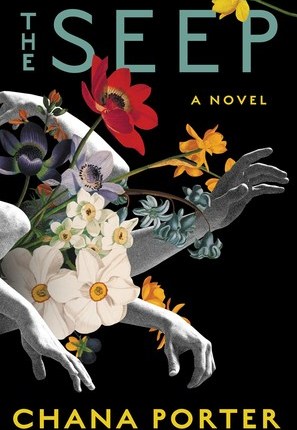
The Seep by Chana Porter

The Seep by Chana Porter

Warning: minor spoilers ahead that are listed in the book’s description on Goodreads. Do not read this review if you don’t want to know anything about the book’s plot before beginning it.

“They would soon realize that The Seep had already infiltrated their city’s water supply. They were already compromised, already bodily hosts to their new alien friends. It was through that connection they could hear one another’s thoughts, feel the same emotions, overlaid with the all-consuming adage that Everything Will Be All Right, No Matter What.” pg 10, ebook

The Seep by Chana Porter asks many questions like: what would humanity and society look like if thoughts could actually create reality, if physical material was permeated with the spiritual, if enlightenment was only a sip or two of alien-filled water away?

Photo by Arnie Watkins on Pexels.com

How would people live, work and raise their children? What would relationships look like? And how would it feel to adults who grew up with a whole other version of reality only to spend the last half of their lives in a world, that to them, feels turned upside-down?

Would they embrace it, fight against it or choose another as-yet unknown path?

Trina, a trans-woman from the time before alien technology, when humanity changed genders with surgery and hormone therapy, is in a happy and fulfilling marriage with her wife, Deeba, until the day when Deeba decides she wants to become a child and live her life again. She asks Trina to be her mother in this second life, still sharing her reality but in an entirely different way than as a lover. This desire is something that is within the realm of the possible now thanks to the alien invasion called, “The Seep”.

Trina does not take this revelation well.

“It felt akin to coming home one day to find that your wife had become a hawk, with dusty talons and a great golden eye. Your hawk-wife can’t live with you anymore. She wants to live in the sky and eat smaller birds, not drink coffee and read the newspaper in bed with you.” pg 26, ebook

Photo by Flickr on Pexels.com

The majority of this book reveals how Trina adjusts to her new reality.

“The main message I have for you today is that we don’t yet know what to call ourselves, as both human beings and symbionts of The Seep.” pg 46, ebook

I think this book does a good job, like other science fiction novels, of holding up a mirror to reality and saying, what if. It also makes a great metaphor for how older generations might feel out of touch with the generations who come after them.

Prior to the alien invasion, Trina was on the leading edge of society in both her self actualization and lifestyle. After, she feels abandoned in a landscape that no longer makes sense and unloved by the people in her life she valued the most.

There’s a palpable sense of isolation and ever-increasing paranoia in this story. If the aliens exist on a level of conscious thought, they know what you want before you even voice it. It’s disturbing, but with technology increasing the pace of life and guessing consumers’ wants and needs before they even know, how far off the mark are we from that sort of interaction, really.

Highly recommended for readers who enjoy short science fiction that makes you think.

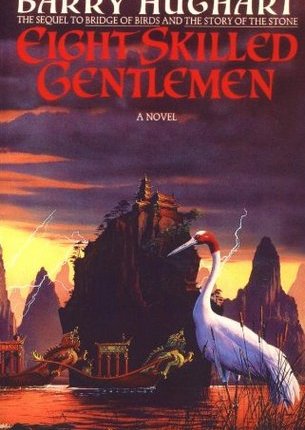
Eight Skilled Gentlemen (The Chronicles of Master Li and Number Ten Ox, #3) by Barry Hughart

Eight Skilled Gentlemen (The Chronicles of Master Li and Number Ten Ox, #3) by Barry Hughart

“My experience with the old man has taught me to keep my mouth shut when the wrinkles around his eyes squeeze up in tight concentric circles, so I waited until his mind relaxed along with the wrinkles, and then he shook himself and turned toward me.” “Ox, have you ever visited the Forbidden City?”

Photo by David Yu on Pexels.com

Eight Skilled Gentlemen is the final book of The Chronicles of Master Li and Number Ten Ox series. I feel it missed the mark somewhat.

Like the previous two books, it has some beautiful imagery and fantastical magic sequences based in an ancient fictional China of Barry Hughart, the author’s, own creation. As usual, I liked the interactions between our two heroes. I also liked riding along while Master Li and Ox attempt to solve the murder mystery.

“All we can do now is go down that list of involved mandarins and find the weak link. You may have you break a few of the bastard’s bones, my boy, but one way or another he’s going to enable us to toss the rest of them in jail,” the sage said grimly.”

Unlike the rest of the series, the overarching story for this entry felt scattered, so much so, that the ending felt almost tacked on. Which seems like a harsh criticism, except those final scenes were my favorite of the book.

Photo by Magda Ehlers on Pexels.com

If only it had felt more connected to the rest of the tale…

Like some of the other readers of this series, I noticed some repetition in Hughart’s storytelling by the third book. Formulaic can still be brilliant, but I’m not certain this book reached that bar.

There was also Hughart’s unfortunate tendency to have his characters launch into song or prose within the story. This should have added to the immersive feeling of the reading experience, but I found myself skimming when I reached those sections. Again, it felt more repetitive this time around than magical.

Adding to my disappointment, Eight Skilled Gentlemen was clearly supposed to be part of a longer series. The final few lines of the book offer no satisfying conclusion for characters whom I have come to love during the 850 pages I spent with them.

The little bit I have researched about the author seems to indicate Hughart had a disagreement with his publisher and then tired of writing it. He passed away in August of last year.

It is incredibly sad because the books are so lovely and Hughart deserved the chance to finish them in a manner he saw fit. I think it’s a loss not just for the author’s family but for the entire fantasy-reading world.

Photo by Magda Ehlers on Pexels.com

In conclusion, if you haven’t read this series and like fantasy, you must give it a try. Just be aware it is a work of art with an abrupt end.

The Story of the Stone (The Chronicles of Master Li and Number Ten Ox, #2) by Barry Hughart

The Story of the Stone (The Chronicles of Master Li and Number Ten Ox, #2) by Barry Hughart

“Ox,” he said, “the writing of your memoirs is doing wonders for your calligraphy, but I must question the content. Why do you choose the rare cases in which matters run melodramatically amok?” I heroically refrained from saying, “They always do.”

The Story of Stone, Barry Hughart

Master Li and Number Ten Ox are at it again.

There’s an unexplained murder, puzzling fragment of a poorly-finished forgery, and nature herself is leaving clues behind with whole swathes of plants dying in a strange pattern.

Photo by carol wd on Pexels.com

“I wasn’t sure that any autopsy could be delightful, but I didn’t care. The old fire had returned to Master Li’s eyes, and I felt like a warhorse who was being called back into battle.”

In the course of solving the mystery, Li and Ox encounter ghosts, hidden torture chambers, and make a journey down to the depths of hell. It is one of the finest homages to Dante’s Inferno that I’ve ever had the pleasure to read.

“Ox, what do you smell in the air?” he asked. “Wet earth, pine needles, pork fat, donkey manure, and perfume from Mother Ho’s House of Joy,” I said. “Wrong. You smell destiny,” Master Li said happily.

And, as usual, readers get to enjoy the sometimes hilarious, and always entertaining, interplay between a brilliant scholar and his surprisingly strong sidekick.

Recommended for readers who enjoy a blend of fantasy, mystery and historical fiction.

Nobilis by R. Sean Borgstrom, Bruce Baugh

Nobilis by R. Sean Borgstrom, Bruce Baugh

Though not a traditional “book”, the rules and world-building instructions for the fantasy role-playing game, Nobilis, has more than 300 pages in it. And reads like a beautiful work of fiction.

“His eyes open, black as night. A star falls through them. ‘It is strange,’ he says, ‘how humans need but a taste of power to grow arrogant. You walk in a world of things greater than you can imagine, and you speak defiance.”

Nobilis by R. Sean Borgstrom, Bruce Baugh
Photo by Achraf Alan on Pexels.com

The game itself has been labeled so complex that, after reading the rules book, some gamers don’t bother to try it. Therefore, I think it’s fair to rate it on Goodreads where it can be appreciated more for its fantastic literature rather than its playability as an actual game.

“The Imperator Ananda rules Murder, the Infinite, and (some say) the Fourth Age that is to come. His glory is terrible: humans and Powers weak in spirit dare not face him, lest his countenance drive them mad with joy.”

The basic premise is there are major forces behind the every day reality that we all know. These forces are striving to either preserve the universe or end it.

Photo by Engin Akyurt on Pexels.com

They work through intermediaries and lesser servants to influence what goes on in the real world. The point of the game is to create a story with levels and nuances rather than to brute force your will into existence.

“More beautiful than the angels are the Excrucians, whose eyes show darkness full of ever-falling stars. It is said that the Creator bargained with them long ago, that he or she might capture a touch of this beauty in the world of Ygg- and then failed to carry out his or her end of the bargain. It is said that this is why the Excrucians on their pale horses seek the destruction of all that there is…”

Photo by Anastasia Zhenina on Pexels.com

The rules book describes all of these powers in extraordinary detail, or the manner for choosing a custom name and backstory of your own. There’s no limit to what you can create except your imagination.

The players embody the ruling powers and all of their minions simultaneously. So, a game scene can go from the real world, to the divine, to a place where a god resides and back again.

And you begin to see why so few people attempt this game in the first place… 🙂

“Powers bridge divine nature and human nature, the supernatural and the natural. They fight battles on all those levels, facing the challenges of gods and ordinary humans alike. They must learn to move fluidly from a world of spirits and myths to a polluted world of highways and computers, and from their Imperator’s custom reality to the broad Earth.”

Recommended for gamers who are looking for an incredibly detailed fantasy world to romp around in or readers who like open-ended works of fantasy. Beyond simple enjoyment as a game or work of literature, I could see Nobilis being a useful tool as a writing prompt for fantasy authors.

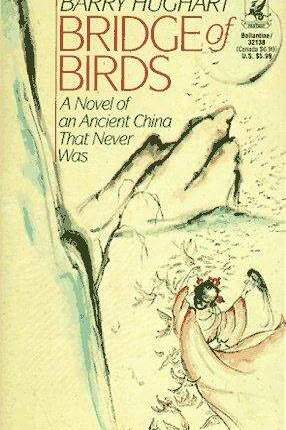
Bridge of Birds (The Chronicles of Master Li and Number Ten Ox, #1) by Barry Hughart

Bridge of Birds (The Chronicles of Master Li and Number Ten Ox, #1) by Barry Hughart

Bridge of Birds is a charming, award-winning fantasy novel that follows the investigative efforts of Master Li as he strives to safe the mysteriously stricken children from the village where Number Ten Ox lives.

“Jade plate, Six, Eight. Fire that burns hot, Night that is not. Fire that burns cold, First Silver, then gold.” pg 22, ebook

Photo by Somya Dinkar on Pexels.com

A beautiful blend of myth and fantasy, the reader is ferried from one exotic locale to the next at the side of the two heroes, one ancient and one young with surprising strength.

We navigate dangerous mazes to hidden treasure hoards, satisfy the grieving souls of haunted ghosts, and marvel at the lightning intellect of Master Li, the scholarly genius with “a slight flaw in his character”.

“My surname is Li and my personal name is Kao, and there is a slight flaw in my character,” he said matter-of-factly. “You got a problem?” pg 32, ebook

There is very little downtime in Bridge of Birds. And just when you think things couldn’t possibly get worse for Master Li and Number Ten Ox, somehow they do.

Despite its breakneck pacing, I found many beautiful moments to marvel over in this story. It is a fairy tale with both substance and heart. Easy to see why it received the 1985 World Fantasy Award for Best Novel and 1986 Mythopoeic Award for Best Fantasy.

Photo by eberhard grossgasteiger on Pexels.com

I think that’s even more impressive when you consider this was Barry Hughart’s debut novel.

“Reverend Sir, in your studies of myth and folklore, have you ever encountered a ghostly handmaiden who pleads that birds must fly?” pg 154, ebook

Highly recommended for readers who like fantasy and historical fiction novels with a dash of mystery and for their heroes to have slight flaws in their character – such a propensity to drink too much wine or the willingness to swindle others but for very good reasons.

The Lies of Locke Lamora (Gentleman Bastard, #1) by Scott Lynch

The Lies of Locke Lamora (Gentleman Bastard, #1) by Scott Lynch

In The Lies of Locke Lamora, readers are introduced to Locke, an orphan in a fantastical city with magical glass relics the size of entire city blocks. The glass is all that was left behind by the people who founded the city. Its inhabitants now do not understand how it was constructed, but that doesn’t keep them from utilizing the spires of magic glass or appreciating its otherworldly beauty.

Within this strange city that is similar to our world’s Venice, yet so different, Locke Lamora is taken in by various characters in the realm’s criminal underworld. The boy shows promise for a life of theft and confidence games… if he can reign in his propensity for accidentally getting people killed.

Photo by Pixabay on Pexels.com

“At the height of a long wet summer of the seventy-seventh year of Sendovani, the Thiefmaker of Camorr paid a sudden and unannounced visit to the Eyeless Priest at the Temple of Perelandro, desperately hoping to sell him the Lamora boy.”

There are layers to this tale. There’s intrigue and backstabbing among the criminal underworld or those who call themselves, “the right people”. There’s a gang of criminal masterminds, the Gentleman Bastards, who prey on the city’s upper class citizens, but who pass themselves off as simple sneak thieves to the rest of the gangs.

And while Locke’s gang, the Gentleman Bastards, are running one of the biggest cons of their life, the chapters of that storyline are interspersed with the personal histories of the gang’s members. Part of that history includes the Gentleman Bastards’ training as priests of the various orders in the city, of which there are many.

So, to recap: there’s complex religion, city hierarchy, criminal hierarchy, levels of con games, and then the real story begins when Locke’s plan, as usual, begins to go sideways.

“I ache in places I didn’t previously realize I owned,” said Locke, gingerly applying adhesive paste to his chin with his fingers. “But it can’t be helped.”

Photo by Francesco Ungaro on Pexels.com

I first read The Lies of Locke Lamora eight years ago in March 2012. I recently re-read it in May 2020. To my surprise, I enjoyed it somewhat less the second time around.

I still like the characters, the story and the setting, all of which were beautifully written. My complaint was the pacing. Just as the author gets rolling on the main story line, he draws us back into the past. I didn’t seem to mind it the first time I read the book, but I definitely noticed it in the second reading.

But don’t let a small thing like pacing dissuade you from reading The Lies of Locke Lamora. It is an awfully entertaining fantasy read. And if I remember correctly, the next two books in the series are fun as well.

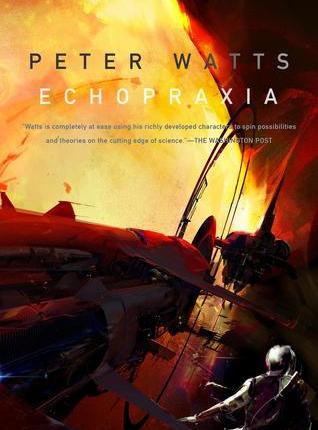
Echopraxia (Firefall, #2) by Peter Watts

Echopraxia (Firefall, #2) by Peter Watts

Peter Watts returns readers to the dystopian world of Firefall with Echopraxia, the second novel in the series.

Meet Daniel Bruks, an outcast biologist with a secret. He’s struggling to continue with his scientific studies in a world that has ceased to make sense after the alien contact in Firefall.

Photo by Pixabay on Pexels.com

“The Theseus mission would be well past Pluto by now. If it had found anything, Bruks hadn’t heard about it. For his part, he was sick of waiting. He was sick of life on hold, waiting for monsters or saviors to make an appearance. … He wished the world would just hurry up and end.” pg 15

His life quickly changes when he finds himself herded into an esoteric and technologically advanced cult’s desert compound while they’re under attack from weaponized zombies. (It makes more sense when you read it, I promise.) What follows is an exploration into the realms of religion, technology and faith.

“One day you’re minding your own business on your camping trip…” “Field research.” “… the next you’re in the crossfire of a Tran war, the day after that you wake up on a spaceship with a bull’s-eye painted on its hull.” “I do wonder what I’m doing here. Every thirty seconds or so.” pg 81

The same microscopic lens Watts used to take apart consciousness in the last book, he applies to a totally different topic, religion, in this one and it doesn’t quite work.

He doesn’t take any time to introduce readers to some of the more far-out concepts from the last book. If I had dived into Echopraxia without reading Firefall, I would have been totally lost. And as it was, I certainly was confused by the end.

Photo by Pixabay on Pexels.com

Where the last book was a space and science adventure, this one is a journey, both metaphorical and physical. The threats along the way are somewhat as scary, but the characters aren’t as well-fleshed out.

Maybe I was spoiled in the last book because I really enjoyed Siri, the narrator’s, character. Daniel Bruks is more difficult to love.

But it’s not just the characters. The science of the last book was more connected to the story line. In this book, it almost felt like a tacked-on after thought.

And as hard as I tried to put the pieces together, the ending never quite made sense. I put some serious thought into it too. It’s one thing to leave an ending somewhat ambiguous so the readers can hash it out, it’s another to give almost no clues at all.

That’s not to say Watts isn’t brilliant, because he is. However, if you have the choice between reading Firefall or Echopraxia, I would suggest the former rather than the latter.

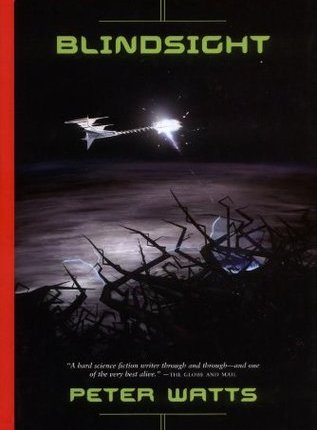
Blindsight (Firefall, #1) by Peter Watts

Blindsight (Firefall, #1) by Peter Watts

Blindsight is an incredibly imaginative science fiction novel that takes on the foibles of human consciousness and examines, in a serious way, what an alien-form of consciousness might look like.

Siri is a unique protagonist. Because of severe seizures when he was young, doctors performed dramatic brain surgery in order to save his life, essentially cutting his brain in half.

Photo by meo on Pexels.com

“The brain’s a very flexible piece of meat; it took some doing, but it adapted. I adapted.” pg 9, ebook.

This early surgery changed the way Siri’s brain worked and how it processed reality, making him the perfect translator for other humans whose brains and bodies have been so changed that baseline humans can no longer communicate with them.

And Siri’s special talents are desperately needed after aliens unleash surveillance technology in the atmosphere. Humanity called the strange lights in the sky, “fireflies.”

“How else would you explain 65,536 probes evenly dispersed along a lat-long grid that barely left any square meter of planetary surface unexposed? Obviously the Flies had taken our picture.” pg 24, ebook.

Photo by Felipe Helfstein on Pexels.com

Siri becomes part of an elite mission sent by Earth to discover where the “fireflies” originated from and who or what created them.

Blindsight isn’t a simple read. It proposes complex ideas that demand some attention to unravel and it makes the reader consider how real is her own perception of this thing we call “reality.”

It asks how technology may change not only how humankind takes in information, but how that information is interpreted and how that would separate people from each other. The characters Peter Watts has created for the alien-seeking mission are some of the most unique I’ve read because he takes those ideas to extreme conclusions.

“When the fate of the world hangs in the balance, you want to keep an eye on anyone whose career-defining moment involves consorting with the enemy.” pg 135, ebook.

But it feels very real. That is Watts’ strength – making the fantastical seem perfectly logical like vampires, real vampires.

Highly recommended for readers who enjoy “hard” science fiction.