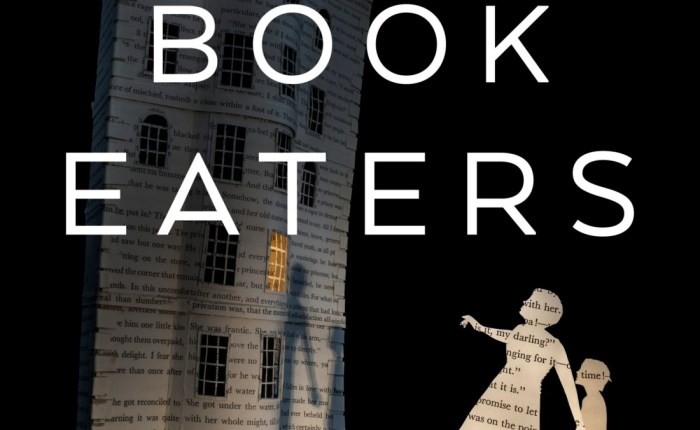
The Book Eaters by Sunyi Dean

The Book Eaters by Sunyi Dean

In the world of The Book Eaters, there are supernatural people who exist by consuming books, the content of which then stick with them throughout the rest of their lives. This small group has other members who, instead of books, eat other people’s minds. This second group they call, “dragons”.

Devon, a member of the first group, is a young woman who is married off to produce children. Once she completes this task, she is sent back to her home, only to do it all again a few years later.

The marriages and child-bearing are carefully managed by society because the book eaters are a dying race. This is intolerable to Devon, who wants to remain close to her children, but who is instead cruelly separated from them like the other young mothers.

The story begins with Devon and her young son, Cai, on the run from the knights- book eaters who control the dragons and facilitate the book eater manner of life. It develops into a life and death struggle for Devon. How can she save her children when she can’t manage to save herself?

“Love doesn’t have a cost. It’s just a choice you make.” pg 205, ebook

I really liked Sunyi Dean’s imaginative creation of people who eat books. The descriptions of what she imagined literature tasted like were fascinating and my favorite part of the story. I also liked the idea of carrying around every book one has ever read in your mind like some sort of living library.

The book was well-written, but I didn’t care for what Dean did with her characters once she established them. I just didn’t connect with it.

As a mother myself, it was difficult to read about children being taken away and/or treated poorly. The story turned out to be a lot darker than I initially thought it would be.

Recommended for readers who enjoy dark fantasy.

Aching God (Iconoclasts, #1) by Mike Shel

Aching God (Iconoclasts, #1) by Mike Shel

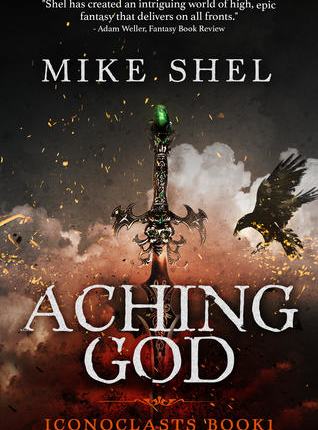
In the fantasy world of Aching God, a mysterious plague has emerged at the headquarters of the Syraeic League, an adventuring guild that explores the ruins of an ancient civilization. Their century-old quest is to retrieve relics from the ruins and to discover more information about its culture and gods.

Auric Manteo used to go on these quests for the League until a disastrous final foray led to an abrupt retirement and years of nightmares. But things have been looking up for the aging adventurer, until he receives a letter from the League requesting his help in banishing the plague.

Photo by John-Mark Smith on Pexels.com

“Three years of untroubled sleep, disturbed by this nightmare the very morning a summons to Boudun and the Citadel arrived? Was it a hateful premonition?” pg 28, ebook

Can Auric face the demons from his past in order to save the afflicted from the ravages of the Aching God?

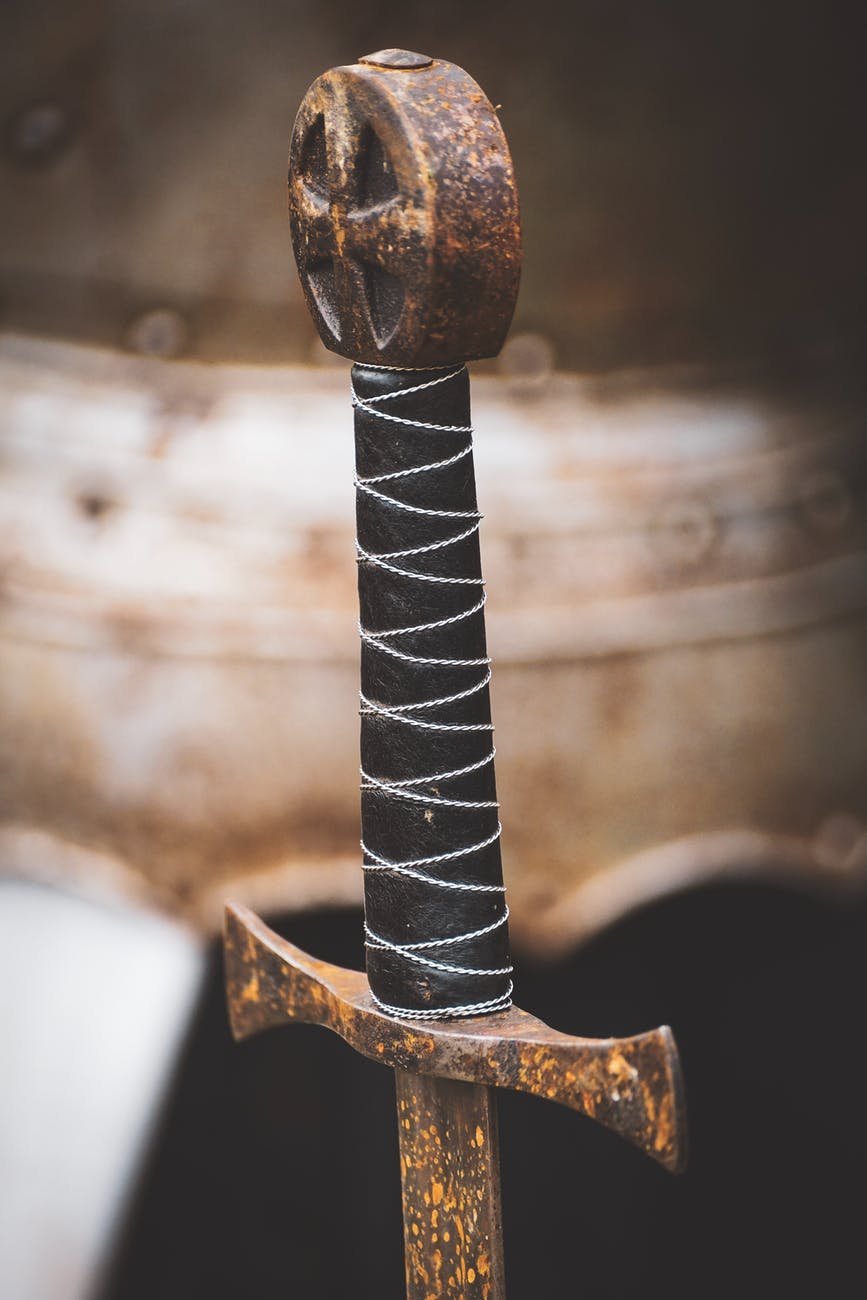
“His mind flashed to images from his tenacious nightmare: the corpses, the pit, Lenda’s raggedly severed head gaping at him in accusation. He rested a shaking hand on the pommel of his sword to steady it.” pg 73, ebook

Photo by Susanne Jutzeler on Pexels.com

Despite its promise, I think Aching God would be a better dungeon module than it is a story. Mike Shel begins to flesh out his characters, but they never get far beyond the basics of birthplace and motivation. I didn’t feel drawn to any of the characters because of this superficial depiction.

His magic system with its secretive sorcerers who embed gems in their foreheads in order to bind themselves to their magical powers and comrades was also interesting. But, again, Shel leaves a majority of the storytelling to the reader’s imagination rather than actually writing it.

The adventure itself is linear with few unexpected twists and turns. Even the reveal of the great mystery of the Aching God leaves something to be desired.

Only recommended for readers who adore the fantasy adventure genre. Otherwise I would give this a pass.

Thanks for reading!

The Golden Ass by Apuleius

The Golden Ass by Apuleius

Lucian longs to experience real magic. When he discovers it, an unfortunate misstep turns him into the title character. In the shape of an ass, Lucian suffers through a series of misadventures.

Photo by Nilina on Pexels.com

I wonder when Apuleius was writing The Golden Ass, if he ever imagined this particular novel would be the only one written in Latin to have made it through his time to ours in its entirety.

Perhaps that’s an unfair question, because how could a writer imagine something like that?

But if he could have somehow foreseen it, I think that he would have written something different than this rambling, depressing, occasionally obscene adventure. Or maybe not. Maybe it summoned up his society nicely.

Photo by Mike Andrei on Pexels.com

Hypothetical ramblings aside, it didn’t make for an enjoyable reading experience.

A very large consideration for readers of The Golden Ass is the quality of the translation and how that may affect your enjoyment of the book. A friend and I read this book in tandem and this particular problem became clear quite quickly.

My edition, borrowed from the library, is a reprint of a translation by William Adlington in “Oxenford, September 1566,” and comes complete with the spelling and idiosyncrasies of his era.

“You perhappes (sic) that are of an obstinate minde (sic) and grosse (sic) eares (sic), mocke (sic) and contemme (sic) those things which are reported for truth, know you not that it is accounted untrue by the depraved opinion of men, which either is rarely seene (sic), seldome (sic) heard, or passeth the capacitie (sic) of mans reason, which if it be more narrowly scanned, you shall not onely (sic) finde (sic) it evident and plaine (sic), but also very easy to be brought to passe.” pgs 14-15, ebook

Photo by Andrea Piacquadio on Pexels.com

I found many passages “passeth the capacitie of” my reason because the nearly five hundred years between Adlington’s translation and this made so much of it nearly unintelligible.

My friend read a modern translation by Penguin Publishing and reported a more positive reading experience. If given a choice between the two, please do pick the more modern version.

“Verily shee (sic) is a Magitian (sic), which hath power to rule the heavens, to bringe (sic) downe (sic) the sky, to beare (sic) up the earth, to turne (sic) the waters into hills and the hills into running waters, to lift up the terrestrial spirits into the aire (sic), and to pull the gods out of the heavens, to extinguish the planets, and to lighten the deepe (sic) darknesse (sic) of hell.” pg 19, ebook

Translation problems aside, I found the bulk of the story to be repetitive and, on the main, depressing. Things get worse and worse for our hero.

Photo by Emmylou on Pexels.com

Yes, there is some measure of relief when we reach the end of our story and explore the mysteries of a cult whose rituals have been forgotten to history. But between the beatings and, as I mentioned, various obscene interludes, the end couldn’t come fast enough. Poor Lucian, “poore” William Adlington, and poor me!

The version I read of The Golden Ass, I recommend only for English majors, classicists or religious scholars. The appeal for modern readers just isn’t there.

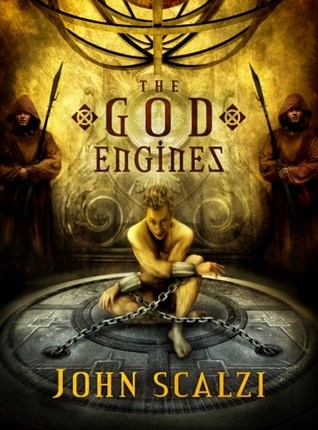
The God Engines by John Scalzi

The God Engines by John Scalzi

In the world of The God Engines, beings called gods power the ships that take humanity between the stars. How the world became this way is not for Captain Tephe to question, instead it is a matter of faith. As part of Tephe’s service and devotion to his own deity, he has to keep the being that powers his engine in check and subservient to his will.

That is not a simple task.

Photo by Pixabay on Pexels.com

“I do not know why this is. Why single made iron can kill a god. I know only that it can. I know the gods fear death more than do men. I can kill you with this, god.” pg 8, ebook

When Tephe is called to perform a secret mission of great importance for his deity, it throws his entire world view in jeopardy. He discovers his god, and all the others, may not be what they appeared to be.

“Words. They have power. To name a god is to give it power. To deny it such is to take it.” pg 16, ebook

I feel like this story was too short to fulfill its full potential. The general idea was very promising – what would a world where embodied gods were used as power sources look like? How would the society be structured? And how would a worshiper’s faith change or be challenged through day-to-day interactions with the gods?

Photo by Ben Yi on Pexels.com

The plot felt rushed as the characters raced from one place to another. I also wanted a bit more background about the universe of The God Engines, but the lack of it added somewhat to the mystery of the story.

“You are charged with silence,” proclaimed the third Bishop. “What is spoken to you here is not to be spoken again, on remit of your soul.” pg 31, ebook

I think the strength of this story is in how it addresses faith. Faith in the goodness of the unseen shapes lives and guides actions. It explains why some gods power ships and others rule empires. Because of faith, humanity has waged wars and conquered planets.

Perhaps someone should have made certain this faith wasn’t misplaced…

Recommended for readers who enjoy short science fiction novels with a liberal dash of horror.