The Daughters of Ys opens with a father relating a story to his daughters. The story concerns the magical way he met his wife and their future mother on a dark stormy night in the middle of the sea. From there, the two carve a city from the sea and begin a new life.
But now, their mother is dead and, the king and his daughters (Rozenn and Dahut) have to figure out their lives and how to run their magical kingdom, Ys, without her.
In this coming-of-age tale, secrets run in every direction. The discovery of what those secrets are make this story fascinating.
Magic and living comes with a cost is one of the many lessons that could be learned from this fairy tale.
I loved the illustrations by Jo Rioux and feel like they really elevated the story. She uses mostly muted colors to weave shadows and magic throughout the tale. The brightest colors are reserved for Dahut, the younger and more magically inclined daughter.
I think this book is appropriate for young adults. There are some mature themes that are dealt with, but they’re not explicit. Highly recommended.
“I gradually understood the truth of my situation: I was a secret.” pg 14, ebook.
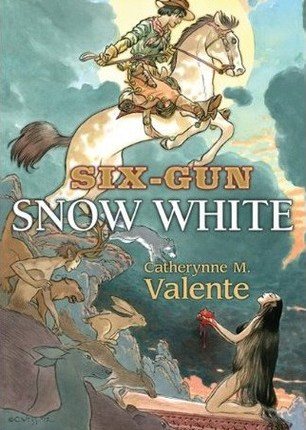
Catherynne Valente has penned a bewildering and ultimately disappointing western-tinged fairy tale retelling in Six-Gun Snow White. Her reimagining of the classic story has Snow White as an unloved daughter of a mine speculator and an abused, indigenous mother. When her mother ends her own life, Snow White’s father marries a mysterious woman from back East, the evil stepmother of fairytale infamy, whom the narrator calls Mrs. H.
“She named me a thing I could aspire to but never become, the one thing I was not and could never be: Snow White.” pg 27, ebook
The disappointing part of the story is not the set up or general idea of Snow White as a western, both of which I thought were excellent. The trouble arrives in the magical portions of the story which are, in my opinion, not well written. They felt disjointed and tacked on.
It’s curious to me that I didn’t like this story because Valente is one of my favorite authors. There is no one like her when it comes to an interwoven story or mysterious magic. Maybe my issue with this tale is that it’s so short Valente didn’t have a chance to work her usual story telling magic? Perhaps.
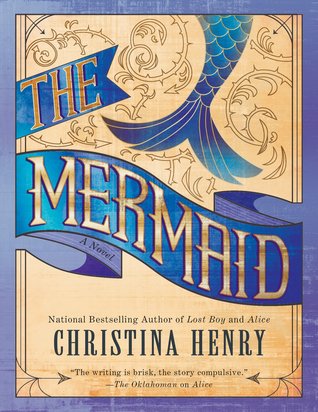
The Mermaid begins like most other mermaid tales. A creature from the sea is caught in a fisherman’s net. With one glance, the mermaid falls in love with him and decides to leave the ocean.
But her eyes had seen inside him the way that women’s eyes do, and his loneliness snaked into her, and she was sorry for it, for that loneliness caught her more surely than the net.” pg 4
Predictably, their life together goes well, until one day it doesn’t.
Then, one of P.T. Barnum’s right-hand men, Levi Lyman, comes seeking a real mermaid, or at least a woman with a reputation of being a mermaid, for the showman’s museum.
“What he’d caught in his net had been far more alien, a creature covered in silver scales all over, with webbing between its fingers and teeth much sharper than any human’s. pg 9
Barnum is cast as the villain of this tale, a grasping coin-counter with little regard for the feelings of people, let alone magical creatures like a mermaid: “Barnum privately thought that if the woman was really a mermaid — not likely, as Levi had said, but there was always hope — she wouldn’t be going anywhere. There wasn’t a chance in heaven or hell that Barnum would let something like that go once he had it.” pg 43
Coincidentally, the day before I picked up this book, I had the chance to watch “The Greatest Showman“, a musical film about P.T. Barnum’s life, museum, and the people he hired to fill its halls.
I enjoyed the music and choreography, but felt that a man as complex as P.T. Barnum couldn’t fairly be depicted in a 90-minute film. There was a darker side to Barnum’s story — the way he fleeced people out of their money with “humbugs” and, in a particular, his treatment of a woman named Joice Heth.
P.T. Barnum is a purveyor of wonders, a seller of miracles, a showman of the first order.” pg 58
In this book, Christina Henry doesn’t shy from these shadows in Barnum’s life, but I didn’t feel like he was a particularly scary antagonist.
I suppose the true struggle in The Mermaid could be Amelia’s difficulty in maintaining her mermaid nature in a human world. However, that story has been told before.
She meant to do the proper human thing, to behave the right way, but they were not as easy with each other as she’d thought they would be.” pg 153
Henry didn’t put a twist to this fantasy tale as she so successfully managed to do with Alice, her dark re-telling of Alice’s Adventures in Wonderland by Lewis Carroll. I confess, I was rather disappointed.
I wanted a unique mermaid story. Instead, I got a fairly standard interpretation of a classic.
“I left because I wanted something I didn’t have, and once I loved Jack and lost him, I wasn’t the same as I was before. Love does that. It changes you in ways that can’t be undone.” pg 177.
The Mermaid is a charming little tale, for what it’s worth. Just don’t expect too much out of it. It’s not a humbug, but I wouldn’t call it a wonder of the world either.
Here are some of my other reviews of books by Christina Henry:
A beautiful, magic-tinged tale of an aging couple, the bleak Alaskan wilderness and a child who appears one day in the wood.
Mabel and Jack always wanted a child, but after suffering a miscarriage, they begin to lose hope of ever conceiving. Mabel suffers in female society without a child of her own.
She begs Jack to take her to Alaska for a fresh start. He agrees. But it doesn’t work.
The weather is dark and freezing. The ground is hard and takes more effort than Jack can give. They aren’t thriving.
“All her life she had believed in something more, in the mystery that shape-shifted at the edge of her senses. It was the flutter of moth wings on glass and the promise of river nymphs in the dappled creek beds. … Mabel could not remember the last time she caught such a flicker.” pg 6, ebook.
Then, out of the blue, a child magically appears during a snow storm.
She is so light on her feet and silent, Jack and Mabel don’t at first believe their eyes. The child travels with a fox and barely leaves prints to follow on the snow.
“What did he expect to find? A fairy-tale beast that holds young girls captive in a mountain cave? … Or nothing at all, no child, no tracks, no door, only insanity bared in the untouched snow? That is perhaps what he feared the most, that he would discover he had followed nothing more than an illusion.” pg 72, ebook.
Mabel remembers a Russian fairy tale from her childhood, of a couple who builds a girl out of snow. In the story within the story, the girl becomes real.
Could Jack and Mabel have created the child they have always dreamed of?
“I am sorry to say no matter which version, the story ends badly. The little snow girl comes and goes with winter, but in the end she always melts.” pg 96, ebook.
How will Jack and Mabel’s story end?
Recommended for fans of historical fiction and tales that contain magical realism.
“In my old age, I see that life itself is often more fantastic and terrible than the stories we believed as children, and that perhaps there is no harm in finding magic among the trees.” pg 189, ebook.
I thought The Snow Child was beautiful and well-told. Highly recommended.
I don’t think The Snow Child has been made into a film, yet, but it has been staged as a musical play.
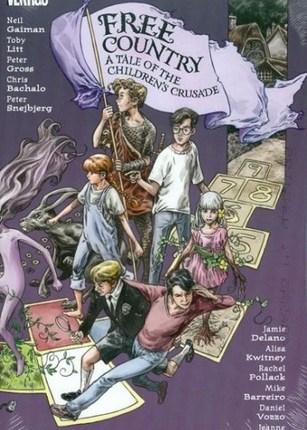
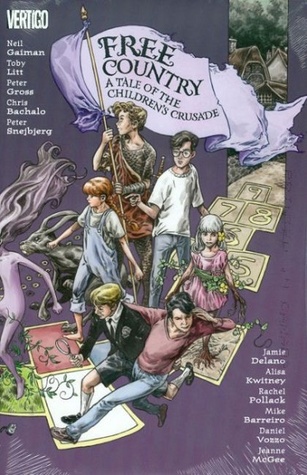
A fantastic tale about two dead detectives, who are trying to solve a missing person case. It sounds macabre but it’s actually a fairy tale.
Neil Gaiman includes this in his introduction: “I asked Alisa Kwitney, who cowrote much of the second half of The Children’s Crusade, if there was anything she wanted me to point out and she said yes. I should tell people that in the double-page spread with the mermaids and the magic, she had instructed artist Peter Snejbjerg to draw a very young Nail Gaiman reading a book, oblivious to the wonders around him.”
I made sure to check on that page- and there he was. If you read this too, make sure to look for Neil in the full-page spread depicting Free Country.
The premise of this tale is like Peter Pan, but with a twist. There’s a land where children can live in peace and harmony and never grow old… but at what cost.
“Look at them, who call themselves adult- they eat, they work, they sleep. Their pleasures are gross and ugly, their lives are squalid and dark. They no longer feel, or hurt, or dream. And they hurt us. They say every adult has successfully killed at least one child, heh? Free Country is the refuge. In the past, it was the refuge only for the most fortunate of the few. But those days are ending. It will soon be the home of every living child.”
If I had known the catalog of Vertigo comics, I may have enjoyed this more. But, you don’t need to be an aficionado of comics to enjoy Free Country. It can be a stand-alone graphic novel with plenty of chills and thrills along the way.
It was for me.
Recommended for adults to like twisted tales with a fairy-tale flavor or for 16+ because of the potentially disturbing content.
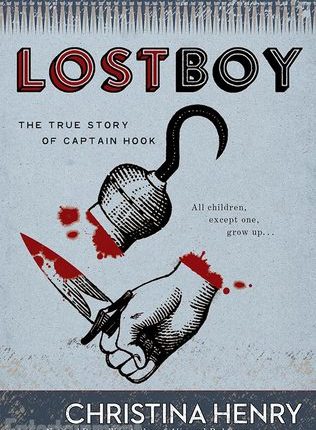
Christina Henry, author of the chilling Alice, which is a brilliant re-telling of Alice in Wonderland, has shifted focus to a new fairytale. In Lost Boy, readers get to experience the story of the boy-who-never-grew-up through the origin story of his arch-nemesis. And what a story it is.
“Peter will say I’m a villain, that I wronged him, that I never was his friend. But I told you already. Peter lies. This is what really happened.” loc 85, ebook. Goosebumps? Yeah.
Fans of the original tale will need to prepare themselves for having beloved characters shown in a new and sinister light. Think Longbourn, but worse, much worse. “I had been with Peter longer than I’d been in the Other Place, longer than I could count, anyway. The seasons did not pass here and the days had no meaning. I would be here forever. I would never grow up.” loc 146, ebook. The others in Peter’s group call the narrator, Jamie.
He is a fierce fighter- the best. And he protects the younger and weaker members of those lucky few that Peter brings back from the real world or in this tale, the Other Place. This protective instinct is sneered at by Peter who accuses Jamie of “babying” or “mothering” the boys. In truth, there is no worse insult in Peter’s arsenal. Grown ups either abuse you or take your stuff or both. They’re pirates.
“(Peter) had invited us there, had promised us we would be young and happy forever. So we were. Unless we got sick, or died, or were taken by the pirates.” loc 257, ebook. So, Neverland is not the paradise that it is portrayed as in the original tale. There are also monsters called Many-Eyed that eat the boys alive, if they catch them.
“Was this, I wondered, what it felt like to be a grown-up? Did you always feel the weight of things on you, your cares pressing you down like a burden you could never shake? No wonder Peter could fly. He had no worries to weight him to the earth.” loc 1971, ebook.
The stage is set. Love and hate intertwine with magic, blood and, of course, a little bit of fairy dust.
If you enjoyed this tale, you may also want to explore some other Peter Pan re-tellings like Tiger Lily by Jodi Lynn Anderson or All Darling Children by Katrina Monroe. The last, a horror-filled offering, may really appeal to those who want to delve more into the potential shadows of Neverland. There’s a price to pay for never growing up. In that tale, as in this, Peter pays it without a qualm.
Thank you to NetGalley and Berkley Publishing for a free advance reader’s copy of this book. Reminder: the short quotations I cited in this review may vary in the final published version.
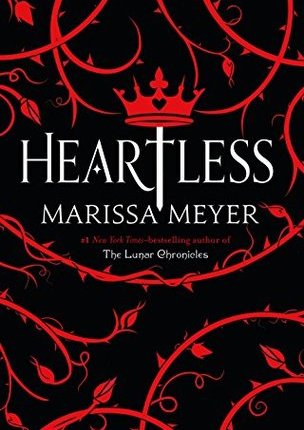
This is the tale of how the Queen of Hearts became the cold and heartless character of Through the Looking Glass fame.
Origin stories and fairy tale re-tellings are where its at. I’ve lost track of how many books I’ve read that examine well-known stories from a different point of view. Marissa Meyer does an excellent job maintaining the whimsy of the first book while weaving her new story in-between.
I’ll confess- I wasn’t expecting to enjoy Heartless as much as I did.
A few months ago, I read her Lunar Chronicles and I was sorely disappointed with it. Meyer is playing upon all of her strengths here. She tells the story of two or three characters rather than a cast of twelve or more. Whenever her character’s conversations threatened to bog down the action, they were cut short.
The pace is excellent. The tale kept me guessing. And the ending was something to be enjoyed rather than eye-rollingly trite. (Unlike some other books by this author that I won’t sully this review by mentioning.)
Catherine is the daughter of the Marquis and Marchioness of Rock Turtle Cove. She loves to bake and dreams of the bakery shop that she will surely one day own with her dear friend and maid, Mary Ann. Unfortunately, Catherine’s mother has other plans.
I liked that Meyer made Catherine both a product of nature and destiny. See the description of Catherine’s mother: “She was often a warm, loving woman, and Cath’s father, the Marquis, doted on her incessantly, but Cath was all too familiar with her mood swings. All cooing and delighted one moment and screaming at the top of her lungs the next. Despite her tiny stature, she had a booming voice and a particular glare that could make even a lion’s heart shrivel beneath it.” pgs 14-15. Sounds familiar, no?
The King of Hearts and his court of cards, talking animals and other magical creatures were also similar to the original book: “The King was a sweet man. A simple man. A happy man, which was important, as a happy king made for a happy kingdom. He simply wasn’t a clever man.” pg 26.
One of my favorite characters, the Cheshire Cat, appears in this too:“She slumped against the baker’s table. “I never dreamed such a thing could happen here.” Cheshire’s yellow eyes slitted as he held her gaze for one beat, two. Then he began to unravel from the tip of his tail, a slow unwinding of his stripes. “These things do not happen in dreams, dear girl,” he said, vanishing up to his neck. “They happen only in nightmares.” pg 93. Dun, dun, daaaaaaah!
And also, the merry, merry unbirthday singer and snappy dresser himself, Hatta, also known as the perhaps-not-yet-mad Hatter: “Was he mad already? She couldn’t help inspecting him, newly speculative and curious. He didn’t seem mad. No more mad than anyone else she knew. No more mad than she was herself. They were all a little mad, if one was to be forthright.” pg 222. Harkens back to the original text: “We’re all mad here.”, doesn’t it.
We are introduced to an entirely new character, the King’s joker, a man named Jest. At the beginning of the story, Catherine finds herself dreaming of a man with yellow eyes and guess who matches that description?
Mix all of these together and you have a great young adult fantasy. Recommended for anyone who is curious as to why a raven is like a writing desk.
Warning: There are spoilers in this review. Please do not read further if you have not read this book.
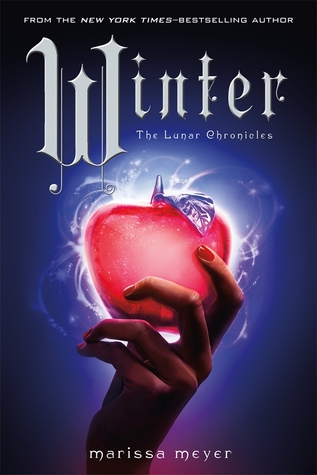
Winter is the disappointing final installment of the promising Lunar Chronicles. Coming in at over 800 pages, I thought that this was going to be an epic conclusion. Sadly, I found it to be uninspired and far too repetitive.
Cress was my favorite of this series. In it, Meyer is at her best. Her fairy tale re-telling of Rapunzel was brilliant. She took the elements of the classic tale and gave it a science fiction twist. There’s adventure, danger and an inspiring heroine.
Winter reaches for that mix with the re-telling of Snow White, but it never makes it.
I started going through the stages of mourning with the ending of this series.
First, I was in denial. This couldn’t be the last of it. That’s not how the story ends… it can’t be!
Then, I was angry. These were characters I cared about. They deserved inventive and unique endings and not necessarily all perfectly happy ones wrapped in a bow. I know this isn’t a popular opinion but, sometimes there isn’t a happily ever after. Every single one of the protagonists ends up together. How predictable and trite.
On to bargaining. I thought that maybe if I waited to write my review, that I’d like it more. Perhaps time passing would blunt the edges of my disappointment. Perhaps I needed to accept that this book was written for the young adult audience and look at it from that point of view.
Then depression. So many readers loved this series, maybe my opinion was just wrong. Maybe I wouldn’t know what a good story was if it punched me in the face. Maybe I disliked this series just to be contrary to popular opinion.
Finally, acceptance. I did not like Winter. I didn’t like its emphasis on physical appearance and connecting that to internal characteristics. How many times did we have to hear how ugly Levana was under her glamour? And don’t we find out in this book that it wasn’t her fault? That she was physically abused and then taunted because of her appearance? So, yeah, let’s talk more about how repulsive she is.
I didn’t like how the worst thing that Meyer could think to write of her antagonists was “He/she was INSANE.” We get it.
I didn’t like how the characters would turn to each other and talk through obvious motivations. Do you think she/he did that/this because she knows we’re coming/going/trying to escape? Yeah, I do! Now stop talking and go face your destiny. We could have saved almost 200 pages if the characters would have acted instead of talked endlessly about acting.
And Iko’s happy ending was that she got a bunch of dresses and color-changing eyes? That was the final straw for me. She was my favorite character and she deserved an ending that matched her unflagging spirit, loyalty and optimism.
I listened to this entire series on audiobook. Was it worth the hours of my time? I guess that depends on what which book we’re talking about. If this series had ended on a book the quality of Cress, this would be a very different review.
My apologies if this is your favorite series. No book appeals to every reader. Winter just wasn’t for me.
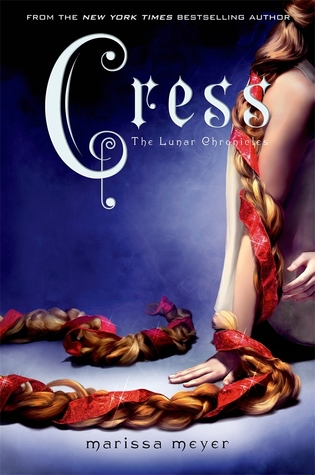
I’m pleased to report that this series continues to improve. Cress, the third entry in The Lunar Chronicles, introduces the reader (or audio book listener) to a girl named Crescent Moon.
Cress, for short, has long tangled hair like Rapunzel. The clever parallels to the classic fairy tale continue through the story and, of course, the characters from the first two books are woven throughout.
I find that I’m invested in Cinder’s story now whereas after the first book, I was lukewarm about the whole thing. And how about that Scarlet? I think her portion of this novel nearly gave me a heart attack.
No spoilers, but one of the most fascinating new characters in this entry comes from Luna. If you’ve read it, I’m sure you know who I’m talking about. Can this new person be as kind or genuine as he/she appears to be or is it all just another glamour? Here’s hoping.
Teen angst continues in this book but it is, thankfully, hidden behind intergalactic and earth-bound chase scenes and daring missions. Small gripe here, but did literally everyone in this book have to have a love interest?
And, in case anyone is wondering, I am still Team Iko. 🙂
Recommended for readers looking for slightly different fairy tales or who enjoy young adult fantasy. I can’t say that the first two entries lived up to the hype that I’d heard, but this one was approaching it.









 Warning: There are spoilers in this review. Please do not read further if you have not read this book.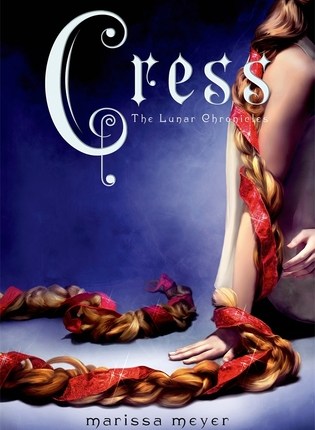
 I’m pleased to report that this series continues to improve. Cress, the third entry in The Lunar Chronicles, introduces the reader (or audio book listener) to a girl named Crescent Moon.
 The Help Desk Book Blog