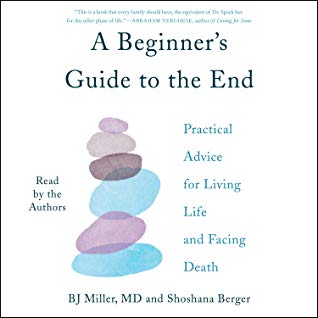
A Beginner’s Guide to the End: Practical Advice for Living Life and Facing Death by B.J. Miller, Shoshana Berger

A Beginner’s Guide to the End: Practical Advice for Living Life and Facing Death by B.J. Miller, Shoshana Berger

A Beginner’s Guide to the End is a definitive guide about death and how to handle it, both for yourself and your loved ones.

Topics range from planning your estate and dealing with life-ending illnesses all the way through to what to do in the first 24 hours after someone dies and how to liquidate an estate.

Photo by KoolShooters on Pexels.com

I could see this book being incredibly useful to anyone who has received a terminal diagnosis, their family or caregivers of all types.

I picked this book up because my father-in-law recently died and I was looking for information on how to help myself and others with grief.

“Grief is a force of nature. Though it can feel problematic as hell, bereavement is an essential piece of the human picture, whichever way it surfaces. pg 420

Photo by Alex Green on Pexels.com

I learned all about that, but also a bunch of other helpful end-of-life details. For example, I knew nothing about the legalities of transporting and spreading cremated remains. Now, I know.

“A friend snuck down to the field of the Oakland-Alameda County Coliseum at half-time and dumped some of his father’s dust at the fifteen-yard line. His pop, a doctor, had been a hard-core Raiders fan, and though his son knew he was doing something illegal, he felt a jolt of joy, knowing that part of his father would always be in that stadium.” pg 459

The text in this book is printed slightly larger than normal, which could be exactly what is needed for elderly readers.

Highly recommended for anyone who needs some guidance about death-related issues.

Thanks for reading.

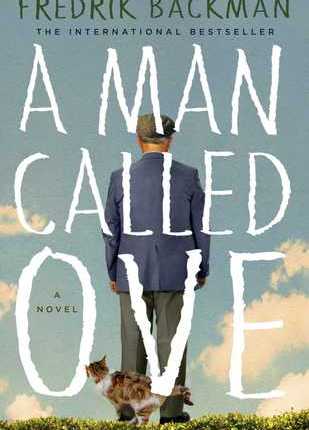
A Man Called Ove by Fredrik Backman

A Man Called Ove by Fredrik Backman

A Man Called Ove is indeed about a man named Ove. He’s depressed. His wife died and he wants nothing more than to join her.

But, somehow, life itself seems to be conspiring to keep him alive.

Photo by Brett Sayles on Pexels.com

To borrow a line from Shrek: Ove is like an onion.

On the outside, his personality is kinda smelly and makes people cry. But, he has layers.

This story takes apart those layers.

Highly recommended to me by one of my book club members and my mother-in-law. A Man Called Ove by Fredrik Bachman is a treat. I highly recommend it, now, too.

The novel has been made into a movie, which I enjoyed nearly as much as this book. That’s high praise.

Thanks for reading!

Leaving Tinkertown by Tanya Ward Goodman

Leaving Tinkertown by Tanya Ward Goodman

This is Tanya Ward Goodman‘s memoir about how she loses her father and grandmother- first through Alzheimer’s and then to death. Leaving Tinkertown is a powerful look at end-of-life issues and family love.

It is an incredibly raw and straight forward account of a period of unimaginable change in the author’s life.

Photo by Matthias Zomer on Pexels.com

Tanya handles the deterioration of her father very well. I suspect that this ability to quickly and seamlessly accustom herself to change probably evolved from her childhood experiences with her father at carnivals and on road trips. With the background changing continuously, she had to change too but hold on to some essential part of herself. This characteristic served her well during her adult years.

Tanya’s father was a prolific artist. Because of his extreme creativity, I think that she was exposed to his mercurial moods long before he began losing his battle with Alzheimer’s. Artistic types seem to walk a fine line between logical thinking and madness. Their families get to walk that journey with them. That doesn’t mean that his descent into darkness didn’t hurt Tanya, but that she was more able to cope with his moment to moment shifts in behavior because she had experienced them before.

Photo by Shelagh Murphy on Pexels.com

Through this adversity, she grows closer to her brother, step-mom, and mother as they work together to care for her dad.

Tanya doesn’t gloss over her family’s shortcomings but comes to accept everything that each person brings to the table: “… I am starting to understand that doing all you can do, even if it doesn’t seem like very much, is enough.” pg 193.

When a strong, vital person in your life is no longer able to care for themselves, it’s heartbreaking.

My own grandfather, a force of nature, lost some of his heart when the family had to take the keys to the car away because he didn’t have the strength to drive safely anymore. This book was hard for me to read because Tanya knows what it feels like to cause that type of pain too.

Photo by Pixabay on Pexels.com

It brought back so many small moments when I was in a care-taking position for him. You want to provide the best quality of life that you can, but when the person can no longer clean, feed, or clothe themselves, then the really difficult decision making begins. Tanya and her relatives seem to make the process relatively simple even though I know that it is anything but that.

We all know that we’re not going to live forever but when you’re dealing with loss of physical strength or mental capacity in your own life or the lives of those you love, you get very close to that idea. It’s like the difference between looking through a window and having your face smashed up against the glass. When it’s right there, you can’t look away.

I’d recommend this for anyone who is caring for an aging or ill family member and needs a reminder that it’s all going to turn out alright. As Tanya reminds us, we just need to do all that we can do even if it doesn’t seem like it is very much.

I received a free copy of this book through Goodreads First Reads program. Thanks for reading!