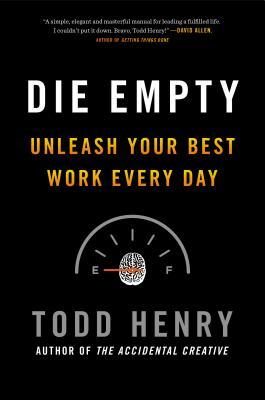
Die Empty: Unleash Your Best Work Every Day by Todd Henry

Die Empty: Unleash Your Best Work Every Day by Todd Henry

Your days are finite. One day, they will run out. As a friend of mine likes to say, “You know, the death rate is hovering right around one hundred percent.” pg 3

Todd Henry has given the world a call-to-action with Die Empty. The book is one big reminder that one day you (yes, you!) will die and he imparts some useful tools to help you discover what you’re meant to do and then to do it to the best of your ability.

Photo by Ketut Subiyanto on Pexels.com

“If there is one overriding goal of this book it is this: to bring a new found clarity and sense of urgency to how you approach your work on a daily basis, and over your lifetime.” pgs 5-6

Henry is into catchy acronyms and veers very close to empty motivational jargon. But, I feel, he pulls himself back in time.

“No one charts a course for mediocrity, yet it’s still a destination of choice. It’s chosen in small ways over time, and those tiny, seemingly inconsequential decisions accumulate until they result in a state of crisis. pg 35

I learned a great deal from his abc’s of mediocrity that include “comfort zone” as the letter C. If I am guilty of anything, it is finding my comfort zone boundaries and then staying carefully inside of them. Henry believes you do the world a disservice when you don’t push yourself. Who knows how much you can do if you don’t try?

Photo by Ketut Subiyanto on Pexels.com

“Growth is about daily, measured, and disciplined action. It’s about embracing purposeful skill development and pursuing new opportunities that stretch you a step beyond your comfort zone, even when it means venturing boldly into the unknown.” pg 89

You escape your comfort zone, Henry says, by creating goals in steps, sprints and stretches. Steps are goals that can be accomplished in one day. Sprints are completed in one or two weeks. Stretches are a big goal that takes longer than that.

Throughout much of the book, the lesson seems to be act, observe, and act again. It touches on everything from fear of failure and delusions to inflated egos and effective communication. Die Empty could be described as a one-stop-shop for almost anything that holds you back from “unleashing your best work every day”.

Photo by Prateek Katyal on Pexels.com

Henry even addresses the fact that no self help book is the complete answer for anyone. The final ingredient in any lasting change or improvement in your life is you.

You can have the map, and there can be gas in the tank, but unless you’re willing to fire up the engine and put your foot on the gas, you’ll never get anywhere. Intention and theory don’t change the world; decisive action does.” pg 201

Recommended for readers who are unwilling to settle for less than their very best work every day.

Thanks for reading!

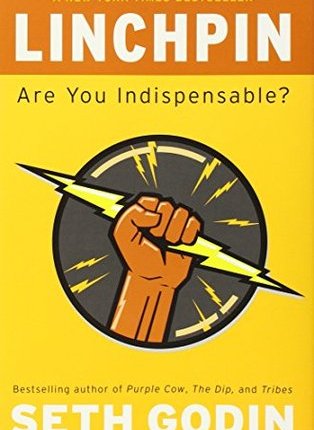
Linchpin: Are You Indispensable? by Seth Godin

Linchpin: Are You Indispensable? by Seth Godin
linchpin

Seth Godin draws on his experiences in business and life to convince the reader to be a linchpin rather than a cog in the machine of work.

He says it better than I did: “This book is about love and art and change and fear. It’s about overcoming a multigenerational conspiracy designed to sap your creativity and restlessness. It’s about leading and making a difference and it’s about succeeding.” pg 2

You have our attention, Godin. What do we do?

Through a series of blog-like sections, Godin explains that there is no road map or simple answer. “Our world no longer fairly compensates people who are cogs in a giant machine. … Leaders don’t get a map or a set of rules. Living life without a map requires a different attitude. It requires you to be a linchpin.” pg 19

Essentially, you have to embrace the uniqueness and drive that is inside of you. You have to create a platform of work rather than a resume. You have to decide to discard mediocrity.

“The very system that produced standardized tests and the command-and-control model that chokes us also invented the resume. … Great jobs, world-class jobs, jobs people kill for- these jobs don’t get filled by people e-mailing in resumes.” pg 72

That’s so outside the usual paradigm of work, for most of us, that it can sound scary.

Photo by Andrea Piacquadio on Pexels.com

“Often, when people hear about my radical ideas for how you should train for a career, as well as the best way to present yourself, they object. They point out that not fitting in is certainly going to be an ineffective way of getting one of these average jobs. … If you need to conceal your true nature to get in the door, understand that you’ll probably have to conceal your true nature to keep that job. … The linchpin says, “I don’t want a job that a non-linchpin could get.” pgs 78-79

It seems like he’s asking a lot, but the alternative is to give up and conform. Godin says that this mindset isn’t impossible: “My fundamental argument here is simple: In everything you do, it’s possible to be an artist, at least a little bit.” pg 94. We can do that, right?

I didn’t agree with everything in Linchpin. I thought that Godin was far too hard on journalists… it is easy to look at an industry, or any situation really, from the outside and criticize the people in the thick of it.

News agencies know that they have to embrace the future or die. Just how to do that is up for grabs and adding Godin’s toolbox of how to excel at work couldn’t hurt. I don’t think that reinvention or evolution is an impossible task. It’s just tricky because, as Godin noted, “there is no roadmap.”

Recommended for people who may be bored with where they are and can see a glimmer of where they want to be- but aren’t sure how to get there. Also recommended for those who work in the newspaper business because we clearly need more linchpins.

The Optimistic Workplace: Creating an Environment That Energizes Everyone by Shawn Murphy

The Optimistic Workplace: Creating an Environment That Energizes Everyone by Shawn Murphy

The Optimistic Workplace is a complex but useful manual on how to shift the environment at work. Shawn Murphy talks about all aspects of business from the individual to management to all the levels in-between. There weren’t many surprises in these pages, but the advice was solid.

I knew that leadership was important to the overall vibe in the work space and Murphy does say that it’s important: “…your leadership style impacts climate by up to 70 percent. Think about that 70 percent. It’s mostly how you show up and interact with others that shapes the climate that influences your team’s performance.” pg 9 But, it isn’t the only thing that matters.

Photo by Yan Krukov on Pexels.com

There are also ways in which the individual can change the work space. It all starts with greater self knowledge: “Workplace optimism thrives when people understand why they show up to work. Not only is the purpose and meaning of work important, but so, too, are the personal implications. … Personal expression through work is a major contributor to your employees’ well-being. Doing work that matters facilitates the expression of one’s talents.” pg 19 Makes sense. Know thyself does seem to be the foundation of most major life-changing movements.

“..the benefit to positively shaping the climate for your team is getting to know yourself better and discovering how to fulfill your own potential. You position yourself to love your work. In doing so, you set the tone and lead the way to help your employees realize their own potential and find greater meaning in their work and life.” pg 48 Sort of a trickle-down effect of optimistic workplace awesomeness.

Photo by Mikhail Nilov on Pexels.com

Of all of the myriad of studies included in this book, my favorite was the study of “ikigai” : “Your health is linked to a sense of purpose in life, or, as the Japanese all it, ikigai. … A 2008 study in Japan by Toshimasa Sone and his colleagues sought to understand how, if at all, ikigai contributed to longevity in life. … Mortality risks were higher in those who did not have a sense of being and of joy. Those lacking clarity in intentional living had a higher incidence of cardiovascular disease and other life-threatening illnesses.” pg 89 Purpose or death.

The only critical thing I have to say about The Optimistic Workplace is that it’s so broad. Towards the end, I despaired of ever having the time to implement all of the changes suggested, even though they seem like good ones. My boss suggested that I take my favorites and start there. I think I will.

Recommended for those who have plenty of time for reflection and transformative meetings- I think that this book has huge potential. I just wonder how many businesses would be able to take the time and actually work their way through it. Some further reading: Mastering Civility: A Manifesto for the Workplace, The Happiness Advantage: The Seven Principles of Positive Psychology That Fuel Success and Performance at Work, and Work Rules!: Insights from Inside Google That Will Transform How You Live and Lead.

Thanks for reading!