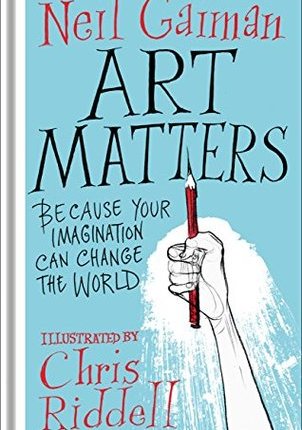
Art Matters: Because Your Imagination Can Change the World by Neil Gaiman, Illustrated by Chris Riddell

Art Matters: Because Your Imagination Can Change the World by Neil Gaiman, Illustrated by Chris Riddell

Neil Gaiman and Chris Riddell have created a manifesto for readers, librarians and content creators. This little book celebrates everything having to do with reading, freedom of information and ideas, and how to start creating the life of your dreams, even if you don’t know where to start.

It was compiled from Gaiman’s prolific back catalog of speeches, poems and various other writings about creativity.

“The world always seems brighter when you’ve just made something that wasn’t there before.”

Photo by Matt Hardy on Pexels.com

I feel like this should be required reading — especially the parts about how to respond to intellectual disagreements. I think Gaiman penned these words after the bombing at Charlie Hebdo, and they still ring true.

“I believe I have the right to think and say the wrong things. I believe your remedy for that should be to argue with me or to ignore me. And that I should have the same remedy for the wrong things that I believe you think.”

And, of course, I was partial to all of the praise directed towards librarians and libraries, having been a librarian once myself. Sometimes people ask me if I ever think libraries will be closed because “they’re just a building with books” or “they’re a waste of taxpayer money”.

This is how I wished I had replied: “Libraries are about freedom. Freedom to read, freedom of ideas, freedom of communication. They are about education, about entertainment, about making safe spaces and about access to information.” How could that ever possibly go out of style?

Photo by Zichuan Han on Pexels.com

Gaiman also gives attention to the bookworms of the world. We make it a better place through our reading and daydreaming and daydreaming about reading. Also, our epic library patronage is a good thing.

“We have an obligation to read for pleasure. If others see us reading, we show that reading is a good thing. We have an obligation to support libraries, to protest the closure of libraries. If you do not value libraries you are silencing the voices of the past and you are damaging the future.”

Gaiman shares a bit about how he became the universally beloved author he is today. Step one, you’ve just got to get started.

“If you have an idea of what you want to make, what you were put here to do, then just go and do that and that’s much harder than it sounds and, sometimes in the end, so much easier than you might imagine.”

He confesses that he lied on early resumes to get his foot in the door. But, after his later success, he went back and worked at all of the places he had claimed before. That way, he didn’t see himself as lying but as “chronologically challenged.” I loved that he took the time to make things right.

Gaiman also has some interesting views about no-start dreamers. He says the saddest thing to him are friends that say they’re too committed to follow their dreams. There’s bills to pay, mortgages and families to support and they can’t take the dive to do whatever it is they’ve always dreamed of doing.

Photo by Karolina Grabowska on Pexels.com

He said he dodged that particular roadblock by skipping a well-paying job or two early in his career, so that he didn’t get too comfortable doing something other than writing. I thought that was an interesting strategy. Creating is about having the courage to just do it, no matter what and not stopping until you’re doing it.

“Somebody on the internet thinks what you do is stupid or evil or it’s all been done before? Make good art.”

The good news is there are more platforms than ever before to get your creations in front of the people who will care about them.

“The gatekeepers are leaving their gates. You can be as creative as you need to be to get your work seen. YouTube and the web (and whatever comes after YouTube and the web) can give you more people watching than television ever did. The old rules are crumbling and nobody knows what the new rules are. So make up your own rules.”

My own life right now points to the truth of that. I left a guaranteed paycheck and employer provided health care to write for my husband’s YouTube channel. We’re not only succeeding but we’re having a lot of fun doing it.

Thank you, Gaiman and Riddell for this beautiful book. I hope it encourages creators everywhere to take the leap.

Thanks for reading!

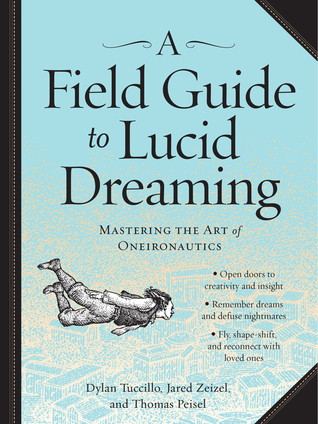
A Field Guide to Lucid Dreaming: Mastering the Art of Oneironautics by Dylan Tuccillo

A Field Guide to Lucid Dreaming: Mastering the Art of Oneironautics by Dylan Tuccillo
luciddreaming

An excellent guide to experiencing or deepening lucid dreams, A Field Guide to Lucid Dreaming is filled with tips, tricks and advice to explore your dream world.

My husband and daughter experience lucid dreams all the time and I don’t or, at least, haven’t yet. It’s embarrassing.

It’s as if they have access to worlds that I can only dream about, literally. I picked this book up because I wanted to develop this skill too.

So far, with the advice contained within this Field Guide, I’ve realized that I was dreaming once, became lucid and immediately woke up. But, that’s progress.

I’m encouraged actually. If I can go lucid once, I can do it again.

“Lucid dreaming is the ability to know you’re dreaming while you’re dreaming. A lucid dreamer is able to go to sleep at night and wake up within his or her dream. With this unique awareness, you can generally behave like someone who is awake, exercising the free will, imagination, and memory of waking life.” introduction. How fun would that be?

Ever wanted to fly? Face your nightmares? Talk to a deceased loved one? The authors of this book claim that it is all possible.

Photo by Ron Lach on Pexels.com

They addressed some of my problems directly: “Quite often, the amateur lucid dreamer’s early exploits in lucidity last only a few moments. If you’ve become lucid already but lost your awareness very quickly, don’t worry. This is common. In the next chapter we’ll look at ways in which you can stabilize the dream and stay lucid for long stretches of time.” pg 106.

Practice makes perfect, it seems.

The shamanistic beliefs about the dream world are intriguing:“…shamans of indigenous cultures understood that in order for something to be created in the physical world (such as that kitchen you’ve been meaning to remodel, or this book), it must first be constructed in the “imaginal realm.” In other words, lucid dreaming might be a tool in creating our physical reality.”pg 151.

Life is like a dream and we are the dreamers, whether asleep or awake:“This world can be a nightmare or a nice dream. It’s full of friends or enemies, success or failure, meaning or nihilism. We’re headed toward destruction or we’re headed toward rebirth. There are many viewpoints on Earth as there are people. And just like the dream, we shape our experience with our thoughts, emotions, and expectations. pg 246.

Recommended for anyone who, like me, wants to master lucid dreaming. I think that this book will help you find your way.

Sweet dreams 🙂

Thanks for reading!

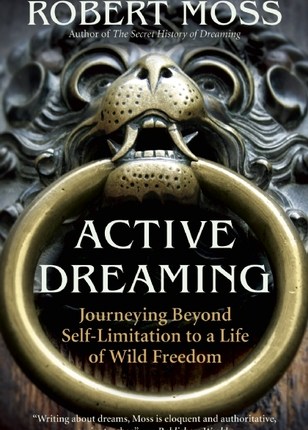
Active Dreaming: Journeying Beyond Self-Limitation to a Life of Wild Freedom by Robert Moss

Active Dreaming: Journeying Beyond Self-Limitation to a Life of Wild Freedom by Robert Moss

Active Dreaming is more than just another book about lucid dreaming or dream interpretation. Moss takes the Aboriginal practices of his native Australia and develops a living practice wherein one treats the world, whether waking or sleeping, like an lucid dream.

Moss invites the readers to fully live their lives and to “wake up” through drumming circles, sharing and interpretation of dreams, choosing your names and how you define yourself, practicing mindful creativity, noticing synchronicities, journaling, storytelling, creative visualization (and more).

Photo by Sabel Blanco on Pexels.com

Some of the concepts in this book were a bit far out there- things like shared dreams or visions in which, theoretically, you invite another person into your dreamspace to help you address whatever is going on for you or instructions on how to start Dream Groups.

Active Dreaming is a call to action, but in so many directions that it is difficult to really know where to start. I think I’m going to cherry pick a few of Moss’s techniques and see how I do.

Robert Moss’s definition of Active Dreaming: “This approach includes paying attention to night dreams, but it is not only, or even essentially, about what happens at night. It is a method for conscious living. When you become an active dreamer, you’ll notice that the world speaks to you in a different way.” pg xii introduction

Photo by GEORGE DESIPRIS on Pexels.com

Here are some of the benefits of practicing Active Dreaming: “The journey opens gateways for soul recovery and the release of life blockages. It introduces and strengthens connections with the animal guardians and brings their vitality, tracking skills, and healing energies richly alive in the body. It encourages spontaneous art and creativity and offers rich personal mythology, which is healing in itself. Properly conducted, the journey raises a tremendous amount of life force and channels the movement of that energy into harmonious, unrestricted flow.” pg 98

And finally, a passage that really resonated with me: “You must know your story and tell your story and have your story received. … Learn to do that, and you can survive the worst nightmares of history and bring heart and healing to others…” pg 134

Tell your story. I can do that.

Photo by cottonbro on Pexels.com

This review has really only touched the tip of the iceberg that is Active Dreaming. Read this book if you want to adjust the lens with which you perceive reality or if you just want to read a book that is completely different from anything else that you’ve ever read.

Robert Moss is not for everyone, but, if you can set aside any preconceived notions about what this book should be, I think that you’ll find at least some chapters that will speak to you.

If you’re looking for more spiritual books like this, look no further than another of Moss’s titles: The Boy Who Died and Came Back: Adventures of a Dream Archaeologist in the Multiverse

Thanks for reading!