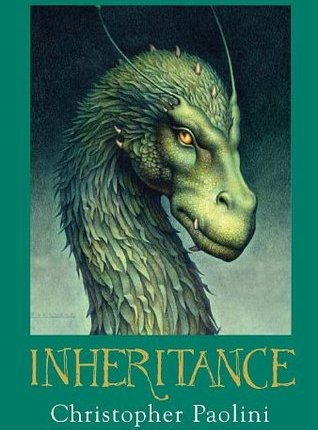
Inheritance (The Inheritance Cycle, #4) by Christopher Paolini

Inheritance (The Inheritance Cycle, #4) by Christopher Paolini

Christopher Paolini brings his fantasy series for young adults to an end with Inheritance, the fourth and final book in The Inheritance Cycle.

Eragon, Saphira, the Varden and their various allies including elves, dwarves and urgals, make their way to Uru-baen, the capital of the evil Galbatorix’s empire, in a thrilling set of battles that bring a conclusion to the struggle between the characters of this world.
Photo by Rene Asmussen on Pexels.com

If you’ve been following my reviews as I made my way through this series, you’ll note that this is the highest rating (four stars) I’ve given any of the books. I could tell that Paolini brought all of the skills that he learned in writing the first three books to this one.

The characters are well-developed as he’s had thousands of pages to make them that way. The battles are nail-bitingly awesome.

The fallout after the main confrontation is long enough to tie up loose ends, but not so long that I was tired of reading about the world.

And it is a fun world to visit. Paolini took his cues from the classics of fantasy to craft his own world so that it feels familiar in a comforting way to fans of fantasy fiction.

Photo by Lukas Rodriguez on Pexels.com

But that familiarity cuts both ways. Paolini doesn’t move far from the expected tropes in the creation of his story. There were a few large reveals in Inheritance that I wanted to be more imaginative than the twists that Paolini crafted.

That being said, I did enjoy this book more than all the others. Once I started the final hundred pages, I couldn’t put the book down.

I think this series could be a lot of fun for young readers. Despite its predictability, there is much to enjoy in The Inheritance Cycle. Older readers or the young at heart might want something that veers a little more off of the expected paths.

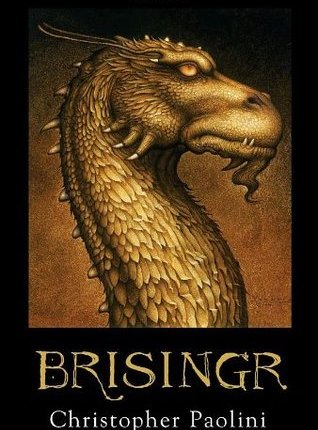
Brisingr (The Inheritance Cycle, #3) by Christopher Paolini

Brisingr (The Inheritance Cycle, #3) by Christopher Paolini

In Book 3 of The Inheritance Cycle, our hero Eragon and his numerous allies continue to inch their way towards the final confrontation with Galbatorix and his dragon, Shruikan.

Photo by Dapo Abideen on Pexels.com

Unlike the first two books in the series, I felt Paolini’s pacing was off. Everything is moving much too slowly. And then, when one of the leaders of the Varden sends Eragon off on a secret mission after the armies finally begin engaging each other, I actually groaned. 

Yes, I realize there’s more to this fantasy story than endless battles and sieges. But they’re the fun part!

I also realize that I’m not the intended audience for this series, crafted for young adults. But that’s never stopped me from reading a book that looks entertaining. And these targeted young adult readers deserve better plot development than the sudden appearance of ancient artifacts or obscure dragon anatomy that changes the entire course of the story in the final chapters of a 600+ page book.

Photo by Pixabay on Pexels.com

I think that is my main quibble with this series. It was written over such a long period of time that Paolini wasn’t able to build levels into his tale with foreshadowing. Important elements like Eragon’s mysterious parentage feel almost tacked on or added as after thoughts.

On the other hand, I do like the way Paolini has continued to develop the Rider/dragon relationship between Eragon and Saphira and her growing maturity as a character. And, despite my complaints with some story elements and pacing, I will continue on to the final book in the series.

I hope he does the ending justice.

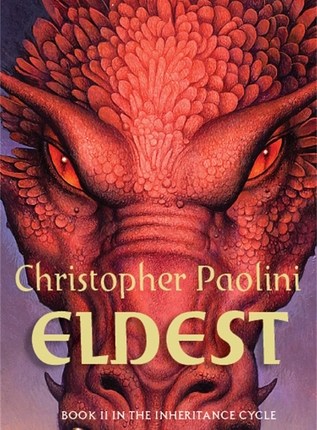
Eldest (The Inheritance Cycle, #2) by Christopher Paolini

Eldest (The Inheritance Cycle, #2) by Christopher Paolini

Eldest is an enjoyable follow up to Eragon, a fantasy tale about a young man, his dragon, and a desperate fight to save the world from an evil immortal.

The best part about this entry of The Inheritance Cycle is that portions of it follow Roran, Eragon’s non-magical cousin, as he struggles to keep his village alive during the fall out of Eragon’s actions from the previous book.

“As he walked, he continued to order his thoughts. After Garrow’s death, Roran had abandoned his job at Dempton’s mill in Therinsford and returned to Carvahall.” pg 37, ebook

Photo by Spencer Selover on Pexels.com

I’ve often wondered about the relatives and neighbors of the magical heroes that are featured in most fantasy tales. What happens to them while earth-shattering events are going on, rings are being melted, and orcs, or ‘urgals’ in this tale, plunder and pillage?

Eldest begins to tell that forgotten story through Roran’s eyes.

“After the last mournful note faded into silence, family members praised the feats and traits of those they had lost. Then the bodies were buried.” pg 111, ebook

Photo by sergio souza on Pexels.com

Christopher Paolini writes at a pace that engages younger readers but doesn’t leave adult readers, like myself, wanting more depth. He carefully constructs scenes and backstories for characters with enough context to make you care about what happens next.

“A tingle of awe and joy shuddered along Eragon’s spine. This was where he belonged, as a Rider. Of all the things in Alagaesia, he had been lucky enough to be joined with this. pg 132, ebook

A funny quibble I have with this book, like in the last one, is I don’t particularly like how Paolini writes the character of Eragon’s dragon, Saphira. He makes her out to be occasionally insecure or jealous, and I’ve always pictured dragons as wise, free and powerful spirits of nature. But those are my preconceived visions of what dragons should be like and I understand how not every reader will have my sort of view on the matter.

Photo by Lachlan Ross on Pexels.com

I also don’t like Paolini’s take on elves. In some ways, the elves in Eldest come off as pretentious and pompous jerks. I get that he was going for a type of removed, immortal elegance, but it didn’t quite work for me.

All that being said, I will be continuing on to the next book. Young adult fantasy readers will most likely enjoy this read too.

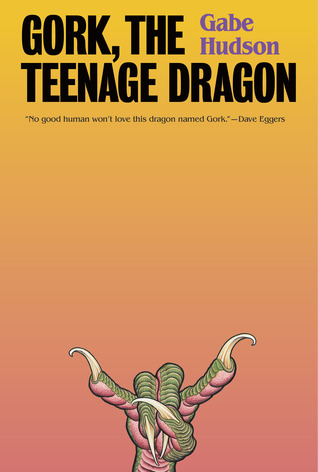
Gork, the Teenage Dragon by Gabe Hudson

Gork, the Teenage Dragon by Gabe Hudson
gork

Gork needs to crown his queen today and leave to take over a distant planet or suffer terrible consequences. He has a few major problems: he’s in love with one of the most popular females at the military academy, his heart is far too big, his horns are far too small, his class rating is too low and his grandfather, Doctor Terrible, has gone missing.

Nothing a teenage dragon can’t handle, right?

Gork, the Teenage Dragon is one of the most unique books I’ve read in a long time. It is a story about dragons, yes, but not just that. Gabe Hudson has created an entire dragon culture.

WarWings graduates continue to conquer the universe one planet at a time. We are the proud preservers of the EggHarvest tradition. Victory will always be ours! pg 30.

In some ways, WarWings reminded me of the military academy from Ender’s Game. It is dog eat dog, or dragon eat dragon.

My favorite part of the dragon culture is its use of poetry: “I don’t know why it is, but singing a poem out loud will always make you appear more repulsive and psychotic to those who you intend to enslave.” pg 56.

I also enjoyed the nudging of journalists: “The vibe in the room was definitely fiendish, and you should know that dragon journalists on Blegwethia are notoriously ruthless. Because on my home planet Blegwethia if a journalist shows up to report a story and they don’t like the situation they’re seeing, they’re not afraid to wade right in and get their claws and beak bloody. That’s dragon journalism for you.” pg 88.

If anything, Gork, the Teenage Dragon suffered from too many lovingly crafted details about dragon culture to the detriment of the story. It dragged as a result. And some of the gags didn’t quite work.

On the other hand, I was laughing out loud quite a lot at Gork’s antics: “… I study my scaly green reflection and see five nasty-looking slashes in my forehead from where that demon Torp has swiped me with his claws. ‘Not bad, Professor,’ I say, looking at the slashes. ‘This could make some nice scars.’ Now in case you don’t know, teenage dragons love scars.”

I was also not fond of the ending.

Recommended for readers with patience and the willingness to overlook some repetitious dialogue.

Gork, the Teenage Dragon won’t appeal to everyone, but I could see some die-hard dragon fans absolutely devouring this book.

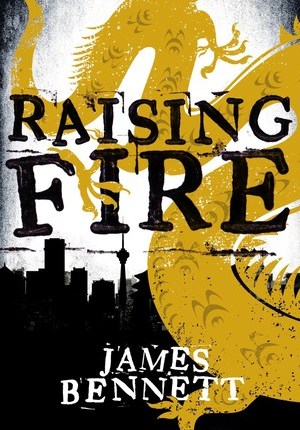
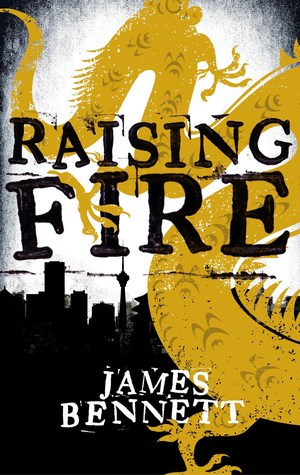
Raising Fire (Ben Garston, #2) by James Bennett

Raising Fire (Ben Garston, #2) by James Bennett
raisingfire

Red Ben, a dragon, is the last of his kind. He is a Remnant, one of the few magical creatures left to walk the earth after the sealing of magic by King John in 1215.

However, laws have been broken, the ancient guild of knights that was tasked with guarding the lore has been slaughtered and the religious branch of the pact is after Ben.

Meanwhile, the last fairy who guards the enchanted sleep of all of the magical creatures, as well as other ancient magics, has gone missing. Could things get much worse? Probably. Ben isn’t holding his breath.

I like the world James Bennett has created.

I also like Ben. He reminds me of a draconic Harry Dresden. He’s magic, cynical and sometimes makes mistakes when he’s tired.

And, like the wizard Harry Dresden, Ben protects the unsuspecting public from great evil and all manner of magical mischief makers.

“Ahead, an open space spread out before him. Tiananmen Square, the largest square in the world, at least offered a safer battleground. With a snap of his wings, he pushed himself after the dragon, flying beyond firing range. A moment of grace that he knew wouldn’t last. He was already too late.” pg 112

Raising Fire is the sequel to Chasing Embers. It delves more deeply into the legend of the fey and how they left the world, and their creatures, behind.

Photo by Eva Elijas on Pexels.com

In the great brier of fabulous beings, the Fay were like roses made of steel. The petals might look pretty enough, but if you didn’t watch your fingers, you’d quickly find out that they were sharper than razor blades.” pg 165

Readers also get to meet Jia, the Guardian of the East. A young being when her parents are put into the enchanted sleep, Jia grows and matures without her family and only the fairy that put them to sleep for a teacher. She plays an important role in this story.

Jia traipsed behind Ben through the valleys of treasure, her eyes wide, her feet crunching over jewels, kicking the occasional urn from her path. An enchanted light illuminated the cavern, shimmering from the treasure itself, gathered over centuries into a bed.” pg 202.

Photo by cottonbro on Pexels.com

Warning: Raising Fire ends on a cliffhanger. If such things bug you, you may want to wait to read it until the next book is out.

Recommended for readers who enjoy cynical heroes, urban fantasy and dragons.

Thanks for reading!

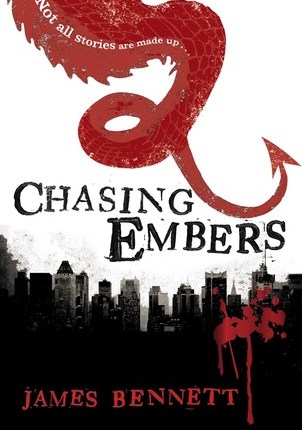
Chasing Embers by James Bennett

Chasing Embers by James Bennett

I seem to be on a dragon themed reading kick lately. And, as far as I’m concerned, that’s awesome!

Red Ben is a dragon, masquerading in human form so that he can walk down the street without everybody freaking out. Hundreds of years before this, he signed a pact called the Lore with a bunch of other magical creatures and knights, in which, he essentially agreed to hide his existence from humanity at large and the knights, in turn, would protect him. Tonight, he was attacked twice. What’s up with that? Ben doesn’t know, but he’s going to find out. He’s also had a falling out with his lady fair. Hiding your true nature from someone doesn’t make for a healthy relationship, but Ben’s enemies seem to know Rose’s (the girlfriend) name. So, now, he has to save his hide, her life, and still preserve the Lore.

Meanwhile, in a desert in Africa, an ancient power is awakening…

I enjoyed Chasing Embers. I really dig the basic premise that there’s a magical world existing alongside ours but we just can’t perceive it. Also, the idea that the Magna Carta wasn’t a political document but a secret, magical pact is fun too.“John, by the grace of God, King of England, Lord of Ireland, Duke of Normandy and Aquitaine and Count of Anjou, doth decree and grant this day, by common counsel of our kingdom, this Pact devised by the Curia Occultus and witnessed by those guardians of our realm. Those Remnants of the Old Lands, which yet linger amongst us, shall forthwith succumb to the Long Sleep…” loc 362, ebook.

The other magical creatures are straight up creepy- like magical creatures should be in my opinion. Also, Bennett seems to ascribe to the Terry Pratchett view that too much magic use thins the veil between worlds and draws attention of the things outside of this world to the magic user, which is also pretty creepy: “The nether wasn’t space, nor the ambient cosmos, but a place that lay beyond, or between, as inner as it was outer. Perhaps it was the raw, empyreal stuff of creation, for all Ben knew. Things lurked in that astral sea, creatures hungry for life, and all magic had its price. When a person drew on the nether- drew on it like a thread in a carpet- they risked unravelling the world entire.” loc 393, ebook.

The romance between Ben and Rose is just the perfect amounts of dysfunction and sparks (nothing graphic in here though for folks who look for such things): “I miss you,” she said, quiet and fierce. “I hate you.” Defeated, Ben rested his head on her shoulder, smoothing down the flowers on her dress. He let her anger hit him like a wave, tasting her muted fury at her love for him. Since he’d first crawled out of his egg, it had always been this way. Some women went for the knight. Others wanted the beast. Neither stood a chance of a happy ending.” loc 711, ebook.

Ben’s angst at his long-lived existence reminded me of Atticus in The Iron Druid Chronicles. He loves deeply but, at the same time, he realizes that those he loves aren’t going to be around that long: “Your love of humans. Do you never grow tired of it? You might as well love a sunbeam that flickers through a cloud. This world was not meant to hold them. Time will take them all so quickly. A blink in the life of a god.” loc 3112, ebook.

What kept Chasing Embers from being a five star read to me is that I thought Bennett explained himself too much. Leave some of the plot mysterious and murky, like magic itself. I don’t need to be spoon-fed why this happened or that happened. Otherwise, this was an excellent read. There’s some language in here and a few disturbing, physical descriptions, but nothing that a mature teen couldn’t handle. Highly recommended for urban fantasy and dragon readers!

Some read alikes: Hounded by Kevin Hearne or Lords and Ladies by Terry Pratchett.

A big thank you to NetGalley and Orbit books for a free, digital advanced reader’s copy of this book for review purposes.  And, thank you for reading!

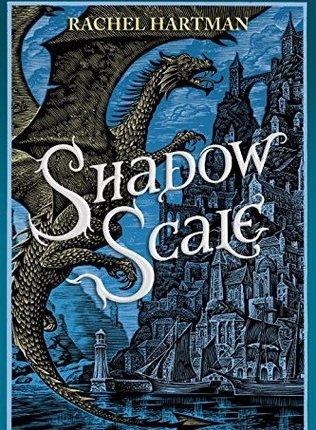
Shadow Scale by Rachel Hartman

Shadow Scale by Rachel Hartman

This is the second book in the Seraphina series. Seraphina is a half dragon/half human musician who, in the last book, was trying to hide her identity from those around her because, in this world where dragons are real, her existence was considered an abomination by religious authorities. How would a human and a dragon come together to make such a child, you ask? Dragons can take human form when they choose to, the trouble is that, they’re not very human-like in their actions and behavior, even when they do. Dragons consider emotions to be beneath logic, so, to put it in Star Trek terms, Hartman wrote them like Vulcans.

Seraphina, for a young adult novel, was rather complex. Not only was Seraphina dealing with her species identity, there’s also religious conflicts, internal/emotional conflicts, a meditation based “magic” system, a burgeoning war between the humans and dragons, factions on both sides who are opposed to the majority, dragon culture and hierarchy questions, tricky cross species friendships, the obligatory romance that every young adult book seems it MUST have and, in Shadow Scale, the added complication of Seraphina trying to find other half dragons like herself. It’s mind-boggling really when you write it all down and try to sort it out. I enjoyed trying to keep it all straight but I can see how Seraphina might not be a good fit for reluctant readers. There is a long list of characters at the end so that if you get confused, you can look each one up. If that kind of thing makes you crazy, you may want to pass on this one.

Seraphina has really come into her own in this story. Hartman certainly doesn’t skimp on the characterizations:“These scales, my visible emblem of shame… which I had hidden, suppressed, and even once tried to pry off with a knife- how was i now able to laugh about them with strangers? Something had changed in me. I was such a long way from where I had started.”pg 436, ebook.

My favorite parts of this book were anything to do with dragons! :“Dragons lay one egg at a time, and we grow slowly. Each death is significant, and so we settle our differences with litigation, or with an individual combat at most. It has never been our way to fight on this scale; if the war continues, our whole species loses.” pg 38, ebook.

Seraphina has a dream- to bring all the half-dragons like herself together to create a family, of sorts: “I am on a mission to find all our kind. Goredd requires our assistance with the dragon civil war, but once that’s over, I hope we might form a community of half-dragons, supporting and valuing each other.” Dame Okra rolled her eyes so hard I feared she’d give herself an aneurysm.” pg 112, ebook.

The intolerance taught by the religion in Seraphina’s world was terrifying, perhaps because it sounded so real: “I was no great hand at scripture- I avoided most of it- but I knew every line written about my kind, thanks to the pamphlet Orma had made me. “Half human, all malevolence” was one of Abaster’s best. Or: “If a woman hath lain with the beast, beat her with a mallet until she miscarries or dies. Let it be both, lest her horrifying issue live to claw its way out, or the woman live to conceive evil again.” pg 287, ebook. One of the main messages of Seraphina is tolerance for different cultures- that everyone has something positive to contribute in their own way.

As much as I gripe about the romance that always crops up in the young adult books, at least this one is well written:“However strenuously the world pulls us apart, however long the absence, we are not changed for being dashed upon the rocks. I knew you then, I know you now, I shall know you again when you come home.” pg 491, ebook. Awww, right?

This is a well written fantasy about dragons- fire breathing, scaled, roaring dragons! There’s nothing in here that parents should find objectionable for their teens to read and the messages that it teaches are worth while and should be repeated. Some read alikes: Daggerspell by Katharine Kerr (first book in a long, adult series, but, eventually, there’s dragons!) or The Last Dragonslayer by Jasper Fforde (appropriate for young adults).

Thanks for reading!