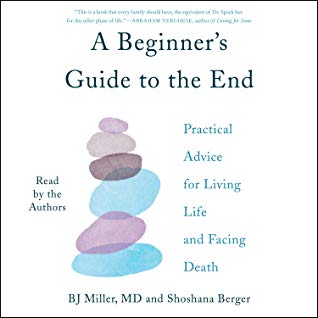
A Beginner’s Guide to the End: Practical Advice for Living Life and Facing Death by B.J. Miller, Shoshana Berger

A Beginner’s Guide to the End: Practical Advice for Living Life and Facing Death by B.J. Miller, Shoshana Berger

A Beginner’s Guide to the End is a definitive guide about death and how to handle it, both for yourself and your loved ones.

Topics range from planning your estate and dealing with life-ending illnesses all the way through to what to do in the first 24 hours after someone dies and how to liquidate an estate.

Photo by KoolShooters on Pexels.com

I could see this book being incredibly useful to anyone who has received a terminal diagnosis, their family or caregivers of all types.

I picked this book up because my father-in-law recently died and I was looking for information on how to help myself and others with grief.

“Grief is a force of nature. Though it can feel problematic as hell, bereavement is an essential piece of the human picture, whichever way it surfaces. pg 420

Photo by Alex Green on Pexels.com

I learned all about that, but also a bunch of other helpful end-of-life details. For example, I knew nothing about the legalities of transporting and spreading cremated remains. Now, I know.

“A friend snuck down to the field of the Oakland-Alameda County Coliseum at half-time and dumped some of his father’s dust at the fifteen-yard line. His pop, a doctor, had been a hard-core Raiders fan, and though his son knew he was doing something illegal, he felt a jolt of joy, knowing that part of his father would always be in that stadium.” pg 459

The text in this book is printed slightly larger than normal, which could be exactly what is needed for elderly readers.

Highly recommended for anyone who needs some guidance about death-related issues.

Thanks for reading.

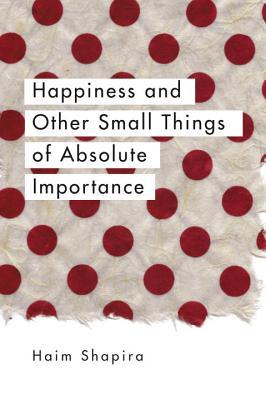
Happiness and Other Small Things of Absolute Importance by Haim Shapira

Happiness and Other Small Things of Absolute Importance by Haim Shapira
haimshapira

Happiness and Other Small Things of Absolute Importance does not resemble a self help book as much as it does a long, meandering lecture by your favorite professor.

Shapira talks about happiness, the passage of time, love, death, money, and so much more by tying it to classic literature and his own musings. I loved it.

There is little that Shapira doesn’t cover in these pages and, when you’re done, you feel as if you’ve just had a long discussion with a very dear friend.

“This little book is meant to change your perspective on almost everything in your life- and primarily the concept of happiness. … As serious and life-changing as the voyage to the land of the Things That Matter may be, it’s no less important to enjoy the ride.” loc 27, ebook. Shapira succeeds with flying colors.

His humor shines through his words. There aren’t any laugh-out-loud moments, but I found myself grinning throughout: “There’s empirical proof that How-To-Be-Happy Books are useless. If just a shred of the promises made in many of those books came true, the world would be knee-deep in incomprehensible quantities of bliss. We all know that this is not the case.” loc 73, ebook. True story.

My favorite parts were about the importance of a positive mind-set and love.

Photo by Sharon McCutcheon on Pexels.com

This passage is about being positive: “Anyone who has lived on this planet long enough knows that pessimism is the natural way to think. It requires no effort, like a rock rolling downhill. It’s much harder to push the rock up the hill, to think positively. Just see the effort it takes to think like (Winnie the) Pooh, to find a bit of magic and grace in everything. That is a mission worthy of the wise.” loc 387 I agree.

I also found the sections on anger and forgiveness to be very meaningful.

Here, Shapira is talking about the futility of being angry and how we can learn to control our tempers, rather than have them control us: “My wife, a chemical engineer by profession, has reached an important understanding. In nature, she told me, each substance has a typical, unique and fixed boiling point. We can artificially change it, however, by using other substances that act as inhibitors, thereby raising the boiling point. For example, anyone who cooks knows that salted water takes longer to boil than water alone. The same applies to people. Their boiling points can be raised. Wisdom can be salt for our water…” loc 610, ebook.

Recommended for spiritual seekers, happiness chasers, and anyone who wants to learn more about themselves. This book is a gem.

Some similar reading, if you liked this: How to Talk About Places You’ve Never Been: On the Importance of Armchair Travel, The End of Self-Help: Discovering Peace and Happiness Right at the Heart of Your Messy, Scary, Brilliant Life, or The Power of the Heart: Finding Your True Purpose in Life.

Thank you to NetGalley and Watkins Publishing for a free digital copy of this book.  And, thank you for reading!