O’s Little Book of Happiness by O, The Oprah Magazine (Editor), Thelma Adams (Contributor)

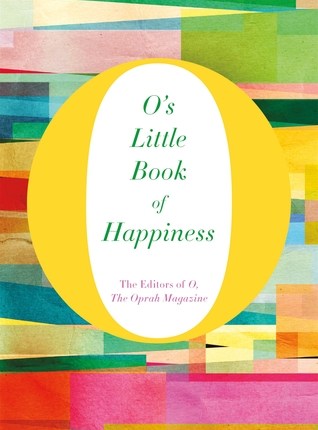
O’s Little Book of Happiness by O, The Oprah Magazine (Editor), Thelma Adams (Contributor)

This collection of essays from the pages of O are wonderful. Through memories and insights, the writers of each chapter have something uplifting and inspiring to share.

My favorite was the chapter entitled “My Unplanned Adventure” by Catherine Price, pgs 88-99. It’s about an uptight traveler who planned every aspect of her trips around the world until she came to the conclusion that she was overthinking it.

Photo by Andrew Neel on Pexels.com

Once she figured this out, she walked up to a person, asked them where they would travel if they could go anywhere, and went there. I won’t ruin the essay by relating all of it here, but it resonated with me. I also have to remind myself that going with the flow is always more desirable than white-knuckling intricate plans and time tables.

I have to confess: I am not a reader of magazines. I find them to be filled to the brim with advertisements for things I neither want nor need and, after I’ve dug through the pages of stuff for sale, I find the writing to be insipid. “Six new sex positions!” “Keep your romance alive!” blah, blah, blah…

Photo by KoolShooters on Pexels.com

That being said, O’s Little Book of Happiness was totally different from my expectations of what a magazine is and introduced to me the idea of what a magazine could be. (And there were no advertisements!)

A couple of the essays felt too short- one page or one paragraph in some instances- but for the most part I enjoyed their length and the order they are arranged in.

There’s something very powerful in reading back-to-back essays about happiness and accounts of people finding their path in life. I read this through in almost one sitting but it could also be savored slowly like a-chapter-a-day devotional guide.

Photo by Andre Furtado on Pexels.com

I enjoyed this very much. And I hope you will too.

If you like O’s Little Book of Happiness, I would also recommend Happiness: A Guide to Developing Life’s Most Important Skill by Matthieu Ricard and Living Oprah: My One-Year Experiment to Live as TV’s Most Influential Guru Advises by Robyn Okrant.

I received a free copy of this book through Goodreads First Reads. FTC guidelines: check! And thank you for reading.

You’re Not Listening: What You’re Missing and Why It Matters by Kate Murphy

You’re Not Listening: What You’re Missing and Why It Matters by Kate Murphy

You’re Not Listening is a fun and enlightening non-fiction read about, you guessed it, listening. Theoretically, we all have the capability of listening, but, as author Kate Murphy points out, we kind of suck at it.

“This is a book in praise of listening and a lament that as a culture we seem to be losing our listening mojo.” pg 3

From politics to business, scientific studies to families, Murphy illustrates pitfalls on the path of active listening and highlights the fact that rhetoric and conversational skills are taught all over the world. The other half of the equation, listening to the information that’s delivered, is not.

Photo by Andrea Piacquadio on Pexels.com

“Done well and with deliberation, listening can transform your understanding of the people and the world around you, which inevitably enriches and elevates your experience and existence. It is how you develop wisdom and form meaningful relationships.” pg 4

In the modern age of social media and the ability to establish instantaneous connections all around the world, you would think people would be feeling more interconnected than ever. Not so, says Murphy.

“People get lonely for lack of listening. Psychology and sociology researchers have begun warning of an epidemic of loneliness in the United States. Experts are calling it a public health crisis, as loneliness increases the risk of death as much as obesity, alcoholism, and heart disease combined.” pg 9

All of our technology bombards us with information while at the same time diverting our attention from the people in our physical lives. It is not just a matter of deciding who to listen to; it’s also a question of shrinking attention spans and one of the many challenges faced by a technologically advanced society. Meanwhile, we’re blasting out our own thoughts and feelings as quickly as they arise… so who has time for any of that?

Photo by fauxels on Pexels.com

“It takes awareness, focus, and experience to unearth and understand what is really being communicated. Good listeners are not born that way, they become that way.” pg 69

I love books that I learn from and that help me become the type of person whom I aspire to be. You’re Not Listening ticks both those boxes in a big way. I can’t recommend it enough for readers who enjoy non-fiction, learning, and the eternal quest of self improvement.

Thank you to the publisher for a free advance reader’s copy of this book.

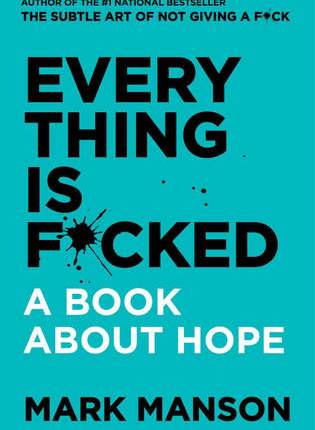
Everything is F*cked: A Book About Hope by Mark Manson

Everything is F*cked: A Book About Hope by Mark Manson

This creatively titled self-help book, Everything is F*cked, presents psychology, philosophy and the author’s view of reality.

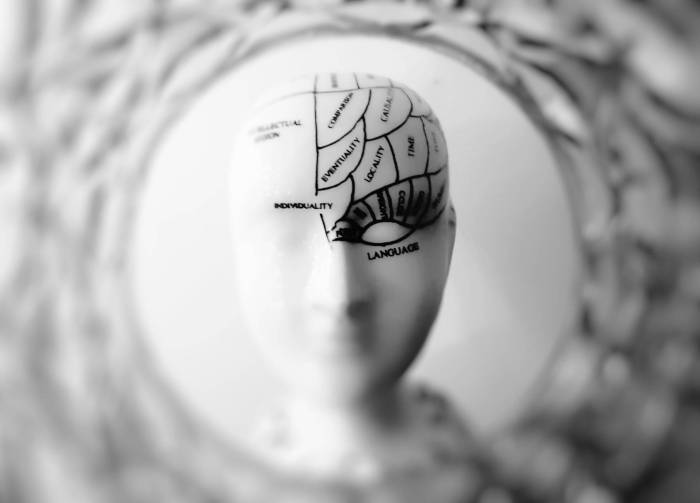
In a series of essays, Mark Manson discusses a variety of topics including the differences between the “thinking brain” and “feeling brain.” He uses Isaac Newton’s laws to create a parallel universe’s version of emotional laws and completes a fairly scathing dissection of religion.

Throughout the various topics, he circles back to the idea of hope and how it can potentially create more problems than it solves.

Photo by meo on Pexels.com

Why did Manson write a book about hope?

“This book is my little source of hope. It gives me purpose; it gives me meaning. And the narrative that I’ve constructed around hope is that I believe this book might help some people, that it might make both my life and the world a little bit better.” pg 15

I did not read Manson’s other incredibly popular title, The Subtle Art of Not Giving a F*ck: A Counterintuitive Approach to Living a Good Life, so I went into this one not knowing what to expect. I found Manson to be particularly adept at breaking down complex topics into simple, easy-to-understand analogies.

For example, here’s his take on the psychological cause of a underlying feeling of unworthiness: “This feeling of unworthiness is usually the result of some bad sh*t happening to us at some point. We suffer through some terrible stuff, and our Feeling Brain decides that we deserved those bad experiences. Therefore, it sets out, despite the Thinking Brain’s better knowledge, to repeat and re-experience that suffering.” pg 46

Photo by Pixabay on Pexels.com

And here’s the analogy he crafts around his explanation of unworthiness: “Put another way, the problem isn’t that we don’t know how not to get punched in the face. The problem is that, at some point, likely a long time ago, we got punched in the face, and instead of punching back, we decided we deserved it.” pg 46

His writing is simple and succinct, which could be incredibly useful for readers who are looking for more information about the self help topics presented. I didn’t particularly care for Manson’s overall style, but that’s a personal preference rather than a commentary on the value of what he’s discussing.

“The stories of our future define our hopes. And our ability to step into those narratives and live them, to make them reality, is what gives our lives meaning.” pg 70

Photo by Engin Akyurt on Pexels.com

I think this author may be similar to Sarah Knight and her series of self help books about The Life-Changing Magic of Not Giving a F**k. Readers either love or hate those, I fell somewhere in between.

My favorite part of this was when Manson dived into some Buddhist philosophy in the chapter, “Pain is the Universal Constant.” He discusses the teaching of suffering being similar to a person struck by arrows. The first arrow brings physical pain and the second brings the emotional pain, which can be far worse and last longer than the physical pain because of the narratives we weave around it.

Through meditation, the second arrow, emotional pain, can be diminished or perhaps eliminated.

“That while pain is inevitable, suffering is always a choice. That there is always a separation between what we experience and how we interpret that experience. That there’s always a gap between what our Feeling Brain feels and what our Thinking Brain thinks. And in that gap, you can find the power to bear anything.” pg 186

Photo by Aleksandar Pasaric on Pexels.com

Recommended for readers who aren’t offended by strong language and have the ability to hold the book they’re reading in that gap in their minds — between the thoughts and the emotions, in the space of pure being.

I’ll meet you there. 🙂

Hellhole by Gina Damico

Hellhole by Gina Damico
hellhole

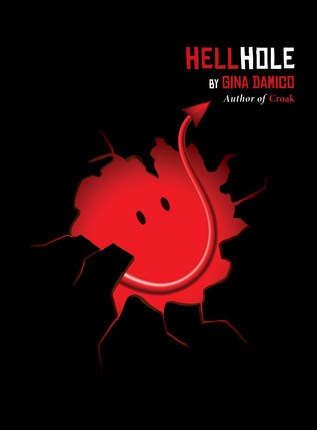
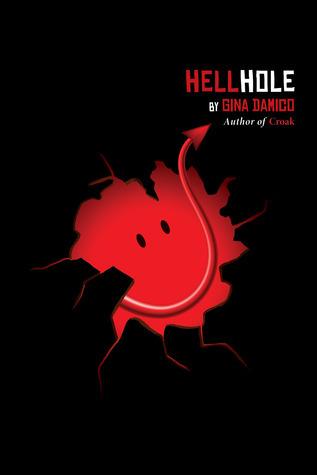
Hellhole is a modern Faustian tale about Max Kilgore, his deathly ill mother and the devil.

Though written for a young adult audience, readers need to be aware that there are some bad words in the dialogue and innuendo in some situations. All kids are different, but I’d lean towards 15 and up forHellhole.

Our hero is just a regular guy: “Seventeen-year-old Max Kilgore suffered from the unfortunate curse of having a name that was far cooler than the person it was attached to.” pg 8, ebook.

Max attends high school, holds down a job and cares for his ailing mother in Eastville. “The town of Eastville was known for four things: its renowned hospital, its renowned high school football team, its renowned granite quarry, and its stupid, stupid name. No one could say with authority what Eastville was supposed to be east of…” pg 13, ebook.

One day, after a bad decision on Max’s part, Burgundy Cluttermuck (Burg) walks through his door. “The name is Burgundy Cluttermuck, devil-at-large. I do bachelorette parties and retirement galas, but no more children’s birthday.” He sucked in some air through his teeth. “Too much screaming.” pg 38.

How is Max going to get rid of him? And how long is this devil going to stick around? It’s dangerous to have a devil around the house: “He won’t go after you. He’ll go after the ones you love, and then you’ll have to live with the guilt. That’s your ‘punishment for dealing in devilry’…” pg 107, ebook.

Photo by PhotoMIX Company on Pexels.com

Recommended for young adults, 15 plus. If you enjoy this book, a similar read is The Gentleman by Forrest Leo.

Thanks for reading!

Time in a Bottle: Mastering the Experience of Life by Howard Falco

Time in a Bottle: Mastering the Experience of Life by Howard Falco
timeinabottle

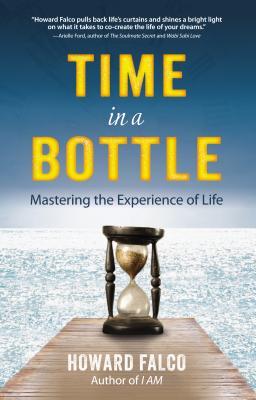
Time in a Bottle is a self help book about changing your perceptions to improve your life. Though not a new message, some readers may find this book worth the time.

Howard Falco presents this knowledge with a spiritual slant. Readers who are turned off by that kind of thing may want to choose another book.

The main premise: “Our misunderstanding of time- how our thoughts relate to time, how time is actually created, and how time seems limited- is one of the biggest reasons we suffer and at times feel hopeless or powerless in our lives.” pg 1, introduction.

One of the ways to “master the experience of life” is to realize that you are infinite potential like the universe itself: “You are a part of infinity. To the degree that you feel that life is finite and limited, you will act out of this fear, and work to create an experience that is a result of this fear.” pg 33.

I agree that mindset is important to determining your life’s path. Love and fear seem to be the two driving forces of our world. Wonder why that is…

Photo by Nacho Juu00e1rez on Pexels.com

Falco also discusses giving up resistance to how life is: “It is critical that you know that the ending of your resistance toward any particular thing (sickness, layoffs, war, family, financial trouble, death, political chaos, natural disasters, etc.) is not in anyway condoning these terrible things or giving up on change. It is simply the full acknowledgment that for the moment this is what is happening.” pg 40

He talks about giving up regrets about the past that could potentially be holding you back: “This is not about accepting that something had to happen to you; it is about acknowledging that it did happen and standing in front of the universe saying, “I trust that there is perfection and a specific, divine purpose for my past and the exact way it unfolded. Because of this, I am realizing more of my unlimited potential for the future.”

So then, unburdened, you step into your future with faith.

Falco incorporates quotes from famous philosophers and scientists along with anecdotal stories to illustrate his points. As I said, no new wisdom here, but plenty of good reminders to trust, forgive and move forward to a life outside of time.

Thanks for reading!

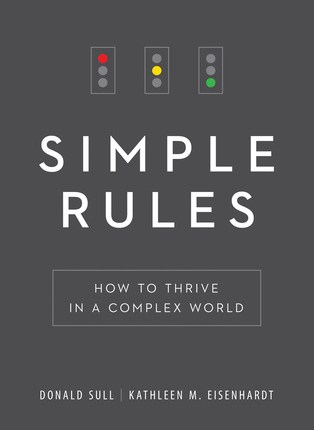
Simple Rules: How to Thrive in a Complex World by Donald Sull and Kathleen M. Eisenhardt

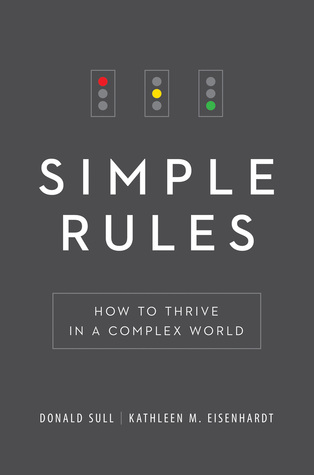
Simple Rules: How to Thrive in a Complex World by Donald Sull and Kathleen M. Eisenhardt
simplerules

I enjoyed the examples that the authors cite for simple rules helping to solve complex problems, but the manner in which to create your own ‘simple rules’ wasn’t really that simple.

I thought that in a book with the title, Simple Rules, that they’d give me a checklist of how to do it: Step 1, 2, 3, you know. The simple rules for how to make simple rules.

But, that wasn’t the case.

Since each problem, situation, business, and life is different, the authors essentially told the readers to use their discernment in the creation of the rules. Pick a ‘bottleneck’ and solve it. I found the suggestion too vague to be very helpful.

Despite these complaints, I did find a gem or two:

“Decisions that require coordination across different departments or teams are another good place to look for bottlenecks.” pg 135

“Better rules are better, and even apparently irrelevant rules can be reasonably effective if they happen to encourage helpful behavior.” pgs 172-173

If you enjoyed Simple Rules, I’d suggest The Checklist Manifesto by Atul Gawande (ways to simplify your work processes) or Yes, And: How Improvisation Reverses “No, But” Thinking and Improves Creativity and Collaboration—Lessons from The Second City by Kelly Leonard (for more simple rules on collaborations).

Thanks for reading.

Get Your Sh*t Together: How to Stop Worrying About What You Should Do So You Can Finish What You Need to Do and Start Doing What You Want to Do (A No F*cks Given Guide) by Sarah Knight

getyoursht

Knight is an acquired taste, but I generally enjoyed Get Your Sh*t Together. Her self help books are full of useful tips, profanity, and irreverent humor so don’t pick this title up if you’re easily offended.

If you know someone who seriously needs to get their you-know-what together, this could be the title you’ve been waiting for!

Knight keeps it real from the first page: “(This book) is more of a let-me-help-you-help-yourself-help book, with “me” here to “help” when your “self” gets in the way. Let’s face it- if you could help yourself, you’d have done it by now, right? Also, unlike many traditional self-help authors, I am going to use the word sh*t 332 times (including several sh*tmanteaus of my own invention), so please do not go on Amazon saying you were expecting sunshine and kittens and got sh*tstorms and sh*ttens.” loc 31, ebook. And so on, and so forth.

I’ve also enjoyed The Life-Changing Magic of Not Giving a F*ck: How to Stop Spending Time You Don’t Have with People You Don’t Like Doing Things You Don’t Want to Do and I felt as if Knight shared more of herself in this offering than that one.

We learn that she had/has anxiety attacks and had to pull her life together because it was falling apart. Not many self help authors display their humanity and imperfections like that and I really appreciated her honesty.

Photo by Suzy Hazelwood on Pexels.com

Plus, readers get to reap the benefits of her hard won wisdom and we know it works because she got her stuff together enough to write the book.

I really like Knight’s various life philosophies, which she sprinkles throughout.

Here’s one of my favorites: “In my book- and in the Game of Life- you’re competing exclusively against yourself. Not other players, not even the computer. … Winning is getting what you want out of your time on planet Earth, whatever that entails. It could be the house, job, car, partner, or hairstyle of your dreams.” loc 502, ebook.

Be the best you that you can be and forget about the rest. Good advice.

Knight also gives a ‘nod’ to Marie Kondo’s internationally best selling title and Knight’s thoughts about it may appeal to more readers than the original material: “At this point, we’re living in a post-tidying society. … People get their tidying groove on for a few months, or even just a few weeks, and then… kinda lose the thread. … Why is that? Well, I submit that if they had their sh*t together in the first place, the tidying bug would have stuck.” loc 2547, ebook. Sound familiar to anyone?

Among the many life issues that Knight tackles, her thoughts on perfectionism struck particularly close to home for me: “When you accept that failure is an option, you move it from the realm of anxiety-inducing anticipation into a reality that you’ll deal with when (and more importantly, IF) that ever happens. Your energy is better spent on accomplishing goals in the here and now than on worrying about failure in the abstract.” loc 3049, ebook.

Recommended for people who need self help but don’t like reading self help, probably 18+ because of the language.

Sarah Knight will give you some life changing tips and along the way, you may learn some unique new uses for the word: sh*t. Some further reading: The Life-Changing Magic of Not Giving a F*ck: How to Stop Spending Time You Don’t Have with People You Don’t Like Doing Things You Don’t Want to Do, The Joy of Leaving Your Sh*t All Over the Place: The Art of Being Messy, and How to Be Dull: Standing Out Next to Genius.

Thank you to NetGalley and Little, Brown and Company for a free ARC of this book! And, thank you for reading.