The Guild: Knights of Good (Guild v. 2) by Felicia Day

The Guild: Knights of Good (Guild v. 2) by Felicia Day
knightsofgood

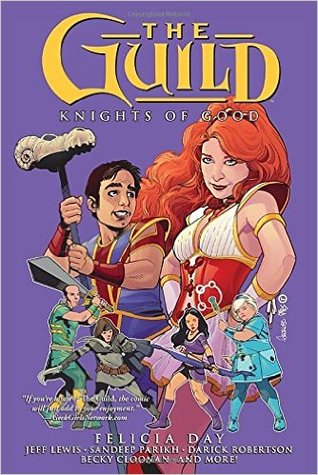
A continuation of the first Guild comic. Please watch the show before you enjoy these comics!

If you don’t know what The Guild is about, let me give you a quick recap: Cyd likes to play videogames, specifically MMORPG’s. She spends much of her time avoiding reality and playing a character named Codex.

Codex is a member of an online guild, which is a group of other real life people who are also playing the computer game.

Together, they forge friendships and explore real life issues, online and off. It’s a heart-felt series and perfect for any fans of MMORPG’s or loved ones of computer players who want to understand their partners more.

On to the context of the comic itself: the first chapter/issue with Vork’s backstory and the story behind Bladezz’s infamous sausage photo were engaging but the rest was so-so.

I felt like all of the other characters were basically re-hashing what happens on the show rather than giving the reader any huge surprises. On the plus side, there are some more panels showing the characters in-game, which is more than we were ever given on screen.

If you’re going to read any of the Guild comic books, I recommend reading The Guild (the first one) and skipping this. Unless you’re a major fan of the show and you have to read every little piece of literature that is out there on it, by all means, borrow this from the nearest library.

Thanks for reading!

Solomon’s Thieves, Book 1 by Jordan Mechner

Solomon’s Thieves, Book 1 by Jordan Mechner
solomons-thieves

I almost flipped out over this series today because I went to request the second book and found that it was never published. Not to be deterred, I used my mad librarian skillz and discovered that, after the release of Solomon’s Thieves, the publisher bound all of the issues together rather than releasing them one at a time.

The continuation to this story is found in the graphic novel: Templar. Crisis averted.

And what is this comic about?

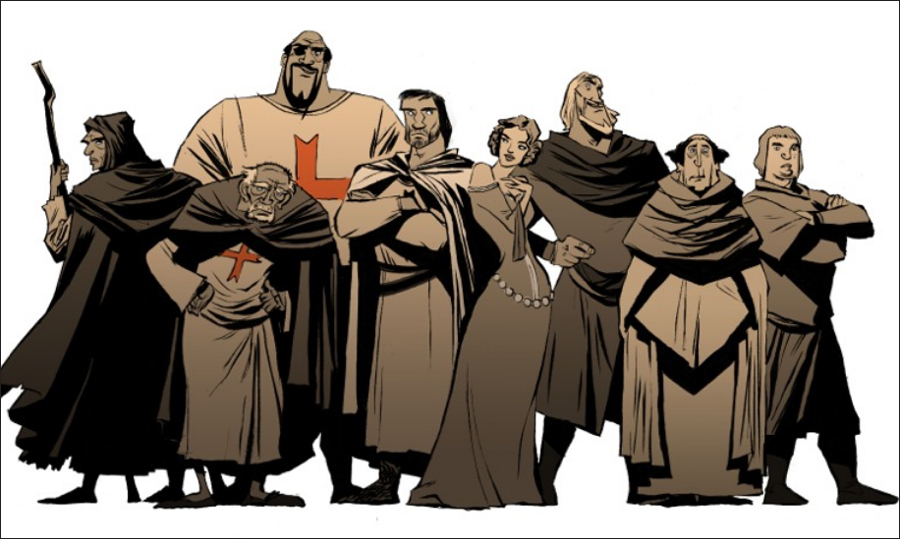
Solomon’s Thieves is a fun romp through 1300’s Paris at the time of the Templar’s disbanding and destruction.

The focus of the story is on a knight named Martin. He was unlucky in love and joined the order to change his life, which he manages to do. But, on the Templar’s return from an unsuccessful campaign in the Holy Land, after a wild night of drinking and some bad choice making in Paris, he ends up not being present when his brethren are arrested by the French king, Philip the Fair.

The adventure really starts when the king’s men discover that the fabled treasure of the Templars is not in their church/compound. Martin, after a series of misadventures and a chance meeting with some unsavory characters, decides to find out where that treasure is and steal it back.

Bit of trivia: the Paris Templars were arrested on Friday, October 13th, 1307. So, 709 years ago tomorrow (I wrote this review on October 12th, 2016). Now, you know.

templarcastFrom the introduction: “From humble beginnings the Knights Templar rose to become the most powerful military monastic order of the medieval world. Pledged to protect pilgrims during the Crusades, the Templars become heroes to Christians everywhere. Their fighting prowess was legendary. … But the Crusades were an expensive, blood-soaked failure. In 1291, after two centuries of warfare, the Muslims drove the Christian armies from the Holy Land once and for all. For the Templars, it was the beginning of the end…” Goosebumps!
I’d consider this a PG-13 level comic because of some rough language, non-graphic violence (dude sticks his sword through the chest of a guy in one of the panels, but there isn’t blood everywhere), and some, again non-graphic, torture scenes.

The afterward by Jordan Mechner is fantastic. Not only does he give the actual history that he based the comic on, but also the sources that he used to research it. Huge librarian thumbs up from me. 🙂

“Like Western gunslingers or Japanese samurai, their legend grew, and it attracted new recruits, donations, and privileges. By their peak in the thirteenth century, the Templars had grown into a religious, military, and banking organization whose assets, power, and reach rivaled any of the kings of Europe. They were the Jedi of their time. Their incredible downfall rocked the world. Its echoes reverberate to this day.” pg 135

If you enjoyed this comic, you may like: The Religion by Tim Willocks(regular book- not a graphic novel, very bloody, for adults only) or The Knights Templar: Discovering The Myth And Reality Of A Legendary Brotherhood by Susie Hodge (regular book also- non-fiction but in-depth examination of the templars).

Thanks for reading!

A Flight of Angels, Illustrated by Rebecca Guay

A Flight of Angels, Illustrated by Rebecca Guay

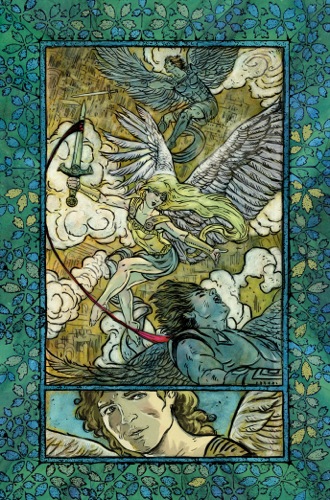
A Flight of Angels includes stories by Holly Black, Louise Hawes, Todd Mitchell, Alisa Kwitney, Bill Willingham.

Lovely art elevates a so-so collection of short stories about angels. Rebecca Guay, in my opinion, is one of the most talented illustrators I’ve ever seen. The artwork is classic but ephemeral with tasteful nudes and multi-layered backgrounds. In a word: gorgeous.

flightofangels

I picked this one up because of The Last Dragon by Jane Yolen. In that book, as in this, I loved the art but thought that the story was predictable. I feel like the authors that Guay has partnered with, at least so far, don’t measure up to the masterworks she produces.

flightofangels2

Borrow this one from your nearest library so that you can see how beautiful it is.

Read alikes: some of the Fables, Vol. 1: Legends in Exile series has art on this level but they’re kind of hit or miss. Saga, Volume 1 is beautiful but the story has some very vulgar moments popped in there. If you can handle that, and I know that some people are huge fans of Saga, then that series might be a good fit. Or, of course, you may want to pick up The Last Dragon as that is done by the same illustrator.

Thanks for reading!

Princeless, Volume 4: Be Yourself by Jeremy Whitley

Princeless, Volume 4: Be Yourself by Jeremy Whitley

Dear readers, there are some spoilers in this review, but they’re necessary for a thorough discussion of the comic.  Please, if you haven’t read this one yet, go pick it up from your local library and then come back to this review.  Thank you 🙂

The Princeless series continues to deliver strong female characters, beautiful (child appropriate) artwork, and storylines with meaning. Each time Adrienne and Bedelia venture out to rescue one of Adrienne’s sisters, a facet of relationships is dissected and examined. This volume dealt with abusive relationships and gender roles in government.

Now, it’s not that cut and dry on the surface- the story itself is really fun and engaging. Adrienne and Bedelia have to survive a cannibalistic tribe of goblins in a monster infested swamp in order to reach Angoisse’s tower. On the way, they befriend unlikely allies and encounter a plant-like terror.

While this is going on, Adrienne’s brother, Devin, refuses to embrace traditional gender roles and activities, which continues to infuriate his tyrannical father. Their relationship illustrates the eternal struggle between parent and child. Parents think they know better and push their child in the direction they believe they should go, while children want to follow their natural inclinations. In the push-pull dynamic, somehow everything works out fine, but with more bad feelings on either side than there need to be.

The abusive relationship portion is tactfully presented in the interactions between Angoisse and Raphael. Sometimes people act a certain way because they want something out of you, other than your company. Kids get it. But in an era of Twilight idealization, I think the presentation of a “vampire” who acts out of self-interest rather than undying love is an important topic to discuss.

Teen relationships are just as thorny and prone to abuse as adult relationships and, because they are some of the first experiences that teens have, they have the potential to color the rest of that person’s lifetime and set the stage for the relationships to come.

Angoisse is a victim of Raphael but also her own beliefs. She’s always thought that she needed a man to complete her and she was going to do whatever it took to keep that relationship intact, even to the point of giving up her humanity or betraying her own family.

It didn’t take a very smart predator to see that she could be manipulated through her feelings. Sadly, such people actually exist. Thank you, Princeless for opening a door to the discussion of how to remain true to yourself in relationships and a powerful example of how to leave the ones that have soured.

The story is not too complex and adult readers may find it rather simplistic (unless you dig deeper into the underlying meaning), but it’s perfect for the 8 to 12 year olds. This comic will appeal to reluctant readers of either gender. I highly recommend it.

Thank you for reading!

Shakespeare’s Guide to Parenting by James Andrews

Shakespeare’s Guide to Parenting by James Andrews

Shakespeare’s Guide to Parenting, like the wildly popular xkcd comic, is written with simple stick figures paired with, as you probably guessed from the title, quotations from Shakespeare’s works.

This format works for most of the panels, but did fall flat from time to time.

I think the problem is that, when you’re telling a story and using something as complex as Shakespeare, which relies on context to build the drama, for your main narrative voice, it’s hard to make it work as intended. Also, to simplify a joke down to one, perhaps two lines and maintain the comic punch is a very difficult thing. That being said, I did pull some favorite moments from this one.

If your child continues to be particular about their food, explain in no uncertain terms what the alternative will be: “I’ll make you feed on berries and on roots, and feed on curds and whey, and suck the goat. Titus Andronicus: IV, ii” pg 121

Photo by EKATERINA BOLOVTSOVA on Pexels.com

Having dealt with a picky eater for years and experiencing hair-pulling frustration at her recalcitrance, I may actually use that line at my house.

Be wary of rashly administering a sanction that you may later lack the resolve to see through. Remember, excellent outcomes can be achieved through epic-sounding yet non-specific threats: “I will have such revenges on you both that all the world shall- I will do such things- what they are I know not; but they shall be the terrors of the earth. King Lear: II, iv”pg 103  Ah, the drama of parenthood.

And finally, the drawing accompanying this one is of a little girl who has dropped her ice cream as her mother looks over at her:

Stoicism: Introducing your child to philosophy at a young age can help them come to terms with difficult concepts such as loss and bereavement: “What can be avoided whose end is purposed by the mighty gods? Julius Caesar: II, ii pg 43  Classic.

Photo by Daria Shevtsova on Pexels.com

If you enjoyed Shakespeare’s Guide to Parenting, I’d recommend I Was a Child by Bruce Kaplan (a memoir told in simple but surprisingly powerful doodles) or Penguins with People Problems by Mary Laura Philpott.

A big thank you to Goodreads First Reads program for a free copy of this book for review purposes and thanks for reading!

Malice in Ovenland: Volume 1 by Micheline Hess

Malice in Ovenland: Volume 1 by Micheline Hess

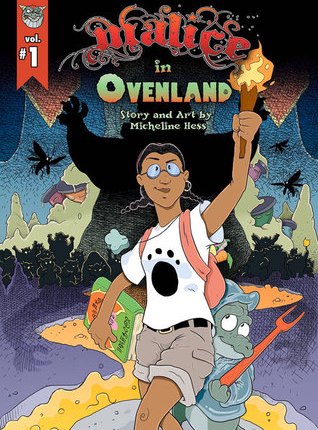
Malice in Ovenland by Micheline Hess is a graphic novel for children. Lily Brown’s mom tells her to clean the kitchen- and her adventure begins.

An excellent pick for reluctant readers, this story is a cute, gross, and, endearing romp through a fantastical world hidden behind an oven.

Lily’s heroic journey reminded me of the comic series, Princeless by Jeremy Whitley. In Princeless, the heroine tires of waiting for a prince to come save her, so, she sets about saving herself.

Lily is no wilting flower either, despite her name. 🙂

With art and a storyline appropriate for the pre-teen crowd and an empowered female protagonist, I could see this being a great addition to any juvenile’s graphic art collection.

What I enjoyed most about Malice in Ovenland were the homages to other great works of children’s literature.

The obvious one, of course, is to Alice in Wonderland but I also caught shades of the Lord of the Rings in the poem included at the end of Chapter 1.

The moment that Crumb comes to visit Lily in the dungeon reminded me of when Taran met Gurgi in the Black Cauldron.

The Queen’s advisor, named Crispodemus, reminded me of Nicodemus the rat from the classic children’s story, Mrs. Frisby and the Rats of NIMH by Robert O’Brien. (One of my all-time favorites, by the way)

And finally, The Royal Rangers reminded me of the Beagle Boys from Duck Tales– bumbling, minimally intelligent thugs, who would be harmless if they weren’t so determined to be bad.

Malice in Ovenland would be a great title for a reluctant reader or a reluctant eater. The story, in addition to the adventure, teaches kids to not be afraid to try new things- either food or life related.

It’s a message that can’t be repeated enough.

The humor is mainly gross-out or potty-related but, as a mother of a soon-to-be-10 year old, that’s exactly where her humor is at right now. It’s perfect for the audience that it is seeking.

Big thanks to NetGalley for providing me with a free digital edition of this title for review purposes and thanks for reading!