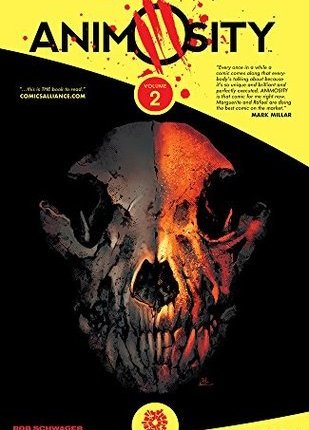
Animosity, Vol. 2: The Dragon by Marguerite Bennett

Animosity, Vol. 2: The Dragon by Marguerite Bennett

The plot thickens for Sandor, the hound dog, and his human, Jesse, as they attempt to make their way across the country to reunite Jesse with her half-brother.

“Jesse is growing up, and signs of it frighten Sandor more than they even frighten her. Sandor fears, so much, that he will be unable to protect Jesse from all pain, all terror, aware that he will not be there for her adulthood.”

Photo by cheptu00e9 cormani on Pexels.com

Now that all of the animals are sentient, the lines between human and animal, predator and prey have blurred. Certain species are starving to death. Other species are being farmed for their meat. It’s a dark story, but still fascinating in the way it flips reality on its head.

“The honeybees have retreated to some secret place, and the ants threaten blistering violence for the paw that reads the wrong mound, yet each seem unusual in their clannishness to their own kind.”

Along with their new sentience, some of the animals are considering the state of their souls… do they have one, and where do they go when they die? Others are banding together to fight against the humans or each other. And still others are protecting the only person or thing they care about, like Sandor.

My favorite part of this issue was the series recap at the end where the author, Marguerite Bennett, gives a brief glimpse into what’s going on in every state and country since the animals “woke”. Highlights include my home state of Illinois trying to figure out how to regulate the new reality (you know they would) and her description of the new Mongolia: “Little has changed.”

Photo by Julia Volk on Pexels.com

Honestly, this book is worth reading if only for that section. I can’t help but be impressed by the imagination it took to combine the cultures, unique creatures and people of each corner of the world and provide its own mini-story.

The artwork, as you can tell from the cover, is haunting in places. You see animals wielding human weapons and wearing clothing. But it’s not cute, the overall effect is very disturbing. I won’t soon forget a deer lobbing a hand grenade into a group of shadowy figures in the forest and I think that’s probably the point.

Recommended for fans of dark science fiction graphic novels. Thanks for reading!

To read more of my reviews of graphic novels, go to
https://thehelpdeskbookblog.wordpress.com/category/comic-or-graphic-novel/page/1/


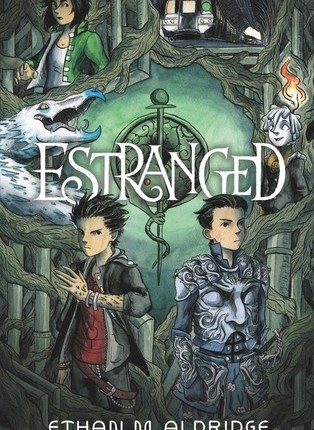
Estranged (Estranged, #1) by Ethan M. Aldridge

Estranged (Estranged, #1) by Ethan M. Aldridge

A cute graphic novel for middle graders that features a changeling, his human counterpart, their human sister and a golem made out of wax.

“There hasn’t been a human in High Court in a century. That makes you special, doesn’t it?” “Oh, they never let me forget that. It’s always ‘the human childe’.”

Photo by Danielle Reese on Pexels.com

But trouble brews when a disgruntled elf turns the king and queen of the High Court into rodents. Then, she goes after the “Childe”. In response, he seeks out his changeling twin in the world above or the real world. And that is where our adventure begins.

“The only home I’ve ever had has been taken! This was meant to be my home, my life, and it was taken before I was old enough to remember it!” “I’ve got nothing, nowhere to go! I have as much right to be here as you!”

Along the way, they have to face goblins, magic statues, a witch and a treasure-hungry dragon. The plot is a bit simplistic but it is perfect for children who like fantasy and urban fantasy.

In fact, I picked this book up at the local game shop for my daughter and she read it in one sitting, which is a miracle because she’s a reluctant reader. I’m always looking for stories or formats that appeal to someone who enjoys video games more than books.

Photo by Andrea Piacquadio on Pexels.com

She absolutely loved it and said I HAD to read it. I asked why and she said, “Because it’s just awesome.” She loved the magic and world Ethan Aldridge has created. She also loved the artwork. Her favorite character, and mine, was Whick, the brave wax golem who accompanies the Human Childe from the court below to the world above and back.

The story also touches on the sometimes difficult relationship between a brother and sister. There’s a good message about taking care of your family that I resonated with.

In conclusion, I loved that my Human Childe loved it. Highly recommended.

Thanks for reading!

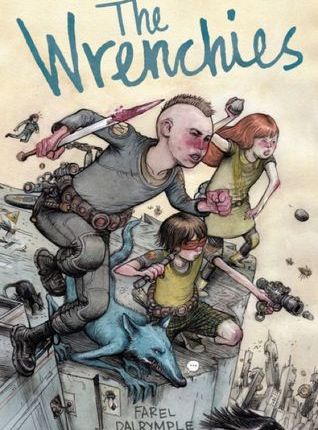
The Wrenchies by Farel Dalrymple

The Wrenchies by Farel Dalrymple

A gorgeously-drawn graphic novel that suffers from a bonkers plot and scrambled timeline.

I’ll try to give a brief summary here, but understand that this is gleaned from every part of the book — beginning, middle, end. Farel Dalrymple doesn’t present the story in a linear fashion, which is incredibly frustrating.

A boy and his brother enter a cave and are attacked by a demon-like creature called a shadowman. During the course of the attack, the demon messes with the first boy’s eyes and something radically shifts in his brain/destiny. After his brother saves him, the boy’s eyes are drawn to a medallion in the demon’s cave through which he sees/astral travels into a different dimension where he can view aspects of the future.

Photo by Francesco Ungaro on Pexels.com

This future is an apocalyptic world filled with these shadowmen and children who fight against them. All grownups in the world have become shadowmen. When a child reaches a certain age, they are “harvested” by the demons and become part of the problem. Something powerful and magical is fueling these shadowmen, but discovering and disabling that artifact is the large story arc so I won’t spoil it for you here.

Meanwhile, the boy-with-the-demon-altered-eyes is (I kid you not) kidnapped by aliens while his brother goes on to fight the shadowmen in the real world. Then there’s some character development about the children/warriors in the apocalyptic world, the involvement of a child from our time, a blind child who uses technology in a way that borders on magic, another child who actually uses magic… And, at one point, I think the author tries to add the difficulty he had writing the comic into the comic itself. 

Photo by Michael Herren on Pexels.com

I think that’s enough of a summary. Don’t you?

This isn’t a fairy tale story for teens though it seems to reach for a coming-of-age feel. The children use drugs to protect themselves from the mind-altering powers of the shadowmen and are constantly fighting bugs that pop out of the shadowmens’ heads after they kill them. It is a paranoid schizophrenic’s nightmare.

The Wrenches is violent and disturbing, rather like Peter Pan on acid with demons instead of pirates. And not in a good way.

I suppose if you just looked at the artwork and didn’t read it, you might enjoy this graphic novel. Honestly, the panels are stunning. Shame about the story tho.

Thanks for reading!

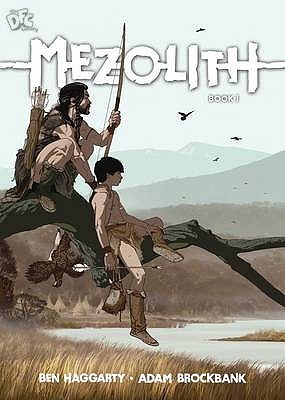
Mezolith by Ben Haggarty, Adam Brockbank

Mezolith by Ben Haggarty, Adam Brockbank

A beautifully illustrated coming-of-age tale about a boy who lives with his stone age tribe. Reality and mythology are mixed in his life to create something else, something that feels true though it couldn’t possibly be.

“Poika, at the heart of the world there is a cave and in that cave there are countless urgas, all sleeping… all dreaming… and when one dreams that a brother has been destroyed he wakes. Crawls into the world. Finds some humans and cries pitifully near them… until someone comes to care for him…”

Photo by Rozemarijn van Kampen on Pexels.com

How do you imagine that Stone Age peoples explained phenomena that scientists today have only begun to unravel? Where does love come from? What brings a fever or trouble? They explained these things by telling stories.

There’s the story of a man who fell in love with a woman who was actually a swan, so he travels to the end of the world to convince her father, the Swan King, to let her live with him.

There’s a demon who conceals itself as a baby and then in the night, if you take it into your tribe, it wakes and consumes everything in its path.

There’s a woman who should have died, but survived, and now has an uncanny relationship with crows and can see through their eyes… and more.

Photo by Pixabay on Pexels.com

It’s magical and strange, and Adam Brockbank has illustrated Ben Haggarty’s stories beautifully. It is easy to see why this was a Times pick for Best Graphic Novel.

Despite this excellence, only one library in my enormous, interconnected library system owned this book. I was surprised. It has appeal for both young adults and the young-at-heart. The violence in it isn’t overly graphic. The themes are appropriate and intriguing for reluctant readers.

If any librarians read this review, please consider buying a copy of Mezolith for your shelves. I think your patrons would enjoy it. I certainly did.

Thanks for reading!

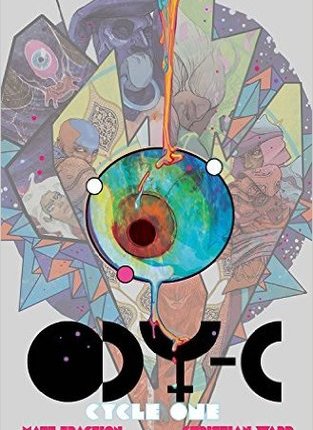
ODY-C: Cycle One by Matt Fraction

ODY-C: Cycle One by Matt Fraction

ODY-C is an incredibly strange, but beautiful graphic novel that takes the classic story line of Homer’s The Odyssey and flips it on its head.

“Here where so many great women died. Three ships leave Troiian space. Three adventures now start. Three great heroes begin their last odyssey.”

Photo by Edvin Richardson on Pexels.com

The book begins with the warriors returning home from an epic war in space. Instead of Helen of Troy, the war was fought over one of the only males in the galaxy, a latex-covered man named “He.”

Like in the old tale, the goddesses, children of Titans, overthrew their father, Kronos. In a twist in this world, they decided that all children grow up to throw down their parents and kill several generations of their own children. In order to ultimately control humanity, Zeus, a curvaceous, powerful woman, in an extraordinary display of power, destroys every male in existence. Eventually leading to the events I just described…

“Sing in us, Muse of Odyssia, witchjack and wanderer. Homeward bound. Warless at last.

Honestly, this book is hard to explain. I think “acid trip” might do it justice. The colors are vivid and the characters can be nightmarish, vulgar or gorgeous. The universe within this book is a science fiction-themed romp with monsters, goddesses, and all sorts of unbelievable settings — a world of bones wherein the child of a goddess forever seeks its prey, a type of space station fueled by a star in which a rare male child of a goddess endlessly mates with women and then kills them when they inevitably give birth to another female… and more.

“Down in the ruinous piles of viscera once her command and her crew, Odyssia recalibrates. Watching the Cyclops of Kylos make feast of the ODY-C’s girls, they know for the first time since Troiia did fall just what fear really feels like inside.”

Photo by Cosmopolitano Model on Pexels.com

It helps to be familiar with classic mythology because the authors don’t take the time to explain how the two are related. Or, I suppose, you could just jump into it blind. I felt like I enjoyed it more knowing both sets of stories.

I was fortunate that the library’s copy of this book included creator interviews in the back to give more context to this incredible work they’ve created.

“Between bearded-lady gods, gender-flipped heroines, gender-uncertain sebex and the odd character who keeps the same gender as their source, the ODY-C is less a gender-bent Odyssey than it is an Odyssey-flavored gender pretzel. Rather, ODY-C is an early next step into what comes after the gender flip: the unfurling of the gender spectrum both to comment on and to dismiss outright what we understand as gender roles and norms in classic literature.”

There is certainly a lot to unpack in here. And it is such a good story.

“The act of telling a story — especially of telling one well — turns your audience’s brain into a photocopy of your own, overriding any other stimuli that the listener is experiencing independently. When a story is so good you feel like you were actually there in the middle of it, it’s because, at least as far as your brain is concerned, you actually were.”

Photo by Engin Akyurt on Pexels.com

In addition to the Greek and Roman mythology, there’s shades of Scheherazade in the unfolding of the fate of He. Readers are also treated to a new twist on the foundation of Rome myth. At least, I think that’s what it is. With the level of creativity in here, it’s honestly hard to tell.

Recommended for readers who are looking for a graphic novel that is completely different from anything you’ve ever seen before. This is that book.

Thanks for reading!

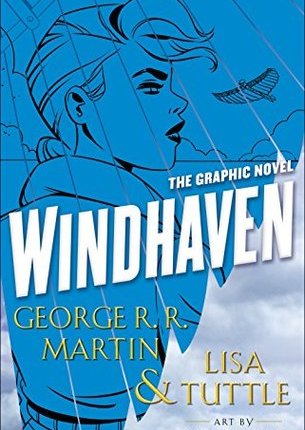
Windhaven: the Graphic Novel by George R.R. Martin, Lisa Tuttle

Windhaven: the Graphic Novel by George R.R. Martin, Lisa Tuttle

Windhaven is a world of small islands, connected by messengers who fly with intricate metal wings. The culture of the “flyers” is a closed one, with wings handed from messenger to his or her first born child.

Maris is not the child of a flyer, but that’s not going to keep her from joining their world.

“You don’t bother me. Maybe when you grow up, you can help the flyers like my friends here. Would you like that?” “No.” ” No? What then.” “I want to fly.”

Photo by eberhard grossgasteiger on Pexels.com

And when she does, things will never be the same.

This graphic novel was based off of Windhaven, the first book in a fantasy series by George R.R. Martin and Lisa Tuttle. Readers get a “Game of Thrones”-ish feeling from this book in the political machinations between the flyers and those they call the “land bound.” But it lacks the intricacy and extraordinary cast of characters that is “Game of Thrones”.

Having never read anything by Tuttle, I’m not sure how she and Martin blended their visions.

“Don’t waste your time on foolish dreams! I won’t have my daughter be a woodwings!”

Photo by Wendy Wei on Pexels.com

The artwork by Elsa Charretier is pretty and I enjoyed how she aged Maris throughout the book.

The scenes of the flyers themselves, especially a few of the chase scenes, must have been difficult to draw. Charretier had to make the characters look like they were in motion for it work. I think she did well, but the wings look kind of chunky in some of the pages, rather than the slick, technological wonders I pictured in my mind.

As for the story itself, I was surprised by the actions of some of the characters, but for the most part, it all seemed inevitable. Maybe that’s what the authors were going for — Maris’ fate was more destiny than choice.

Thanks for reading!

Shades of Magic Vol. 1: The Steel Prince by V.E. Schwab

Shades of Magic Vol. 1: The Steel Prince by V.E. Schwab

V.E. Schwab has penned a graphic novel about Maxim Maresh, one of the ancillary characters from The Shades of Magic series.

I was very excited to read this. The tidbits Schwab dropped about Maxim in the trilogy were enticing. We learned he had a storied past. He fought notable outlaw figures. Somehow he developed an extraordinary control of his powers, which others had not been able to mimic.

Under his reign, a certain magician opened the doors between the worlds to act as emissaries and messengers. But also, exposed the worlds to the greatest danger that they had ever faced.

Photo by Aidan Roof on Pexels.com

“Before he was the King of Arnes, Maxim Maresh was a young, head strong prince with a penchant for metal magic and a lot to learn about the world beyond Red London. Banished by his own father to Verose, a city on the dangerous Blood Coast, Maxim was plunged into a world of danger and adventure.” Foreward, by V.E. Schwab.

So, who was this man? This graphic novel series sheds some light on an enigmatic figure.

“Why would you see those doors pried open again?” “Because sooner or later, all spells fail. And one day the doors to those worlds will open whether we wish it or not.”

What did I think of it? It was the first in a series. It’s hard to give all of the contextual information of a new story without it turning into an info dump or neglecting to develop the characters.

Schwab does a good job of avoiding these pitfalls, but I wanted more depth and development.

We do get to see something of “bone magic,” one of the more terrifying of the magics from Schwab’s stories. Bone magic, unlike the elemental basis of the other magics, allows the user to literally control the actions of those around them.

Photo by Pixabay on Pexels.com

Bone magicians can make you throw yourself onto their enemies or your friends. Hold still while you’re tortured. Stick a knife in your own eye.

Bone magic, the removal of free will, is the idea that has continued to haunt me from the Shades of Magic series and Schwab uses it to good effect in this story.

That being said, Maxim, at first, acts like a brat and doesn’t understand the complexities of real life, running headlong into the “royalty removed from the world” trope. This focus of his character doesn’t lend itself to likability. Perhaps that will change as the series goes along. Also, we get to see so very little of his extraordinarily abilities and more of his mediocrity.

However, the artwork is stunning. I hope to read and enjoy the next volume. But I can’t say I was knocked off my feet by this installment.

Recommended, of course, for fans of the Shades of Magic series.

Thanks for reading!

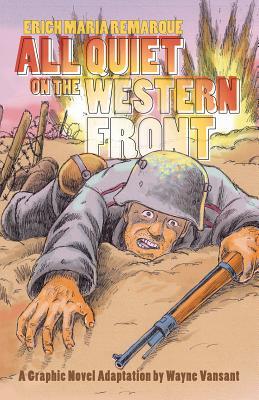
All Quiet on the Western Front by Wayne Vansant (adapter), Erich Maria Remarque

All Quiet on the Western Front  by Wayne Vansant (adapter), Erich Maria Remarque

This is a graphic novel remake of the classic All Quiet on the Western Front and it packs as much punch as the original.

Paul Bäumer and his classmates are encouraged to join the German army in WWI by an enthusiastic professor. What they find is not the heroic battlefields of the classical texts they’ve studied, but one nightmare after another.

“We plunge again into the horror, powerless, madly savage, and raging; we will kill, for they are still our mortal enemies, their rifles and bombs are aimed against us, and if we don’t destroy them they will destroy us.” pg 68

Photo by Kirsten Bu00fchne on Pexels.com

As his friends slowly die and he takes an uncomfortable leave home, Paul comes to realize that there will be no end to this war for him.

“He fell in October 1918, on a day that was so quiet and still on the whole front, that the army report confined itself to the single sentence: All quiet on the western front.” pg 170

This book is an interpretation of war that was banned and burned in Erich Maria Remarque’s home country of Germany. To go to war, it seems that the world has to sanitize it and completely demonize the other side, otherwise, we would never do it.

All Quiet on the Western Front refuses to look away from the humanity on both sides of the conflict. It is tough to read, and kicks you in the feels. But, in my mind, that’s what makes it so great.

Photo by Jan Tancar on Pexels.com

Though it is fictional, it is the story of a generation of young men who were shipped off to war and never came home again. And, if by some miracle they did, they’re forever haunted by the sound of a train car because it reminded them of the sound of falling bombs. When they picked up a book that they used to love, it didn’t ignite their souls in the same way, because they’d seen the worst that life can offer. War kills more than the ones who end up dead on the battlefield.

This graphic novel version of All Quiet on the Western Front should appeal to reluctant readers. Though it is about a very serious and triggering topic, the artwork is done tastefully. I read the original All Quiet on the Western Front as a seventh grader, age 13. I think this book would be appropriate for children of that age and up.

I received a free advance reader copy of this book from the publisher. This quotations I cited in this review may vary in the final printed version.

Thanks for reading.

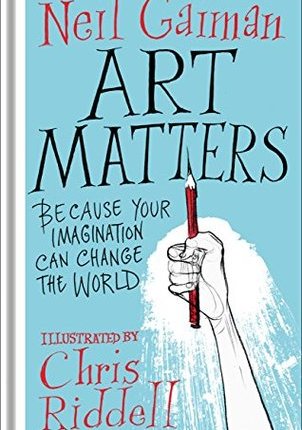
Art Matters: Because Your Imagination Can Change the World by Neil Gaiman, Illustrated by Chris Riddell

Art Matters: Because Your Imagination Can Change the World by Neil Gaiman, Illustrated by Chris Riddell

Neil Gaiman and Chris Riddell have created a manifesto for readers, librarians and content creators. This little book celebrates everything having to do with reading, freedom of information and ideas, and how to start creating the life of your dreams, even if you don’t know where to start.

It was compiled from Gaiman’s prolific back catalog of speeches, poems and various other writings about creativity.

“The world always seems brighter when you’ve just made something that wasn’t there before.”

Photo by Matt Hardy on Pexels.com

I feel like this should be required reading — especially the parts about how to respond to intellectual disagreements. I think Gaiman penned these words after the bombing at Charlie Hebdo, and they still ring true.

“I believe I have the right to think and say the wrong things. I believe your remedy for that should be to argue with me or to ignore me. And that I should have the same remedy for the wrong things that I believe you think.”

And, of course, I was partial to all of the praise directed towards librarians and libraries, having been a librarian once myself. Sometimes people ask me if I ever think libraries will be closed because “they’re just a building with books” or “they’re a waste of taxpayer money”.

This is how I wished I had replied: “Libraries are about freedom. Freedom to read, freedom of ideas, freedom of communication. They are about education, about entertainment, about making safe spaces and about access to information.” How could that ever possibly go out of style?

Photo by Zichuan Han on Pexels.com

Gaiman also gives attention to the bookworms of the world. We make it a better place through our reading and daydreaming and daydreaming about reading. Also, our epic library patronage is a good thing.

“We have an obligation to read for pleasure. If others see us reading, we show that reading is a good thing. We have an obligation to support libraries, to protest the closure of libraries. If you do not value libraries you are silencing the voices of the past and you are damaging the future.”

Gaiman shares a bit about how he became the universally beloved author he is today. Step one, you’ve just got to get started.

“If you have an idea of what you want to make, what you were put here to do, then just go and do that and that’s much harder than it sounds and, sometimes in the end, so much easier than you might imagine.”

He confesses that he lied on early resumes to get his foot in the door. But, after his later success, he went back and worked at all of the places he had claimed before. That way, he didn’t see himself as lying but as “chronologically challenged.” I loved that he took the time to make things right.

Gaiman also has some interesting views about no-start dreamers. He says the saddest thing to him are friends that say they’re too committed to follow their dreams. There’s bills to pay, mortgages and families to support and they can’t take the dive to do whatever it is they’ve always dreamed of doing.

Photo by Karolina Grabowska on Pexels.com

He said he dodged that particular roadblock by skipping a well-paying job or two early in his career, so that he didn’t get too comfortable doing something other than writing. I thought that was an interesting strategy. Creating is about having the courage to just do it, no matter what and not stopping until you’re doing it.

“Somebody on the internet thinks what you do is stupid or evil or it’s all been done before? Make good art.”

The good news is there are more platforms than ever before to get your creations in front of the people who will care about them.

“The gatekeepers are leaving their gates. You can be as creative as you need to be to get your work seen. YouTube and the web (and whatever comes after YouTube and the web) can give you more people watching than television ever did. The old rules are crumbling and nobody knows what the new rules are. So make up your own rules.”

My own life right now points to the truth of that. I left a guaranteed paycheck and employer provided health care to write for my husband’s YouTube channel. We’re not only succeeding but we’re having a lot of fun doing it.

Thank you, Gaiman and Riddell for this beautiful book. I hope it encourages creators everywhere to take the leap.

Thanks for reading!