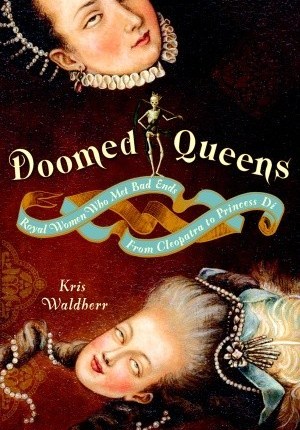
Doomed Queens: Royal Women Who Met Bad Ends, From Cleopatra to Princess Di by Kris Waldherr

Doomed Queens: Royal Women Who Met Bad Ends, From Cleopatra to Princess Di by Kris Waldherr

doomedqueensA quirky yet educational list of Doomed Queens that is organized by time period. I learned a lot and was entertained- everything that I look for in a non-fiction book.

“While kings were also vulnerable to political upheaval… for the most part men pulled the strings at court. Therefore any woman blocking the way to power was a threat to be eliminated. Common ways to bump off an inconvenient consort included beheading, burning, drowning, poison, stabbing, strangling, starving, and forcing suicide.” pg 8, ebook. Shocking, isn’t it. One would think that a queen’s power would afford her a measure of protection, but it didn’t.

Here’s one of the facts I learned: “Arsinoe’s story has been overlooked in the face of her more successful older sister, Cleopatra… But in death, Arsinoe was buried with the queenly honors that had been denied her in life. Her remains were interred in a tomb in the Temple of Artemis, one of the seven wonders of the ancient world.” pg 31, ebook. If you’d like a historical fiction book about Arsinoe, may I suggest The Drowning King.

I also learned the Roman viewpoint of the fury of Boudicca, queen of the Iceni: “Dio Cassius later wrote, “All this ruin was brought upon the Romans by a woman, a fact which in itself caused them the greatest shame.”pg 37, ebook. Silly Romans. Here’s a historical fiction about Boudicca if you’re interested: The Eagle and the Raven.

Doomed Queens includes plenty of puns and amusing witticisms. Take this passage from the chapter about Brunhilde: “… the queen of Austrasia incited a forty-year war between her realm and Neustria that made the Hatfields and the McCoys seem downright Merchant-Ivory. “ pg 44-45, ebook.

Or in Sibyl of Jerusalem’s entry: “Sibyl’s marital history took on Liv Taylor proportions as she became engaged, married, widowed, and annulled in varying combinations. pg 53, book. Burn.

Recommended for readers interested in royal stories and unfortunate yet powerful females. Reluctant readers may enjoy Doomed Queens because of the short chapters and light-hearted delivery of some seriously sad history.

Thanks for reading!
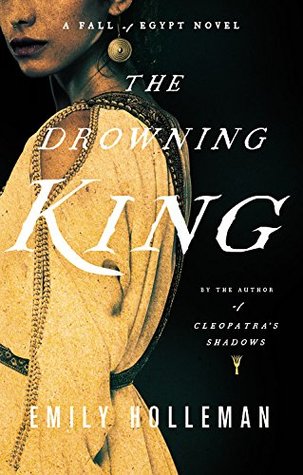
The Drowning King (Fall of Egypt #2) by Emily Holleman

thedrowningkingA well-researched historical fiction written from the point of view of Arsinoe and Ptolemy, Cleopatra’s ill-starred siblings. I didn’t even know that Cleopatra had a sister. And, I only knew Cleopatra had a brother because of his infamous gaffe when he presented Caesar with Pompey’s head.

The Ptolemys were a storied dynasty. Descended from one of Alexander the Great’s generals, they had the charming tradition of marrying their siblings. This politically motivated inbreeding kept all of the power in the family. There’s a lot of weird brother/sister vibes in this book, but it’s historically accurate. If that kind of thing freaks you out, you’d be better off avoiding this read.

The Drowning King takes advantage of these unknown characters to spin the history in a different way. I can’t say that I was a fan of all of the changes.

Holleman depicts Cleopatra as a manipulative hysteric who sat idly by while her libraries burned because she trusted that Caesar’s men would protect them. Blinded by love, perhaps? I couldn’t swallow that interpretation.

But, the Roman attitude towards women is portrayed accurately: “The soldiers distrusted her sister for what she was: an Eastern woman with an eye for rule. Hadn’t they already deposed one of those? In Rome, Cleopatra had told her once, slack-jawed with shock, women are chattel, no more and often less. Or as Arsinoe had heard more than one centurion sneer after Berenice’s death, In Rome, women know their place.” loc 96, ebook. How extraordinary then that Cleopatra managed to rise to the heights that she ultimately obtained. I suppose that also helps explain her extraordinary fall.

I liked how Holleman incorporates the size and diversity of Egypt in her tale: “Alexandria was full of Upper Landers, but they bore no more relation to these creatures than a tomcat did to a lion. The men who busied themselves along the palace courtyards wore tunics and mantles and bantered in flawless Greek. … But here men of the same blood looked different, foreign to her eyes, ghosts of some forgotten land. She doubted whether they could even speak her tongue, and she wondered how so many members of her family had ruled without bothering to learn theirs.” loc 871. That’s because the descendants of Alexander’s general spoke Greek and the common people spoke Egyptian. It reminds me of how the nobility in England spoke French while everybody else spoke English.

I also enjoyed the conversation between Ptolemy’s counselors and the young ruler about whether or not they should kill Pompey: “Pompey was once wed to Caesar’s beloved daughter, Julia. And if you kill him, you’ll be slaying Caesar’s former son-in-law.” loc 2472. Beyond the fact that Pompey was Caesar’s son-in-law, he was still a Roman. Ptolemy was not. Romans divided the world into two groups- those that were Roman and those that were not. The counselors didn’t understand that, advised the boy poorly and sowed the seeds for his destruction from that very first meeting with Caesar.

I felt badly for Ptolemy. He was surrounded by either incompetent or power hungry people. There were none who loved him for just who he was rather than what he could bring them. “Nothing he’d done- nothing he’d ever done- had made a dent. With one nauseating exception: the murder of Pompey. And for all he knew, that would be his sole legacy: the ignoble assassination of his father’s alley. Dark thoughts consumed him too frequently now; he had to stay strong and drive them from his mind.” loc 4532, ebook. “The drowning king,” indeed.

I enjoyed this book, I did, but it was no Margaret George’s The Memoirs of Cleopatra. I found myself comparing the two in my mind and this one came up wanting. Unfair, perhaps, but there it is.

Thank you to NetGalley and Little, Brown and Company publishing for a free digital copy of this book.

And thank you for reading!