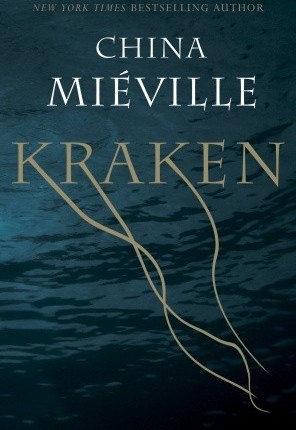
Kraken by China Miéville

Kraken by China Miéville

A book review of Kraken by China Miéville.

Kraken is a complex urban fantasy about a missing squid, an astonishing large cast of characters and the end of the world – in no particular order.

Photo by Anni Roenkae on Pexels.com

China Miéville is an incredibly imaginative author. In this story, he has created a half dozen separate religions with their own gods and customs. (Hundreds more are hinted at.) Not content with that, he also created magic of all kinds, a strike by familiars, protective London-based angels and a supernatural police force.

And that’s just the tip of the storytelling iceberg.

I would put forth the argument that he is one of the most inventive authors I’ve ever read.

That being said, I wanted more story and less world building.

Miéville has a cadence to his storytelling. Just when I thought the next important point in the plot would be revealed, he’d unveil a new character. It started to become annoying rather than astonishing.

Photo by Yura Forrat on Pexels.com

The pace of Kraken is slow, so slow. But, for readers who enjoy a complex setup and completely unexpected reveal, this may be the read for you.

Personally, I like my stories to move at a faster clip.

There’s also a good bit of coarse language in Kraken. I’m not the most sensitive person in the world, but it did grate my ears at times. Consider yourself warned.

My absolute favorite character, out of the legions to choose from, is Wati. It’s not just for his unique premise either, which is incredibly inventive. (Another tip of the hat to Miéville.)

Photo by Allan Mas on Pexels.com

Wati has so much heart. He fearlessly goes where others can’t or won’t, putting himself in danger for his friends.

And Miéville certainly takes the time to build his characters. That is his absolute strength – world and character building.

Recommended for readers who enjoy complexity and stunningly fantastical worlds, and who have the patience to thoroughly savor all of it.

Thanks for reading!

Railsea by China Miéville

Railsea by China Miéville

“This is the story of a bloodstained boy.” That’s the first line of this strange and fantastical tale of giant creatures that “swim” in the earth’s soil and the brave and flawed “molers” who chase them for profit and life purpose. Miéville has created a dystopian world covered in railway ties with skies poisoned by chemicals and filled with monstrous, alien creatures who feast on those who get too close. But, there may just be something beyond the rails, if the characters in this story are determined and lucky enough to see their way through to the end of the world… Though based off of the tale of Moby Dick, Railsea is an engaging adventure and coming of age story that reads like nothing else I’ve ever experienced. Miéville has blended together steampunk, dytopian, and fantasy elements to create something completely different.

Sham is a boy on the cusp of manhood who can’t quite figure out what he wants to do with his adulthood: “Sham felt sure there was something he fervently wanted to do & to which he was excellently suited. Which made the more frustrating that he could not say what it was. Too vague about his interests for further study; too cautious in company, perhaps a little bruised by less-than-stellar school days, to thrive in sales or service; too young & sluggish to excel at heavy work: Sham’s tryings-out of various candidate activities left him het up.” pg 36, ebook. Anyone who has ever been lost about what path to follow in life will be able to empathize with Sham.

Miéville’s story, like Moby Dick has layers of meaning built into it: “Edging such places is the railseaside, called the littoral zone. Those are the shorelands. Port towns, from where transport, freight & hunting trains set out. Where lighthouses light ways past rubbish reefs breaking earth. “Give me the inland or give me the open rails,” say both the railsailor & the landlubber, “only spare me the littoral-minded.” pg 51 ebook. Clever, no? A warning, if you don’t enjoy reads where the author makes up words to tell the story, you may want to skip Railsea. There’s a bunch of creative adjectives and nouns mixed up in this one.

The religions of this world were a fascinating too. I wish Miéville had explored them more: “He muttered in his head to That Apt Ohm, the great rotund boss-god, one of the few deities worshipped across the railsea, whatever the peculiarities of local pantheons. Bollons was ecumenical, granted church-licences to any deities whose worshippers could pay the fees. But the disrespectful worship of That Apt Ohm was taken more seriously there, pursued with more verve, than at most stops on the railsea. Sham had no idea quite what, if anything, he believed, but there seemed little harm in a quick silent word with one of the few gods whose name he remembered.” pg 100, ebook.

Part of the homage to Moby Dick, finding a captain’s “philosophy”: “How many of these philosophies were out there? Not every captain of the Stereggeye Lands had one, but a fair proportion grew into a close antipathy-cum-connection with one particular animal, which they came to realise or decide-to decidalise-embodied meanings, potentialities, ways of looking at the world. At a certain point, & it was hard to be exact but you knew it when you saw it, the usual cunning thinking about professional prey switched onto a new rail & became something else- a faithfulness to an animal that was now a world-view.” pg 130 ebook. What’s your white mole?

I enjoyed Railsea but I can see how this writer might not be for everyone. He uses fragmented sentences and ampersands (&) to move the story along. The chapters are incredibly short which also kept the pace rolling but it could also be viewed as making the novel choppy. Sometimes, Miéville breaks through the fourth wall and addresses the reader directly. I thought that device was charming, conjuring up images in my mind of storytellers sitting in front of the fire or at a pub. But, again, this may not work for everyone.

Some read-alikes for Railsea: Chaos Walking series by Patrick Ness or Under the Empyrean Sky by Chuck Wendig.  Thanks for reading!