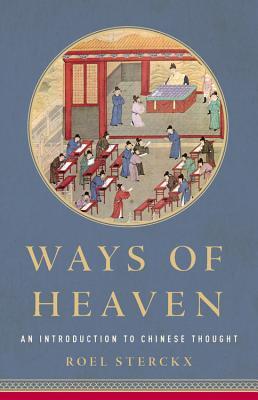
“China, so far, tends to creep into our narrative only from the time it appears on the imperial horizons of the West, or when it enters the international politics of the twentieth century, or when its economy seems unresistingly relevant (or threatening) to us.” Preface, x
Ways of Heaven, by professor Roel Sterckx from the University of Cambridge, seeks to build a bridge for the western mind to a thorough understanding of Chinese thought through its philosophy, history, historical figures, rituals, food and more.
The result is a delightful window into a different world, complete with context and signposts to guide your way.

I was looking for a book with a general overview of Chinese philosophy and this one definitely fits the bill.
Duke Ling of Wei asked Confucius about military formation. Confucius replied: ‘I have, indeed, heard something about the use of sacrificial vessels, but I have never studied military matters.’ The following day, he left the state. (An. 15.1) pg 221
Sterckx explains how Chinese history changed with each dynasty as well as the interpretations of key philosophical texts. Each succeeding ruling figure had to prove that their rule was legitimate and connected to all of the ones that went before it. Also, if Confucius’s teachings didn’t fit with how the current emperor wanted to rule, all that had to be done was to craft a different interpretation for the new ruler.

In that way, Chinese history and philosophy are both living systems, shaped by those who came before us and also, perhaps, changed in ways we will never know. It is fascinating to consider.
(And also ripe fodder for any authors who are looking for material to create historical fiction or alternative universes.)
I appreciated how Sterckx teases out the importance of symbols and materials that permeate Chinese culture. Lately, I’ve been on a Chinese and Korean television binge through Netflix and I could tell I was missing all sorts of meanings because I didn’t grasp the cultural cues.
Ways of Heaven helps with that too.
“In the Olympics of Chinese metaphor, champions are those who float along the river of life with ease, accompanied by a teacher or loved one and with the looks of a dragon and a character like jade.” pg 367

My favorite part of the book is when Sterckx talks about the use of music in Chinese ritual. How many times in films and television have you seen an ancient sage playing a flute while seated serenely on the side of a mountain? I can think of dozens of examples of just that. Now I know why:
“Music creates an unspoken bond that no other medium can achieve. … It is ritual lived through sound: ‘Music is what sages delight in, and it can be used to make the hearts of the people good. Its effect on people is deep; it can change habits and alter customs.'” pg 241
Highly recommended for readers who are interested in Chinese history or philosophy.
Thanks for reading!
- The Ballad of a Small Player: a Metaphysical Movie Review
- Otherwhere: A Field Guide to Nonphysical Reality for the Out-Of-Body Traveler by Kurt Leland
- Psychic Dreamwalking: Explorations at the Edge of Self by Michelle Belanger
- Archetypes on the Tree of Life: The Tarot as Pathwork by Madonna Compton
- The Goddess and the Shaman: The Art & Science of Magical Healing by J.A. Kent

 The Help Desk Book Blog